By Ritu Midha
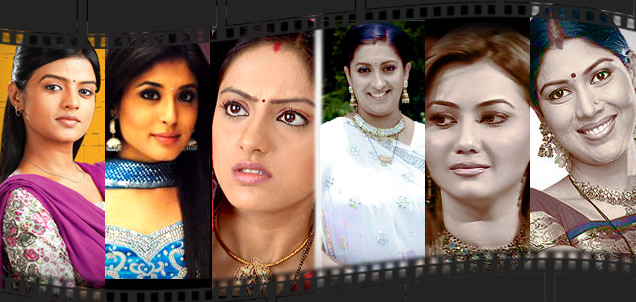
About a decade ago, we saw the emergence of Tulsi, Parvati and Kussum. Strong protagonists – but all of them set in more or less the same socio-cultural setting, grounded in traditions but fighting against the evil (another woman in most cases) trying to tear their families apart.
Cut to the present-day GEC. The protagonist is stronger, and differentiated. She is no longer just about pacifying the mother-in-law, and mothering her growing-up children. She is aware, educated, has a mind of her own, and she speaks it too. She has the spunk, and many a time, she takes the lead in decision-making. To put it simply, she does not wait for someone to save her, she is fully capable of doing the saving. And in between all this, she has a heart too, and dotes on her family.
There is a Pratigya fighting against the issues in her own house – a decision maker in Allahabad; there are working or aspiring-to-work women in quite a few soaps – among them Kuch Toh Log Kahenge set in Lucknow and Afsar Bitiya with a Bihar backdrop. There also is a Hitler Didi, where the protagonist, living in Delhi, is the master of the house, and of course Balika Vadhu and Diya Aur Baati Hum (both set in Rajasthan), which propagate women’s empowerment in the rural and semi-urban areas.
Is it an accurate reflection of the real Indian woman, or are these shows akin to the funhouse mirrors that exaggerate certain parts of our collective reality? Even if it does exaggerate the social consciousness, it definitely provides an example for those women whose staple diet of entertainment is still the Hindi GEC.
States Anamika Mehta, COO, Lodestar Universal: “Undoubtedly media, at an overall level, influences society and television has a huge role to play in that sense. While at some level, some shows and protagonists do play a role in sounding a wake-up call or instilling confidence, courage, and independence of thought, they thereby create followers or loyalists. However it’s more of media mirroring society on television essentially – witnessed for instance in the shift from ‘saas bahu’ soaps to the current lot.”
While the woman protagonists are bolder and more intelligent now, the socio-cultural cauldron from which they emerge varies from show to show. The reason, of course, is increase in purchasing power of women across middle India – Madhya Pradesh, not a favourite setting for television serials till some time ago, suddenly finds itself as the backdrop for a number of soaps. Is the appeal of these shows universal or does it appeal to audiences in a particular geography? States Nandini Dias: “The traditional shows like Uttaran and Balika Vadhu do find better resonance in smaller towns while the talk shows like Oprah Winfrey or Barkha Dutt show a skew towards metros. The shows which do well across all towns are usually love stories like Kuch Toh Log Kahenge.”
However, Shubha George, COO, MEC, South Asia, believes that in case the objective is to target a specific audience profile, a lot more needs to be done in this direction. She states: “Indian TV shows are fairly homogeneous and cater to a pan-India audience in most instances. I cannot think of any particular example that is more popular in metros because of a bolder woman character. Rather, this is a concept which is yet to be experimented on by Indian TV shows for mass audiences.”
Many of these shows depict subjects like second marriages, domestic violence and other women-centric issues, but do they manage to send a message across to society? As per Anamika Mehta: “Frankly it’s little to do with evoking social consciousness and more to do with experimentation with new audiences, new generation, different content and eventually eyeballs. While many of these shows initially kicked off with a social idea and an attempt to rouse audiences, eventually, given the eyeball battle, they turn more into trials and tribulations of a woman with plot twists and turns.”
There is a conscious attempt at creating a protagonist who wants to change the world, who would capture the attention and imagination of young women. Are these shows with the new realistic woman favoured by certain brands – or it is only TRPs that matter in the end? States Ms Dias: “Media planning is called a science and an art for exactly these reasons. Media planners do look at data , quantitative parameters. But finally when they take decisions they need to predict the future of how a show will do in the future. So the qualitative factors need to be considered too. In fact with the number of brand integrations that are done, it is detrimental to a brand if they do these brand integrations without understanding the content and relevance of the show.”
Ms Mehta too states that brands do look at the content of the show, however, many times the storyline changes in chase of TRPs. She says, “Only if the brand’s personality is in sync with the show do they look at doing show exclusive deals. Very often the shows digress/change/derail chasing eye balls which often could defeat the rationale for association.”
On India’s wide-ranging social canvas, there are many Indias, and the psychographics change not only from New Delhi to Basti, but also from Defence Colony to Rohini. It is not easy to depict the myriad colours of the Indian woman. However, the effort is being made towards being progressive, covering a broader spectrum, and bringing to the fore social issues that women in particular face. Does it matter that it is for the sake of eyeballs, or to get more advertisers on board, if the issues are addressed in the end?
| INDEX |
| Success mantras from media captains |
| All work and some play |
| Riding the creative crest |
| Holding up the managerial sky |
| Celebrating the difference |
| Managing Middle India’s Golden Lady |
| Wooing vibrant India’s Wonder Woman |
| Rural women – how strong is their ‘spending say’? |
| Is the serial woman tellying it like it is? |
 By Gouri Dange