By Ranjona Banerji
Bal Thackeray started life as a cartoonist in a newspaper. He carried that necessary incisive humour and sarcasm with him to his political life to great effect. From this, one might conjecture that he should then have had very good relationships with the media. But instead, it was up and down, like a see-saw. Once he got into his particular brand of divisive, identity politics, a difficult relationship with the media was inevitable.
Thackeray’s irresponsible off-the-cuff remarks made for great reading but he rarely accepted that they had consequences that could be potentially dangerous. As he started to flex his muscles in Bombay – as it was then – and control his cadre to do his will, his relationship with the media continued on this shaky path.
| Also Read |
|
He was a Bindaas cartoonist: Hemant Morparia
The Anchor: How the Sunday papers announced the Bal Thackeray news the morning after
Anil Thakraney: Insensitive for channels to call know Thackeray-baiters
Ranjona Banerji: How the channels & papers fared
Jaldi 5 with Bharat Dabholkar: Thackeray was unique… he was a Brand
|
However, it is important to keep in mind that the media was not this over-bearing constant presence in our lives the way it is now. The mainstream Marathi and English newspapers both were somewhat distant from the reader and the media was placed far more to the left than it is today. And Thackeray was initially used as a tool to attack trade unions, a domain of the left. The very erudite ivory-tower editors of the 1960s, ’70s and ’80s were rarely impressed with either Thackeray’s bluster or his tactics.
When the Shiv Sena started its mouthpiece newspaper Saamna in 1989, this was Thackeray’s answer to the mainstream media. It was where he got to have his say and take pot shots at all his rivals which could range from other politicians to the cultural elite. The more outrageous his pronouncements, the more his followers loved it. The Saamna edit would sometimes determine the events of the day and how they panned out in Mumbai. It was Thackeray’s revenge on the Govind Talwalkars and Madhav Godboles, you might say.
When Thackeray turned from his Marathi identity politics to Hindutva, as especially after the riots of 1992-93, any gloves that were on came off. His interview to Anita Pratap for Time magazine where he talked about his admiration for Adolf Hitler became something of a scandal. He had a long-running battle with Nikhil Wagle and Mahanagar. And he made some rather needlessly derogatory remarks about women journalists which did not go down too well.
He also kept track of what was said about him. Once in the late 1990s I had a very difficult time as deputy editor of Mid-Day in trying to organise an interview with him for an anniversary issue. The senior reporter who approached him for the interview he felt had been too critical of him. It took a bizarre meeting with Sanjay Nirupam, then still with the Sena, to get Thackeray to agree to meet Mid-Day but he absolutely refused to meet the chosen journalist. The odd thing was none of us could find any critical articles of him by her! (Some of the most critical were in fact written by me, but I had not asked to meet him!) But Thackeray was adamant and initially messages of his anger came to us through various sources ranging from the publisher-owner to the distributor.
Shiv Sainiks also gained a reputation for attacking newspaper offices – a tradition which they have maintained to this day, now expanding their scope to television as well. It was here where the Sena and Thackeray’s relationship with the media reached its lowest point. There have been instances where Thackeray expressed regret or made some kind of amends for the physical attacks on the media including when a woman journalist was roughed up by Sainiks. But it was his aggressive posturing and his subtle encouragement of violence which allowed his party workers to use violence as an answer.
However, almost every journalist who met Thackeray was charmed by him. He had wit and charm and could even display a sense of warmth up close. He was not the sort of social hypocrite that so many politicians can be, and this made him unique. Even journalists who disliked his politics became his friends.
But with a generation change in newsrooms, Thackeray became larger than life and his fans in journalism grew. To many who arrived in Mumbai, he was a grand figure that they had only heard about, and they admired his celebrity. This was the new kind of journalist which emerged in the 2000s, less discerning and more starry-eyed, fed on myths and legends. An older, ailing Thackeray became less accessible, and the legend grew.
The sort of fawning, laudatory TV interviews which were being replayed after Thackeray’s funeral may have amused the man himself. If there was one thing that was undeniable – he was always up for a sparring match.
Ranjona Banerji is a senior journalist and commentator based in Mumbai. She is also Contributing Editor, MxMIndia. The views expressed here are her own.
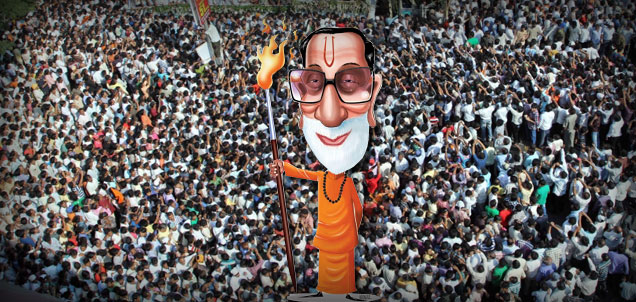
Big Story image cartoon is by Manjul in DNA (www.dnaindia.com). Used with permission from Mr Manjul. Please refer to Mr Manjul’s recent cartoons on Mr Bal Thackeray at http://www.manjul.com/tag/bal-thackeray. One of the toons he had drawn on the Sena chief won him the Maya Kamath Memorial Awards for Excellence in Cartooning 2009.
Background image of crowds at the funeral: Fotocorp
 By Vidyadhar Date