The Advertising Club and the Advertising Agencies Association of India jointly announced the first ever Champions of Excellence who would be felicitated at the Goafest on April 7.  The awards “acknowledge and salute visionary advertisers who have taken the leap of faith and invested resources, ensuring that ‘Great ideas transform into Great advertising’â€.
Said Nakul Chopra, President AAAI: “For the first time we are honoring advertisers at the Goafest. This award is very special as it acknowledges the pivotal role played by these men and women we call “clients” but who have acquired a much larger status in the overall brand scenario. These are the select few individuals who have helped build and nurture brands, supporting their Agency partners every step of the way.
Added Raj Nayak, President, The Advertising Club: “As an industry we need to salute these Brand Custodians who stake the reputation and money of their Brands on the creativity of their advertising agencies. They literally take that leap of faith every day. Having them at Goafest would be very inspirational for the audience.
Said Ashish Bhasin, Chairman Goafest: “Wwe always celebrated advertising agencies, digital companies, production houses and media companies at the Goafest. Now with top advertisers being honored, the festival is more complete.
And this is what Ramesh Narayan, Chairman, Awards Governing Council said: “This award really places the advertiser at the center of the communication effort, and rightfully so. The response for nominations from advertising agencies was quite good and I am confident this would go on to become one of the highlights of the Goafest in the years ahead. What is advertising without the advertiser?”
With celebrity contributing writers including the likes of Amitabh Bachchan, Shashi Tharoor, Jug Suraiya, Indrajit Hazra, Jai Arjun Singh, Santosh Desai, Naresh Fernandes, Agnello Dias, Arnab Goswami and Karan Johar and of course the topical Amul adverts, Amul’s India 3.0 tracks the Amul ads that reflect on the highs and lows that Indians experience through the eyes Amul moppet. Covering topical grounds and popular incidents from the contemporary context, Amul’s India 3.0 is a revised and updated edition which speaks for the curious instance of when a butter brand becomes the barometer of a nation.
During the engaging panel discussion preceding the launch, there were many insights and observations shared about the iconic Amul Girl and her relevance in contemporary times, her larger role in the society, and her continuing resonance among other aspects. Amul India Managing Director RS Sodhi said that while they don’t have big advertising budgets, the creativity of the campaign has carried it through for so long, and when he is travelling and interacting with people, he often realises that it’s not the butter that people recognise the brand for, immediately, but the Amul girl campaign. Brand specialist and author Santosh Desai added on that as a mascot, the Amul girl, belongs to all who have grown up with her around, and is the spokesperson of the times. Adman, Rahul daCunha wondered about whether the Amul Girl needs to change, journalist Indrajit Hazra reflected that she needn’t as everything around her is changing while, in film writer Jai Arjun Singh’s words,  the Amul girl is like the anchoring figure that provides the much needed familiarity, to make sense through the information overload of our times.
The 232-page paperback has been published by HarperCollins India   and comes with an MRP of Rs 299.
The Brief: The brief was to communicate the “Amul – A cooperative movement that empowered 35 lakh women farmers”
Research insights: Today, women farmers are multitasking, handling more than just routine domestic work – from looking after cattle to studying to teaching in management colleges to even financing their children’s education abroad. The co-operative movement has created numerous women entrepreneurs empowering them to become equal contributors (financially) to the household.
The thought process behind the creative: Village men were shown acknowledging the triumph of these empowered women and celebrating their new role as ‘sethani’ in the family. Placing the pagdi on the women’s head epitomizes this acceptance.
Media vehicles chosen: TV and Digital.
Key issues kept in mind while executing the ad: The challenge was to retain the earthy feeling and look of the earlier TVC, but simultaneously show how these women have taken the big leap from being self-reliant to a tech-savvy entrepreneur of today.
RS Sodhi
What is the differentiating factor about the ad:Â Manthan as a story is very unique to brand Amul and platform which no other brand can ever claim. The success stories of these women at the grassroot level truly denote the success of the brand.
Client comment: Talking about the campaign, GCMMF’s Managing Director R S Sodhi says, “We are extremely proud of the Amul journey so far and the role played by women in managing the dairy cooperatives. This film is an attempt to celebrate their contribution and demonstrate their capabilities to the urban world.”
Nitin Karkare
Agency comment: “The new TVC is an extension of the earlier versions. While, the earlier ones were about the whole journey, right from the milk collection, processing to delivery to the urban homes, the latest TVC celebrates women empowerment. The idea is to showcase men acknowledging women as financially independent and celebrating their role as the sethani,” says Nitin Karkare, Chief Operating Officer, Draftfcb Ulka.
Subodh Poddar
Additional agency comment: Says Subodh Poddar, Creative Director, Films, Draftfcb Ulka:“The real challenge was to think of an idea depicting modernity while keeping all the colours  of  Gujarat/ India intact. The idea came after seeing a lady attending a board meeting of GCMMF, lady who started her work with just one buffalo. Now she owns a trail of cool trucks that brings milk from faraway places. And that she is a board member today stirred my thoughts. It was very inspiring and the sethani happened in my mind.”
You just cannot ignore the impish Amul girl with her chubby cheeks and red-polka dot dress. Don’t go by her diminutive form as the li’l one has a take on everything that is going around her. Being created in 1966, the Amul girl is still going strong after more than four decades. It is the perfect example for all those following advertising how a simple idea and even simpler words can catch the fancy of a nation. Not to forget that the Amul ads are not a critique of a nation but also a masterpiece in advertising for people across the globe to study and understand.
It all started in 1966 when Sylvester da Cunha was entrusted with the responsibility of working on Amul and they came up with the Amul girl which actually was in answer to the rival brand’s mascot. When it started, Amul hoardings which grace the skyline of many cities today were intelligent play of words that got the people intrigued and wait for the next hoardings. However, slowly these ads changed and morphed into being mouthpiece of a nation and bringing a take on happenings not just in India but across.
When asked if he ever expected that what he was creating in 1966 would become an advertising icon and continue for so long, Mr da Cunha says: “I think in 1966, we knew that we had created something special in both the Amul girl as well as the tag line, Utterly Butterly Delicious – but a good creative product requires inspired clients to believe in it – Dr Kurien believed in this campaign in 1966, and Mr RS Sodhi believes in this campaign in 2012. That’s why this campaign has lasted as long as 47 years!”
So what is it that when in today’s advertising people are always bringing in new faces even if the message remains the same but the Amul girl never seems dated.”I think the Amul Girl, has never seemed dated, because we invest time and creativity in her,” reasons Mr da Cunha. “Plus we can see what a universally loved cartoon character she is. We strive every single day, to keep her young and relevant.”
Rahul da Cunha
Rahul da Cunha, the Managing Director and Creative Head, daCunha Communications who has taken over from his father Sylvester and has been working on Amul advertising for a while added, “No, I don’t think the Amul girl will be dated as long as we keep her contemporary and keep the topics covered relevant. One thing I’ve learnt, you are only as good as your last creative.”
The launch of Amul’s India
The Amul ads are no less than a study on modern day India thus DY Works and Harper Collins along with daCunha Communications has come out with the Amul book titled Amul’s India which is an anthology of Amul advertising plus eminent people giving their take of the advertising.
Says Rahul da Cunha on the reason behind coming up with the book, “As an agency we’ve been wanting to bring out book tracking this amazing campaign, its history, controversies, anecdotes and the rest associated with the book. Attempts with several publishers failed and then DY Works and Harper Collins came along, and the fit seemed right.”
The book took about a year to take shape and be published. The objective is to track the amazing history of the Amul outdoor campaign from its inception to its present avatar thereby tracking the history of India
Alpana Parida, President, DY Works commenting on the design aspects that were kept in mind while working on this book, said, “The book had to be accessible to a large number of readers and thus we had to keep it a paperback. But we were clear that we needed a unique design element that would hold the diverse essays from different personalities on various topics together. The polka dots were a clear winner as a continuity device - as they are unique to the Amul girl. You do not see another brand in India using these red dots. The design had to do justice to the hoardings and not over power them. Eventually, we believe the design has enhanced the content of the book greatly.”
She added that for her the chasing up all the celebrity contributors was the toughest part. She said, “There were many who refused as there was no remuneration for the writers. There were many who were so difficult to get hold of. We would have loved to get Aamir Khan, SRK, Ratan Tata and Rahul Gandhi - but our attempts to reach them were unsuccessful. To our utter delight, Amitabh Bachchan was the easiest to get hold of - and he agreed to contribute to the book immediately. Rajdeep Sardesai wrote a beautiful piece with a personal memory about an obituary to his dad. Harsha Bhogle was all over the map and it was hard to pin him down - but he graciously obliged somewhere between London and Australia. And there were many days spent with Santosh Desai to shape the definitive content for the essay that would be central to the book. Without doubt - the book had more moving parts than pages! We pulled it off eventually.”
The book will be officially launched on June 11 in Mumbai and June 13 in Delhi.
While Amul advertising is being continued for decades has there been a change in the way the advertising is being done today? Mr Sylvester da Cunha points out that there are two main differences that he can clearly see. One is that the hoardings are being created at a much faster pace. In the ’70s there was one hoarding every month or so and now they are done almost daily for some city or the other. Another is that as we live in rougher, edgier, more controversial times, the hoardings and the messages too are reflecting these times.
Adds Mr Rahul da Cunha, “I think two things have changed one definitely is our speed of response to an event has become faster. And the tone of our hoardings has become edgier. We are not scared to take on an issue however controversial. We are careful however not to be malicious.”
On the periodicity, he says, “Actually it’s not every week, it’s now almost every two days. So much is now happening in our crazy country – be it politics, sport, Bollywood, popular culture and we’d like to comment on all of it. So one new hoarding leaves the agency almost every day.”
Recalling one of the recent incident that happened, Mr Sylvester da Cunha says, “The funniest incident was in 2009, when we ran a hoarding criticising Satyam for the terrible scam it had wreaked on the Indian public, to the tune of Rs 7000 crore. We said ‘Satyam Sharam Scandalam’ and we got a letter from the Satyam board, telling us how ‘wounded’ they were, and if we didn’t withdraw the hoarding, they would advise all Satyam employees to stop using Amul products! We were at a loss of words.”
Mr Rahul da Cunha picks up his three favorite Amul ads which include ‘Victoria Termianted” when VT got renamed, the obituary we did recently for cartoonist Mario Miranda and the one done recently on Mamata Banerjee’s response to the controversial cartoon ‘KOLKARTOON!”
Giving her take on Amul ads, Priti Nair of Curry-Nation, says, “I feel they take a nice lopsided view of the mess we face day in and day out. They at least put a smile on hopeless situations because quite frankly there is nothing you can do but feel angry and frustrated by the stupidity you fall prey to. Their potshots at least lighten you up most times.”
“Also as advertisers we know if Amul picks on a topic it is the hot topic or for instance if they pick on your ad you feel quite happy. I know we felt damn good when they did a spoof on Balbir Pasha and Manjula. That’s the power of the communication medium they have chosen and stuck to for years,” adds Ms Nair.
Says Anil Nair, CEO and Managing Partner, Law & Kenneth India, “Amul is the only brand which has truly done what many brands have preached about, ‘connecting with consumers life beyond making transactions’. Advertising is applied anthropology and hence (should) reflect the society as it evolves. Amul hoardings have done that for years, consistently. Amul hoardings bring huge credibility and pride to an otherwise frowned upon industry. Am a fan… No, am an eternal fan.”
Prathap Suthan, Founding Member of Bang in the Middle, believes Amul manages to always come up with a perspective that brightens up the subject. “There is an innocence that is welcome no matter the event or subject. A spot of optimism that works like charm, and often disarms the audience,” Mr Suthan says. “With its almost topical and quick changes, it adds to the daily relevance that butter is all about. So much so, like the butter it sells, its advertising has grown to become almost a habit for India.”
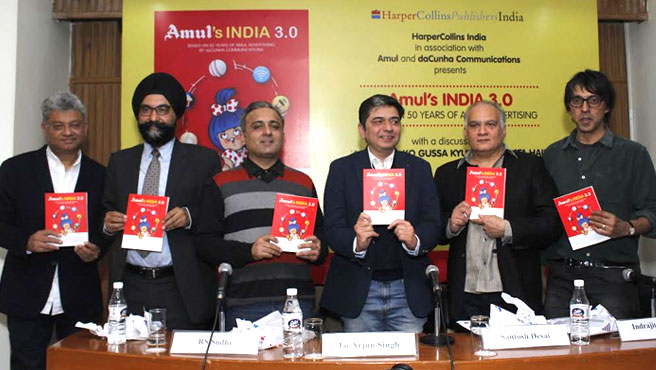 With celebrity contributing writers including the likes of Amitabh Bachchan, Shashi Tharoor, Jug Suraiya, Indrajit Hazra, Jai Arjun Singh, Santosh Desai, Naresh Fernandes, Agnello Dias, Arnab Goswami and Karan Johar and of course the topical Amul adverts, Amul’s India 3.0 tracks the Amul ads that reflect on the highs and lows that Indians experience through the eyes Amul moppet. Covering topical grounds and popular incidents from the contemporary context, Amul’s India 3.0 is a revised and updated edition which speaks for the curious instance of when a butter brand becomes the barometer of a nation.