Tag: Rovio Entertainment

  • Rovio appoints Anurag Sachdeva Country Director for India and South Asia

    By A Correspondent


    Anurag Sachdeva

    Rovio Entertainment, the creator of Angry Birds,  announced the appointment of Anurag Sachdeva as its new Country Director for India and South Asia.


    In his new role, Sachdeva will focus on consolidating Rovio’s strong presence in the market, driving global partnerships and strategic alliances while strengthening the organizational capabilities within Rovio. He will also lead telecom operator relations for South East Asia while focusing on the expansion of the company’s market base.


    Previously Sachdeva served as Rovio’s Associate Director, Business Development for India and Southeast Asia.
    “Anurag has proven to be an asset steering the growth of Rovio in this very important market,” says Alex Lambeek, Rovio’s Chief Commercial Officer. “He brings valuable experience to our Flock’s leadership in South Asia and he will be key to helping us raise our game even further in the region.  We look forward to working closely with Anurag and supporting him in this new journey.”


    Sachdeva has worked previously with Vodafone, Bharti Airtel, Virgin Mobile India and Aircel. He  holds a degree in B.Tech from GAU.


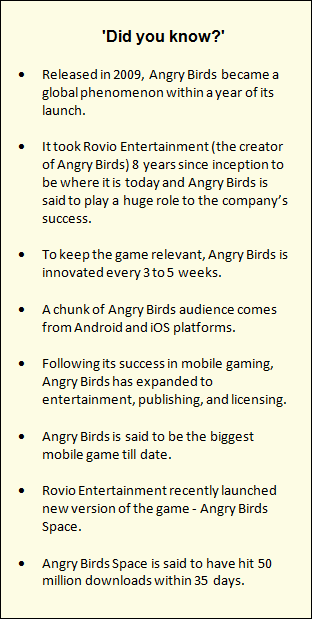
  • Angry Birds forever!

    Angry Birds Space visual Courtesy Rovio.com


    Henri Holm is the Senior Vice President at Rovio Entertainment, the creators of Angry Birds. Holm, a Harvard alumnus, has extensive international management experience in consumer electronics, mobile internet, manufacturing, distribution, retail and brand management. At the sidelines of the recently concluded MTV Youth Marketing Forum 2012, MxMIndia’s Robin Thomas caught up with Henri Holm  who spoke at length about his India plans, India as a market for gaming and of course about Angry Birds and much more.


    You had said that it took Rovio Entertainment eight years to be where it is today. Tell us a little more about your company and your journey so far?

    Rovio Entertainment is a company which has grown very fast. We grew from a 12 people organization to over 300 plus professionals as of today. In our operations we cover mobile gaming, entertainments which include animations, books and publications, education content or edutainment, merchandising, licensing and sponsorships. In the entertainment space, we also cover advertising, so we are a major premium advertising channel provider. Globally, in fact, our ad impressions reach over 10 billion. It’s a company of young people who believe in their course, who neither give up nor give in.


    There are talks about the slow death of console gaming in India with the onslaught of mobile gaming especially with 3G and 4G coming in. Would you agree? Is the next phase of gaming coming from mobile?

    Console gaming is not necessarily as scalable as mobile gaming because I think it caters to a different set of audience or different media consumption or entertainment consumption. The mobile devices, including the tablets, are always with you and you can consume the game anytime anywhere, so the industry is certainly changing.


    Can you please throw some light on the entire thought process behind the Angry Birds concept? How did it come about?

    Everything started from the fact that the company has gone through 50 plus games. Being an audio manufacturer, we didn’t own a brand, we wanted to have our own IP and we wanted to build a brand. The thought process started with the characters and with distinctive personalities in those characters. The story was unique too, it was not a me-too story, and besides, the mechanics of the game itself was about simplicity, quality and paying a lot of attention to the details.


    You also said that Angry Birds will continue forever and that this is only just the beginning… How do you intend to stay relevant to the audience?

    Yes, we feel that this is just the beginning for us. Angry Birds as a brand, and as a story, will definitely continue. Every three to five weeks we try to keep the game relevant and innovative or new for our audience. However this does not mean that we will not be looking at other games or characters or stories, it’s just that we need to find the right time to introduce something new.


    Where is the Angry Birds audience coming from?

    Today’s audience primarily comes from the android and IOS platforms, however there are other very significant platforms besides the androids and IOS. So today we can cover all operating systems in mobile devices ranging from the smallest screens of the feature phones to the largest of the screen which are the tablets. So the mobile space is certainly growing the fastest. When you move away from the mobile to the web we cover the operating systems where Chrome has been leading the web experience supported by flash and now the social gaming like Angry Birds on Facebook. So each one of these platforms needs to be looked after individually and what is important is that we present the channel and the content where the fans are. So, if the fans are moving primarily into one operating system or one type of access into the content, we move with it.


    What is the role social networking sites have played for the success of games? According to a survey, young people in the west visit social networking sites only for friends and not necessarily brands…

    We are an entertainment company and we engage our fans on social media so, we are living social media 24×7 and we are participating in conversation all the time. Our business is about the fan engagement, delighting them and therefore I believe that social networking sites play a huge role in the success of any brand.


    What is the business model of Rovio Entertainment? Is it advertising led and how much has Angry Birds contributed to its revenue share?

    We have different business units, we have the games business unit, entertainment business unit and merchandising and licensing business unit. Each one of them contribute their own revenue but, they also complement the entire brand experience and the brand presence because of the huge opportunity to manage and monetize the brand. So our business model is purely based on the fan and the brand.


    How has 2012 welcomed you? What are your business plans this year? When you compare it with 2011 how has the growth been so far?

    In 2011 we launched one game and this year we have already launched two and have several more to go. The year 2011 was about building the infrastructure and the making the organization ready, 2012 on the other hand is about finding the right partnership and making the entire business ecosystem stronger and more global.


    So are you looking for more expansions and new partners?

    We are constantly looking for new partners and expansions as we need to build a very robust business and country plans before this.


    What is your view on India as a market for gaming and for your business?

    India is a very important market for us, as of now we are scouting for partners and once we find the right partnerships here it will give us better footprint and presence. We are looking for partnerships in the media space, in the digital distribution space, operators, and the major brands and all the big movers and shakers in the country.


  • Authenticity and engagement is what brands must give consumers: MTV youth summit

    By A Correspondent


    Brands today need to listen, learn and begin to engage with the youth; they need to be authentic as young people today are willing to speak positively about the brand they trust. These were some of the points discussed at the ‘MTV Power of One’- Youth Marketing Forum 2012.


    Ms Angela Barkan, Senior Director, Marketing and Publicity, Sony Music Entertainment; Mr Chetan Bhagat, Author of five blockbuster novels; Mr Andrew Ridley, Executive Director and Co-Founder, Earth Hour; Mr Henri Holm, Senior Vice President, Rovio Entertainment, the creators of Angry Birds; Simon Smith, European Digital Director at Interbrand were some of the speakers at the Youth Marketing Forum which saw presentations and a panel discussion on ways to engage the youth in the digital media era.


    Aditya Swamy

    The MTV Youth Marketing Forum 2012 kick-started with Mr Aditya Swamy, EVP and Business Head, MTV India sharing some of the findings from the MTV’s study on the Indian youth. The study titled ‘Power of One’ was unveiled on Friday, April 27. Mr Swamy said that over 5,000 youth were interviewed across the Country and an overwhelming 76 per cent said that they are happy with their life. According to the findings, for today’s youth family is more important than their friends, as a lot of young people see their parents as their role model.


    The survey also says that 97 per cent of the youth believe that they can bring about change and that social media has given them a voice, thus making them feel empowered. “Single screen engagements are not going to work, today web and mobile are required to engage the youth. Today the youth do not need inspirations but engagement, so there needs to be a two way conversation. If brands learn to keep the promises they make to their consumers, it will see more people, particularly youngsters flocking towards their brands” Mr Swamy added.


    Andrew Ridley

    A good idea needs good platform:

    Mr Andrew Ridley, Executive Director and Co-Founder, Earth Hour spoke about how the movement first started in one city -Sydney, before it became a global movement. He spoke about how every individual has the power to change the world they live in and how social media strengthens that power and provides a vehicle to take action. Citing the example of how Earth Hour was designed to build reach and increase its reach to billions of people around the world, Mr Ridley was of the view that a good idea needs a good platform in order to reap rich benefits. “I believe that for the first time we have the power to connect. We are still at the initial stage of creating a big change, but if our core idea is relevant and connected to the young people in particular, it will lead to a huge change in the world” said Mr Ridley.


    Henri Holm

    It’s all about communication…

    Speaking on the success story of Angry Birds, Mr Henri Holm, Senior Vice President, Rovio Entertainment, said that it took the company nearly eight years to be where it is today. He also spoke about how to engage the younger generation with the powerful concept and the characters and also how the distribution channels were also chosen carefully to reach out to the millions and to be of service to the fans. Since youth is the core TG, Rovio Entertainment hopes to stay relevant, connected and constantly find new ways to engage the youth.


    Besides the online experience, Angry Birds also gave the audience offline experience of the game, thus not only engaging its TG but even getting newer audience. “One of the reasons for the success of Angry Birds is its simplicity. We put a lot of weight on communication and feedback from our audience, therefore for us it is all about building business with fans and not features. Angry Birds is a permanent part of the youth culture and our aim is to further service the youth efficiently in the years to come.”


    Chetan Bhagat

    Reaching out through social media

    Author of five blockbuster novels, Mr Chetan Bhagat, also known as the marketing guru gave his insights on marketing. He said that social media is a good way to execute the power of one: “Social media has become very popular today and one must know what a Facebook or a Twitter is. As far as I am concerned social media is a great platform, my goal is to reach out to maximum number of people and social media is one of the ways to reach out.”


    He said that one of the reasons why his books worked was because the plots were tight, they were unputdownable, the language was simple, and the characters were relatable. Mr Bhagat also gave some insights into the mind of the youth. He said that the youth today has the ‘hunger’ to do well in life, to gain respect and make money; that they want an education that could provide them skills that would help them make money. Besides the love for their careers and seeking out their love, youth today deeply care for their country and are willing to clean up the system.


    Simon Smith

    The power of one

    Mr Simon Smith, European Digital Director, Interbrand spoke about the power of conformity, and the willingness to conform publicly in order to attain social rewards. We need to understand the power of one and how powerful it is. The power of one, I believe, is simply about being human. One must not move with the crowd but, remain an individual he or she is supposed to be. “Fundamentally, as humans, we haven’t changed much, but our expressions to our needs have dramatically changed with technology, society and changing power structure. The relation between brand and consumer has fundamentally changed, so if a brand makes a promise to its consumers, it better deliver on those promises or the consumer will never trust the brand and influence others to rebuke the brand too.”


    Angela Barkan

    Authenticity and the art of listening to the youth

    Ms Angela Barkan of Sony Music International spoke about millennials, youngsters aged between 12 to 30 years. She was of the view that millenials are multi-taskers and optimists, that they expect brands to be authentic and have two way communications with them. She also said that this is a group which loves to share and that they define themselves by what they share. She also said that this unusual group is found mostly online. “Collaborations and interactions are very important when talking about music as it results in lifelong fans. However, there is a need for brands to be authentic because if a brand is authentic, then millenials are willing to speak positively about the brand they trust.”


    Reaching out to the youth

    A panel discussion which included eminent panelists like Mr Avinash Pant, Marketing Head, Nike India; Mr Sumeet Pahwa, DGM – Marketing, TATA Docomo; Mr Vikram Malhotra, COO Viacom 18 Motion Pictures; Mr Bejoy Nambiar, Director and Screen Writer; and Mr Ayushman Khurana, VJ turned Actor and was moderated by Mr Nikhil Chinappa, VJ and Founder, Summer Sunburn Festival spoke about the difficulties of marketing to the young generation and the possible ways of reaching out the youth. They also spoke on the role of social media marketing and whether social media is actually an effective tool to reach out to the youth.


    Mr Pahwa spoke about how the social media is a big platform to engage the youth citing the example of how it helped Tata Docomo successfully engage the youth by having a two way conversation with them.


    According to Mr Malhotra, “Brands need to listen a lot more, even to criticisms, and problems must be solved as and when brought by the consumers. The attitudes of the youth are fast changing, today they trust their family and friends more than the brands, hence brands need to listen, learn and begin to engage with the youth.”


    Mr Pant was of the view that the youth today are looking for innovation: “Things are moving so fast today that our conventional thought process itself needs to change drastically. We have to think a lot more digital.”


    Ayushman Khurana pointed out that the youth do not have the patience to listen, but they do have a strong opinion about films or any other product or brand. So one needs to understand its audience and find ways to connect with the audience and have a two way communication with them.


    Be authentic, have a two way communication, listen a lot more to your consumers, respond to criticisms and fix problems because young people are willing to be advocates of brands on social networking sites as long as they trust it otherwise brands must be ready for a backlash. These are some of the lessons to be learnt from the MTV Youth Marketing Forum 2012.

     

  • Chinese Madhouse looks to wow India


    By Johnson Napier


    Countless comparisons could be drawn on how two of the biggest and most admired economies are driving brands from all across the world to be a part of a growth story that is unparelled. Or how the APAC region is all about just these two economies today, putting the other developed nations in the region in a state of oblivion. Having wowed the world with growth stories that defy market odds, China and India today command attention from business stalwarts and entrepreneurs like no other, especially entrepreneurs from emerging mediums like Digital and Mobile that are shaping the way the world goes about doing its business. But despite the huge buzz around these two economies, there is very little that transpires when it comes to the two economies trying to venture into each other’s territory to gain mileage and expand base – especially in the digital space.


    But all that could change with the advent of the largest mobile solutions and advertising network firm from China- Madhouse. Launched in 2006, the company enjoys the reputation of being tagged as the most intellectual and largest mobile ad solutions company in China. In India, Madhouse will work towards providing brands, advertising and media agencies and marketers with a host of comprehensive mobile marketing solutions. It has already tied up with a host of strategic partners including WPP, Vivaki, Omnicom, Aegis and so on from the media agency side of the business and would work towards providing them holistic mobile marketing and advertising network solutions.


    The Madhouse India team would be headed by Vinod Thadani, who until now was handling mobile responsibilities for Group M India andSouth Asia. Given that the two countries share market complexities that are similar in nature and have a population base that is very high, it seemed like a natural extension for Madhouse to step in to India, making it the first such venture into foreign territory in APAC.


    Throwing light on how the APAC market compares to the other regions and reacting on his choice of targeting India as the hub for launching the venture, Joshua Maa, Founder & CEO, Madhouse Inc. said: “Today APAC occupies ad spends growth to the tune of 32 per cent, making it the largest in the world. These are led by the economies of China , India and Indonesia that are the key drivers of this growth in APAC. To gain success in a market like India requires the ability to manage complexity, and this is an area where we excel.”


    Hoping to leverage the opportunity of using mobile as a mass media device, Maa went on to elaborate the business module by stating: “If you compare the mobile markets of India and China, they are almost identical. While China has a mobile user base of 960 million, India’s number stands at 894 million. But where mobile internet users are concerned, China has 356 million users while India’s number stands at 150 million. Therefore, we foresee a huge growth in India and decided to make this our first market to launch in APAC.”


    In India, the agency’s focus would be centred around disciplines of mobile ad serving, mobile ad network and mobile marketing solutions. Having wowed clients in China like HP, KFC, Unilever, Intel, Coke, and others, Maa hopes to emulate a similar example here by getting important brands to align with the network: “Being the only full-service provider in the market and having a skilled and experienced team in place, we hope to attract a lot of clients in the days to come.”


    Emphasising on the partnership, Vinod Thadani, COO, Madhouse said: “Madhouse will offer mobile marketing solutions created and carried out for advertisers by a team of experienced media professionals that understand this medium. On a technical level, mobile advertising can now achieve accurate intelligent targeting and provide real-time reporting – a very convincing proposition for advertisers.” According to Thadani, the need of the hour is to unlock the potential of the mobile medium and they are therefore determined to grow the Indian Digital Media market from Rs125 crores to Rs1,000 crores in the next 3 years. “The need of the hour is to understand the medium thoroughly and this would be possible by partnering with the right partners and going back with the right solutions to clients.”


    Perhaps the best reason for elation among mobile clients in India was provided by Ranjan Kapur, Country Manager, WPP, who began by discussing how India, as an advertising market, was highly undervalued. “Despite India boasting such a good growth in economy, the advertising spends in China stand at US $55 billion while for India it is at US $6 billion, this shows that we are still an under-advertised and under-branded market.” Citing the reason for China leapfrogging ahead of India, Kapur said that the single biggest factor for India’s dismal record in getting more ad spends was because it jumped on to the services bandwagon and chose to ignore the manufacturing sector. “While the Services sector contributes about 55 per cent to the GDP growth, it is still very shy on spending on marketing and promotional activities. And this is an area where Manufacturing excels. But all that is changing and the Services industry is opening up and spending more.”


    On the ad spends growth in India, Kapur said that while there is a 15-20 per cent growth, it is digital that is intriguing the advertisers the most. “Digital ad spends recorded a growth of 30 per cent.Mobile, specifically, is a Rs125 crore industry today and given that there are 300 million internet users predicted by 2015, mobile advertising is expected to account for about one-fourth of conventional traditional advertising. So it can be said that a revolution in digital in India is beginning to happen now.” This growth will be boosted further by the Government’s efforts to spread mobile and internet usage in rural areas for which it has promised 2,50,000 nodes for broadband in the next four years. “So mobile marketing in the rural areas will be a mass phenomenon, once this plan gains momentum.”


    Another interesting addition to the venture would be Rovio Entertainment that is more popular for its Angry Birds concept around the world. “Madhouse is a valuable partner for us in China , and we are excited about the opportunity to extend our collaboration to India as well,” said Bijay Gurung, Key Account Director, Rovio Entertainment Ltd. “With India being the second largest Facebook market, it opens the door for us to entertain even more fans as we are aiming for one billion downloads by the end of the year.” The current number stands at 700 million. Apart from that, Rovio would also focus on pushing itself as a publishing firm, a large-scale animations firm and further look to enhance its merchandise business.


    In an era where it is becoming difficult to lead lives without smartphones, iPads and other such mobile gizmos and with a lot left to be accomplished in the Data, Voice and Text domain and lack of established tools and systems that makes it difficult to answer the question of how this medium can be leveraged by advertisers to reach out to their consumers, probably an established Chinese mobile dragon could well show Indian mobile companies the way this medium could be harnessed to its full potential.