Tag: roop sharma

  • Stakeholder view of one month of digitization


    By Ananya Saha


    It has been a month of mandatory digitization in the three metros of Mumbai, Delhi and Kolkata. Even though government officials may make us believe that the metros are completely digitized, , the ground reality appears to be different. Analogue signals continue to be available, and not all stakeholders are happy with the way things are shaping up. Meanwhile, in Chennai, the digitzation hearing has been postponed by four weeks. It is likely to happen only by December 31, though given a cloud over whether the government will be allowed to run a cable service (in Arasu Cable),  will be allowed to be


    Man Jit singh

    Calling the Phase I a tremendous success for industry, Man Jit Singh, President of the Indian Broadcasting Federation (IBF) and CEO, Multi Screen Media said, “Digitization has been a huge success. The kinds of effort that was done to get digitized, no where in the world have we seen this kind of achievement has been done. Kolkata has not reached 100% digitization yet, but I think it will get there.” He also acknowledged that fact that there are few illegal signals in Delhi and Mumbai but assured that the IBF is working with other stakeholders to have these illegal signals completely switched off.


    Roop Sharma

    On the other hand, Roop Sharma, President, Cable Operators Federation of India (COFI) highlighted how none of the promises made on digitization by MIB have been achieved so far. She said, said, “During Parliament discussion on the Cable TV Act Amendment Bill last November, the then I&B Minister Ambika Soni said digitization will provide choice of channels to consumers-through a-la-carte selection, provide high quality service, controlled pricing of pay channels and thus lowered billing to consumers, and that consumer to pay only for what they wish to watch. Consumers were to get internet video-on-demand and value added services through set-top-boxes, and she had said that small cable operators will not be rendered unemployed, there will be transparency and correct accounting of channel viewership, govt will get tax on all connections as no under-declaration will exist, and that there will be no ambiguity in TRP ratings. Now, with one month of digitisation over, has this been achieved?” She is of the view that nothing that I&B Minister had promised the Parliament has been achieved yet and still, the Ministry has announced successful completion of phase I and started roll out of phase II.


    The figures

    Swapan Chowdhury

    Currently, according to various stakeholders, over 95% digitization has been achieved in Delhi and Mumbai even as Kolkata trails behind with quite a less percentage. Swapan Chowdhury, General Secretary, Cable & Broadband Operators’ Welfare Association, Kolkata, however, estimated, “Mumbai achieved 75% digitization and 70% in Delhi while digitization in Kolkata is only about 40-45%.”


    Mr Chowdhury also said that the actual activation of set-top boxes in November for Kolkata has been than a lakh. Arvind Prabhoo, Owner, Orbit Television Network, Mumbai said that the actual reason behind high numbers from Mumbai is because of stopping of analogue signals. “Most of the networks have reported 90-95% switchover in Mumbai. This figure has happened after the stoppage of analogue signals. We were hardly touching 60-65% before the analogue signals were not switched off. Even then, at least 35-40% people have not taken to digitisation voluntarily.” Though the piracy is still an issue in some pockets of Mumbai, over 8-9 lakh STBs were installed this month alone.


    Certainties and Uncertainties

    “There are certain distributors who have not made their pricing policy clear yet. There us a lot of confusion over revenue-sharing. One of the major issue is Entertainment Tax. If the govt charges Rs 45 per STB connection, does that mean every house that has two television sets, pays Rs 90 entertainment tax,” voiced Mr Prabhoo.


    Ms Sharma said that broadcasters are making lumpsum deals with MSOs for pay channels and not based on the number of consumers opting for those channels. “Hence, there are no accurate figures. Discrimination is rampant. Rates of pay channels are not based on market demand but whims of the large content aggregators, vertical monopoy business houses/ companies like MediaPro who enjoy monopoly in pay TV content distribution,” she remarked.


    Ashok Mansukhani

    Although, the DTH operators this writer reached were unavailable for comment, there have been mixed reports on its success rate. While one report says it has done well in the Capital where the availability of analogue signals has been low, MSO Alliance chief Ashok Mansukhani has another view. “DTH is surprised at its poor performance. They need to take a call on what they are upto: have they grown in the last six months,” he asked. “According to statistics, it’s 70:30 in favour of cable and that is not going to change soon. Where did cable have the capacity to retain 70% of cable base? For DTH, there is enormous churn which is as much as 33% of the total amount claimed. And how come the government doesn’t take the churn into account,” asks Mr Mansukhani.


    While Ms Sharma and Mr Prabhoo said that the issue of carriage fees has not been sorted out yet either, Mr Man Jit Singh sounded optimistic, “We expect there will be decrease in carriage fees as digitization rolls out for simple reason that the capacity constraint of analogue system will go away. However, carriage fees is not going away completely and it will take time. Both broadcasters and MSOs are working together to make a gradual transition to reach a stage economically in the short run so that it sorts itself out in the long run. We feel that carriage fees is moving in the right direction.”


    Phase II: Lessons from Phase I

    Phase I was not a smooth ride. And Phase II will be even tougher since it will be rolled out in 38 cities simultaneously. Apart from stronger communication aimed at the end consumer, the stakeholders need to tighten their belt for doing their bits too.


    Mr Mansukhani said that in the second phase, more attention should be given to the consumers and less to the broadcaster. “Awareness creation by all stakeholders is necessary since once people are aware, they are open to change. In the phase I, we were not communicated on the need of digitization and we still do not know why digitisation is happening,” said Mr Prabhoo.


    Ms Sharma said insisted that for the next phase transparency is required on each level: between broadcasters and channel aggregators; between channel aggregators and MSOs; between MSOs and LCOs and between LCOs and consumers. “Digital Cable System is new and is not tried and tested. Lots of teething problems, application hazards are poping up which needs to be addressed. Redressal of all such issues should be considered on practical ground and not on any task force or ministrial meeting. The first phase of digitization is practically incomplete. Supply of STB in the first phase is inadequate, the pressure of second phase will push the process into much more complication. Authority is not accepting the time for settling down for supply of STB and the technology,”said Mr Chowdhury.


    Mr Singh concluded, “The early seeding of boxes and getting the message out to consumers that they need to get their boxes early is one key message. IBF’s campaign to build public awareness was extremely effective and we should continue with that campaign for phase II. The ministry’s effort to coordinate with all stakeholders was in excellent trend that should continue. If anything, I think MIB  is going to take even more proactive stance of monitoring the actual implementation of the roll out of boxes city by city. So I think a lot of the learning from phase 1 will apply to Phase 2 and it is very positive.”


  • MxM Mondays: Expectations from Manish Tewari, the new I&B Minister


    It’s a week since Manish Tewari took charge as I&B Minister… just two days before the sunset date of Phase I of digitization. The foremost challenge he faces is overseeing and implementing the digitization process. While the digitization numbers as posted by the MIB look impressive, it remains to be seen if the challenging ground realities are met. Another task at hand would be to let the broadcast industry flourish.


    MxMIndia spoke to industry captains about their expectations from the new I&B Minister.


    Ravi Dhariwal

    Ravi Dhariwal, CEO – Publishing, BCCL

    I just wish that the new minister on board would help media industry in India grow and become more relevant – whether it is print or television. The minister should create an enabling environment where we, as a media fraternity, can serve the country in best traditions.


    Man Jit Singh, President, Indian Broadcasting Foundation and CEO, Multi Screen Media

    Man Jit Singh

    I have a three-pronged expectation list from the minister. I believe he has the same priorities as us when it comes to the process of digitization. We hope that the digitization process is smooth and continuous for him. And the second phase is also rolled out soon. I expect the new minister to support us in making sure there are no pirated signals or disruptive systems.


    The new I&B minister, as we know, supports self-regulation. As broadcasters, we believe self-regulation, and we look for his continuous support.


    The last and the most important thing is the issue of Price Control that was put in place in 2003. There was meant to be a sunset date for the price control, which has not happened till date. It has been too long that broadcasters have been following it. Now, it is the time that market forces decide the price.


    KVL Narayan Rao, President, News Broadcasters Association and Executive Vice-Chairman, NDTV Group

    KVL Narayan Rao

    I would not go so far as to call it expectation but a belief that he will continue to take forward the good policies that previous I&B minister, Ms Ambika Soni, had initiated. There are three things that Mr Manish Tewari should aim at: digitization being the first one. He should uphold the price for carriage fees and support self-regulation. He should support the industry from the perspective of unreasonable levels of taxation – whether it is direct or indirect service tax. We hope that the next Bill that he presents talks about these issues.


    Mr Tewari is a democrat, and will probably look at the whole picture and then make decisions.


    Ashok Mansukhani

    Ashok Mansukhani, President, MSO Alliance

    Basically, three things: the first thing – the first phase of digitization needs his personal interest to stabilize it. It requires political direction to put it on the right path, especially since the process of digitization has to happen through state governments. I don’t think the minister should leave it to bureaucracy alone.


    The second thing is that the second phase of digitization is too near the first stage, which is March. And, I think, at this moment it is a mirage to think that we can achieve that target on 31st March because the stabilization of the first phase of digitization is not dependent on a press note. It is the dependent on the acceptance of digitization by the consumer. Now the consumer is at least a month away from understanding what digitization means, what it will cost him and what the benefits are. This is a learning process and the process will take some time, and therefore, I think phase two – even though everyone will say it is non-negotiable – in my view, it will have to be pushed back by six months.


    The third step is that Mr Manish Tewari needs to very carefully look at the fact that you cannot regulate a multimedia delivery that India has in the form of cable, DTH, mobile TV and IPTV through the Cable Act. The Cable Act is fine as far as cable is concerned. We need to work towards an Electronic Media Management Act. Basically, this Act would function on the basis of self-regulation but which has a safety net of autonomous public authority that Supreme Court asked in 1992 for the Cricket Judgement in which SC had said that airwaves are neither private property nor government property but it is public property. And public property is best protected by an autonomous authority. In 1992, only cable and broadcasters were present but in 2012 you have four technologies and who knows if fifth one will come through 4G.


    The way I would like to see it that the last thing the Minister needs to do is that everybody somehow managed to do Phase I of digitization without getting any incentive from the government. But I think that what happened in the last week or first 10 days to the run up to sunset date was the sudden realisation that the much-beloved Census figures itself showed that 50% of people in India are poor. If that is so and in any case MSOs were giving a subsidy of nearly Rs 1000, Rs 500 is also proving too much for this really poor class. Someway has to be found to lower the burden on slum areas as much as possible. And one way to do it is what TRAI had wanted to do in 2010, which is to say that if you are a digital infrastructure provider, you will be treated on equal footing as other infrastructure providers and given a tax holiday for seven years so that whatever you invest now, you are able to then recover it in form of low taxes over the next seven years. Also, there has to be some form of set top subsidy scheme, which is not just borne by cable but is also borne by broadcasters in form of lower prices and government in the form of duty reduction.


    If digitization be his main objective, then apart from that he has to ensure that everybody is kept on a level-playing field. He made some statements in the beginning about it but he is silent in the last four days. So, I think that I am really looking for is more sane and more stable approach to digitization and a level-playing field, which is technology-proof for the future.


    Roop Sharma

    Roop Sharma, President, Cable Operators Federation of India

    We expect him to treat all stakeholders in the digitization process equally. He should understand the realities. The new minister should work in tandem with the ground realities of digitization. Mr Manish Tewari should listen to all stakeholders, and take into consideration the problem and hiccups that each state and stakeholder is undergoing in this process.


  • The Sun Rises on New Era of Digitization


    By A Correspondent

    Okay, there are the hiccups. The plea to push digitization in Chennai was successful with the Court extending the date to November 5. In Mumbai, the plea was rejected even as local cable operators are gathering in the afternoon to decide on the next course of action. They may even go in for an appeal to the Supreme Court.

    What the stakeholder body bosses say:

    Man Jit singh

    Man Jit Singh, President IBF and CEO, Multi Screen Media

    This has been the biggest step in the broadcast industry. Not only is digitization good for broadcasters as it will bring subscription revenues in line but will also enable us to launch new channels, the carriage fees will be lower; but it is also good for consumers. This is the chance for consumers to get different content, it is also a chance for them to get broadband connectivity, which will bring a great information revolution. It is great for MSOs as they will get fair revenues from customers after having invested in the boxes. FDI is allowed too, so the MSOs can look for investments. For LCOs, ARPUs will go up when they offer services like cable modems and broadband connectivity. Government will get more taxes. It is going to be a fantastic phase.

    Arvind Sharma

    Arvind Sharma, President AAAI and ASCI and chairman and CEO of India subcontinent, Leo Burnett

    Digitiation will be a big leap for everybody involved, either as an advertiser, as a businessman, as an agency. So all of the stakeholders are looking at the day with the hope that all will go well.


    Roop Sharma

    Roop Sharma, President, Cable Operators Federation of India

    We all were waiting for digitization. But i have mixed feelings for the day. We have not been able to deliver what we had promised the consumer. There is no transparency, the electronic bill system is not in place, and moreover, the required number of boxes have not been seeded. What can one say? Chennai has extended the deadline. Mumbai will now be moving to Supreme Court for the extension of deadline.

    In Kolkata, the opposition is kind-of state-sponsored with Chief Minister Mamata Banerjee objecting to the mandatory digitization and the impact it has on the poorest of poor.

    In Delhi, there were some objections raised, but they appeared to have fallen on deaf ears.

    The result: mandatory digitization in three metros is here. And at long last there is going to be some order in the broadcast business. One is not very sure whether those who are very elated about the move will be so in future. Because transparency comes with its own set of problems. Especially for those who have been used to the inefficiencies for far too long.

    See also:
    Shailesh Kapoor/TV Trail: Channel Brand: The Digitization RealityThe Anchor: 5 problems and that you and I will face thanks to digitization


    So, who gains and who loses by the digitization:

    Consumers: Will they gain? Yes and No. It’s great for those who can afford it, but for the lowest common denominator already burdened with rising salaries and falling incomes, it’s going to pinch.

    Broadcasters: Content-makers will now get the money they ought to get as they will know how many people are subscribed to their channel, but no longer will they be able to give the spiel of millions of viewers watching their channel without the relevant proof.  They will save some of the carriage fees paid to Multiple System Operators (MSOs)

    MSOs: Monies coming from carriage fees will take a beating, though it won’t vanish entirely as some revenues from placement etc can be made. Their incomes could rise with better reporting from the local cable operators.

    LCOs: While quality of content will mean greater number subscriptions to niche channels and hence more commissions, the overall revenues will reduce as the set-top boxes will mean zero unaccounted connections (unless of course there’s pilferage)

    Distribution Bouquets: MediaPro with Star and Zee channels in its fold will be the biggest gainer as will be IndiaCast with the Network18 and allied group channels. However, others smaller group but with key channels like, say, Times Now could also flex their muscles.

    Advertisers and Media Agencies: They will now have a better idea of the reach and may be able to negotiate harder, but there may be a few hiccups

    Hiccups there will be for all. The next few months – possibly till end-December – will see a state of uncertainty for stakeholders. The fight for mandatory digitization may have been won, but the battle has just begun.

  • Jaldi 5 with Roop Sharma: All set for digitization!?

    Roop Sharma

    It’s the day of reckoning for the Indian media sector as mandatory digitization is scheduled to happen in the four metros of Chennai, Kolkata, Mumbai and New Delhi. While there are various stakeholders, the role of the local cable operators (LCOs) is most critical for the move to be successful. Over the last few weeks, LCOs have been exceedingly vocal on the problems with digitization move. MxMIndia spoke to Roop Sharma, founder and president of the Cable Operators Federation of India on the morning of October 31…


    01.   So the sun is finally going to set on analogue transmission in the four metros today?

    Yes, this is what looks like considering the attitude of the government.

    Don’t you think some teething troubles would exist even if there was 100% set-top box installation?

    Firstly, everyone including the Ministry knows that seeding of STBs is not 100%. So many consumers would be having a dark day if analogue is switched off tonight. Secondly, consumer choice has not been asked and fed into the SMS systems of the MSOs. Ministry press release says that this would be done in the next 15 days. I doubt if that is possible to collect and feed the data of about 10 million subs in such a situation. Any way, the Ministry’s job will finish after they give another release patting their own back for a good job done. It damn cares for what the consumers go through. I expect a chaotic situation for another two to three months when people come to terms with what has happened.

    Do you still have reservations about whether it will work?

    I have never suspected working of the technology and always favoured digitalisatioin.  However, I do suspect the intention of the government behind the whole exercise. It appears that it is being pressurized by some external force otherwise government would have remembered its social, economical and political responsibility while implementing a new technology, forcing down the throat of the masses in the name of doing good.

    You check the experience in rest of the world. No government has ever mandated digitization in a private cable TV industry anywhere in the world. In the US, Europe, South Africa, Australia and in many other countries, they digitalized terrestrial television services given free to the masses because it frees lot of spectrum that can be used for new telecom services. While doing this, they ensured that till the last customer is given a digital STB, no analog switch off takes place. Not only this, they offered free STBs to millions or gave a subsidy to buy an STB for each TV set.

    India is not so rich. It could have let analogue exist for the poor masses or provided an alternative, digitizing the free terrestrial services of Doordarshan for them. Don’t forget it is cable TV that made a information and knowledge based society in India and not mobile communications. Real globalisation started with cable TV revolution in India in early nineties.


    02.   If the government turns a blind eye to data pilferage to non-digitised subscribers for a few months, LCOs and MSOs should not have any problems?

    Let’s not talk about pilferage of data. Even in the US there is 15% accepted piracy. Has the government stopped pilferage of food grains from its godowns, tax avoidance or corruption in the big industries and politics? However, government should have ensured that every existing customer is enabled to receive digital service and afford the service. Ministry is working like Gestapo as if it is a question of life and death for the nation.


    03.   If LCOs don’t get proactive, you’ll lose customers to DTH, as there are some attractive schemes on offer?

    No, this cannot happen. Don’t forget that DTH existed since 2003 in India. If the service was affordable and so good, cable TV would have lost all its connections to it. This has not happened in the last eight years. It will not happen now also. DTH gains are only in cable dark areas or far flung isolated areas. This is the main reason that Ministry is so proactive in making Cable TV more costly than DTH so that consumers are forced to shift to DTH.

    For your information, there is no transparency on DTH in spite of it being a fully digital service. All their content deals are done not based on the actual consumer consumption but lump some deals. Consumers do not get their choice. To get your choice on DTH, you shell out not less than Rs 400 per month. Government is befooling the masses to help a few large media groups who enjoy monopolies in the media markets through their numerous TV channels, This was very evident from the ads given by the government, broadcasters and DTH companies on TV and print media. They had a threatening and scary tone to terrorise the consumers rather than convince them. Otherwise, why should the ads tell the cable TV subscribers to approach DTH operators when the law is made to digitalise cable TV.

    If you ask me, this law will prove a death knell for all small players, both cable operators and broadcasters.


    04.   Is there fair clarity on the subscription pack tariff and how much LCOs will earn in the new regime?

    No, there is no clarity so far. Many popular channels are missing from packages offered as well as a-la-carte offerings. Consumers are clueless till now.


    05.   As owners of the all-important last mile, your role in this gamechanging move is critical. But there are many who think that cable operators have suddenly started creating obstacles to delay digitization. Why this sudden reluctance?

    We appraised the government what is the true situation on the ground. However, since that was against their mindset, they started ignoring us. In fact, they started having separate meetings with broadcasters and MSOs where cable operators were not made to participate.

    Your critics say that LCOs have realized that their income is going to take a beating… legimately with margins and because digital transmission will require reporting correct subscriber numbers

    It is not a question of dwindling income, what is disturbing to the cable operators is that government has made a law to force LCOs to hand over their years old family business to the big media houses.


  • MxM Monday: Are the 4 metros really ready for digitization?


    By Ananya Saha


    It is less than a month to go (24 days to be precise!) before the extended Sunset Date on Phase I of digitization arrives. The West Bengal government has already asked for an extension, and Chennai grapples with issues too. While Mumbai and Delhi seem on track, does 100 percent digitization in all four metros seem like a remote reality? Are the four metros ready to switch off analogue signals from midnight of October 31?

    MxMIndia sought a variety of views from stakeholders – Multi System Operators (MSOs), Local Cable Operators (LCOs), and broadcasters – on the status of digitization for Phase I.


    Susmit Basu, VP, Strategy & Business Development, DEN Networks Ltd

    I will not comment about Chennai but Delhi, Mumbai and Kolkata are geared for digitization. The cable operators are positioned to digitise the market by the deadline. What is needed for digitization: setting up of digital head-end. Once the digital head-end is established, the same cable network that was running the analogue signals can transmit the digital signals. The third and the critical step is placing the set-top boxes in the homes.


    The first two steps in the three cities have already been covered. For the third step, with the earlier deadline of June 30, it was true that a lot of MSOs were not ready. Many were, like DEN, since we were pushing for STBs aggressively. But in the three months that has passed since then, MSOs have ordered a lot of STBs. Also the ministry, I&B, central government and TRAI are playing a very active role and tracking digitization day-to-day. It is quite remarkable the detail and granularity that they go into on taking status from various MSOs, finding and visiting various kinds of households to see if the digitization is happening and at what level.


    MIB has launched a campaign as well in the last few days, and that kind of consumer messaging was missing. We, as MSOs, came together and were doing a consumer awareness campaign. The kind of push that has been out through the new campaign by MIB, which is being beamed across various channels, is completely unprecedented in terms of the scale and the push from all stakeholders. Broadcasters are giving primetime inventory to run these ads. The entire ecosystem is working together.


    This is the last one month, and if we continue to work like this it is a very achievable task. Between now and the deadline, a lot more awareness is going to come into play.


    Swapan Chowdhury, General Secretary, Cable & Broadband Operators’ Welfare Association, Kolkata

    Digitization of the cable TV system is the need of the hour and cable operators of Kolkata and West Bengal are all set to welcome the next generation technology. The idea of adopting the technology is to win-win situation for all the stakeholders of the industry that started way back in 1990-91.


    Digitization has been taken up in a fashion which is contrary to its actual application. If we set aside the WB state government’s request for extension, what we see on the matter is:


    • There was no movement/activity from any stakeholder after Ordinance and Notification vide dated 11.11.2011 from the central government and cable operators were only been communicated from late December 2011.
    • MSOs were delivering STB without assigning any appropriate scheme to opt with variable price that fluctuates, very often leading to confusion in the market and in the consumers’ sentiment. Neither have MSOs undertaken any consumer awareness programme.
    • Cable operators were not informed of the revenue that will be retained by them after executing their role and responsibility untill April 30, 2012. The revenue sharing model between MSOs and cable Operators in the term of Section 5 of the Tariff order is for FTA @ 55:45 and pay channel @65:35. It has given better right to the MSOs, ignoring the cost incurred by the cable operators in executing the service. In the CAS zone TRAI alloted around Rs 82 for analogue free-to-air channel, but in absolute digital system the revenue of DFTA has brought down to Rs 45 only. Despite objection from cable operators, TRAI has not considered while formulation the sharing nor did they reconsider the same. Cable operators demanded allocation of considerable /justified charges to enable them to deliver digital cable TV service to the consumers after taking into consideration all costs involved therein, including cost of providing services, network upgradation, repairing and recurring cost, salaries and wages, electricity and all government statutory charges.
    • There were no steps to declare the programme package and its price so that cable operators could start dialogue with consumers. Cable operators are the interface of the whole system but have not been considered and kept informed in the matter, though they are responsible for ultimately selling the product to the consumers. Recently cable operators have come to know about the package and its rate from the media, but none of the MSOs have officially communicated this to the operators in detail till now.
    • There was no arrangement from the MSOs in regard to the “Interconnect Agreement” which is to be completed with the cable operators. Only in the last week of September did one MSO come out with their interconnect agreement, while the others are still to come. The terms and conditions of such an agreement is absolutely contrary to the interests of the cable operators; it has been formulated arbitrarily and is biased in nature. The MSOs have failed to win the confidence and trust of the cable operators who have been doing business since the last 20 years and are the key architecture in building this huge industry.
    • There was no advertisement material in the print media from the Ministry of Information & Broadcasting except one only; as a result consumers were not convinced of the system. On the contrary the DTH service providers were coming out with different and negative insertion in the print media, causing even more confusion.
    • The DTH service providers are also using their own infrastructure for promotiom of their own service and system. At a time when the cable TV industry is on the verge of a massive migration process from analogue to digital platform, the DTH service providers have played a negative role and stalled the digitization process.


    In absence of cooperation from the stakeholders, cable operators could not come forward. The malpractice of the broadcasters and the DTH service providers confused the consumers’ sentiment. Demand for STBs did not pick up as expected. Moreover, a few MSOs of Kolkata are running short of inventory and could not deliver set top boxes to their associated cable operators in spite of advance payment from the operators. The government is indifferent and not ready to understand the ground reality, and instead is trying to implement DAS forcibly.


    In the process, the government and the TRAI are giving misleading information in connection with the seeding rate of STBs. The actual penetration is far below the recent announcement by the I&B Ministry. In Kolkata out of approximate 40 lakh STBs, only 12-13 lakh STBs have been seeded and hence forcible implementation of DAS on the deadline date will deprive around 65-70 percent of cable subscribers.


    Anil Khera, CEO, Videocon d2h

    All the responsible bodies, whether it is TRAI, MIB, Broadcaster, DTH operator & MSOs, are doing everything to achieve the deadline.


    As a DTH operator we would like to welcome the efforts by the government and bodies affiliated to broadcasting & distribution. All DTH operators in country have jointly digitized nearly 50 million homes pan India. India’s total household population as per the 2011 survey is 240 million households, out of which 150 million have TVs, which takes India’s CTV ownership penetration to 60 percent. Out of 150 million TV households, 50 million have been digitized already by DTH operators.


    In the first phase of digitization there are 11 million households in four metros. Out of which two million have been already digitized by DTH operators and as per MIB’s latest figures released, there are only 2.2 million homes left to be digitizes or where boxes need to be seeded. We all are 99.99 percent sure that this time, digitization dates will not get postponed. If this phase gets started on the specified dates, the rest of the country’s schedule will follow in a timely way.


    The digitization process will bring about a level playing field for DTH and cable operators in the content cost, taxation and addressability. This also help the DTH and cable operators to increase the ARPUs because of non leakage of revenue. The digitization process will create a wonderful, transparent ecosystem whether it is DTH operator, cable operator, broadcaster, state government or central government. Everyone will reap the benefits of this law of digitization.


    The consumer will get universal pricing, choice of packaging, enhanced picture quality, and better viewing experience, whether he stays on DTH or cable. Earlier the consumer used to switch between cable and DTH as cable has no entry cost. But now it will be a cautious decision by the consumer. This will create box rationalization. Also, everyone will migrate to ‘per TV price’ regime. Digitization is therefore will lead to a paradigm shift in home entertainment.


    There is another benefit to the consumer, and that is high definition. We have almost all the required channels in GEC, movies, music and sports genres in HD format, and most of the DTH players are also capable of broadcasting 3D channels.


    Sunil Lulla, MD and CEO, Times Global Broadcasting Company

    A law has been passed and awaits implementation. Over the last many months, broadcasters, MSO, LCO, DTH operators and consumers have been made aware of digitization and the benefits of the same. MIB has released information which indicates that penetration of the four cities under DAS Phase I is rapidly progressing. The sunset date of October 31 has to be met.


    Broadcasters, MSO s and MIB are all promoting the date and benefits, with a shared responsibility. There is never a perfect marketplace and perhaps some consumers may wait till late or beyond.


    Television has come to be a part of every Indian’s life (definitely in these cities) and consumers will act. Perhaps some may be slow off the block. From a business point of view, Broadcasters and MSOs are in discussion to close DAS-based negotiations. Obviously each part of the eco-system is desirous of gaining an economic advantage. We must not take a short-term view of things – DAS will evolve to a more transparent and welcoming economic regime in satellite television and cable broadcasting, and that’s what we should look forward to.


    In essence, digitization will and must happen. Significant investments have been made by MSOs, DTH operators and broadcasters in ushering in digitization. There should be no spoilers to what will be a new and healthier market place.


    Digitization is not a rainbow; on November 1 we will not find a pot of gold there. It is the ushering in of uniform capacity in cable systems, resulting in transparent choices for the consumer. Moreover, the consumer experience is enhanced in terms of better picture quality and sound. Certainly we expect transparency in terms of declaration of subscribers, which is the first big step towards a stronger economic system. Adoption of channels is the key for viewer homes and that will be a big decision homes evolve, too. From an expectation perspective, with capacity being created and placement as such ‘banned’ as per law, carriage should not be an economic stream for cable systems.


    However, given the investments made by MSOs we expect a phased increase in subscription revenues and it is likely that broadcasters and MSOs will jointly market channels in communities/ micro-geographies. Over time, ARPUs at the homes will need to go up, if there has to be an upside in terms of economic value for all stakeholders. Broadcasters, MIB, MSOs, DTH operators have expended significant resources in communicating the benefits and deadline of DAS. Moreover the beginning of digitization in terms of discussion, policy and partially via CAS all started eight years ago. So the industry cannot say it’s not prepared. However, it can never be perfect. Let’s move on and welcome digitization!


    Ashok Mansukhani, President, MSO Alliance

    Mumbai and Delhi are ready. Chennai is a question mark. Kolkata is a question mark.


    The next step, hence, is up to the government to decide. MSOs are completely geared up for Kolkata, but if there is an issue of the state government, the will of state government prevail. Chennai as a market is not known to many, except there are 3-4 major players there. The ministry has said in its presentation that over 50 percent of Chennai has been covered through DTH and 20 percent has been covered by Sumangi TV, which is its own partner. So Chennai should not be a problem with so much of houses already covered, unless the state government has different view. The way I see it, is that the deadline will not be extended but if the state government is not ready they will speak to the central government.


    The four metros are ready. But if you have political factors deciding on consumer issues, then there is no comment. What more can an MSO do than what we have done or are doing? The MSOs are ready.


    The customers are ready. There have been surveys that prove the awareness of the consumers. What is needed is the education of consumers, and fast, by MSOs and DTH operators to explain various packages. There have been enough advertisements. Even the MSO alliance has campaigned in the four metros. Awareness of DAS is not an issue. Awareness of DTH packages is what has been submitted to the government and the packages should be available on every operator’s website soon.


    The MSOs are ready to broadcast 200-300-500 channels. The question is: are customers ready to buy pay channels in the way they were paying for bulk channels? The cost of channels will be decided by the cost at which the broadcaster wants to sell their product. And whether customers are ready to pay a la carte or bouquet is a question that broadcasters need to answer. The pipeline owner cannot predict what a customer will do. Ultimately, it is their own product (broadcaster) and they should advertise on their own channel to promote their product. I do not see that happening.


    Every broadcaster is thinking that it is the divine right to be bought by the customer. In the past you had packages being sold as bulk. The broadcaster sold a bulk package to MSO, who sold the bulk package to operator, who sold the bulk package to consumer. Now, the customer can ask: I have a budget of Rs 200, which channels can you give me in that budget? This is what going to be the question for the next few weeks. Everybody knows that we are switching to new technology, which is more cost beneficial, more attractive, more features. There is no negative in adopting new technology.


    Vikram Mehra, Chief Marketing Officer, Tata Sky

    Digitization would benefit every stakeholder including the government, broadcaster, MSOs, DTH operators and consumers. The consumers will have an immediate benefit of choice with more channels, a better viewing experience, attractive package options, new and better services like HD, VoD, DVR and an improved quality of service. Going with the latest MIB numbers and reports, we believe that all the four metros are surely geared to meet the deadline.


    Digitization is in favour of every stakeholder especially the consumer. Every stakeholder including the government, broadcaster, MSOs and DTH operators are currently building awareness around digitization to ensure that the deadline is met.


    Every stakeholder including the government, broadcaster, MSOs and DTH operators are currently running multiple campaigns to build awareness and educate the consumer on the benefits of digitization. The internal study across the four metros indicate that there is high awareness among consumers and many of them are now going digital.


    As far as DTH is concerned, the industry has been driving digitization in the country for the last six years. It is currently adding over one million customers every month. With digitization coming in, the unfair pricing advantage arising out of structural anomalies such as under-declaration will go away, thus putting all pay-TV operators on a level playing ground. With pricing becoming similar, the brand that provides the greater customer service and value for money will become a winner.


    Jehangir S Pocha, CEO, INX News

    There is no doubt that people across India (not just the four metros) are not only ready but eager for digitization. It will offer consumers more and better quality TV channels, it will allow the ailing broadcast industry to grow, and most significantly it will allow average Indians to get cheap and instant access to broadband internet connections. All this will empower citizens and produce huge and obvious benefits for advertisers, equipment and IT companies, and a range of industries. The US was the first nation to reap these benefits when it built its ‘information superhighway’ in the 1990s and the rest of the world was quick to follow America’s example.


    Unfortunately in India, some narrow-minded cable operators and misguided politicians have kept India 20 years behind the rest of the world. These people just don’t seem to understand how digitization, especially greater availability of broadband internet lines, can transform nations. They appear to be more interested in protecting the narrow vested interests of a handful of people benefiting from the current artificial scarcity in broadcasting bandwidth. Their main weapon is their ‘go-slow’ strategy, which sees them raising all kinds of spurious excuses to delay the rollout of digital services.


    It is exactly things like this that have always hurt India’s modernisation and progress. I hope better sense prevails in our industry. Failing that, I hope the courts, government and the anti-monopolies commission protect India’s larger interest by ensuring rapid digitization.


    Arvind Prabhoo, Owner, Orbit Television Network

    The cable operators, MSOs and broadcasters are ready for digitization. But it does not look like the consumer is ready for it. In spite of all commercials, in spite of cable operators telling the consumer that digitization is a must, I think 30-40 percent of consumers are not taking it seriously. They are thinking that the cable operator is trying to push the product for their own benefit, or that since it is an initiative of the government it will get postponed. Unfortunately, on November 1 they will ask the cable operator or the MSO to resume the new service immediately, which is not going to be possible. To educate the consumer on how to use the set-top box (STB) is becoming quite an issue. And therefore, I predict that 30-40 percent of at least Mumbai will be blacked out by November 1 if immediate steps are not taken.


    Seeding of boxes is also an issue in Mumbai. Imagine 30-40 percent of households not being connected. To top it all, there were thundershowers in Mumbai a few days ago and 3-4 percent of STBs got damaged. In my network alone, 80-90 percent STBs got damaged because of voltage fluctuations. When we approached the MSO, they said that they will replace it after a particular time. What happens to the consumer in a 2-3-5-day period when they do not have access to STB till the box is replaced or repaired? What is the cable operator supposed to do in that case? We have an inventory of 5-10 service STBs but in case there is more damage, where do we go? It would have been preferred in such a case that government allowed us to keep on the analogue signals, and the consumer would have had access to a few channels if not all channels.


    I think the government needs to look into the matter. The government should come out with a white paper explaining why they have made digitization compulsory. This will help the consumer understand that it is not the cable operator or broadcaster who is initiating the deadline.


    The only beneficiary I see in the whole digitization process is the government. I doubt if any of us in the chain are going to benefit.


    Roop Sharma, President, Cable Operators Federation of India (COFI)

    Two states out of the four are definitely not ready. Chennai has just got the tenders out. They do not even have the required number of STBs. Cases are on in the court currently for revenue sharing with operators. STBs are not inter-operable when they should be.


    The lower-strata consumers are not switching to DTH saying they do not have the money. The government is not making the stance clear that every STB connection needs to pay 10.5 percent as service tax or entertainment tax nor that it will consume 20 watts of electricity.


    The problem of the STB has not been solved. The cable operators are opposing it since they are the face of digitization. The cable operators will face the consumers, not MSOs and broadcasters.


    We are all for digitization, but there should be transparency and consumers should be made aware of all the hidden charges and expenses by the government.


    MR Srinivasan, General Secretary, Chennai Metro Cable TV

    The calculation done by the I&B ministry for the Chennai market is wrong. They have taken Chennai’s cable and satellite homes at 11 lakh. Chennai metropolitan area in itself consists of 40 lakh connectivity of households. Out of 11 lakh, they have numbered 6-6.5 lakh as digital connectivity and two lakh of the existing MSOs in Chennai. Considering 11 lakh is the universe, close to nine lakh homes are digitised and only two lakh STBs are required to complete 100 percent digitization in Chennai.


    But this is an absolutely wrong perception by the I&B ministry. Out of the four million households, seven lakh have STBs. Also, none of the STBs are seeded in Chennai. They are smuggled to the Middle East or Sri Lanka. Out of seven lakh STBs, which they are claiming are present in Chennai, 50 percent are not available. Since it is cheap in India, compared to neighbouring countries, half of the stock ends up getting smuggled. Only two lakh boxes have been seeded out of the 3.3 million STBs are required. Apart from the two MSOs already present, two private players have taken the licenses but are not yet ready. There is uncertainty in the business here in Chennai because of the presence of Government Cable Corporation. Hence, they are not keen to invest STBs.


    Also, the last UPA government distributed free television sets. Hence, every house in Chennai has a second television set at home. To go digital, even the second TV set requires STB. The I&B ministry and TRAI have not come forward in Chennai to check the situation. We have requested the I&B ministry to have representation in the task force from Chennai, but it has not happened. With 25 days left, the tender has been floated recently. Thus, to procure boxes in fast-track mode is going to be difficult.


    Implementing the sunset date in Chennai is impossible. If they still go ahead, only 10 percent of the consumers in Chennai will be able to watch through digital signals. If the analogue signals are turned off according to the current sunset date, it will result in a law and order problem in Chennai.
     

  • Jaldi 5 with Roop Sharma: Govt must be transparent with consumers on digitization

    Roop Sharma

    She has been one of the most vocal voices in various discussions on digitization having been part of the cable industry for over two decades. While the government came up with a status report stating that 68 per cent of the TV households in the four metros was digitized, in the run-up to the Sunset date of October 31, we first asked Roop Sharma, founder President of the Cable Operators Federation of India, on what the reality is on the ground.


    1. We have a little over a month to go for digitization in the four metros. If the government estimates of last week were to be believed, by now over 70 per cent of Mumbai, Delhi, Kolkata and Chennai would be digitized. What is your information?

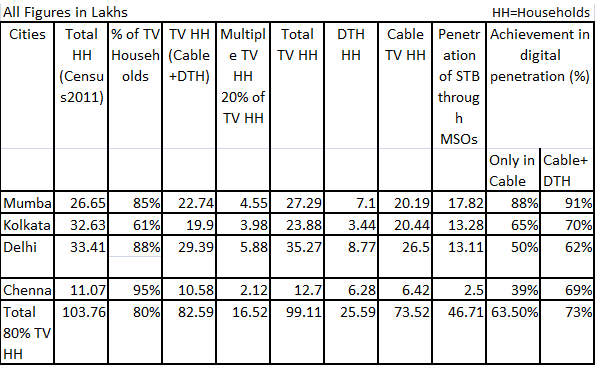
    Well, there are still some issues, but we think the government figures are off the mark. Our figures are as follows:


    Corrected STB Penetration Table -17 September 2012

    ( Includes DTH HH as part of Multiple TV HH not considered by I&B)

    Note:-
    1. Ministry has not included DTH TV HH in multiple TV HH where as it should have done so, being part of the same universe.
    2. Basis of % of TV HH in the Metros is hypothetical. Mechanism of its working out or its source has not been mentioned.


    The time has come to incentivize MSOs, but instead the licences have been cancelled of two of them.


    We are on September 24, and the price that consumers would have to pay is still not out, so things need to be moving faster.


    Broadcasters need to also ensure that there is availability of digital signals in all four metros.


    2. What is your information: are the lower income groups in these cities buying set-top boxes?

    They have been asking many questions. They want to know how much it will really cost them. Remember, some of them don’t even have colour television sets.


    Unfortunately, there is only one group representing consumers in the various taskforce meetings. Consumers would like to know how much it will really cost them.


    There will be an uproar if people don’t get to watch TV from November 1 because of this lack of information.


    3. There is a worry that there will be some piracy in the form of pilferage of signals after November 1…

    Why should there be any such pilferage? The broadcasters can simply stop the analogue signals. The question is: do they want to stop these? Will they fear loss of advertising if according to them digitization is not complete?


    4. What more would you like the government to do to ensure 100% digitization?

    Well, the government needs to do a variety of things.


    First, through the various advertisements, tell consumers very truthfully and clearly that one needs a set-top box for every TV set. And there’s an entertainment tax to be paid per TV set. So in Delhi, a consumer needs to pay Rs 20 for one set-top box and Rs 60 for three, if he or she has three TV sets.


    Second, consumers need to be made aware, that there is electricity consumption of around 18-20 watts per month which would roughly mean an extra spend of Rs 100. Also, they need to be aware that on these vanilla set-top boxes, they can’t get broadband or video on demand. There is no swap scheme and there is no portability currently.


    Third, consumers must also know where are the service centres for these set-top boxes in case the boxes need to be repaired.


    And broadcasters?

    Broadcasters also need to do more. For instance, in the various serials and reality shows, they must get the stars and anchors to talk about the need to buy set-top boxes!


    5. The last mile which is managed by the local cable operators is the key to the implementation of Digitization. Are all cable operators in the four metros about the implementation of the October 31 deadlline?

    Let me reiterate here that all cable operators want digitization. We will be happy to see consumers getting a choice and they will only pay as they watch.


    In fact had there been good availability of set-top boxes, we could have achieved things much faster. Right now, when a cable operator goes to the MSO for boxes on paying money, you don’t get the entire lot of boxes.


    We will be happy to see total transparency. We would like to also see deals between broadcasters and operators signed not on a lumpsum basis but as per the set-top boxes.


  • 100 Days to D-Day…but where are the Set-Top Boxes?

    By Shruti Pushkarna


    Only 100 days to go for Digitization Day and the ground reality does not look too promising at this point. There is a mammoth requirement of set top boxes, Digital Addressable System (DAS) licences have not yet been issued to operators and several other issues remain unresolved as of now.


    To get a clearer picture of the ground reality from the cable operators’ end, MxM India spoke to Roop Sharma, President, Cable Operators Federation of India. Speaking of the ground level scenario, Ms Sharma said, “No DAS licences have been issued to the operators still. Until and unless the operator has the license, he can’t get a bank loan and unless the operator has the license, he will not want to order equipment which is worth no less than 1 crore. And more importantly there is no consumer demand for digital. This is only government’s demand because they want to curry favour to the broadcaster. There isn’t any incentive from the government either. They are only forcing a technology on consumers by mandating it.”


    But more than anything, the biggest problem as pointed out by Ms Sharma is the sheer unavailability of Set Top Boxes (STBs) in the market. She told MxM India, “You need a Set Top Box to go digital and where are the STBs? First there was talk of importing them from China but that will also take atleast four to five months. Now there are some vendors in India but for that too, the chip has to be imported from outside. There is a requirement of 30 lakh STBs for Delhi alone and this is counting only one TV per household. Also, where is the manpower to deploy all these STBs?”


    Another industry source told MxM India, “As per the declared number, there is a requirement of 10 to 12 million STBs but my experience says that the actual total count will be no less than 20 to 22 million, because they have only counted 1 TV per household. The boxes are just not there.”


    Ms Sharma feels that the government is pressurizing the smallest guy in the entire value chain, which is the cable operator. Talking of other unresolved issues, she said, “Even if the cable operator gets the STBs and gets the license, the government has not assured that every operator who gets the license will get the content. How can the operator make such a huge investment when there is no assurance of content? The government is only pressurizing the smallest guy in the value chain, they can’t pressurize the broadcaster, not even the MSO.”


    MxM India also spoke to Mr Neeraj Sanan, EVP- Marketing and Distribution, MCCS to learn of the state of readiness of channels and industry as a whole. Mr Sanan said, “In principle, the entire fraternity of MSOs, LCOs and DTH friends are united in supporting the lead taken by TRAI. In my view, Delhi and Mumbai are slightly ahead of Kolkata in digitization. Being a country where examinations to appraisals to income tax, everything happens at the last minute I see two things:  a huge last minute rush (that too provided TRAI holds it grounds) which will put operational pressure in implementation. I still hope that, in the larger interest of the community, that we see the sunrise of Digitization. Already we have taken a lead in creating consumer pull through tickers which have been running on MCCS’ three channels for a month now and if all players in the value chain do the same I am sure we can see a successful June 30 sunrise.”


    But as per another industry source June 30th seems quite unachievable, “There is a lot of resistance from LCOs and cable operators’ end. Their business is fragmented, that’s how they make their revenues, and digitization will put a stop to that. And moreover, none of the MSOs are really prepared because this requires a capital investment of 30 to 35 crore and they don’t have that kind of funding. The sheer size and the volume of the business is so large that you cannot do it even by December 31st. One thing is certain, it will create unforeseen situation on ground.”


    Ms Sharma feels that the deadline might seem possible only if STBs are made available. Listing out all issues that need to be addressed before June 30th, she said, “First and foremost, tariff needs to be in place. DAS licenses have to be issued. Interconnection agreements have to be in place. Revenue share has to be specified. STBs have to be made available in the market. And there have to be fiscal incentives given to the operators. Also, we need to have many consumer awareness programmes. All these problems have to be addressed if the deadline has to be achieved by the notified date.”


    She also added that the TRAI had only done one open house recently in Delhi but since the June 30th deadline applies to all the four metros, TRAI should have done an open house in each of these cities.


    What’s your view on Digitization? Do you think the four metros can meet the deadline? Email us at shrutip@mxmindia.com and editor@mxmindia.com.