
By Alam Srinivas
 From Shobhana Bhartia: Paper Tigress
“What did she learn at the Post? One of the most important learnings was that the look and feel of a newspaper matters a lot. These issues were almost irrelevant in India during the 1980s.
‘In those days, newspaper was a messy affair, and the black ink used to come off from the newsprint; one would have black hands by the time one had finished reading the paper. There were many manual interventions. Like the fact that column galleys had to be physically pasted before being printed. Sometimes, the galleys would be crooked, but no one would bother; the common reaction was “aaj thoda teda ho gaya and it would okay the next day”.’
|
More than a woman… |
|
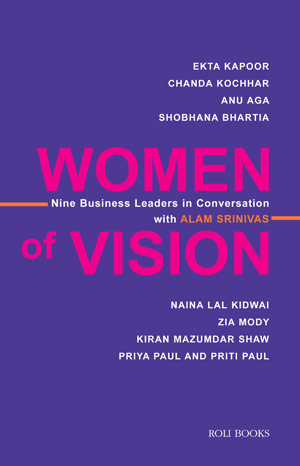
With Women of Vision, author Alam Srinivas, who is a freelance journalist with over 25 years of experience, has managed to get up close and personal with nine of the most influential women business leaders, who have laid bare their personal and professional lives like never before. As Mr Srinivas says, “I was pretty surprised that each of the women leaders whom I met was so candid and transparent about any or every aspect of their lives.”
In conversation with Johnson Napier of MxMIndia, Alam Srinivas tells of how in a face-to-face interview, each icon shares her journey of how she battled male-dominated hierarchies to shatter the glass ceiling and set up successful business empires through grit, determination, hard work and merit.
How did the thought of profiling women business achievers come about? There were a few things that went into the whole process of putting together this book. Although there have been books on successful women in India they have been more inclined towards celebrities or people from art & culture, and have included some women from the business arena. But I cannot think of any book that has only focused on women business leaders. So that was one gap that we identified and which we thought ought to be fulfilled. Also if you observe the last twenty years, post-economic reforms a lot of women have done very well not just as entrepreneurs or business women but as business leaders, managers, CEOs…In fact there are enough Indian women leaders who’ve made a mark around the world as well. So there was a need to do such kind of a book and also the time was appropriate to do such a venture because there were enough people to talk to and also enough people who were aspiring to become managers, leaders, CEOs etc.
Women, especially from the business sphere, have been a source of inspiration for authors to often chronicle and talk about. Right? When you talk about successful business women they are not just women who have inherited their family’s wealth or business, there were also women who were first generation entrepreneurs, there were women who have successfully become managers, CEOs, etc. So there was this whole spectrum of women who were doing well and in different ways. Even when you look at their SEC profiles they come from different backgrounds. There are some who hail from middle class families, there are some who come from well-to-do but not rich families, there were people who come from business families…yet again there was this whole spectrum of women who were doing well so I thought one needs to capture all this in a book format. Also the publishers had this idea of doing a book around business women and that’s how it all started.
Was it a conscious decision to profile just nine women from across diverse fields? There have been quite a few influential names that have been missed out… I had made a list of about 40 women from across different age groups and sectors. But as I started going through the research work I realised that a book on 40 people would become very unwieldy, and also a lot of stories and issues were similar so that kind of made it seem repetitive. It’s then that I decided to narrow down to just ten women who encompassed every shade and contour that I need to put on paper. If you look at the current list, there are women from North, South, East and West. Also, in terms of age range, there is a person who is 30 years old and there is someone who is a grandmother. As I said, in terms of SEC there are people who are managers, first generation entrepreneurs, etc. So we had to capture all kinds of nuances and also not become too repetitive. If you read the articles in this book, they are not biographical in nature but rather consist of sketches of these people. So it was not the numbers game but trying to capture the whole idea.
One is surprised to see the vast access you’ve managed to gain into the lives of each of the subjects. What was it that made them open up and get as candid with you about their personal and professional doings? I was pretty surprised that each of the people I met was so candid and transparent and open about any or every aspect of their lives. Like, for example, Ekta Kapoor, who says that there was a phase in her life where she was arrogant but that she is trying to change and be a better person. Similarly with Chanda Kochhar, it was her initiative to take ICICI into Retail Loans which kind of backfired as the global economy went down. So there are multiple such candid moments that have been shared by these women leaders. I am not sure if this has been the case before. Maybe women leaders are more sensitised to their surroundings etc…I was pretty surprised by the response that I got from each of them where they allowed me to get deep into their personal and professional lives.
What has been the initial response that you’ve been receiving for your book? It’s too early to talk about the reception that my book has been receiving from all quarters but the initial reactions are that of surprise for the fact that they have allowed access inside their world so intimately and passionately. That’s been the general reaction as of now. |
 Any attempt to dig into the professional and the more challenging personal lives of celebrities takes quite some doing. And if the subject happens to be a woman – and an influential one at that – the task becomes that much more daunting.
Shobhana was amazed to find out that the Western media had given up manual technology years ago, and had embraced state-of-the-art systems and software.
Another critical lesson was the manner in which a global media organization looked at the readers. It studied and figured who its readers were and targeted them. There was a synergy between the readers, the product and the platform that a newspaper provided for its customers.
‘This was something we would not think of in the 1980s. None of these insights went into our decision-making process. In addition, most of the Indian newspapers had little competition and were on their own trajectory. Even the Indian consumer never thought of the newspaper as a product. For her, it was more of a habit; she would wake up in the morning and carry the paper as a companion.’
But, over the next decade or so, the Indian media changed. Along with technology and the rise of the middle class came the concepts of consumer satisfaction and choice. The consumer demanded certain things from her paper, which had to change.”
From Ekta Kapoor: Queen of Soaps
“Ekta was 20, and she was willing to slug it out. It took almost 5-6 years for her, and Balaji Telefilms, to break the TV barrier. Hum Paanch ran for five years on Zee; subsequent serials like Itihaas on DD and Kudumbum (Tamil) on Sun TV became huge hits.
Part luck and part vision helped Ekta achieve initial success. Her entry into Hindi and regional serials coincided with the ongoing boom in cable television and private broadcasting. As the stranglehold of DD waned, a huge viewership was awaiting the launch of new serials, and Ekta was there at the right time to whet their appetite.
Throughout the second half of the 1990s, while other production houses and broadcasters focused on Western-style soaps, mostly as copies (as even Ekta did with Hum Paanch), Balaji went a step further. Its research showed that the viewership of Hindi fiction-based soaps was 60 per cent, which appealed to a large number of women across regions and languages.
‘We were stable only by 2000,’ Ekta said. Her mother added that they continued to keep a strict control on expenditure, and worked out of a basement since the channel’s budgets for shows were low and the margins for the production houses were meagre. ‘We could not afford expensive office space in Mumbai; it was only after our IPO [Initial Public Offering in late 2000] that we moved into this plush office and did well in the TV entertainment business.’
By 2000, Ekta had arrived. Balaji Telefilms launched seven shows in that year. The next year saw another 3-4 serials. All of them were lapped up by the audience.”
*****
“Ekta’s splash in the past two years has been in her achievements in Bollywood. In March 2010 came Love, Sex and Dhoka, followed by Once Upon a Time in Mumbai, and culminated in other hits like Ragini MMS. The final dhamaka came in the form of The Dirty Picture. The string of such films proved that Ekta had acquired a new creative edge, and there was a radical shift in her content strategy. For one, most of these movies were low budget ones. While some had well-known stars like Ajay Devgn and Vidya Balan, who won her first National Award for The Dirty Picture, the production and editing expenses were kept low. Many films had lesser-known actors.
Two, they were made with a specific audience in mind. Ekta had long realized, in 2008, that the viewers had changed and were fragmented. In urban towns they were younger, urban, mostly liberal, ambitious, aggressive and confident about finding their feet in this dog-eat-dog world. Among them, the more affluent ones went to malls and PVRs to watch movies. Almost all the movies she produced in the 2010-12 period fell under the genre of the so-called PVR movies.
More importantly, Ekta’s characters changed dramatically. While the K-serials portrayed women as conservative and traditional, those in LSD and The Dirty Picture were in-your-face individuals, who were willing to experiment with life and shed their conservatism. They were women of the 21st century, who rubbed shoulders with men and many times stood above them. They knew their minds and bodies, and they knew what they had to do and why.
Women of Vision: Nine Business Leaders in Conversation with Alam Srinivas
Excerpted with permission of the publisher, Roli Books
Price Rs 140, 128 pages