Tag: ROI

  • Nielsen reports underspending in 50% of media plans

    By Our Staff


    Nielsen has released its first-ever ROI Report, which identified gaps in marketers’ budgets, channels and media strategies that are compromising returns on investment (ROI) on media plans. The global report reveals data and delivers insights on what drives returns on ad spends, how to measure the returns, and how to improve on the metrics brands already have, with content unique to advertiser, agency, and publisher audiences.


    According to the report, about half of marketers are not spending enough in a channel to get maximum ROI. While a poor ROI might cause brands to pull back on spending, Nielsen found that spend often needs to be higher to break through and drive returns. Nielsen’s “50-50-50 Gap” states that while 50% of media plans are underinvested by a median of 50%, ROI can be improved 50% with the ideal budget.


    Beyond budgeting, the ROI Report delivers key insights and recommendations to deliver higher ROI across multiple marketing areas including:


    :: Full funnel marketing: It’s rare for channels to deliver above average returns for both brand and sales outcomes, with 36% of media channels faring above average on both revenue and brand metrics. To grow ROI, brands should pursue a balanced strategy for both upper and lower funnel initiatives. Nielsen found that adding upper funnel marketing to existing lower and mid funnel marketing can grow overall ROI by 13-70%.

    :: Emerging media: It’s difficult for brands to spend big amounts without proof that the new media works, but spending small amounts can make it hard to see if the media is working. Nielsen found that podcast ads, influencer marketing and branded content can deliver over 70% in aided brand recall, and that influencer marketing ROI is comparable to ROI from mainstream media.

    :: Ad sales growth strategy: Ultimately, ROI will inform publisher pricing power. Publishers are not just competing against others in their channel, but also against other channels, so comparing channel ROIs can help set pricing strategy. The ROI Report uncovered that social media delivers 1.7x the ROI of TV, yet social gets less than one-third of TV ad budgets.

    :: Audience measurement: Campaigns with strong on-target reach deliver better sales outcomes. However, only 63% of ads across desktop and mobile are on-target for age and gender in the U.S., meaning that on the channels with the most exhaustive data coverage and quality, over one third of ad spend is off-target. To capitalize on opportunity and drive impact, advertisers should prioritize measurement solutions that coverall platforms and devices, with near-real-time insights. “Nielsen’s 2022 ROI Report serves as a guide for brands, agencies and publishers. In a time when there are more channels than ever to reach desired audiences, it’s critical that insights on ROI are attainable and easy to understand,” said Imran Hirani, Vice President, Media & Advertiser Analytics, Nielsen.“Brands can’t afford to waste valuable ads on the wrong audiences. By investing wisely and having a balanced strategy of both upper-funnel and lower-funnel initiatives, brands can reach the right audiences and maximize their ROI.”


  • Globale Media launches new product for app marketers

    By Our Staff

    Adtech startup Globale Media has been trying to help advertisers up revenues through app recommendation engines, targeted ad campaigns, high-quality OEM placements, guaranteed 0% fraud rate, and accurate performance monitoring. Hence the app.

    Said Bhavesh Talreja, Founder and CEO: “We are excited to launch this product as we have already tried it with our advertisers and we are witnessing tremendous results. Mobile advertising is a space that needs continuous innovation and I am glad that Globale Media is leading from the front and trying out different ways to maximize ROI for the advertisers. Our new product is being loved by the app marketers and they are getting higher than ever post-install engagement.”


  • The Anchor: Yutaka Kamoshita’s 5 must-have digital strategies to improve brand ROI

    By Yutaka Kamoshita


    #1 Set clear agreement amongst stakeholders on what is ‘Return on Investment’

    This is where everything begins.


    Digital is not a magic wand. Users don’t close their browsers and run to the nearest store just because they saw a brand’s digital marketing campaign. But if a user comes across a brand hoarding and remembers that brand’s digital campaign which ran say, three months ago, then perhaps one can say that digital has worked to some extent. In case of this example, the brand stakeholders’ perspective would be “At this phase, our ROI should be evaluated by users’ content consumption behaviour and not yet by sales.”


    Unlike this example, ROI is clearer for web-service brands such as eCommerce. But still, is volume of sales the only critical KPI? Or is someone on the brand team looking at number of new user registrations as well? It is a marketer’s responsibility to define what the KPI really are. They need to identify the KPI and develop clear, concise agreement with stakeholders. These are time intensive and not easy, but inevitably, the best way forward.


    #2 Let users decide – not ‘gut-feel’

    Decision-making is a subjective action. If you are stumped between short-listing one main copy line from two other options, create three different versions and roll-out a quick test run on the web. It’s the user feedback and opinion and not gut-feel that is the best measure to prove what works. This works well after Step 1 as it helps brands identify what to evaluate from the result.


    #3 Let your content travel by itself

    Brand websites are just another set of html files on the world wide web. They are not a ‘physical property’ of a brand. Remember where Hotmail succeeded in their marketing in ’90s? Sometimes, it helps for marketers to loosen their emotional attachment with their own website just a little and try looking at it objectively. Content can travel anywhere in the internet. Content should be designed to make it as much accessible as possible. Users would love to spread brand messages to others for free. Copying, in other words ‘WOM’ or brand advocacy is the beauty of both digital and advertising. This works best after Step 2 so marketers get a sense on the potential of their message.


    #4 Think about the 99 percent

    Usually CTR of display ads is below 1 percent. Where does the other 99 percent go? Users don’t click display ads, because it is too much for brands to ask.


    What do TV commercials require viewers to do? Nothing but that they stay seated and wait for a few minutes till the commercial break is over. How about display ads? They compel users to stop what they are doing, move the cursor on a banner, click and go to another website which is a totally unknown environment for the user.


    Ninety nine percentile of human beings are very passive who don’t like taking risks. How can brands convert this 99 percent? Like you do for the 1 percent, solutions need to be implemented for the 99 percent! Services such as third party ad serving platforms or attribution tracking tools are available for evaluating the behaviour and usage/ consumption patterns of this 99 percentile.


    #5 Get out from your comfort zone

    Market saturation is inevitable. No demand means no business. If a marketer senses that something is stuck, then it may be the right time for him to extend his areas of consideration/ activity.


    SEM not performing as well as it used to? Before changing bidding price for keywords, isn’t there anything that can be done to create such demand? We don’t need search engines if we don’t have a specific demand in our minds. In general, activities to create demand end up with worse ROI, compared to activities to collect existing demand like SEM. But why compare two activities that have different purposes?


    Get out from what you have been doing before. Step out of your comfort zone and try something that had been avoided because of wrong expected ROI. This something could be viral video activities, advertorials with publishers, FB applications among several other options! It is advised to close Step 1 before this, so that all stakeholders are aware that CPA from a viral video is not being compared with CPA from SEM campaigns.


    Yutaka Kamoshita is Digital Strategist, Dentsu Digital


  • Can Facebook, the marketer’s online best friend ever become its ace salesman?

    By Delshad Irani & Ravi Balakrishnan


    In 2009, Facebook terminated the ‘Whopper Sacrifice’, Burger King’s social experiment cum marketing activation. Created by Crispin Porter Bogusky, the campaign’s premise was the more ties you sever the closer you get to your BK Whopper. The application as it turned out was a whopping success.


    Within a week 200,000 ‘friends’ were virtually burned out of existence from various lists. Facebook couldn’t handle the loss of those hard-earned friendships. Burger King, on the other hand, proved the point it set out to make – Americans sure do love their burgers. That same year, Swedish furniture giant Ikea spent practically nothing to create a campaign to promote its newest store.


    The agency Forsman & Bodenfors created a new Facebook account for the manager at the store in the city of Malmo and posted catalogue pictures of furnished rooms.


    Users could win furniture and other items in the photos if they beat their friends to the punch. All they needed to do was tag the pieces with their names first. Needless to say the prospect of first-to-tag-wins drove Facebookians crazy. The campaign was hassle-free, cheap and effective, just like the Scandinavian furniture it was advertising.


    Fast-forward to a few weeks ago. General Motors, the world’s fourth-largest advertiser and spender of $3.9 billion globally on advertising in 2010, haunted by questions related to effectiveness and ROI, pulled out its pretty penny, all $10 million of it, from Facebook’s paid-ad kitty just days before the social network’s stock went public.


    In addition to that sum, the automaker spends a reported $30 million on content creation for social media. These examples make Baccarat-crystal clear what we know already – you don’t have to pay big to make an impact via social media.


    In India, most marketers love talking about the worth of a campaign by the number of fans, or likes received on the most recent post. But even they are starting to ask a tricky question: what’s the real worth of their campaigns on Facebook? Worth more than a burger, eh?


    The site itself has been trying to tell advertisers that no longer will mere presence and innovative social media campaigns cut it. If they want scale, they’ll have to shell out the hard cash for offerings like “sponsored stories”, not to be confused with “sponsored ads”.


    For instance, products like Reach Generator guarantee that posts by a brand stand to be seen by 75 per cent of its fans every month or an estimated 50 per cent every week. Non users of the tool will have to settle for an average of only 16 per cent of fans viewing posts on a weekly basis. Not everyone’s buying though, believing that compelling content will win any day of the week.


    Anuradha Aggarwal, senior VP, brand communication and insights, Vodafone India said: “Since having high engagement scores is our goal, we focus on creating content on our Facebook page rather than on advertising. We focus on creating posts and apps to enable our 3.2 million fans to create conversations and experiences around the brand.”


    PepsiCo’s approach is to use a combination of both, posts/promotions on brand pages and display advertising. One of the cola maker’s prominent campaigns on the site was ‘Meet Messi in Miami’ where fans had to complete a series of tasks to win a chance to meet The Atomic Flea.


    During the 2011 ICC Cricket World Cup, Pepsi launched an online progamme as part of the ‘Change the Game’ campaign where fans could win a dream trip across the country for all India matches. The latter initiative was listed as one of the 19 best campaigns in the world by Facebook on their success stories blog, the only Indian effort to feature on the page.


    According to Homi Battiwalla, category director – colas, hydration and mango based beverages, PepsiCo India, it is too early to give a conclusive opinion on new advertising properties like sponsored stories and other offers. So the bottom line when it comes to the marketing on the social network is the game hasn’t quite changed. “The primary focus remains on organic content as we believe it results in better consumer connect,” said Mr Battiwalla.


    For automakers like Mahindra & Mahindra, Facebook is good for what it was born to do in the first place. Well, that and to spy on “old acquaintances”. According to Vivek Nayer, senior VP, marketing, automotive division, Mahindra & Mahindra: “Rather than looking at Facebook for advertising reach, we’ve leveraged it for what the platform is inherently good at; building communities. Today at 5 million, we are the largest automotive community on Facebook in India”


    In the case of Unilever, the company moved from almost accidentally stumbling on the power of the site – after noting a lot of action on its first Cornetto Luv Reels page long after the promotion was over – to it being a key pillar to the launch of Fruttare, its new range for the summer. Sapan Sharma, general manager – ice creams, Hindustan Unilever, said: “There’s an advertiser login where you get all the details. In the first 10 days of launch, 1.2 lakh fans signed up and there were 1.2 to 1.5 lakh conversations.”


    Arch-rival P&G is not lagging either. According to a company spokesperson: “In just less than two months, we have over 690,000 fans for our Thank You, Mom campaign. This makes it the largest, most engaged-with Thank You, Mom community globally.” For the launch of Olay’s premium skin care range, Olay Regenerist, a Facebook waiting list was created, with both fashion journalists and consumers signing up for an exclusive trial on the site; in less than three weeks, over 11,400 people had registered.


    But as the eight-year-old Facebook enters a new league as a listed company, it needs to, and rather urgently, scale its revenues to sync with its audience. Minute, often ineffective, right-rail ads aren’t exactly a juicy bone to dangle in front of existing and potential advertisers; thus the introduction of premium ads and better placement.


    According to Siddhart Rao, CEO of digital agency Webchutney, the sweet spot between organic and paid promotion is the one that will yield maximum benefit to brands looking to extract value from social media marketing platforms like Facebook. “One cannot work without the other,” he said.


    S Yesudas, managing director – Indian subcontinent, Vizeum, said: “I do not think all marketers know what to expect from the medium. The hurry to be on to the bandwagon gets them there. The fact that Facebook offers free advertising inventory for brands to test the medium gets overlooked. In my opinion, the medium can be successfully used to build relationships with the consumers.


    Targeting can be done based on profile information, relationship status, interest or based on certain words in profiles or status messages. But the truth is the brand communication will always compete with the updates, videos, etc from friends.”


    Indeed, it’s complicated; the relationship between advertisers and Facebook. Especially when one moves from the fluffy world of engagement to hard sales. Many retailers in the West like JC Penney, Gamestop and Gap pulled the shutters on their stores on Facebook this February.


    Chhaya Balachandran Aiyer – founder – MD, BC Web Wise said: “Ironically Wade

    Gerten, the founder of 8thBridge – the flower store that was responsible for the coinage of the term F-commerce as it was the first to open shop on Facebook for 1,800 Flowers – has admitted that sales never really materialised for their first or other F-outlets, adding that F-commerce deserved an F. Given the fact that F-commerce (Facebook commerce) has failed in the west for retailers, it appears that Facebook would be an engagement vehicle. Peer recommendation and product ratings are not integrated. Should it launch a brand intelligence tool which can be used by consumers – which exposes peer comments and recommendations that can be accessed by the FB community – then the ball game will change.”


    Venkat Mallik – president, Tribal DDB & Rapp India says Facebook’s ability to deliver sales impact has been a bit of a mixed bag: “There need to be more strong case studies demonstrating the sales or brand impact from the use of Facebook led engagement.”


    However while Facebook may not itself be a platform to sell it can impact sales according to some of its satisfied customers. Unilever’s Mr Sharma for instance believes there’s a definite co-relation between high levels of engagement and products sold.


    According to Carlton D’Silva, chief creative officer, Hungama Digital Media, “Opinions of family and friends matter when making purchase decisions decisions and Facebook activity will provide a lot of data to consumers, which can be leveraged in places where they make these decisions, causing a significant, if not direct impact on purchase behaviour.”


    “GM is slashing its advertising budgets by $ 2 billion, of this only $10 million or 0.5 per cent was on Facebook. They have also announced they won’t advertise on Super Bowl, either. Further, what should be noted is that GM has 8 million fans already. I am sure that they are going to continue with the engagement plans for acquired fans. It would be foolish to assume anything beyond, or assume Facebook has failed for GM, it would be just that advertising further is currently not the best bet in its media plan,” said Ms Aiyer


    The users of Facebook both on the agency and the marketer side each have their wishlist ready.


    “The analytics are available at a lag of 7 to 15 days; I’m sure it can come earlier. I’m sure there will be a time when we can talk to people from a specific city or market,” said Mr Sharma


    “They are hugely data rich. If in some way they get to using some of the data millions of people put in their hands on a minute to minute basis, sky will be the limit for them.This will surely come in with resistance from the users, unless they persuade them. They have to walk this path very carefully,” added Mr Yesudas.


    Most brands have a clear agenda from marketing spends on social media platforms like Facebook – greater outreach among target audiences through personalised interaction and engagement, leading to higher impact on conversions and sales.


    “It’s a perfectly reasonable expectation from a social communication platform with 900 million members,” said Mr Rao of Webchutney, “but whether brands invest enough thought, time, resources and action to engage audiences meaningfully is another question.” And one helluva question it is. Because for every whopper of a Scandinavian success story, there are at least a dozen marketing campaigns that have fallen flat on their face. So, ask not what you can do on Facebook but what Facebook can do for you.


    Source: The Economic Times
    Copyright © 2012, Bennett, Coleman & Co. Ltd. All Rights Reserved

  • The Anchor: 5 Reasons why Brands get it wrong with the Youth

    By Samyak Chakrabarty


    1. Boxing youth into strict definitions

    In a country as diverse asIndia, one cannot define our youth or predict consumption behaviour by merely categorizing them under conventional economic segmentation or geographies. Our youth is continuously evolving, especially those born after 1988 are still caught in a transitional phase from and into very different eras. It can never be obvious what a SEC A+ 20 year old male inNew Delhiwill purchase just by looking at the size of his wallet or the kind of college he studies in !


    2. Youth don’t wake up thinking about brands

    Just because your brand ambassador maybe Ranbir Kapoor or your communication is ‘cool’ (I hate it when brand managers say this!), one can’t take it for granted that youngsters will always have your brand on their top of mind or will purchase your product. Today, we are more conscious and calculative about what we consume, hence substance is equally as important as packaging. Second, to build loyalty with this generation, the brand has to be equally loyal to them!


    3. Digital is the holy grail

    There was a time when brand managers would pull out their hair trying to figure how to engage youth sustainably. Soon enough,Silicon Valleyanswered their prayers and there landed from ‘the cloud’ Facebook, Twitter and YouTube. But unfortunately, brands take it for granted that just because they are on social media or rather have a million likes/views, theirs is a ‘cool youth brand’. This is not true, these days we ‘view’, ‘like’ or ‘tweet’ about anything and everything that comes into our online space – it has become a function of habit. These numbers cannot be used to measure brand engagement/conversions in pure statistical terms. Just because your brand is now digital, it is not young.


    4. Trying to measure word of mouth

    Indiais perhaps the only country in the world where brand managers ask for a ‘measurement matrix’ for world of mouth campaigns conducted in colleges. I guess they like to show off to their bosses how much they know and meticulous they are. How can one ever measure, record or contain conversations that happen offline? And just because therefore there is no direct ‘ROI’, youth brands in India refuse to run simple WOM campaigns, even though in fact, if rightly administered and structured, the investment can be more profitable then all digital spends put together since most purchases/brand decisions happen through peer references that take place in conversations over chai in the canteen or a beer in the pub – NOT on Facebook.


    5. Today’s Youth is an alien species

    To my final point, brands look at ‘youth’ as a totally alien species, which they are trying to figure and due to that very attitude, all the numbers, insights and ideas start not making sense. I, myself, have written above that those born after 1988 are indeed a totally different than their predecessors but that doesn’t mean that we overcomplicate and give too much importance to the way they think, eat, drink and surf! I guess the simplest thing to do is work on an intelligent, creative and smart campaign without reading too much into youth behaviour because reality is that one will never ever be able to understand how these mindsets function since there is no one point where this transition will end.


    Samyak Chakrabarty is Chief Youth Marketer, DDB Mudra Max


  • IPL 5: 38 matches later, ave TVR touches 3.41

    By A Correspondent


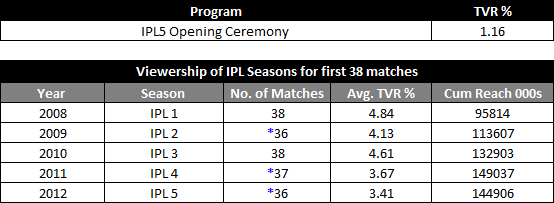
    The ratings for the first 38 of the Indian Premier League (IPL) season 5 continue to be lower than the previous seasons. According to TAM Sports, CS 4+, All India, IPL 5 delivered a TVR of 3.41 per cent in the 36 matches played so far during the tournament. Interestingly, media planners point out that one of the plus points of IPL5 is that it has been consistent in its ratings, which will lead to better ROI for advertisers.


    It may be recalled that first 27 matches of season 5 delivered a TVR of 3.53 per cent and the first 16 matches, a TVR of 3.65 per cent. The inaugural season (IPL1) however continues to remain the highest viewed season with a TVR of a whopping 4.84 per cent. Too much cricket in the past few months,India’s dismal ODI and Test match performance and too many matches in season 5 leading to cricket fatigue are said to be the possible reasons for the low ratings.


    Media planners believe that as the tournament progresses, especially towards the semi-finals and the finals, the ratings are expected to further increase. According to Mr Dinesh Vyas, GM, MEC India: “IPL 5 may have been receiving the lowest TVR as compared to the previous seasons, but it is also the only programme on television which has been delivering consistently. Therefore a TVR of 3.41 per cent for the first 36 matches is a good. In fact, now is the time that we will see more and more people viewing IPL matches and the ratings will only further increase.”


    Mr R Venkata Subramanian, Senior Director-Investments, MPG India was of the view that one of the plus points of season five is its consistency: “There has been consistency in the ratings which is certainly beneficial for advertisers however the numbers continue to be lower than the previous seasons. Despite some really good matches, the numbers have been low, probably because of too many matches leading to cricket fatigue. Nonetheless as the tournament progresses, I do expect the viewership to grow but, I don’t expect a dramatic increase.”


    Source : TAM Sports, Period : First 38 matches of all IPL Seasons, TG : CS 4+ yrs, Market : All India, Channel : MAX


    * In IPL 1 one match (47th) was abandoned due to rain
    * In IPL 2 two matches (7th & 13th)were abandoned due to rain
    * In IPL 4 one match (20th) was abandoned due to rain
    * In IPL 5 two matches (32th & 34th) were abandoned due to rain