Tag: Reuters Institute Digital News Report

  • Are ‘Trust in News’ & ‘Happiness’ interconnected?

    Are ‘Trust in News’ & ‘Happiness’ interconnected?

    Avik ChattopadhyayTwo very interesting global reports have been published over the last one week. The first is the Reuters Institute Digital News Report 2023 and the second is the 2023 edition of the World Happiness Report. As a marketer and ‘brand-o-phile’, I see a subliminal connect between the two.


    The Reuters Institute Digital News Report is an outcome of more than 90,000 responses across 46 countries on how much one trusts news, through conventional as well as digital media. While the overall global trust score has dropped a few percentage points, the report states that “it is not surprising that news consumers are increasingly feeling overwhelmed and confused, and many are turning away temporarily or permanently. Selective news avoidance and news fatigue have been exacerbated by the challenging times we live in.”
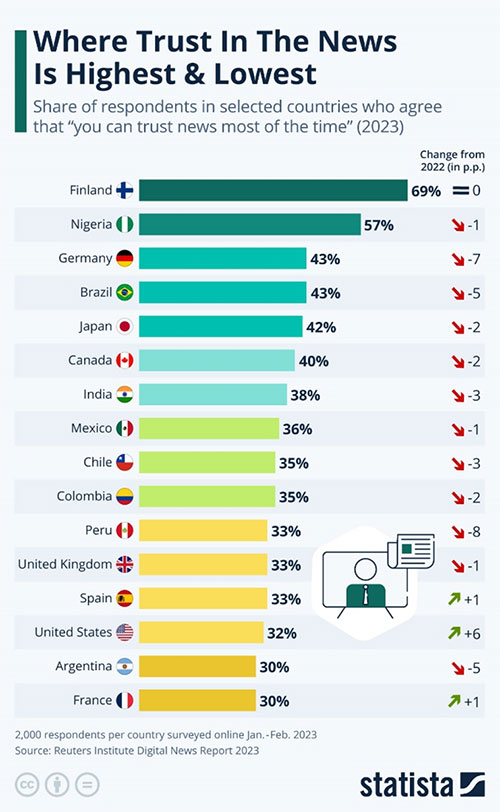


    India is somewhere middling with 38% of news consumers trusting what they read and see. It has dropped 3 % points since the 2022 report. Now with the election season looming upon us, one can expect a sudden drop in the score with every political party resorting to downright unethical and fake communication without batting an eyelid on the impact on an already tense social fabric.

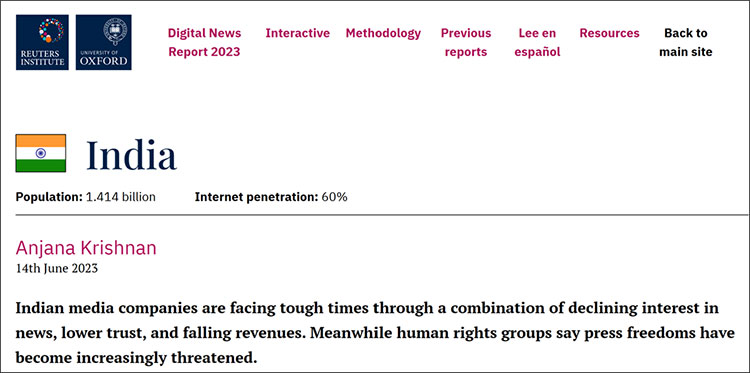
    The special note on India in the report is quite telling.


    Credibility is a huge factor. With the latest Press Freedom Index ranking of 161 out of 180, however much one may want to downplay the Reporters Without Borders study as being driven by agenda and deliberately disparaging towards the world’s biggest democracy, one cannot cross one’s heart and denounce it.


    The note states that “our Digital News Report survey finds steep falls in both the consumption and sharing of news. There was a sharp decrease in access to online news (12 percentage points lower than last year), particularly through social media (-11pp), the main sources of news for a predominantly younger audience. Television, popular among a large section of the population, also saw a 10pp decline as a news source with our younger and more urban-based sample.”


    While the government has brought checks and measures for media platforms, especially digital, on the authenticity of the news and its possible impact on factors like social harmony and national security, there are none for the social media teams of all political parties who deliberately churn out one-sided or fake posts, with the clear objective of misleading the populace and even instigating it into unrest. When the digital platforms dig up and expose these untruths, there is no legal recourse to punishing these people. All the Johnnies are consuming too much sugar without remorse.


    As the judiciary at the highest level seems to be the only panacea for most ills in the country, some sane citizens should file a PIL against such lie-spinners and let the court pull them to task.


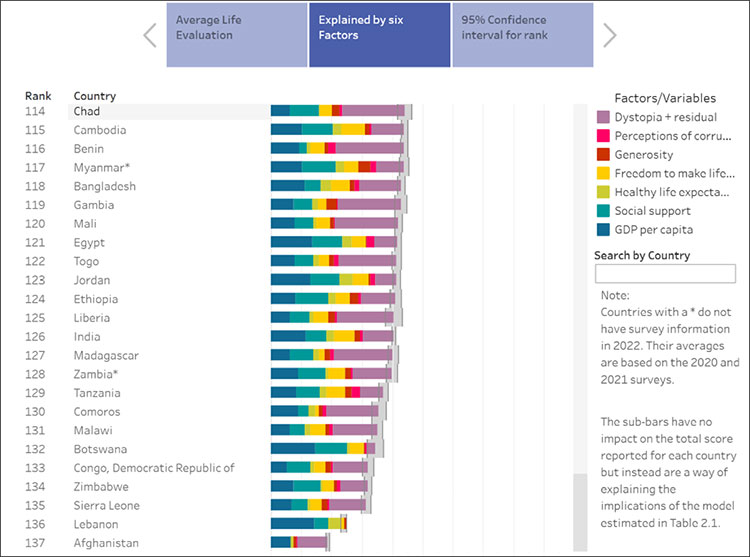
    The second report is the much debated and hated World Happiness Index by Gallup wherein certain sections of our thought leaders and citizenry cannot understand how can people in Pakistan, Bangladesh and Sri Lanka be happier than us, especially when we are going through our “Amritkaal” towards becoming the undisputed “Vishwaguru”. They need to understand that once again, this global report is not being undertaken with the sole purpose of showing India in bad light, but to help us introspect.


    If we study our score across the seven parameters in the second chart below, we will observe that we score badly on factors like life expectancy, corruption and generosity. These factors may not be as easily measurable like per capita income and are largely perceptual, but strong enough to take our score down. Also, the dystopia score is significant enough implying an undercurrent of social stress, possibly amongst certain communities.


    How are these two reports interdependent? Happiness is an active ingredient for trust. The lack of the first leads to increased scepticism and therefore the tendency to discount what you consume as news. You may put up a brave face in one report but the mask comes off in the other one.


    You posture to amplify the news that you opt to believe in as it shows you in better light. That is a fundamental defence mechanism, borne out of deep down insecurity and an inferiority complex. It is not that you openly consume and debate all sorts of news and digital content to logically establish that you are in the right. Similarly, you pose as happy, taking selfies next to objects, visiting places or doing things that take you away from your uncomfortable harsh reality. When it comes to responding to a survey, your disappointments with aspects of life around you get exposed. It is not the proverbial bed of roses.


    No external intervention can work in this case. Only a slow and gradual improvement in collective consciousness can shake the citizenry out of this sucrose-induced slumber.


    As a common citizen, you too are consuming enough sugar without even admitting to yourself. That is far worse than the media magnate spinning fake stories to drive you into a frenzy.


    The festival of democracy is less than a month away. Look before you leap.

    Jai Hind!


    Avik Chattopadhyay is a Gurugram-based brand and business strategist and commentator. He is currently also working along with XLRI to set up the Indian School for Design of Automobiles. He writes on MxMIndia every other Thursday. His views here are personal.

  • Why are young people abandoning news websites?


    By Nic Newman


    The crisis in journalism caused by the traditional news media’s struggles to cope with the digital revolution has been well documented over many years. But news organisations now face a much more fundamental change driven by generations who have grown up with and rely almost entirely on various digital media.

    Data published in this year’s Reuters Institute Digital News Report shows an acceleration in the structural shifts towards more digital, mobile and media environments. This is where news content is delivered via social media and now, increasingly video-led platforms such as TikTok, rather than via what to a new generation of media consumers look like the more formal and stuffy traditional of “legacy” media, including newspapers and television.

    Not only is consumption of traditional television news and print formats continuing to decline at a relentless rate, but online websites are also struggling to engage news users, despite the tumultuous times in which we live.

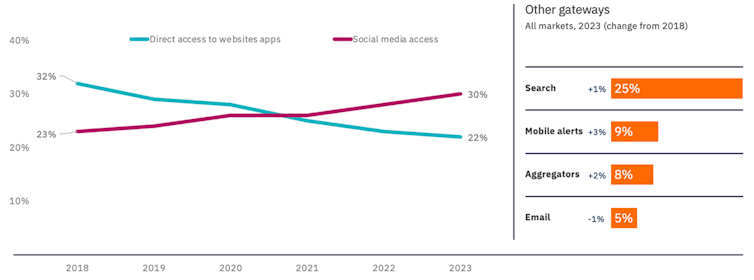
    One benchmark of this shift is a question we ask about key gateways that people use to access news. Using average data across all 46 countries surveyed in our annual report, we found that more people choose social media each year, mostly at the expense of direct access via a traditional news website or app. Access via search and other aggregators has also increased slightly over time.


    Use of news websites/apps versus social media to access news:

    Graph showing direct news website/app use decline and social news increasing.
    Which of these was the main way in which you came across news in the last week? Base: All who used a news gateway in the last week in each market-year ≈ 2000. Note: Number of markets grew from 36 in 2018 to 46 from 2021 onwards. Markets listed in online methodology.
    Reuters Institute for the Study of Journalism, Oxford University, Author provided


    These are averages, and it is important to point out that direct connection remains strong in some markets – mainly in northern Europe, where there is keen interest in news and relatively high trust. But elsewhere – especially in parts of Asia, Latin America, and Africa – social media or other aggregators are by far the most important gateways, leaving news brands much more dependent on third-party platforms for traffic.

    Generational differences are also a big part of the story. In almost every country we find that younger users are less likely to go directly to a news site or app and more likely to use social media or other intermediaries.

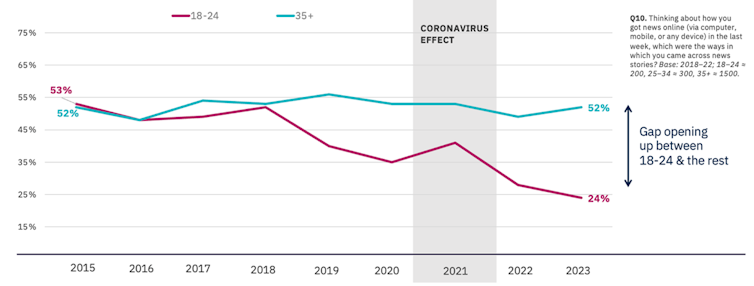
    The following chart for the UK shows that over-35s (blue line) have hardly changed their direct preferences over time, but that the 18–24 group (pink line) has become significantly less likely to use a news website or app.

    This is just one indication of how the generation that has grown up in the age of social and messaging apps is displaying very different behaviours as they come into adulthood.


    Percentage of people using a news website or app:

    Graph showing declining use of news websites and apps among 18-24 age group from 53% in 2015 to 24% in 2023 while 35+ group stayed around 52% (see previous two paragraphs).
    Thinking about how you got news online (via computer, mobile, or any device) in the last week, which were the ways in which you came across news stories? Base: 2018–22; 18–24 ≈ 200, 25–34 ≈ 300, 35+ ≈ 1500. Reuters Institute for the Study of Journalism, Oxford University, Author provided


    Dependence on social media may be growing, but it is not necessarily the same old networks. Across all age groups, Facebook is becoming much less important as a source of news – and by implication as a driver of traffic to news websites. Just 28% say they accessed news via Facebook in 2023 compared with 42% in 2016, based on data from 12 countries we have been tracking since 2014.

    This decline is partly driven by Facebook pulling back from news and partly by the way that video-based networks such as YouTube and TikTok are capturing much of the attention of younger users.

    Twitter usage is also reportedly declining following the chaotic set of changes introduced by Elon Musk, even if our survey shows relatively stable weekly reach overall.

    New platforms

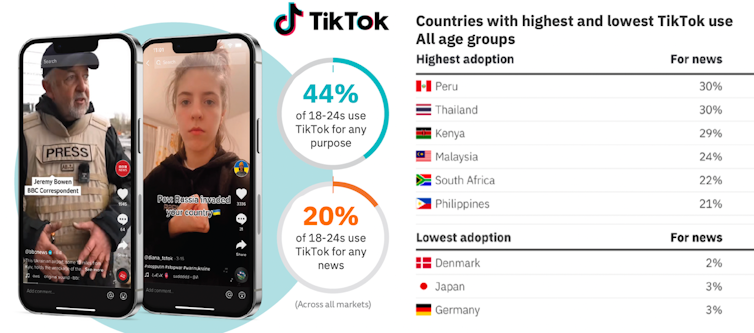
    TikTok is the fastest growing social network in our survey, used by 44% of 18–24 year-olds for any purpose and by 20% for news (up five percentage points compared with last year). Our survey results also show that the Chinese-owned app is most heavily used in parts of Asia, Latin America and Africa.

    Graph showing which platforms and websites people have used to access news.
    Which, if any, of the following have you used for news in the last week? Base: Total sample in each market ≈ 2000. Note: TikTok has been banned in India and does not operate in Hong Kong.
    Reuters Institute for the Study of Journalism, Oxford University, Author provided


    The report also provides evidence that users of TikTok, Instagram and Snapchat tend to pay more attention to celebrities and social media influencers than they do to journalists or media companies when it comes to news topics. This marks a sharp contrast with “legacy” – or more established – social networks such as Facebook and Twitter, where news organisations still attract most attention and lead conversations.

    Although news organisations have been experimenting with TikTok accounts, many are struggling to adapt to the more informal tone where creativity is the key to attracting an audience.

    These shifts are additionally challenging for publishers because they often require expensive bespoke content to be created and there are few ways to monetise short form videos, with limited linking opportunities back to websites or apps.


    Younger people less likely to read online

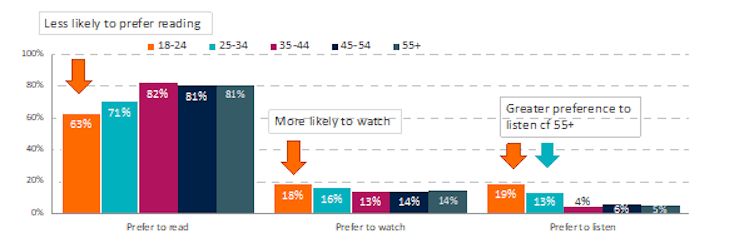
    These platform shifts are part of a wider move away from reading and towards watching or listening to news content online. While all age groups say they still prefer to read news online because of the speed and control if offers, younger groups are more likely to express preferences for watching or listening to news content, as the chart below shows. And this translates into greater consumption of short-form videos and podcasts by this group, according to our data.


    News consumption preferences by age and media:

    Graph showing young people are less likely to read and more likely to watch or listen to news.
    In thinking about your online habits around news and current affairs, which of the following statements applies best to you? Please select one. Base UK= 1740 (excl. DKs)
    Reuters Institute for the Study of Journalism, Oxford University, Author provided


    Our research over more than a decade has captured the way that all age groups have adopted digital media, alongside more familiar formats such as TV and print. But now we are seeing the emergence of a generation of social natives that are not bound by traditional definitions of news.

    As our previous research has shown, younger groups expect news to be engaging, participatory and to be available on their terms – in the networks and platforms where they spend their time. Trust is not a given, it needs to be earned – as much by journalists as by any other creator of content.

    For all the difficulties this entails – around trust, attention and business models – this is the media environment that the public is increasingly choosing for themselves. It is one where journalists and news media will need to carve out their place if they want to maintain their relevance and connection with the wider public.The Conversation


    Nic Newman is Senior Research Associate, Reuters Institute for the Study of Journalism, University of Oxford. This article is republished from The Conversation under a Creative Commons license. Read the original article.