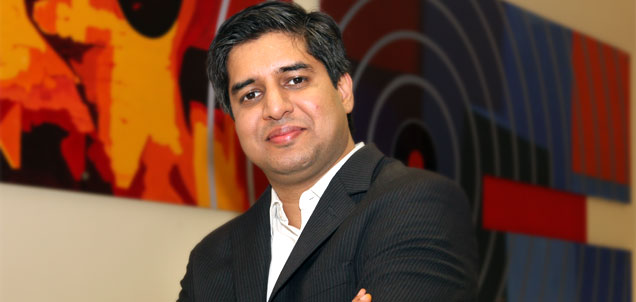
Quick Takes with 2014 Stars
Â
Beginning a four-or-more-part series of interviews with A quick Q&A with Tarun Katial, CEO of Reliance Broadcast Network Ltd whose 45-station 92.7 Big FM climbed the ratings roster after it switched to a retro music format in some of its key markets.
Do talk us through the Big switch to retro
We were in the business of radio for about four to five years before we took the plunge. We realised that just being one of the pack doesn’t work. Some of our competitors were in the market for 10-odd years. While the station did really well initially, the growth had plateaued. Being in radio, we’re also in the business of consumer insights. We realised there was a clear gap in the market and a market in the gap. Our research told us that a large number of 25-plus discerning, paying consumers  were now present on radio in large volumes. A combination of putting the consumer at the centre and understanding what the competition would and wouldn’t do and what were the possible unique gaps in the market made us decide to go retro.
Did the dispute with T-Series have a role to play in the switch?
No, it was largely driven by consumer insights and a deep-ended research conducted by a couple of agencies. I won’t link it to T-Series but what we also saw was there was a high amount of fatigue and low amount of involvement with interest in new music. Music was burning out quicker and was not engaging listeners as much. The number of music hits is reducing year-on-year. Even the biggest movies don’t have some very big music song hits anymore. The shelf-life of that music is reducing from six months to just four to five weeks.
Wasn’t there a worry that you would alienate young listeners?
When we did our research with both young and old listeners, we realised that everlasting or all-time favourite hits were popular across age groups.
And what about teenyboppers?
There were 50 to 60% of them who voted for the retro positioning. Also, we believe that the discerning and paying audience was largely in the 25-plus age bracket. Most advertising categories focused there.
But as you go along, you’ll need to incorporate newer music
Most radio stations in our position worldwide add another five years in their music library every two or three years.
Has the issue with T-Series been resolved?
We don’t really need them so where’s the issue?
But five years from now, you’ll need them.
Then we’ll take them because we’ll do what is right for the consumer. Needless to say, there have been fairly big competitors in that space. Zee, for instance, has done very well with music and we’re working with them in several of our geographies where we don’t do Retro. They’ve released large volume of new music which has done really well and we do play it.
How has the retro switch worked for your revenues?
Exponentially and I think both our volumes have increased significantly. We’ve seen at least over 25% year-on-year growth on both topline and bottomline.
What next on the current offering?
The effort to innovate within the format is going to be continuous. We’ve launched Anup Jalota in our morning band which is a first on radio. That kind of talent is rarely seen on Indian media, let alone, radio. So, a combination of Neelesh Mishra, Annu Kapoor and Anup Jalota is quite powerful. We’ve also launched Richa Anirudh, the famous TV journalist who did Zindagi Live on our daily station as our morning show host. We’ve got veteran journalist Bhawana Somaaya, full-time as our entertainment editor and all of these are enriching the content and making it well poised and well positioned.
Phase 3 has taken a long time. Are your plans for it still on?
With Phase 3, radio will be one of the segments that will probably grow the most in 2015 among the various media categories. The hope is not only will the base of radio advertisers and the inventory will grow, but also radio will appeal more demographically and geographically in this country.
Once Phase 3 is in, you could also have competition in the radio space.
May be we will, may be we won’t, depends on what whose plan and strategy is.
Independent news continues to be a no-no on private FM?
We’re hoping that there will be final news guidelines very soon and that they will be more liberal than what we’ve heard.
Now that others have seen your success, the same thing that happened in the hit music space may happen with retro…
We have the first leader, first mover advantage here that we didn’t have there.
A shorter version of this interview appeared in ‘dna of brands’ on January 5, 2015
 1. So why the switch to retro in Mumbai too?