Tag: retail

  • Tesco expects Bengaluru to up competitive edge

    By N Shivapriya & Harsimran Julka

     

    The proposal to permit FDI in multi-brand retail may have come a cropper but as technology becomes the next big battleground for retailers, India may well be where these battles are fought.


    Tesco, the world’s third-largest retailer, is building a crack team in Bangalore as shopping goes online and supply-chain efficiencies become more critical in keeping prices affordable.


    From scheduling transportation in Thailand to floor planning for its stores in UK, there’s a bit of Bangalore in everything Tesco does, and its Chief Information Officer (CIO), Mike McNamara, only sees that growing in the days to come. “Digital and technology will be big battlegrounds within each of the markets,” McNamara told ET in an exclusive interview, and he sees the Bangalore office playing a central role in giving it that competitive edge.


    The centre started in 2004 and Tesco was one of the first retailers to set up a captive unit here. The world’s largest retailer, Walmart, also followed setting up Walmart Labs in Bangalore but only a few years ago. Both of them, as well as other global retailers, use Indian service providers for parts of their IT and analytics.


    Mr McNamara himself is averse to calling Tesco’s centre a captive because he finds it subservient. “We’ve watched it blossom from a fairly solid operations centre into something that’s doing this very sophisticated work,” he said.


    The centre employs over 6,000 people, who work on functions as varied as online advertising, mobile applications, store design and transport scheduling, in addition to IT and back-office functions.


    A team of mathematicians in Bangalore and UK work on algorithms for sophisticated supply chain systems that take into account everything from weather patterns to sporting events and seasonal variations. “If we don’t get the mathematics exactly right for the fresh foods, it goes waste. Getting it right is a tricky business – it’s a huge leverage on profitability,” said Mr McNamara.


    Mr McNamara, who is on Tesco’s executive committee, wants to centralise all the skills Tesco has learnt from its 100 years of retailing experience in UK at its facility in India and run the supply chain for its Asian markets from here. These markets are relatively newer for Tesco but they are already key markets from a revenue point. Korea, where it is the second-largest retailer, is also its second-largest market after UK.


    In US, where its business is struggling, the Bangalore office helped to launch a loyalty scheme, which is entirely digital. Most of the IT for US is done entirely from Bangalore. “The US team is very small,” said Mr McNamara. Overall, 70 per cent of the IT across the Tesco Group is from India and that’s likely to increase rather than decrease, he added.


    The centre currently services every single country in the Tesco Group, including new businesses such as banking, where it has built new systems and completed a massive programme to migrate over 2 million credit card customers. Over time, he expects the banking business, which is relatively younger, will do more work out of India.


    As CIO for Tesco, most of Mr McNamara’s time is now spent in marketing and commercial functions as compared to five years ago when it was mostly operations and productivity. “It’s not so much a digital strategy any more but a retailing strategy that is becoming digital. And that’s a very important distinction,” he says, “It’s not just about applications selling things on the internet but about helping people buy things in shops as well.”


    While many global companies are looking to cut down on IT spending, retailers such as Tesco are increasing it. “It’s a good time to be an IT guy in retail. In other industries, IT budgets are under more pressure. In retail, because we need to meet the consumer need for mobile apps, for social views, for all of these things, spending is on the rise.”


    Tesco has switched investments from property to technology, says Mr McNamara.


    “We would typically invest in the billions in property. You don’t have to shift too much of that into technology to make a difference. We have increased our technology spends quite significantly. And much of that increase is going into customer facing technology,” he added.


    Tesco is also unique because it is one of the companies, which has a former CIO, Philip Clarke, as its CEO. Mr McNamara describes Mr Clarke as a retailer by background who’s a technophile and himself as technologist who loves retail. “He (Clarke) has a very deep understanding of what technology can do for business. It’s a huge positive when there’s somebody else in the executive team who speaks the same language as you.”


    In retail, the tough part is to get economies of scale in operations, says Mr McNamara. “You can get them in buying, no doubt. But to leverage your operational skill across countries, that is difficult. Just because you manage supply chain well in UK, doesn’t mean you can do the same China,” he said.


    And this what Mr McNamara is trying to do through Tesco’s India centre – put the skills in one place where it can service Europe and China and leverage the operational skill across the entire group, rather than teach it in every country. The battle lines are being drawn.


    Source: The Economic Times

    Copyright © 2012, Bennett, Coleman & Co. Ltd. All Rights Reserved
     

  • DDB MudraMax bags media for Nirmal Lifestyle

    By A Correspondent


    DDB MudraMax, the experience and engagement network of the DDB Mudra Group has bagged the media duties of Nirmal Lifestyle. The account was won following a multi-agency pitch. The size of the business is said to be in the range of Rs25-30 crore.


    On choosing DDB MudraMax, Rajeev Jain, Director, Nirmal Lifestyle, said: “We at Nirmal Lifestyle have a vision for the next 25 years for our growth and expansion through ‘innovating creating and transforming’ strategy. In the last ten years, Nirmal was successful in creating residential townships and shopping malls which transformed Mulund. We have a vision to take up fitness and sports as our company’s core DNA and to also make it a part of our townships and retail and commercial projects. As this is a big leap for our company in terms of the growth, we also require a media design and planning agency of equal caliber who can give our vision support. We are delighted to partner with DDB MudraMax and are confident that they will do a great job and take our brand to the next level.”


    Commenting on the new win, Samir Khanna, Head, DDB MudraMax, Media, Mumbai, said: “This is a prestigious win for us. The vibrant vision of Nirmal Lifestyle of ‘Innovating, Creating and Transforming’ and focus on sports and fitness as their core DNA has got us very excited.  We look forward to partnering with the team at Nirmal Lifestyle.”


    Nirmal Lifestyle, a leading property developer, is identified as the front ranking property development companies in Mumbai. While building and construction has been the core activity for the company, quality and innovation has by far been the soul for all its projects. The group has been instrumental in promoting Mulund as a preferred destination for both residential and commercial spaces


    DDB MudraMax is the Experience and Engagement network of the DDB Mudra Group. It enable clients to interact at a single point to reach consumers through a complete spectrum of specialist touch points such as TV, Print, Radio, Digital, Out-of-Home, Retail, Activation, Events, Bottom of the pyramid, Sports, Music, Youth, Entertainment. The agency has won more than 300 awards in the last two years. DDB MudraMax clients include Pepsi, Gillette, Volkswagen, Reebok, Aircel, ITC, Birla Sun Life, Titan, Castrol, Uninor, Star, Colgate, Standard Chartered Bank, Tata, Hindustan Times, Asian Paints, Yamaha, Kotak, Hewlett Packard, Fosters, L&T, Ashok Leyland,Western Union, Jyothy Laboratories – Henkel,  LIC, World Gold Council, BPCL, TTK Prestige, Wipro Consumer Care, Amway, ACC  and others.

  • Hiring expected to pick up in the coming quarter

    By A Correspondent


    Indian employers are treading on a cautious yet optimistic trail and maintaining staff levels across major industries. Employers have definitely become selective and are conscious about the need for ‘right’ hiring at this juncture. The good news is that this period of uncertainty is better than 2008, since there are no large layoffs or hefty cost cuts and people are not losing jobs.


    The inaugural issue of the TimesJobs RecruiteX Quarterly Report throws light on this trend providing expert opinions and data-backed insights into the demand for skills and talent and the supply of human resources & capital.


    The report is segregated into three sections: top ten industries, locations and experience ranges. For the industrial section, the report provides the views of market experts alongside the research analysis thereby providing a balanced and comprehensive view of the recruitment market. Similarly, for locations and experience levels, the findings are confirmed with the interviews of senior executives from major HR consultancies and companies.


    Industrial Hiring Patterns-


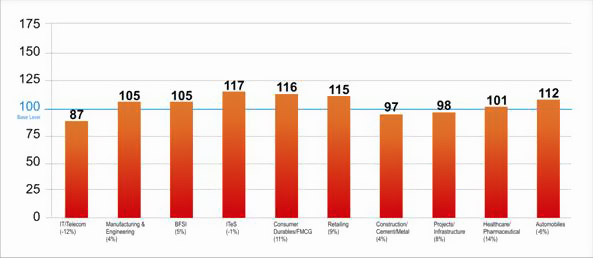
    The TimesJobs’ RecruiteX reports that all major industries clocked stable hiring patterns during the October-December 2011 quarter. According to the quarterly analysis of the RecruiteX, only three industries, BPO/ITeS, Consumer Durable/FMCG and Retail, out of the top ten industries, reported double-digit growth over the base level recorded in December 2010. Demand in support functions such as HR and Accounting & Finance has overshadowed core functions across top ten industries.


    This in-depth journal of statistics, information and analyses on employers (demand) and jobseekers (supply) and will serve as a reliable reference guide to present and future developments in recruitment.


    Geographic Hiring Patterns –


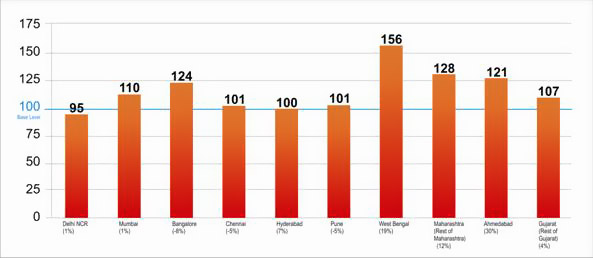
    As per TimesJobs’ RecruiteX, both, Delhi NCR and Mumbai have performed poorly on the demand index. Market experts opine that the hiring activity was negative in metros due to the poor macro-environment and negligible business investments.


    Among the other geographies that the TimesJobs RecruiteX covers, Pune witnessed decent growth in demand during the October-December 2011 quarter. Bangalore reported an increase in hiring activity and was the top performer during the same period.


    Work Ex Related Hiring Patterns –


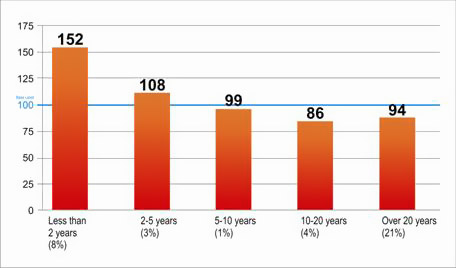
    Hiring activity for fresher/junior level and executive level positions witnessed a substantial fillip while recruitments in the middle-management level were sluggish. In comparison, recruitment for top management positions was healthier.


    Demand for candidates with less than 2 years of experience was robust across industries and locations. The Demand Index for this segment registered an 18-point growth in December 2011 compared to July 2011.


    This TimesJobs RecruiteX Report reinforces the portal’s efforts in becoming a strong medium to pull Indian employment market closer to the line of reality and presents a balanced outlook on the positions & perspectives of employers and job-seekers in Indian employment scenario.


    Other Key Findings:


    • Hiring expected to start picking up during the transition period of January to March 2012
    • Consumer Durables/ FMCG, Automobile, Energy and Infrastructure sector could be major employment drivers in the coming months
    • Demand in support functions such as HR and Accounting & Finance has overshadowed core functions across top ten industries
    • Engineering is the only major profession to maintain consistent growth pattern during the quarter in allied industries, locations and experience levels
    • Amongst top locations, only Bangalore and West Bengal have been able to maintain healthy supply of talent
    • Demand for senior experienced professionals will grow in Education, Healthcare/ Pharmaceutical domain


    RecruiteX Methodology


    To minimise the scope of inaccuracy, the TimesJobs RecruiteX analysis is based on demand and supply data integrated with numbers collected by our offline teams and then segregated according to top industry verticals, experience ranges and locations. Demand for talent is computed by factoring activities of recruiters on TimesJobs.com. Supply of talent is calculated by the activities of the jobseekers on the portal. The base value of RecruiteX has been kept as 100 for the month of December 2010. All RecruiteX values for subsequent months represent the trend of RecruiteX viz-a-viz December 2010.


  • Asterii seeks to create new wave in the world of analytics

    By Johnson Napier


    How often do we come across marketers, media agencies and surprisingly, even research bodies who say the inevitable: ‘due to lack of data… we couldn’t project the right numbers’ or ‘our projections fell short of expectations due to the variation in numbers’ and so on? In fact most marketers are wary of pumping in huge monies behind a project or activity given the lack of availability of accurate data that goes a long way in simplifying trends and analysing customer behaviour across markets – ingredients that play a critical role in the marketing plan of most brands.


    While research agencies are the most sought after for mapping such trends, they often fall short in providing a plan that is wholesome; something that could alter the way marketers look at the future. Such shortcomings are turning out to be easy pickings for agencies, which are on an overdrive launching divisions dedicated solely to analytics and data. And the latest to join the bandwagon is ad agency DraftFCB+Ulka that has announced the launch of specialty division, Asterii Analytics in India.


    Niteen Bhagwat

    In India, the team will be led by Niteen Bhagwat, who has been assigned the post of Executive Director and CEO. Sharing his views on the new launch, Mr Bhagwat admitted that while agencies were waking up to the phenomenon in a heightened manner, there was still a lot that is needed to be done in the space. “The mantra at DraftFCB+Ulka has always been about creating brand wealth and making our clients richer. At one point in time, it was having right strategies and good creatives, which will continue but the marketplace is becoming increasingly competitive for our clients. The same set of tools or decision-making may not be as optimum or efficient as it was earlier. We believe that if our clients have to compete, they have to take decisions that are completely rooted in data. So, if we have to continue delivering on our promise of creating brand wealth with the underpinning of analytics, it is absolutely critical. It also compliments beautifully with our overall approach of being a strategy strong agency group.”


    An analytics person with more than two decades of experience in the field, Paula Fedoris, EVP, Chief Analytics Officer – DraftFCB pitched in by giving a global overview on the origins of analytics and the need for the discipline to make it big in India. “In certain markets, the marketing and media analytics trend has been taking place for the past 15 years or so. There are certain agencies, particularly in theUnited StatesandEurope, which have gravitated towards making sure that marketing strategies and media investments are as smart as possible. So we have been applying analytics to these challenges for quite a few years now. This is more so for agencies which are more focussed on one-to-one marketing or database marketing or direct marketing, they have always been very quantitative-oriented.”


    Paula Fedoris

    According to Ms Fedoris, with some organisations, when the internet came in a big way in 1999-2000, it was then that some of these tools and techniques went on the online space. “Over the years, we have been able to generate a lot of data by our marketing activity. The companies are trying to data-mine insights from this information to draw new insights and conclusion and make better decisions, not only about their current business but also on where they need to go in the future and how this information can help in identifying new and important trends that they need to be mindful of, as they develop a strategic direction and maintain competitiveness in the marketplace.”


    Citing statistics, Ms Fedoris said that overall businesses are generating about 40 per cent new data every year and how companies are being able to harness this information and in the marketing arena this has been accelerating even more.


    As for the USP that Asterii would bring to the table, Mr Bhagwat stated categorically: “Asterii will bring a far sharper focus on analytics than other offerings from marketing communication companies. That’s majorly because it is a standalone agency, so much of the resources and people in the team will be focussed on Asterii; they won’t get lost in handling other functions within the organisation. As for the other groups that offer analytics, what we understand far better than most is the concept of insights. So we would be far better than the others based on our insights and ideas in the marketplace.”


    In fact, Mr Bhagwat was certain that it was the most opportune time to launch in the country as marketers would take a liking to the service given the hostility that’s being faced by them amidst a hostile economic scenario. “When businesses are under pressure, analytics is proven to be able to give you a lift in terms of sales or profitability and by a huge margin, if done properly. If the market conditions are tough, analytics would probably be the answer to find new segments to increase growth or market share or figure out ways to optimise your marketing communication by doing market mix modelling. So, if at all there are budget pressures, analytics will help clients spend their money more effectively. In a sense, now is the best time for us to launch our division.”


    Chancing upon the opportunity, Mr Bhagwat admits that the agency has approached at least ten marketers to offer their services. These include clients who are aligned to the advertising agency as well. “We have started speaking to a whole host of people we are associated with and the response has been encouraging. Close to ten marketers have evinced interest and we would be meeting up with them to decide future course of action. What actually materialises, I think only time will tell.”


    On the sectors that the solutions would be centred around, Mr Bhagwat said that it would be automotive, packaged goods, financial services and retail. When asked on how they went about shortlisting these sectors, Mr Bhagwat said: “There are certain sectors that are rich in data, so the comfort level in doing analytics in those areas will obviously be very high. Also, at the same time, companies in sectors such as retail, automotive, packaged goods and financial services would be analytics-aware sectors and so the kind of solutions that they would want would be of a different kind versus companies in, say, fashion or food where analytics is not used as much.”


    A much more historical and detailed perspective was provided by Ms Fedoris: “Historically, analytics started with the financial sector because they are very quantitatively-focused and this got further momentum with the advent of credit card transactions and the ability to find out what the people were purchasing. In theUnited States, we were able to marry our purchase decision behaviour with the demographic information and so that was always a robust area that people focused on. It seemed to then migrate to the travel industry, as people began to book their airline tickets and have loyalty programmes, both the airline and the hotel industry understood the importance of relationship marketing and began developing databases of their customers. Ultimately it moved on to retail as people used their credit card in the retail establishment and then finally it moved on to the packaged goods area.” According to Ms Fedoris, a lot of people are going on to the internet to find information on how to go about buying packaged goods product and are able to find solutions online. “So these are the core sectors that emit a lot of data on patterns and trends,” she said.


    So focussed is the group on the new division that it won’t stop short in going all out as far as investment is concerned. Asserts Mr Bhagwat: “Analytics, for us, is an absolutely critical offering that the agency group is going to have. So investments won’t come in the way of growth as such. We are not looking at this only as a revenue model but more as a capable solutions provider. We have invested in new office space in Mumbai that can seat up to 50 people; we are also investing in fairly expensive software and hardware that goes with it. Also, Paula would be coming toIndiaon an ongoing basis to be able to bring along global best practice tools that are in use around the world. This will enable us to have global scale and capability in our Indian operations.”


    As for the growth, Mr Bhagwat feels it is too early to foretell, but that is not of concern as yet. On a stronger note, he feels that the analytics market is still in its infancy and has a lot of potential that’s yet to be explored. “Analytics market inIndiais still in a nascent stage; they do not pay as much money as they do in international markets. So it is an under-served and under-priced market,” quipped Mr Bhagwat. According to him, all this will change once people start understanding the true value of analytics and how one can take advantage over competitors by employing analytics. In his opinion, the tipping point is next couple of years. But what is important is that the availability of good quality data is going to improve dramatically in the future, he concluded.


  • DraftFCB+Ulka launches Asterii Analytics

    By A Correspondent


    The DraftFCB+Ulka group has launched Asterii, an analytics company which is stated to continue the group’s endeavour to build capabilities and solutions that will create brand wealth for its clients.


    Explaining the rationale of the launch, a release from the company said, “Today’s business environment is being reshaped by three distinct factors. The first factor is a rapid decline of exploitable market segments. Easy access to technology and global internet-driven communication systems means that any idea gets replicated in months, if not weeks. The market has millions of profitable niches but these are not visible using conventional marketing techniques. “The second factor is the high cost of launching new brands and variants and consequently the high cost of failure. A cluttered market environment compounds the problem.


    “In such an environment marketers and businessmen are discovering that the time-tested method of intuition-based decision systems, albeit with a lot of process and information backups, is not yielding the desired results. In such an environment, there are several companies, which we call analytic organisations, which are competing on the basis of analytics and have built the entire organisation on a culture and process of data-driven decision systems. These companies increasingly are outperforming their peers in the marketplace “This shift has become possible because of a third factor which is the confluence of data and the computing power needed to manage and interpret that data.India, traditionally, has a paucity of good data and computing power was too expensive for the medium-sized business.


    “But today, India is at a tipping point due to the rapid expansion in the retail and financial sectors and a huge amount of data being available to marketers, the IT and communications revolution would mean computing power on your desktop. These three factors are going to intensify a trend and a shift towards analytics-based decision-making, which would become the game changer for companies over the next ten years.”


    Asterii is headquartered in Mumbai with Niteen Bhagwat as the executive director and CEO. The global analytics network has over 100 analysts within the DRAFTFCB network with key resources in Europe andUSA. Asterii has domain expertise across retail, automotive, financial services and packaged goods. The release said that Asterii, a coined word, is derived from the word Asterism which means seeing a pattern of stars in the sky and patterns, which give meaning to the billions of data points that any business has to interpret and decipher.


    Asterii will draw on over 50 years of expertise in creating ‘brand wealth” and developing communication programmes and marketing strategies that are based on unique consumer insights. The company is unique among analytics companies in that it goes beyond techniques and tools to bring “insights” which are rooted in data and analytics and which will help create solutions that will have a predictable impact on the client’s brands and business.


    Asterii, a specialist marketing analytics company, plans to support clients across the entire spectrum of marketing activities. It is supported by a global network of analysts in the DraftFCB ecosystem, giving its clients and business partners access to the global tool kit and best of breed technology solutions. The Asterii solutions toolkit will span the entire spectrum of marketing activities from the assessment phase to growth and maintenance strategies for a brand. The specific modules that Asterii Analytics offers are as follows:


    • Assessment Solutions

    Robust tools to help clients evaluate and select markets, map competitive forces and thus help assign a value to the consumer opportunity. This will help create a macro view on the brand and also help develop go to market strategies.


    • Growth Solutions

    Growth opportunities that emerge from being able to segment the market and do predictive modelling based on behaviour data or other unstructured data sources. Growth is about designing the right acquisition programme and by developing a robust testing and consumer response model. Growth is also dependent on the pricing decisions.


    • Relationship Management Solutions

    Asterii believes in the adage that the best means of growth are from within and that meeting customer expectations and creating customer delight is far more valuable than acquiring new customers.


    • Monitoring & Optimisation solutions

    Analytics also means that measuring and calibrating the performance of the marketing programme. With state of the art reporting platforms like the smart wall and the social news room data and information becomes easily interpretable insight.


  • Debenhams’ Aditya Nadkarni: Finding the right fit

    Aditya Nadkarni, Brand Head, Debenhams has been leading the brand to become the forefront of multi-brand retailing in India – setting new industry standards, venturing into uncharted territories and launching revolutionary retail concepts to provide an extraordinary shopping experience to the customers. Mr Nadkarni’s association with the retail industry started as an assistant manager – retail at Shopper’s Stop. Since then he has worked with several well known retail houses such as Trent and Piramyd where he undertook various operational functions and has been instrumental in the successful development and launch of a number of private labels as well as international brands like Blend of America, Versace, Versace Sports and Cerruti 1881. Here he talks to MXMindia’s Tuhina Anand on Debenhams’ plan in India.


    Q: How do you see Debenhams poised amongst the fashion brands in India today?

    Debenhams is the only premium woman-centric department store in the country today. We offer wearable fashion for the sophisticated, mature and well-travelled woman. We also provide assistance to women for their beauty and cosmetic needs, stylish home linen, speciality cookware, kids’ apparel and men’s apparel. As we offer not only international products but also products from international designers as well in every category, we believe we are unique in the premium department store segment.


    Q: Can you elaborate on your expansion plans for Debenhams this year?

    This year, we expect to make a strong entry with large format stores in Bangalore and Mumbai. We also aim to open three to four stores on an annual basis. Since Debenhams is a premium department store, we will be targeting Tier 1 cities.


    Q: How have you been promoting the brand here?

    We have focused our attention and resources towards working on an editorial basis with fashion media in the country. We also believe that our presence in the digital media space is helping to take the Debenhams brand to more and more people across the country. And of course, our customers are our brand ambassadors and they really do help to highlight the Debenhams name. Today, we enjoy one of the highest conversion rates in the segment, which is a result of the trust and confidence our loyal customers have placed on us.


    Q: With the FDI in retail, especially multi-brand retail, having gone to the back burner, does it in any way hamper your expansion plans?

    As a leading brand in our segment, we do not believe foreign direct investment in retail, multi-brand or single brand, would stifle our growth. In fact, we welcomed such regulation, as it would bring about more players in the segment and provide consumers with more choice.


    Q: With so many international players vying for the attention of Indian buyers, what advantage does Debenhams have?

    Debenhams enjoys the status of being the sole department store, in the premium segment, in the country today.


    Q: How do you view the fashion retail sector, especially for international brands – the size and opportunity – in India?

    Over the years, Indians have developed their fashion sense to mirror other countries and the latest trends. We see that with consumers travelling more and becoming savvy about international trends and lifestyles. The Indian consumer has evolved much more in the past decade than ever before. With the Indian economy growing positively, consumers are able to more afford the international brands present in the country today.


    Q: What is the kind of investment that Debenhams will make in India in the next three years?

    Debenhams is looking at opening three to four stores per year. The stores will range from 30,000 sq ft to 40,000 sq ft each. We expect to make substantial investments, keeping customer demographics and psychographics in consideration. Each store will be equipped with the traditional superior fit-out and superior quality staff.


  • 50 Brands @ 50 % off sale back in town

    By A Correspondent
    Oberoi Mall, one of Mumbai’s leading retail malls, will be hosting the second ‘50 Brands @ 50 % off’ sale on January 18. This sale will have over 60 leading national and international luxury brands offering flat 50 per cent off for one day.

    The brands participating in the sale are Accessorize, Nike, Adidas, Reebok, United Colors of Benetton, Chemistry, FIFA, Kazo, Levi’s, Cream Center, Allen Solly, Biba, Forever New and other leading lifestyle and food brands.


    Oberoi Mall is the first mall in the country to come up with a unique sale format like this, the first season of which was held in July last year. Similar trends are prevalent in the Dubaishopping festival and malls in Hong Kong.

    Commenting on this, Nirzar Jain, vice president – Oberoi Mall said: “After the success of the first ever 50 Brands @ 50 % sale, we are extremely happy to present the second season. Oberoi Mall has always striven to offer its patrons an enhanced shopping experience and this season we have more than 60 leading brands on flat 50% flat discount for one day. Our retailers too are looking forward to this event as the last 50:50 sale saw the overall sales figures shoot up by 300 per cent and foot falls increasing by almost 200 per cent on a weekday. In fact few brands like Central, Bombay High and FIFA did the highest ever sales in the city in a single day.”

    The 50 Brands @ 50 % sale has been clubbed up with ‘Women’s Wednesday’, which is Oberoi Mall’s existing property exclusively for women, making it a double bonanza for shoppers.


  • Travel industry to lead e-commerce trade in India

    By A Correspondent

    With a booming retail market and over 100 million internet users in the country, e-commerce is likely to enter a high growth phase in coming years, economic advisor at the Department of Information Technology Mr BN Satpathy has said.

    Travel will continue lead the online trade of goods and services in India and globally as new business models emerge in e-commerce space, he said while addressing delegates at a conference organised by The Associated Chambers of Commerce and Industry of India (Assocham).

    Mr Satpathy said the government is working on a new Information Technology Policy which will propel the growth of low-cost, internet-enabled and hand-held devices. He asked business chambers like Assocham to be an interface so that industry data gathering and dissemination can be made online.

    Chamber secretary general Mr DS Rawat said the market size of e-commerce industry is expected to be Rs 46,520 crore by December 2011 with 81 per cent travel transactions and 6 per cent product purchases.

    “India is poised to be one of the top e-commerce hubs in the near future as number of internet users boom. This will bring in a new revolution in retail industry,” he said, adding that the size of e-commerce globally is about 700 billion dollars.

    Accelerated innovations have expanded the online retail market to $241 billion in Europe, $176 billion in the United States, $76.4 billion in China and $10.3 billion in India.

    The Indian retail industry is currently estimated at $520 billion and e-commerce is a sub-set of it. With high GDP growth rate figures, young population with a median age of 25 years, large and relatively insulated rural tracts coupled with people’s hunger for achievement, the country is projected to witness maximum growth coming from tier II and tier III cities.

    At present, small towns contribute 40 percent of all e-commerce transactions due to increasing broadband penetration. Industry experts say the numbers of people who have ever used internet and personal computer literates have increased to 88 million and 119 million respectively.

    India has the second fastest growing travel market globally which is estimated at $42 billion. Of this, the online travel market is expected to grow from $2.9 billion in 2008 to $7 billion by next year.

    Others who spoke during the conference were Mr Balendu Srivastava, group business director of e-Tech Group at IMRB International, Mr Kashyap Vadapalli, director of Category Management at eBay India, Mr Dhruv Shringi, co-founder and CEO of yatra.com, Mr Harish Bijoor, CEO of Harish Bijoor Consults Inc and Mr Bikky Khosla, CEO of tradeindia.com.

  • Retail pioneer Pillai in Hall of Fame

    By A Correspondent

    Raghu Pillai (1957-2011), considered the father of modern retail in India, was declared the first inductee into the Indian Retail Hall of Fame at a function organized at the India Retail Forum 2011.

    In an emotional ceremony jam-packed with delegates at the two-day retail industry get-together at The Renaissance Hotel, Mumbai, business leaders such as Thomas Varghese, CEO, Aditya Birla Retail, Bijou Kurien, Chairman, IRF and President, Reliance Retail, Lifestyle, and Vikram Bakshi, MD, McDonald’s (North and East India), paid rich tributes to Pillai who passed away in Chennai in April this year due to a fatal cardiac arrest. He is survived by his wife, daughter and son.

    Mr Varghese of Aditya Birla Retail said: “Raghu introduced modern retail to India. A towering and inspiring personality, he was a true leader of men who led from the front. He was full of humility and humanity and had a strong sense of right and wrong. The award couldn’t have gone to a more fitting person. He is a worthy example for all young managers to emulate.”

    Mr Bakshi of McDonald’s said: “I learnt a lot from Raghu. When there was a bitter debate going on in India about organized versus unorganized retail, he injected a fresh perspective by saying that there was no clash between the two and it was all about introducing modern retail in India. He believed that modernizing retail was important because it was the last mile for anything that gets manufactured. He was an excellent professional and a true human being. People like him never die but always live in the stories that they leave behind.”

    Mr Kurien of Reliance Retail said: “Raghu loved good food and a good drink and was full of life with an overpowering personality and a loud baritone voice. He had a can-do spirit and was a natural born leader and visionary. Raghu was also very daring who never got stuck with endless analysis. Once he decided something had to be done, he made sure it was done and could be extremely pushy when it came to achieving goals.”

    “He was also a great family man, a loving father and a great husband who never failed to take the call of family members regardless of how busy he was. As a professional, he gave me a lot of insights into the world of retail. He had a unique insight into what makes a store work and just by looking at a location he could tell if an outlet there would be successful or not,” Mr Kurien added.

    Mr Pillai’s wife Janaki Pillai, who specially flew in from Chennai to accept the award on her husband’s behalf, said: “Raghu always said his life must be a story that he could tell to his grand-children. To the last, he was true to his word.  I would like to thank India Retail Forum and the retail fraternity for this honour.”