
Just a few days before the NarendraModi-led Bharatiya Janata Party was elected with a huge margin in the 2014 elections, there was something momentous happening in the lives of two Indian journalists in Islamabad. Both Press Trust of India’s (PTI) Snehesh Alex Philip from the Press Trust of India (PTI) and Meena Menon from The Hindu were told via letters that their visas were not being extended. There was no evident transgression on their part, and they had barely spent nine months in the assignment.
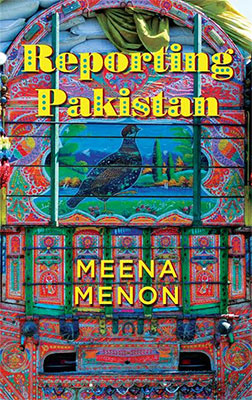
Now an independent journalist, Menon has chronicled her Pakistan experiencein the just-published book ‘Reporting Pakistan’. Menon, a senior journalist has authored two books in the past and co-authored a third. ‘Reporting Pakistan’ is being launched today (Wednesday, June 14) at the Mumbai Press Club with a panel discussion of senior journalists. In this interview with Pradyuman Maheshwari, on the eve of the release of the book, Meena Menon gets candid about her experiences in Pakistan and how she has no regrets about doing the interview with Mama Qadeer.
 It’s been a little over three years since your stint as Pakistan correspondent of the Hindu in Islamabad was terminated. While there may have been hurt and anger then, your sentiments as you look back at what happened to you?
I think I was more angry then that I was expelled without being given a valid reason and in such an abrupt fashion, amid media whispers that we(Snehesh Alex Philip from Press Trust of India and I)  were not doing a job as journalists but something more sinister. I think there is a time and place for everything- and it was not destined to last in any case. My posting in Islamabad despite the spooks and travel restrictions  was an experience of living and working in another country, and the fact that this country was once part of India,made it that much more exciting and complex. The expulsion and spooking cannot take that away. The cloud of Partition will dog us forever and our perceptions and biases will be shaped by that single event which is unfortunate.The decision to end the posting speaks volumes for the state of affairs inPakistan anddoes not reflect on my abilities or integrity as a journalist.
What is most regrettable is that an informal arrangement to station two correspondents in each other’s countries has died out. The last Pakistan correspondent in India was in 2011 and the last two Indian journalists in Islamabad left in 2014. We need to revive this exchange and the media’s role needs to be reinstated with due seriousness in the affairs of our two countries more than ever now.
|
::Â Special to MxM: Extract 01 from Meena Menon’s Reporting Pakistan: On Balochistan, Mama Qadeer & the Interview
::Â Extract 02 from Reporting Pakistan: In Islamabad, a journalist craved the bindis women wore on TV… |
Since you had visited Pakistan on a Mumbai Press Club exchange programme, you had some idea of what the country was like, but of course working there is a different matter. What were your sentiments about working in Pakistan before you headed there and while you were there. You’ve of course written about how Pakistanis were very friendly and cooperative, but a little more?
Yes, I did have a fair idea of the hospitality of Pakistan,it’s quite legendary and we were not disappointed. The first time I had only visited Karachi and Hyderabad for a week, which did seem like a long time since we packed in so much. The Hindu posting was to be for at least three years and in one city. When my editor Siddharth Varadarajan asked me if I wanted to be posted in Pakistan I said yes without giving it a thought. As a journalist it was a not- to –be- missed chance and there were many contenders for that much envied posting. So yes, I was quite excited about it and the visa kept getting delayed till finally it came in August 2013. My colleagues at The Hindu were very helpful– they had spent at least three to four years in Pakistan and gave me good advice. A house was rented and ready to live in by my colleague and I didn’t feel as if I was stepping into a strange country when we landed first I Lahore and later in Islamabad.
There is a clear difference between the people who are warm and welcoming for the most part, there is a strong civil society but for an Indian correspondent as for other journalists but more so for us, there are red lines in reporting. As I wrote in The Hindu on my return there are two states in this nation, two states of mind and I feel the twain may not meet.
There are many who’ve said Pakistan is a failed nation. Although you were there for just nine months, do you agree with the statement?
According to the Fragile (earlier Failed) States Index by the US think tank Fund for Peace and Foreign Policy magazine, Pakistan ranks 18th in 2017 and 14th in 2016. In both years it figures in the top 20 fragile states. In many ways there is a failure of democratic institutions, sectarianism, terrorism,  persecution of the minorities, anda deep stateis very much there,  but on the other hand there is also a vociferous civil society which is protesting and questioning this,  there is a democratically elected government for the second time running,  there is a Human Rights Commission which is bold and persistent in its fight for justice, the media maybe under fire but is holding its own and there are functioning utilities and public systems, though growth and poverty are major issues as are health and infrastructure.
Much has changed in India since your return, but what’s your broad level view on the state of the media in Pakistan? Versus what we have here in India?
The media in Pakistan is functioning on a razor’s edge- I read  a couple of days ago that Rana Tanweer, a journalist writing on the minorities has had an accident where both his legs have been fractured –the Human Rights Commission of Pakistan clearly said this was not a mere accident as Rana was threatened earlier with death. One more journalist was killed in the last few days. Reporting in Pakistan comes at a price. And the state of affairs hasn’t changed over the years –even while I was there the media was constantly under threat- journalists Hamid Mir and Raza Rumi were shot at – Express Tribune staff were killed, their offices were attacked- the Taliban openly threatens and attacks journalists- the security establishment too has red lines and journalists perceive them as a threat. Yet the press keeps writing, they stick their necks out by and large, and keep doing their job.
In India the press is increasingly denigrated andvery much under attack now which is a pathetic state of affairs. The entire media is being sought to be weakened and vilified by the powers that be. That can have a chilling effect, or has had already, which is a terrible thing to happenif we call ourselves a democracy.
Ever since the November 26, 2008 terror siege, Pakistan has been the centre of discussions on our news channels. Although it has touched new highs now, when you were in Pakistan, what was the impact of the highpitch anti-Pakistan sentiment on Indian news channels?
When it comes to TV, I think both our countries try to outshout each other. And in the process no one hears what the other is trying to say- and a deafness has set in. The wheels of jingoism turn continuously and there is little information which is accurately sourced or a debate from which you can learn anything- slanging matches and opinions have replaced sensible discussion and in all this,  facts become a casualty.
If you had to relive those nine months in Pakistan, is there something that you would do differently? As you look back, and if you had an idea that the Mama Qadeer interview could lead to your expulsion, would you still have done the interview?
Looking back, I did almost all the stories I had planned and researched. Living in a place is quite different from occasional visits. I have to clarify that nowhere did the government tell me it was the Mama Qadeer interview which led to my visa not being renewed. No reason was given at all.
However, why should I not do the Mama Qadeer story? It was an interview that I did after thinking it out and my paper carried it. Even with the wisdom of hindsight, I realise if it was not this story then there would be something else that I shouldn’t have done- the list could be endless. Balochistan is a bugbear for the Pakistani security establishment and the government –but for a journalist there are no red lines and I was not the first Indian correspondent to write on the Baloch issue. And by showing me the door, if at all that was the reason, the issue doesn’t die. Others will write on it and it continues. You cannot kill or kick out all journalists.
Your question also raises an important issue – when one is posted in a country, though in this case it is not any other country but Pakistan with whom India has had a history of hostility and war, do you hang on for dear life because of the visa and cease to function like a journalist or write what you think is a good story. While the Pakistani government gets upset if one reports the Baloch issue, even New York Times journalist Carlotta Gall was not spared in Quetta, what was disconcerting was that someof my journalist colleagues in Pakistan and back home felt there was no need to do this Mama Qadeerinterview and stories which were critical of the Pakistan government.
And if you were asked to go there again, for The Hindu or some other publication, would you go to Pakistan again?
This question should be asked to the Pakistan government which holds the strings for a visa. It really doesn’t matter whether I want to go to Pakistan or not.
 By Meena Menon