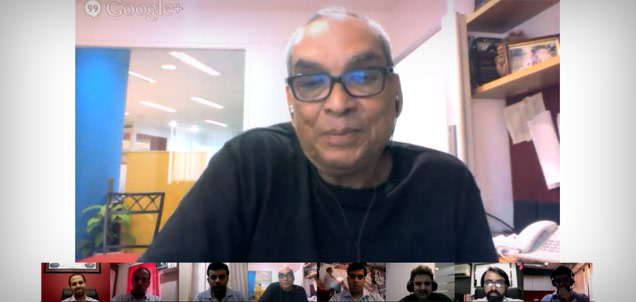
The International Association of Advertisers (India Chapter) conducted its second webinar on Thursday, May 23 with Ajit Balakrishnan, Founder and CEO, Rediff.com. The IAA Webinar series with the theme ‘World Goes Digital’ is spearheaded by Abhishek Karnani, co-chair and director, Free Press Journal group and Manish Advani, head – marketing and public relations, Mahindra Special Services Group. *
The panellists included: Abhishek Karnani, Co-chair, Director, Free Press Journal; Ajay Pandey, founder and CEO, Badhai; Gaurav Mendiratta, CEO, Sociosquare; Aditya Kuber, CEO, Media Sphere Communications and K Narssimhan, CEO, Commit. Pradyuman Maheshwari, Editor-in-chief and CEO, MxmIndia moderated the event. Other than the panellists, some questions that came in from the public in response to our announcements on social networks were also posed to Mr Balakrishnan.
Excerpts from the Q&A:
Opening Remarks by Ajit Balakrishnan, CEO, Rediff.com
There is little doubt that the internet has come a long way since all of us started messing around with it around 18 years ago. The way I look at it is that it has often been a surprise to me that the web technology and internet happened first in the media world and my suspicion is that very soon we are going to see internet and web-based thinking in trade areas like education, healthcare etc what I call as the less-frivolous parts of human endeavours. I for one, am looking forward to that.
Q. With a large number of players venturing into the digital space, how according to you can brands fight with the larger players and continue to make a mark in the digital media space?
Ajit Balakrishnan: Let me say that every giant killer started off by being small. I remember Google when it started in 2000 was a tiny company with revenues to the tune of US $35-40 million. I think the successful ones that we have seen throughout the world tend to offer some consumer promise in a new technological way, which they manage to deliver. If you manage to do that at all times then you have a chance to upstage the big players. I have no doubt about that whatsoever; the field is wide open at all times.
Q. You have been a pioneer in the industry and have seen the industry grow from nothing to what it is today. Have you seen any change in the customer behaviour and expectations on the medium as yet, and, what is the change you foresee in the next 3-5 years?
Ajit Balakrishnan: My guess is that India is at a very early stage of revolution of the internet and the number of users in India who have unconstrained access to high-speed internet on mobile as well as PC is very small. So what has happened so far is that about 12-15 million users in India have so far access to high-speed internet which in relation to about 300 million middle class Indians is a very small number. So it’s a relatively English-speaking, mostly westernised group of people who tend to follow latest trends and what is going on latest in the US and whose brand values are built around the internet. I think that when this number rises from 12-15 million users to around 200 million users in the next 3-5 years by that time you will see more typical Indians landing up on the internet. The first likelihood is that people at that juncture may not necessarily be coming from an English background and secondly, what they do on the internet will also be different – doing more of social. Some of you will remember that in the mid-80s on television there were only a handful English channels that was ruled largely by Star. Then, a pioneer in Subhash Chandra stepped in and broke the rules of the game. Today, English-language television is a very small proportion of the total. So one will see such kind of initiatives taking place in the near future. But, it is still early days and things like email or social messaging will take precedence. In the early stage of all that is happening, technology is very important. I think technology-oriented pace will continue for another 3-5 years. Post that there will be a blending of mediums like content, applications that will be blended with technology…it will become more media applications oriented.
When you started Rediff, what did you expect in terms of users or economic outcome…?
Ajit Balakrishnan: I did not start hoping for any financial outcome from entrepreneurship. I saw an interesting idea at that time and was fascinated by the possibilities that the internet had to offer. I was fascinated by the possibilities of the internet by watching Compuserve and AOL experiment with the medium. So I told Arun that I am going to take a room somewhere in Fort, South Mumbai and figure out where this has to go. So I didn’t have the faintest idea where this would go to but yes, even today it is very unclear to me where the internet is headed next. I personally think that the technological tricks dominated the trade are going to pass in a year or two. In fact among the top 100 companies, everybody uses the same technology; there is nothing unique one can do. The problem in India is that early adopters of sophisticated technology are very small but all that will change soon.
The same could be said of Rediff as well which has undergone a change in the way it now presents itself on the online space. Is that an indication of the changing times…
Ajit Balakrishnan: We essentially took a ‘tight look’ as one would like to call it. Web is increasingly becoming a visual medium today. That is different from 10-15 years ago where it used to imitate the newspaper paradigm. But it is now moving to be a visual metaphor. There is a big swing being observed towards video as well but as yet nobody in the world knows how video on internet will play out. But one part of it is where pirated video is played out more and the second part of it is bloopers. Nobody knows what will be the grammar of the 2-3 minute video but I am sure it will arrive soon. In the early days of television there were not much popular sitcoms, people played movies. But then the sitcoms arrived with 2-3 slots for ads, so something like that will happen for 2-3 minute videos as well.
What according to you will be the low hanging fruit that will make the fence-sitters start using this second screen to complement television, newspapers etc?
Ajit Balakrishnan: I feel the reason why digital ad agencies are not as big as the others is because they tend to be conservative. I have been on that side so I know how it happens. Their best clients are typically the ones that are very large and that make products for mass media conservative audiences. Be it a Colgate or the others, the main market for such clients is outside the sophisticated audience. The internet doesn’t make as much sense to them because their growth comes from smaller towns and rural India. So, big ad agencies tend to be full of such clients. But there are clients in the financial services sector for example, who love to have a sophisticated audience. I’d say do not give up, wait for 2-3 more years and you will see big bucks coming to the sector.
What problems do you face in online shopping for Rediff where you have many big players in the space?
Ajit Balakrishnan: As a group, there are lot of things that are going good for Indian online e-commerce sites like us. First is that private equity has more or less withdrawn from organised retail. So if you are based in some Tier 2 town and you cannot find a good phone in a retail shop you can rush online and shop for your product from there. There has been a sudden explosion in 2011-12 in the range of $ 600mn that has been pumped in the Indian e-commerce sector across say 50 companies. That has woken up the e-commerce industry in India. This injection of capital and excitement has made a player like us grow by 100 per cent year-on-year. While that is good news, the bad news is that infrastructure around e-commerce has not yet developed. For example, if you have a credit card you can shop easily but the failure rates with debit cards on the internet tends to be in the range of 40-50 per cent. The reason for that is that for debit cards to work well through banks it has to be communicated well through an internet high speed line and that kind of telecom service will be tougher to achieve in smaller towns and cities. So while there are 100 million debit card users there are only about 8 million credit card users. But this problem is being looked into. Once this problem is sorted the debit card e-commerce will jump up.
The other thing is that the cost for courier companies is high in relation to margins. So the courier companies need to be much more efficient and make money in no more than Rs 10 per delivery. This is the reason why some players have their own delivery people to capture the imagination of the public. But there are some who are doing a good job compared to Blue Dart and the others that follow a hub-and-spoke model. But like all things in India, these things take some time but when it happens it happens very well. E-commerce is about 2-3 years away from a gigantic boom in India.
How big a role do you see for video playing on the internet in India?
Ajit Balakrishnan: The thing about video is that it jumps over the language barrier. The fact is that Indian language-based internet has not taken off at all but with video, you leapfrog that barrier. So video is indeed terrific. In fact the sales people keep telling me that the ad agencies have woken up from their slumber on the internet and they love video because that is something they understand well. So video is destined to be successful.
The problem that small companies face is talent who get lured away by MNCs after working for a year or two with us. How did you confront a challenge such as this?
Ajit Balakrishnan: This is not a new problem that any new enterprise faces in Mumbai or elsewhere. There are plenty of jobs and lots of talented people mingling together. This problem will continue to happen at any stage in your professional career. When you grow a little older, things like stock options are technical ways of holding things back but I think that there is a pattern among people you recruit. Some who love the idea of doing innovative work, some who love security, some who like the thrill of changing jobs every year. There are guys my age who have changed some 20-odd jobs. So there are things that you cannot control but try and build an anchor group of 5-6 people whom you feel will be critical to the success of a business. The risk with that again is that those who are among your core group today may not be with you tomorrow. While we had the stock option scheme for us it does not work in every industry. But I can promise you that hiring and retaining talent will remain a 24-hour job and will be so at all stages of your life and not just the start-up.
How do you mass-produce content that is creative and engaging enough?
Ajit Balakrishnan: We don’t need to mass-produce content, we should see how we can cost-produce content especially for a 2-3 minute video. I think at most it costs just 5 lakhs but the idea is much more important there than the grand production. I think with television it has come to a point where the ads costs at least 1-2 crore behind an idea which is laughable. I think they have bought this upon themselves. But nobody knows what kind of an idea would work. We are in a situation which Charles Dickens was or the book publishing industry was in the 1830s. Charles came in and showed with ‘Great Expectations’ how we can write a book and we all know that there were more than hundreds of imitators after that. We need such kind of creative geniuses.
In India, most ad revenues go to global top 5 websites that works up roughly to about 75 per cent. What is left for everyone else is a small pie. What do you foresee of this trend?
Ajit Balakrishnan: Advertising has such a trend where the winner takes it all; it is not just a web phenomenon. Take the newspaper industry for example, whoever is No 1 takes about 60 per cent of the revenues while the No 2 takes in another 20 per cent. So from No 3 to 10 barely mange to hang in while all the others hang in for prestige reasons. A similar thing is observed with channels as well where the top 2-3 players take in 70 per cent of the ad pie. So media is akin to ‘winner takes it all’ situation partly because audiences tend to gravitate towards what is most popular. The internet space also such a practice but that will change as the industry evolves. People who mix technology and creativity platform will emerge winners. When things begin to change there is an opportunity to move in. I have seen many creative companies that have created successes especially from Korea. I think it is possible in India too. First we have to get the audience then the revenues will follow.
As an industry, we still hover around the 4-5 per cent ad pie. At Rediff, have you taken any initiatives to increase the pie at a faster pace?
Ajit Balakrishnan: Where ad spends is concerned, my sense is that big agencies should control about 90 per cent of spends in India. I think they are looking for ideas. If each one is able to produce one success story for brands, overnight the pie could increase significantly.
With the youth taking to the web in a big way for content consumption, do you foresee the beginning of the end of live television in 5 years time from now? Do you think there will be convergence of internet with television for content consumption?
Ajit Balakrishnan: I think it is a trend of time-shifting today. It started with the VCD/VCR device that enabled us to record and watch content at leisure. The youth of today are similarly doing time-shifting and watching it whenever they please. The television audience is so large that there are lots of audiences who have nothing to do most of the time. These families will prefer the social family programmes and watch it with friends and family. I think these trends will co-exist.
Do you see independent publishers including bloggers becoming financially independent in India?
Ajit Balakrishnan: I am a great proponent about blogging and I think the innocence about the internet was blogging. Individuals who had ideas could go and publish it without the consent of publishers and editors…that is the touching thing about the internet. Unfortunately, the business model has not yet developed but I am sure that it will develop soon. For example, if you see the NY Times paper, you will want to read the columnists first. I keep wondering what if somebody decides to have his own blog; what are they going to do? Many of us will go directly to the blogs. So in a way the magazines and newspapers ought to be threatened. So why is blogging not economically sustainable in India is because of the scale. If there are 300 million users and if even 4-5 million users come to your blog the ratio would be about $2 per user per year. You will end up being a blogger with about $ 3-400,000 a year. That is much more than what you would get if you work for somebody. So we are waiting for scale to come about but blogging will be about text and video in the future.
If you were to invest $ 1 million in digital in the next two years what would be the three ideas that you would chase?
Ajit Balakrishnan: It’s a tough one but let me give it a try. I think one will be where there is a language application which does not depend on English or anything; probably more voice-based in approach. The other would be something that will be big for professionals like lawyers and doctors because their business models are local in nature. The web will allow them to practice across more places. So an idea that will enable them to expand their business models further. The third would be doing something in education but I am not sure what. These three are likely to be models that will be successful. And all these will also be highly successful on the mobile platform.
- MxMIndia was a partner to the IAA Webinar



 Rediff.com India Limited has released its latest version of its website Rediff.com, featuring a new and enhanced homepage sporting a tiled interface. The design, developed inhouse, is based on user feedback. The Rediff homepage in its new avatar brings alive an assortment of content and services using the contemporary grid layout. Each unit of the grid features information photographs and videos, giving it a more interactive, image-friendly feel.