By Anuka Roy
“A journalist’s peculiar function is to read the mind of the country and to give definite and fearless expression to that mind†– M.K. Gandhi.
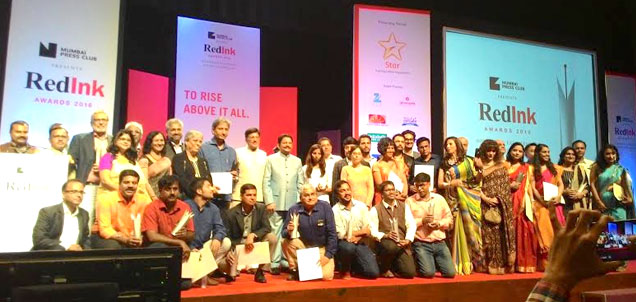
The same peculiar function was celebrated at the Red Ink Awards 2016 on Tuesday evening. Journalists from across fields and organisations came together to celebrate each other and their hard work. The theme this year was ‘To rise above it all’. Indeed the people and the work that was appreciated rose above all.
|
Present & Future of Journalism
“It is a mix of both good and bad. But journalism has improved over the years ,“ said T N Ninan when asked about the current scenario in journalism.
And what about the future? Said Ravish Kumar: “Journalism is evolving each day. You have to fight for this profession. This is your fight. There’s no protection or security but you have to fight. The more quality journalism you do, that is the future of journalism. You have to utilize whatever little space you get.â€
|
The evening started with Gurbir Singh, Chairman of the Mumbai Press Club, speaking about the year 2015 for journalism – hurdles, hastags, trolls and untimely deaths of journalist. After Singh’s speech it was time for the panel discussion with the theme ‘Who shot the messenger’. Moderated by columnist and author Shobhaa De, the panel included veteran journalist Minhaz Merchant, NDTV India senior Executive Editor Ravish Kumar, Moneylife’s founder-editor Sucheta Dalal and Siddharth Varadarajan, co-founder of The Wire. The discussion started with De asking Dalal about whether actually there any ‘azaadi’ for the press. While Dalal said there’s no freedom, Varadarajan felt that the messenger (journalist) has shot itself in the foot. Ravish Kumar engaged in a peaceful banter by pulling Merchant’s leg for siding with the current government, to which Merchant’s retort was ‘he’s on the truth’s side’. A question from the audience about the standard of reporting going down in the country impressed the audience but Ravish Kumar’s reply in reference to the state of journalism  – “Aap standard ki baat karrahe ho? Reporting bandh ho gayi hai – had the audience in splits.
After the engaging and insightful discussion, Chief Guest and Maharashtra governor C VidyasagarRao, and guest of honour PiyushGoyal, Minister of State for Power, Coal, New and Renewable Energy spoke how good journalism helps the government to improve as well as the growing need for good journalists.
It was time to recognise the talents for whom this evening was being hosted. The awards started with felicitating T N Ninan, Chairman and Editor of Business Standard, with the RedInk Lifetime Achievement award. “I have often been disappointed with what journalists have been appointed to do,†Ninan said at the beginning of his acceptance speech. He said that we as journalists should ask ourselves “Are we standing up for what we believe in and rising above it all?†However he ended the speech on a positive note by saying that we should keep doing our job and will to do good work should be kept alive.
The RedInk Veer PatrakarPuraskar was posthumously awarded to Late Jagendra Singh, the braveheart who uncovered the Sand Mafia in Uttar Pradesh. The award was collected by his youngest daughter. Ravish Kumar who won the RedInk Journalist of the Year said we should respect the work of journalists like Jagendra. His advice to all journalists was: “Get out of your offices and comfort zones. Bring out good storiesâ€
The Wire was awarded the ‘Best News Start-Up of the Year’ for setting a trend and building a different model of news reporting in the country. The RedInk Award for business journalism in the print medium went to Madhavankutty Pillai of Open Magazine. The award for Crime journalism in print was shared by Gunjan Sharma of The Week and Pavitra S Rangan of Outlook. In the broadcast space, the RedInk award for excellence in crime reporting went to Mukesh Singh Sengar of NDTV. Indian Express journalists Aniruddha Ghosal and Pritha Chatterjee bagged the award for excellence in Environment reporting in print medium.  In the category of Health and Wellness, the RedInk award in the print space went to Lhendup Gyatso Bhutia from Open Magazine and jointly won by India News team and Sunetra Choudhury of NDTV 24×7 in the broadcast category. The RedInk Award for the Human Rights category in print went to Meher Ali, from The Wire, their maiden award, and for television to Rana Yashwant from India News.  The much awaited RedInk award for excellence in political reportage in print went to Vivekananda Nemana and Suresh Ghattamaneni of Grist Media and in broadcast it went to Seemi Pasha of India Today.
Jonathan Selvaraj of Indian Express walked away with the RedInk award for excellence in sports journalism in the print space, whereas Aamir Rafiq Peerzada of NDTV won the same in the broadcast space. While there has been opinions that and science and innovation is a beat which still has a long way to go in Indian journalism in terms of coverage, the RedInk award for reporting in the same beat went to Gunjan Sharma, a second win for her in the evening, in print and Pallava Bagla of NDTV in broadcast. For the Big Picture award, recognizing photographers, there were two runners up – Sibu K B of Malayala Manorama Weekly and Kamal Kishor Kambojof the Press Trust of India. The winner in this category was B Muralikrishnan of Mathrubhumi Daily. All three of them are from the print medium. RedInk award in the entertainment and lifestyle category went to SumanaRamanan of The Caravan in the print medium and Ezaz Ahmed of India News for the broadcast medium.