Tag: readership

  • The Anchor: 7 reasons print will never die (despite declining readership figures)

    By Pankaj Arora


    #1 Akhbar mein likha hai toh kuchh toh sahi hoga:

    People believe in the written/printed word over television. Huge debates happen around what is read. Depending on the news and its impact as well as the personal points of view, layered by the individuals’ leanings, great discussions at the ground level take place on any event. However, the final word on the subject is based on what is reported.


    #2 Bijli kahaan hai bhai:

    Power is a major issue in most parts of India. Even within the top 10 cities, not all have 24-hour of electricity. And it is not necessary that they will have electricity in the few precious minutes one has before setting out for the day. Mainline newspapers are read by the working people mostly in the morning. Most often, over the cup of morning tea.


    #3 Pura maamla hai kya?

    A basic desire to understand the issues in detail requires one to spend time and dwell on the reportage in depth. Different points of views of the different affected parties as well as the implications will help print stay relevant and around.


    #4 Ghar mein TV hai. Ek!

    Most families are a single-TV household. Unless there is a major event that has taken place, the content that is watched is what the whole family can see together. So crime and horror shows probably blank out the real issues. While news is watched, it is not preferred by the whole family. As a result, the first thing that most people do is wait for the paper to get a complete perspective.


    #5Special Discount! Sab se Sasta! Diwali Ka bumper offer! Sirf Lalaji Ki Dukaan mein.

    The boom in retail will continue to percolate down through India. With more and more malls coming up even in small towns the growth in Tier 2/3 towns will require local advertising. The housewife too, laps up the newspapers or its supplement to keep herself abreast of the great deals that are made available to her.


    #6 Bade Chowk mein aaj Morcha. Dehant ki khabar. Tuition Classes. Dance Masterji.

    Local news and issues are best covered through print and will encourage proliferation of local editions as is evident for the last five years.


    #7 Train/ Bus mein:

    During travel most of the time is used constructively to catch up on the news. As travel times keep increasing, the need will only increase.


    Pankaj Arora is National Planning Director at Triton Communications


  • The Anchor: Shailesh Amonkar on 5 reasons why national advertisers can’t ignore regional media

    By Shailesh Amonkar, Chief Marketing Officer, Sakal Media Group


    1. Relevant Circulation and Readership

    Regional publications in many markets have wider circulation reach and deliver better quality mass audience.


    2.  Stronger bonding

    Regional publications have a far stronger emotional bonding with the reader. The connect that readers have gets leveraged for the advertisers and strong credibility among their readers adds to this.


    3.  Speaking to consumers in their own language

    Reaching out to consumers in their own language delivers better response since they identify with the brand strongly.


    4. Advertisers are looking at maximum reach and sales

    The objective of any communication is reaching out to maximum audiences and achieving sales so if regional publications deliver these they would not be ignored.


    5. Regional markets growing for products and services

    Today regional markets are delivering sizable sales for most products and services and FMCG, telecom, consumer durables have all been focusing on regional publications and hence they are critical in any media plan. Yes, the brand credibility is an important factor and this is where the media planner needs to go beyond figures and understand reader bonds with each brand.


    Shailesh Amonkar is Chief Marketing Officer, Sakal Media Group


  • Magazine readership looking up

    By A Correspondent

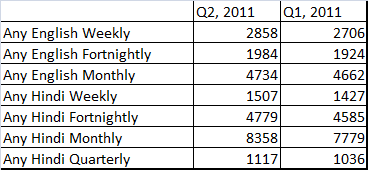
    Magazines have been witnessing a bit of rough weather of late. It is not an Indian phenomenon but is being witnessed worldwide. However, this IRS Q2, 2011 shows an increase in readership of both Hindi and English magazines as compared to Q1, 2011. Here is a quick look at AIR for the same:

    Readership in this duration has increased for Kannada and Telugu publications also. For Assamese, Gujarati and Marathi it has gone down – while for other languages the response is mixed.

    Keeping the focus on English and Hindi magazines for the purpose of this article, is it safe to assume that this IRS marks the revival of magazines? Says Anita Nayyar, CEO – Havas Media, India & South Asia, “This IRS certainly indicates better health for magazines but not necessarily revival.”

    Rajni Menon, Associate Vice President, Carat Media India, too believes that it is not really the revival of magazines and mentions two reasons for marginal upward trend for the magazines. She said, “The Week and Business World have been actively working towards increasing readership and it has had an impact in the market. Secondly, new magazines which were not captured in IRS earlier, eg 2010 Q2 IRS did not cover the following magazines – Outlook Profit, Economist, People, Life Positive. The biggies like India Today, Outlook have seen only marginal shifts only.”

    However the experts believe that there is definite scope of growth in niche and special interest publications, which have shown an upward trend. Ms Nayyar said, “Niche magazines are doing better than mass magazines.” Ms Menon endorsed this, “There has been growth in numbers for niche magazines : India Today Travel Plus, Good Housekeeping, Femina WTW, so that could show an indicative trend along with the fact that one does see more new magazines on the stands every few months. Travel, Women, Lifestyle. “

    However, a major issue faced by media planners and buyers is that a number of niche magazines are not tracked in IRS. As per Ms Menon, “We still can’t make a definite decision on magazines because there are so many in the market which are not covered by IRS. Mainline magazines like Open and Tehelka are yet to be covered, so seeing new niche magazine get covered is a long shot.

    Ms Nayyar too stated that niche and special interest publications are set to grow, but most niche magazines are not tracked.


  • IRS 2011: Metro watch and State watch

    By Ritu Midha

    This article is an attempt at a quick observation of  combined readership of eight metros: Mumbai, Delhi, Kolkata, Chennai, Bangalore, Ahmedabad, Pune and Hyderabad.  The combined data indicates a fall in readership for three publications: Anand Bazar Patrika, Hindustan and Lokmat over Q2, 2010.  All other publications except Daily Thanthi show a single digit growth. Daiy Thanthi shows a sturdy growth of 10 percent.

    If we look at eight metros – The Times of India emerges as the market leader – however, if we look at each metro in isolation, The Times of India leads only in Greater Mumbai. Publications presence in all metros, and that too in the top five, helps it in maintaining leadership position.

    Ananda Bazar Patrika, the number two publication in 8 metros, interestingly, is present in top 10 dailies only in Kolkata – where it is top of the pack.

    Hindustan Times, the number three daily in eight metros leads in Delhi and is number five in Mumbai. It is not in top 10 in the other six metros.

    Navbharat Times, the number four daily is at number three in Delhi and Number nine in Mumbai – it is not there in the top ten in rest of the metros

    Gujarat Samachar is at number five in eight metros  – it is at number two in Ahmedabad and number four in Gujarat. It, too has no presence in top 10 list of any other metro.

    Daily Thanthi leads in Chennai, and is at number eight in Bangalore – and this brings it at number 6 position in eight metros.

    Lokmat at number 8 in Mumbai, is at number 2 in Pune, and occupies number 7 slot in top 10 dailies in eight metros

    Daily Sakal leads in Pune with a big margin, and by its virtue sits on number eight slot in eight metros

    Hindustan Number 4 paper in Delhi is at number 9 in eight metros

    DIvya Bhaskar, the market leader in Ahmedabad completes the top 10 list


    DNA, in the top 10 in Mumbai, Bangalore and Ahmedabad does not find a place in top 10 eight metros.


    Mumbai: In terms of percentage growth – Hindustan Times show the sturdiest growth – a 27.2 percent jump vis-a-vis same quarter previous year. Interestingly all the Marathi publications show a negative growth, while all the English dailies grow positively. However, when compared with previous quarter seven publications show a negative growth.  Top three publications in the city are from The Times of India stable.


    If we look at Mumbai vs Maharashtra – readership patterns are quite different – Punya Nagri, Pudhari and Daily Sakal – among the top 10 in Maharashtra are not there in Mumbai. In its place are DNA, Navakal and Navbharat Times. While in Mumbai, three of the top five dailies are English. One is Gujarati and the other Hindi, in Maharashtra the picture is very different with  The Times of India being the only English daily in top five – and the other four being Marathi publications.


    Delhi: The gap between the market leader Hindustan Times and the Challenger The Times of India narrows as Hindustan Times sees a marginal fall of 0.7 percent, while The Times of India grows by 1.3 percent from Quarter 2, 2010. Nai Duniya needs a special mention as it has grown by 117 percent, though on a small base. Navbharat Times has also shown a double digit growth – some of it, perhaps at the expense of Hindustan, which has gone down by 3 percent.


    Bangalore: The top five publications have shown a positive growth. On the percentage basis growth over quarter 2, 2010, by English Dailies The Times of India (33.9 percent), Deccan Herald (22.6 percent) and Bangalore Mirror (151.6 percent)is much higher than the language counterparts.


    Bangalore and Karnataka top 10 have seven common publications – and the top two remain the same. However, three publications in Bangalore (two of which are English dailies) : Daily Thanthi, Deccan Chrocle and DNA are missing in Karnataka, and in their place are Samyukta Karnatak,  Sanjavani and Tarun Bharat.


    Hyderabad: Hyderabad is the only metro, where all the top dailies have shown a negative growth over the same quarter previous year. Interestingly, on Q on Q basis Daily Munsif is the only daily showing a negative growth, all the other publications show positive growth there, though not enough to cover the shortfall witnessed earlier.


    Andhra Bhoomi and Andhra Prabha are the two publications in the top 10 list of Andhra Pradesh, which are missing in the top 10 of Hyderabad. In their place are The Munsif and The Economic Times


    Chennai :  Six dailies show negative growth, three positive while one remains unchanged. Daily Thanthi, the market leader shows a healthy growth of 8.5 percent and is ahead of number two Dinakaran with a big margin.


    Chennai and Tamilnadu share the top nine dailies – though not necessarily in the same order. There is a change on the tenth position where Malayala Manorama is present in Chennai, while for Tamil Nadu it is, Tamizh Murasu.


    Pune: In Pune market leader Daily Sakal is ahead of its closest competitor Lokmat by a margin of 40 percent – it shows a 10 percent growth vis-a-vis Q2 previous year.  Most noteworthy growth is recorded by Maharashtra Times at a whopping 638.5 percent.


    Pune and Maharshtra, meanwhile have seven publications in common. Three in Maharashtra which are missing in Pune are Deshonatti, Gujarat Samachar and Mumbai Mirror. In its place Pune has Prabhat ka Anand and Samna.


    Ahmedabad: In Ahmedabad, all the English Dailies except DNA show robust growth over Q2, 2010– The Times of India grows by 44.2 percent, Ahmedabad Mirror by 32.1 percent, The Economic Times by 50 percent, and The Indian Express by 66.7 percent. Market leader Divya Bhaskar grows by 6.5 percent and is ahead of Gujarat Samachar by close to 20 percent.

    In Ahmedabad and Gujarat, the top four publications remain same, with Divya Bhaskar and Gujarat Samachar interchanging top two slots.  However three English publications that find a place in Ahmedabad – DNA, The Economic Times and The Indian Express are missing in Gujarat. Only English publication in both Gujarat and Ahmedabad is The Times of India.


    Kolkata: Market leader Ananda Bazar Patrika shows negative growth of 3.8 percent over same quarter previous year. However, in spite of it, it continues to be ahead of Bartaman, the number two daily by more than 100 percent margin. Five Bengali dailies show a negative growth in this duration. Of the English dailies only The Times of India shows a negative growth – of 4.3 percent.

    Kolkata is highly representative of West Bengal as eight publications are same in the capital and the state. Interestingly, the top three are at the same rank. Only two changes are The Statesman and Prabhat Khabar in Kolkata which are replaced by Uttar Banga Sambad and Sambad in West Bengal


    State Watch: Dailies – IRS Q2, 2011

    Here is MXM’s quick observation of the remaining states:

    Rajasthan:  Dainik Bhaskar and Dainik Navjyoti show a healthy growth over Q2, 2010. In spite of 0.9 percent drop when compared quarter on quarter Rajasthan Patrika continues to be the leader, with Dainik Bhaskar close on its heels. Of English dailies Hindustan Times shows the largest percentage growth at 64.1 percent when compared with same quarter in 2010. Five publications show a negative growth over previous quarter. Q on Q, Daininik Navjyoti, Punjab Kesari and Hindustan Times show a healthy double digit growth.


    West Bengal: Moving eastwards, seven of the top ten publications show negative growth over the same quarter previous year. Of these seven Ganashakti is the only one which shows a positive growth over  the previous quarter.  In spite of a 7.3 percent drop in readership over the same quarter previous year, Ananda Bazar Patrika continues to be the leader with a huge margin. Of the English dailies, The Telegraph shows a 1.2 percent growth and continues to be number three in the overall ranking for the state.

    Assam: Only Assam Tribune of 10 leading publications show a positive growth, over the same quarter previous year.  Both the new publications Dainik Jugasankha and Ajir Asom– surveyed from IRS Q1, 2011 also show a negative growth Q on Q.  Asomiya Pratidin, in spite of showing negative growth in both quarters continues to be the market leader with more than three times the size of number two publication Asomiya Khabar.

    Orissa: Unlike other states in East and North East, four English publications find place in the top ten – however The Telegraph is the only English publication to show a positive growth over the same quarter previous year – though on a small reader base. Seven out of 10 leading publications show a negative growth both Q on Q, and over the  same quarter previous year – and fall in numbers is quite substantial in case of Orissa. Sambad, the leader, shows a drop of 6.4 percent as compared to Q2, 2010. Meanwhile, number two, Dhaitri has shown a 10.1 percent growth in the same duration – closing the gap with the number One publication.

    Andhra Pradesh: Moving down South, in Andhra Pradesh, eight out of 10 publications show a down turn over the same quarter previous year.  Sakshi and Andhra Bhoomi are the only two publications to show a positive growth. Market leader Eenadu shows a drop of 2.3 percent over the same quarter previous year. Sakshi, the number two clocks a growth of 9 percent in the same duration – reducing the gap with the market leader.

    Tamil Nadu: Tamil Nadu emerges as an interesting market from a media watcher’s perspective. While six publications show a negative growth over the same quarter previous year, when it comes to quarter on quarter numbers, The Hindu is the only publication to show a negative growth. Daily Thanthi, in spite of a drop of 2.3 percent over the same quarter previous year continues to lead the pack with a massive margin.

    Kerala: Biggest blow in Kerala comes for The Hindu, which shows a percentage drop of 67.8 percent, over the same quarter previous year. Malayala Manorama with a positive growth continues to be the market leader. Five publications show a negative growth over the same quarter previous year.

    Karnataka: Karntaka emerges as the market with most positive growth figures. Nine of the 10 dailies show a positive growth over the same quarter previous year. Only publication to show negative growth is Tarun Bharat with a 36.1 percent fall in readership in this time duration. However, when compared Q on Q, the number of publications with fall in readership goes up to five. Viay Karnataka with a growth of 5.2 percent over the Q2, 2010 continues to be the market leader – however number two daily Prajavani grows at a much faster pace of 31.3 percent and closes the gap with the market leader.

  • Claims and counter-claims start after IRS 2011Q2 release


    By A Correspondent

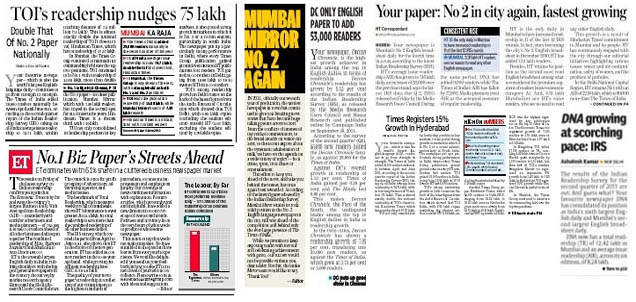
    The claims and counter-claims have begun. In Mumbai, Mumbai Mirror said it’s No 2 again. So did Hindustan Times. Both weren’t incorrect: Mirror may have the second-largest readership, next only to The Times of India, but Hindustan Times is the second-most read broadsheet English daily. DNA’s report too says it’s the second-largest broadsheet daily.

    Sadly, the conferences which the Market Research Users Council and Hansa Research Group would conduct to release every round of the Indian Readership Survey have been done away with. The detailed dump is curiously no longer handed out to the trade media.

    Consequently, what the MRUC and Hansa expect the trade media to do is to either carry unverified claims of various media entities. Or depend on friendly publications and agencies to give out data.

    MxMIndia.com requested veteran media consultant Sundeep Nagpal and his firm Stratagem Media to dig a little deeper and help us come up with a variety of insights given IRS 2011 Q2 data.

    For instance: the DNA report quotes a total readership (TR) figure for itself which most media agencies do not recognise. Media agencies and MxMIndia recognise Average Issue Readers (AIR) as currency. Interestingly,  when you look at the numbers for Greater Mumbai, while DNA is a distant third amongst English language broadsheets vis-a-vis The Times of India, it’s difference with #2 English broadsheet Hindustan Times is just 63,000. For HT of course the growth story in Greater Mumbai is tremendous: 27.2% year-on-year and 4.1% in the second quarter.

    We asked Strategem for the following:

    1. Given the toplines mailed to us by IRS, could we analyse it vis-a-vis the Q1 data for 2011 as well as the Q2 data for 2010 so that we can do a year-on-year analyses?

    2. Can we also similary analyse the data region-wise – Hindi belt and North, West, South and East and North East?

    3. Can we look at the numbers for the 8 metros combined and separately?


    Stratagem has provided us this data, and we present these to you as follows:


    First, take a look at the table withe the Top 10 publications across the country – urban and rural India.


    Publications

    IRS 2011 Q2

    IRS 2011 Q1

    % growth in IRS 11 Q2 over 11 Q1

    IRS 2010 Q2

    % growth in IRS 11 Q2 over 10 Q2

    Est. Individuals (000s)

    889070

    885122

    0.4

    871443

    2.0

    Dainik Jagran

    16393

    15910

    3.0

    15925

    2.9

    Dainik Bhaskar

    14174

    14016

    1.1

    13303

    6.5

    Hindustan

    11985

    11810

    1.5

    10143

    18.2

     Malayala Manorama (Daily)

    9962

    9938

    0.2

    9841

    1.2

    Amar Ujala

    8891

    8747

    1.6

    8417

    5.6

     Lokmat

    7595

    7486

    1.5

    7402

    2.6

     The Times Of India

    7471

    7442

    0.4

    7088

    5.4

     Daily Thanthi

    7290

    7187

    1.4

    7402

    -1.5

    Rajasthan Patrika

    6941

    7033

    -1.3

    6900

    0.6

     Mathrubhumi

    6690

    6800

    -1.6

    6566

    1.9


    Let’s also look at the combined numbers for the eight metros of Mumbai, Delhi, Kolkata, Chennai, Bengaluru, Hyderabad, Pune and Ahmedabad.


    Combined 8 metros-Mum,Kol,Ahm,Bang,Pune,Chen,Del,Hyd

    Publications

    IRS 2011 Q2

    IRS 2011 Q1

    % growth in IRS 11 Q2 over 11 Q1

    IRS 2010 Q2

    % growth in IRS 11 Q2 over 10 Q2

    Est. Individuals (000s)

    73117

    72672

    0.6

    71138

    2.8

     The Times Of India

    5114

    5073

    0.8

    4879

    4.8

     Ananda Bazar Patrika

    2708

    2725

    -0.6

    2821

    -4.0

     Hindustan Times

    2690

    2675

    0.6

    2566

    4.8

     Navbharat Times

    2392

    2349

    1.8

    2216

    7.9

     Gujarat Samachar

    1606

    1641

    -2.1

    1503

    6.9

     Daily Thanthi

    1365

    1319

    3.5

    1233

    10.7

     Lokmat

    1224

    1268

    -3.5

    1295

    -5.5

     Daily Sakal

    1175

    1213

    -3.1

    1089

    7.9

     Hindustan

    1128

    1142

    -1.2

    1167

    -3.3

     Divya Bhaskar

    1124

    1129

    -0.4

    1039

    8.2


    The growth story is undoubtedly that of Hindustan which has grown 18.2 percent over the second quarter of 2010, though the growth in the second quarter of this year has now steadied at 1.5 percent. But the winner of the quarter from the toplines of 2011Q2 for across the country is undoubtedly Dainik Jagran with a 3% growth. On a base of 1.59 crore this is big.  The other stories of the big players is also noteworthy. Bhaskar 6.5% y-o-y, Amar Ujala 5.6% y-o-y and The Times of India too at 5.4% y-o-y. Jagran’s y-o-y is 2.9% and Lokmat has grown 2.6 percent over 2010 Q2.
    We urge you to click on the links below (these will come up later in the day) for detailed numbers.It is important to note that the numbers thrown up in the above table are not truly indicative of the power of the various publications. Remember, these ratings are only for metros, and the picture is dramatically different for an ABP in West Bengal, and Gujarat Samachar in Gujarat or Thanthi in TN and Sakal and Lokmat in Maharashtra. Ditto with Hindustan and Bhaskar.

    Links:

    IRS Q2 2011 Hindi Belt & North


    IRS Q2 2011 – South


    IRS Q2 2011 – East


    IRS Q2 2011 Maharashtra & Gujarat

    Information courtesy:


  • Anil Thakraney’s Hard Knocks: Are newspaper owners in sleep mode?

    The latest IRS figures are in. And as usual, newspaper edits get busy boasting about rise in readership. Or, they’ll work out ingenious ways to interpret the findings, to keep their board of directors and advertisers in good cheer. By the way, I often wonder if everyone’s readership is healthy, who’s taking the fall? Anyway, that’s not the point of my article. And neither do I wish to discuss IRS’s methodology.


    What I want to say is this: Newspaper proprietors in India should be thrilled even if there is no growth for their brands. India is that unique nation where dailies continue to thrive even as they struggle to survive in the rest of the world. And that’s purely because, as Indian Express chief Shekhar Gupta said to me in an interview for GQ mag, and I quote: “India has more space for media than most societies. People read multiple newspapers. We may see a shakeout, but not in the near future. Simply because of the demographics. India is adding nearly three crore literate people to the market every year. That’s the size of a large European country.”


    Shekhar is right. India’s large population base and rise in education will sustain newspapers for a pretty long time. But the proprietors will do well not to get complacent and sit on their laurels. Because the global trends will sooner or later catch up with India. Soon the tech revolution will hit India hard, and many newspaper brands will be compelled to shut shop.


    And innovations and out-of-the-box thinking must start NOW before it’s too late. Sadly, I haven’t seen any signs of that so far. Almost every single news that gets ‘broken’ on the covers of our dailies, I have already been made aware of the previous night by TV and/or Twitter.


    So people, do gloat if you wish on the IRS figures. But also do take care to smell the coffee.


    ***


    PS: I badly wanted to stay inside the Bigg Boss house this time. But couldn’t think of anyone to kill, rape, molest, abuse or cheat. So I didn’t qualify. The loss is all mine.