Tag: Ray Velez

  • The Agency of the Future is an Algorithm: Razorfish-Contagious seminar @CannesLions2015

    By Dyanne Coelho


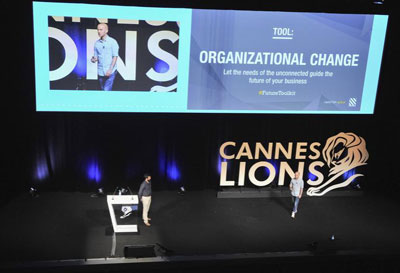
    There’s absolutely no point sticking to the rules anymore. The last decade has changed the way marketing works in our industry and the growth of the digital space has created more opportunities, more expectations and more solutions. But how prepared are we for what comes next? While we talk of the ever increasing pace of change, it’s clear that what matters is not so much what we know about the future, but how we adapt to it. A well-worded introduction, set the pace for the seminar entitled ‘Toolkit for Transformation’with Ray Velez, Chief Technology Officer, Razorfish Global and Will Sansom, Director, Content and Strategy, Contagious Communications.


    “Is it just us or have we reached a point where the industry has hit pause,” Sansom asked. “We carry devices in our pocket now that have more processing power than the super computers that put man on the moon. Statistics suggest, that young people switch media platforms over 25 times an hour,” he said.

    “Technology breeds technology, and innovation breeds innovation. Knowing about the future isn’t enough; you also need to plan on how to adapt to it,” Velez added.


    We think in the future, brand loyalty will become extinct, Sansom revealed. According to him, we’ve never been better enabled andequipped to switch between brands no matter the category. Research shows that there is about $6.2 trillion in revenue to be made from people switching loyalty from one brand to another. This is now being called the switching economy. This is proof that brand loyalty is becoming extinct, they discussed.


    We have more choice now. A lot of the new generation start-ups that are now huge global multibillion dollar companies are all about giving us more choice, Sansom explained. “We have more information at our disposal, comparison sites, reviews, social media, and from a trusted network we can tap into it any time we need it.”


    A major study that Razorfish conducted into cross-channel experiences and loyalty across four key markets – US, UK, Brazil and China, found that word of mouth and online reviews were the greatest influencers of purchase decisions. This led to the next point of ‘Considered Consumption’. This includes decisions consumers make based on how much they know about the brand, like their ethical practices, their carbon footprint etc. For example, the company Sir Richards is a new contraceptive company. For every condom that they sell in the Europe or US, they donate one condom to developing markets specifically those where sexually transmitted diseases are a vital problem. There are a lot of companies like this now, because consumerslike to spend money with good brands, but also like to spend money on brands that do good, they suggested.


    “In our opinion, one of the biggest contributors to brand loyaltyis the fact that we celebrate the self. And we live in an age where we’re equipped and encouraged particularly through social media to promote who we are as individuals. But brands are not treating us as individuals. For far too long brands are relying on flawed segmentation processes that market to demographics, but they don’t market to me,” Velez pointed out.


    Crucially customers increasingly want a relationship with a brand that feels more personal. Razorfish asked in a study how important is it that brands provide a product or service that feels like it was made just for you? Close to two-thirds of the respondents wanted just this. “It’s a challenge, but we believe the solution is in data. Data is how we listen to our customers. If we’re not using data, we’re in essence ignoring our customers. In the end data gives us that roadmap on how to reach customers on a one-to-one basis,” Velez added.


    The speakers divulged a few tools that are essential when dealing with the problem of a fading consumer loyalty. For one, design around them, not around your short-term sales targets. People are migrating towards brands that treat them like individuals, they said. Secondly as far as creativity is concerned, disrupt your business, not just your advertising and for organisational change, make a commitment to being in beta. In the future the unconnected world will need connecting, Sansom pointed out.


    A McKinsey study showed that even by 2017, close to 4.2 billion people will still be unconnected, or will remain offline; that’s roughly half the world’s population. Velez revealed. “For consumers, educate and enable before advertising,” he said.


    For creativity, think beyond browsers, for organisational change, let the needs of the unconnected guide the future of your business, Sansom suggests.


    “Great brands will liberate us from our screens. The connected today face a fatigue from being too connected to screens,” Velez explains. We ought to design for the human interface, not for the screen. The internet is not the screen, Sansom added.


    The agency of the future will be an algorithm, the speakers discussed. We’d be kidding ourselves if we thought that industries aren’t about efficiency, about making things better, faster, cheaper. Are we ever going to get to a point where an algorithm could create a whole piece of advertising from start to finish, by itself?


    “Imagine dealing with a creative director who is an algorithm. He literally knows all the answers,” Sansom said. But does that mean that we will be out of jobs? Not at all, he says, but what we do is going to change, and it will free us up of mundane tasks, it will be better.


     

  • Razorfish acquires Neev; aims to be No 1 in 18 months

    By A Correspondent


    Publicis Groupe announced that it has signed an agreement to acquire Neev, one of India’s leading technology services providers specialising in eCommerce, SaaS (Software as a Service) and cloud applications across web, social and mobile. Neev will be aligned with Razorfish, one of the largest interactive marketing and technology companies in the world.


    The acquisition triggers the launch of the Razorfish brand in India, and the move follows a number of acquisitions recently announced by Publicis Groupe and further strengthens its digital leadership globally as well as its presence in India and the greater APAC region.


    Kanika Mathur

    Kanika Mathur, Managing Director for Razorfish and Digitas India said, “Neev is one of the leading technology services company specialising in e-commerce and cloud applications across social and mobile. It’s more like a mini-Razorfish in India and that was what was exciting about the venture when we spoke to each other. Razorfish is all about business transformation using technology. It’s about creating new business models for clients and about providing a brilliant experience to the consumer.”


    Srikant Sastri

    Srikant Sastri, VivaKi Country Chair for India, who is overseeing the acquisition of Neev, said, “With the acquisition of Neev, we have added cutting-edge tech capabilities. We are now twice as large as any other global network in terms of digital team-strength and revenues, and unparalleled in breadth and depth of digital skills.”


    Founded in 2005 and based in Bengaluru, Neev has aggressively grown and now employs a team of 250 specialists, of which over 220 are technologists, with experience and expertise in leveraging cloud and mobile technologies and promoting innovation that drives business success.


    Elaborating on the agency structure Ms Mathur said, “Neev is growing very aggressively and by the end of first quarter next year we think we’ll be about 450-odd people in India. I think digital marketing as well as digital technology is being adopted at a very fast pace in India and Asia Pacific, so we do feel that we are on a huge growth curve on that front. While our technology hub will be in Bengaluru, we will be present across New Delhi, Mumbai, Pune and Bengaluru.”


    When asked about the agency’s clientele in India, Ms Mathur said that they would initially be tapping global clients at Razorfish and have already started engaging with a few of them. “While we cannot disclose any names as yet but it would suffice to say that we will be moving very fast in the Indian market.”


    Explaining the market and how it has evolved over the years, Ms Mathur said that the space that Razorfish operates in is growing very rapidly. “But when we look at the market we tend to look only at media buyers. If you were to look at technology and using digital to enable new services and products, that’s really the space that we operate in. We can’t really say that the market is about media only. Media, creativity and technology – the intersection of this is where we are placed right now.”


    As for the anticipated growth story, Ms Mathur said Razorfish had a good growth in 2012-13 at about 40 per cent and would like to keep on doing better as they go forward. “While right now we are one of the top 3 players, the goal certainly is to be the No 1 player in the next 12-18 months.”


    The agency will operate as Razorfish Neev led by Neev CEO, Saurabh Chandra. He will report into Kanika Mathur with a direct connection to Ray Velez, Global CTO for Razorfish.


  • Put customer first: Ray Velez @ Goafest 2013

    By A Correspondent


    With the mantra being Digital everywhere one looks, it was not surprising that this theme predominated at the knowledge seminars on Day 1 of Goafest 2013.


    The most significant points came from Ray Velez, Chief Technology Officer of Razorfish, who spoke on Transforming Business at the Intersection of Marketing and Technology. Emphasising that technology is transforming the customer experience, he cited a Gartner study which predicted that CMOs will own more of the technology budget than CTOs.


    This meant that technology plus media plus creativity made for the new brand experience, he said. Traffic is now two-way, and the hashtag is a way for customers to communicate back to the brand.


    He said there are five principles that must be embraced:

    1. Put the customer at the centre.

    2. Think of your brand as a service.

    3. Reject silos.

    4. Act like a startup.

    5. Embrace diversity.


    Your organization must be structured around the customer, Mr Velez said. What you get is data based on actual activity, in digital more than anywhere else. Strategy must be based on actual data from customer feedback. Marketing, technology and creativity are no longer discrete activities. If you don’t act like a startup and put the customer first, someone else will.


    As an example of such proactive responsiveness, Mr Velez cited the case of the Smart Car / Smart USA Twitter reaction to negative comments about the car. The tack taken was Humour the Haters, and for every wisecrack about the car, the company put out well-thought out, informed responses which gained them a great deal of goodwill and appreciation for the wit and good humour with which they had handled the comments.


    Mr Velez stressed that the organization must be structured around the customer; and that if it does not put the customer first, someone else will.


    Roger Mulchandani, Director of Warc Asia-Pacific, tackling the topic of ‘Seriously Social’, said the traditional way of looking at television and digital as rivals was no longer valid. TV and digital are buddies, he said, as their roles were overlapping and often symbiotic.


    Social media is certainly here to stay, he said, but he also highlighted the dangers of over-reliance on it. In any given week, less than 0.5 percent of a brand’s Facebook fans engaged in any actual engagement with the brand that they are fans of. That is how effective Facebook really is, he said, and added that we need to lower our expectations of brands on social media. Social media should be used for reach rather than loyalty, he suggested.


    Nick Vale, Global Planning Director of Maxus Worldwide, speaking on “What great work looks like in our changing world”, said that the focus needs to shift from the big idea to the long idea, ie, ideas that are sustainable over time and have staying power. Digital was a great enabler, as it can make ideas now live beyond the screen, he remarked. He added that the focus should be on storytelling across channels, not silo-based thinking.


    Each speaker also interacted with the audience in a Q&A session at the end of their talk, and the best two questions in each session won iPads.