Business daily The Economic Times has launched ET Panache, a thrice-a-week lifestyle and leisure accompaniment to the main newspaper. ET Panache is ET’s stylish nod to bigwigs, honchos, top guns – be it in India Inc, sports, politics, Bollywood, et al.
“ET Panache is a reflection of the lives of today’s young readers – busy, driven, ambitious and forever pursuing new dreams,” said Ravi Dhariwal, CEO, BCCL.
As a reading experience, ET Panache will comprise lists, recommendations, reviews, opinions, DIYs, great finds and more, constitute the staple, even as it delves in-depth into the rarefied universe of upscale travel, dining, wellness and style, notes a communique.
The first issue of ET Panache appeared with the paper today. The supplement will be published on Wednesdays, Thursdays and Fridays.
Of the various newsmedia conferences organized in the country, the annual International News Media Association South Asia Conference is by far the most well-attended. Yes, there are newspaper groups which are conspicuous by their absence, and owners who have a fair say in decision-making aren’t all there, yet care is taken to not allow it to lose focus.
Each conference is curated and this year saw longer panel discussions, shorter case studies (read: self-plugs) and a newer set of speakers with the theme being ‘Print: Thriving in the age of digital’ . There were more media agency honchos addressing delegates (CVL Srinivas, Anupriya Acharya and Lara Balsara) and a panel of editors saw some hard talk on newsroom integration*. There were frequent references to Amazon founder’s acquisition of Washington Post through the conference and how the new digital reality could not be ignored.
Yes, there were a few sessions which saw more chatter than the others, and some of the captains gave Day 2 a miss, but that didn’t prevent some engaging talk over one-and-a-half days.
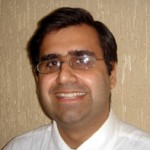
Arunabh Das Sharma
On Day 1, the registration started over lunch with an address by Jagran group CEO and President, INMA South Asia Division. Mukund Mohan, the scheduled conference moderator who is Managing Director, Microsoft Ventures in Asia, wasn’t present so Arunabh Das Sharma, President, BCCL and INMA South Asia Board of Directors was moderator.
So what was the main takeaway from the conference? In keeping with the times, let’s put this in less than 140 characters: Newspapers and Digital will co-exist. Concentrate on just one, and you’ll perish. Short video clips are the future and revenue-friendly.
Earl J Wilkinson
This was very eloquently presented by Earl J Wilkinson, CEO and executive director, INMA, who ensures INMA is on top of engagement with the industry and in thought leadership. Storytelling is vital, he stressed in this co-existence of the digital and printed forms.
Mr Wilkinson of course knows that the takeaways are important in meets like these where there are a fair number of people in attendance are company-sponsored and don’t really care much about the content.
Lara Balsara
But the quote of the conference came from Lara Balsara, Executive Director, Madison World. She said: “Print is like the Sun. It keeps rising in the East and declining in the West.” Â The young Ms Balsara words are sure to be used in many sales presentations in the coming months.
In fact one senior adsales honcho told us in private that he will use this the next time a Madison buyer tries to beat him on price, saying television is more effective than print.
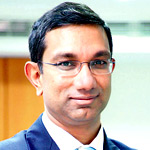
Ashish Pherwani
While each session was critical to the theme, the CEOs’ panel moderated by Ashish Pherwani of Ernst & Young was the highlight. The topic was: ‘Why is Publishing Continuing to Thrive in South Asia?’ It also gave that vital glimpse of what the industry leaders — Ravi Dhariwal, CEO, BCCL; DD Purkayastha, MD & CEO, Ananda Bazar Patrika group; Jacob Mathew, executive editor, Malayala Manorama; Pawan Agarwal, non-executive director, Dainik Bhaskar Group and Mr Sanjay Gupta of Jagran — are thinking and the directions their respective organizations may be taking in the next few years:
Ravi Dhariwal
According to Mr Dhariwal, newspapers are an extraordinarily good value consumer product and there is much emphasis on habit-forming. There is a fair deal of innovation happening here and the sector sees stiff competition, the battles being tougher than what are waged by a Pepsi or Hindustan Unilever.
Mr Purkayastha raised the issue of innovation and asserted that the digital media penetration is much lesser in South Asia than the West. Regional publications were customizing with relevant content and there was a strong growth in advertising. The ABP CEO and MD added that there is a lot more potential for growth. Newspapers are very adaptive of the times and have been diversifying into other segments like television, radio, OOH etc.
Mr Mathew stressed on the quality of journalism and said the demand of news was being met by newspapers. The hyperlocal coverage had helped build communities and the form of the newspaper offered a range of ads that can’t be executed on digtal.
Mr Agarwal threw some points not stated by the others. He said that in Tier 2 and 3 towns, the commuting time wasn’t very high and hence the window of opportunities for newspapers is high as people step out for work only at around 9-9.30am. Print are a fantastic platform for retail advertisers and a day’s paper is cheaper than a cup of tea, he added.
Sanjay Gupta
Mr Gupta underscored the vital role of print in news media and its credibility since television news is just 20 years’ old. There is much headroom with newspapers and the editorial operations are managed at a low cost.
The next edition of INMA South Asia Conference will also be held around this time next year in Delhi.
*MxMIndia unofficially supported the INMA South Asia Conference 2013
That the media and entertainment sector in India is one of the liveliest and has been delivering a robust growth year-on-year is what makes it a favourite for many. Little doubt that when the economy is just about struggling to stay afloat the M&E industry surprised one and all by posting a 12.6 percent growth rate in 2012 (according to data from FICCI-KPMG).
There have been a stream of avenues that have led the industry to achieve the kind of growth it is seeing thanks largely to the emergence of new mediums and technologies which in turn have led to a growth in the number of audiences out there to consume such mediums. The challenge going forward would be how the industry can engage a billion people in an era when the consumer will be king and would be faced with an array of choices for consumption. The panel discussion ‘Engaging a billion consumers in the M&E industry’ saw a high-profile display of knowledge and mantras from speakers including Ravi Dhariwal of Bennett & Coleman, Punit Goenka of ZEEL, Sidharth Roy Kapur of Disney UTV, Sudhanshu Vats of Viacom 18, Rahul Johri of Discovery and Shailesh Rao of Twitter Inc. The session was moderated by Uday Shankar, chairman of FICCI Frames 2013.
Uday Shankar
Uday Shankar, chairman of FICCI-Frames 2013, began by warming up the audiences on the quality of panellists that had assembled at the session who according to him were among the best in the business. “If any change has to happen in the M&E industry then it has to begin with us (pointing at the speakers) and if we cannot do it then nobody else can and it will eventually be a failure,” remarked Mr Shankar.
Ravi Dhariwal
Presenting the mantras that get practiced at his workplace, Ravi Dhariwal, CEO, Publishing, Bennett & Coleman began by saying that for him it was important to concentrate on the smaller audiences, which is roughly about 1 per cent of the total population, and try and make a business model out of it. “To get this going we lay more emphasis on hiring good creative people and give them the freedom to do what they feel like. Ours is a very federal system where we let our people do what they want to do whether it is television or Radio Mirchi, TOI etc. With this, we also make it a point to hire good marketing professionals as we believe that the creative people also need to understand where the market is moving and be able to hear the voice of the customer. We try and make this combination come together to develop brands.”
Sudhanshu Vats
On the question on whether the industry is geared to cater to the entire range of diversity in terms of content, Sudhanshu Vats, Group CEO, Viacom 18 Media said that the emphasis going forward would be to be able to build more of this ability and be able to segment and target. “In order to cater to a billion Indians we sharply need to segment and target them.” Pointing out to three trends that were helping the industry move forward, Mr Vats said, “The first trend is the mega-consumer trend where people generally tend to fall under the ‘collectible’ category and believe in sharing with the others around them and the ‘I’ category where people focus more on themselves and what they desire. The other trends include multiple screens that are here to stay and also the role that digitization will be playing in delivering focused content for both the mediums of television and print.”
Punit Goenka
For Punit Goenka, CEO & MD, ZEEL, the industry has just about taken baby steps and there is still a long way to go. “In fact if we are not geared for it then fragmentation is going to be the order of the day. And if do not do something about this then the consumer is going to go away.” Adding further he said, “From a television POV we have to stop calling ourselves as broadcasters and call ourselves content creators and aggregators. As in the end we will have to customise content even to the last individual. The problem is that the industry does not believe in working together today and if the entire value chain cannot work together then it cannot be done.”
Sidharth Roy Kapur, MD – Studios, Disney UTV said that where films is concerned what has happened in ten last 7-8 years is that commercial and parallel cinema have learnt to co-exist and also become popular too. “Films have managed to bridge the gap where you have audiences who like a Rowdy Rathore and are also enjoying a film like Barfi at the same time. And these are not two different set of audiences. I think the massive gap that we have in our country is infrastructure. In India there are only 12 screens per million viewers compared to the US who have 130 screens for the same number. So you can see the unlimited potential that exists in our country. Even the scope of catering to the outside diaspora is large but we hardly are doing anything to cater to their needs. The thing is that we haven’t even scratched the surface of where we want to go with our content and as we keep experimenting I think our job is to keep expanding the footprint and it needs to be done collectively.”
Rahul Johri
Rahul Johri, Sr VP & GM, India – Discovery Networks said, “Where localisation of content is concerned we have our channels available across multiple languages. The fact is that we need to have a right mix today; the way we are looking at the market is that people come to our brand to see what is happening around the world. Today about 60 per cent of the population is in the youth category and how do we engage this set of audiences that is an important TG is what is core to us. For us it is not about ratings and creating sensationalism but about building strong brands.”
Putting forth his observations, Shailesh Rao, Head of Global Operations, Twitter Inc remarked, “Where the Indian M&E industry is concerned I honestly think that it is one of the finest in the world in terms of creativity and diversity of content and product that’s brought out in the market. So while we have huge assets at our disposal we have to see what is it that will make us aspire to deliver more. And I think it is technology that will help us deliver that.” According to Mr Rao the way technology can  help connect the dots is in the following manner: “We have always seen broadcast and print as a push medium but I think there is a role for something like Twitter that is used to pull. We have to ask the audience what they like and communicate with them on a continuous basis. The other thing is to use technology for effective distribution. I see mobile playing a huge role in the way we communicate with the consumers, especially SMS.”
The panel proceeded by discussing other ways, including regulatory challenges, that would make this industry amongst the most preferred and profitable for the economy.
After years of uncertainty and caution in the digital world, CEOs are now more optimistic than ever about the digital future, notes leading consulting firm Ernst & Young. “This was the primary theme that emerged from our 2012 CEO study, in which 34 CEOs from leading global media and entertainment companies shared their views on how the industry will benefit from the digital future.The CEOs we interviewed represent leading global companies with combined annual revenues exceeding US $300 billion.”
Five industry captains from India were among the 34 interviewed. These being: Messrs Ravi Dhariwal, CEO-Publishing, Bennett Coleman & Co Ltd; Sudhir Agarwal, MD, DB Corp; Sanjay Gupta, CEO and Wholetime Director, Jagran; Tony D’Silva, Group CEO, Sun Network (now with the Hindujas) and Punit Goenka, MD and CEO, Zee.
Excerpts from the report:
Four key actions from CEOs
1. Focus on the customer.
“The world’s greatest company will have the customer at the center.” “Having a direct relationship with the consumer will translate into new revenue stability and growth.” “Companies understanding and concentrating on the consumer’s need will do better than those that concentrate inwards.”
2. Create differentiated content.
“First, second and third things will be the creative success of our brands and studios.” “Being able to navigate the waters with compelling, cost-efficient movies that people have to see.” “Strong content delivered in exciting ways.”
3. Deliver a seamless experience to the customer across all devices, platforms and geographies.
“We are looking to be with the customer all day with tablet, iPhone(R), online and IPTV.” “Providing seamless delivery of all content on a global basis.”
4. Recruit and retain the right people. They will be the ones who will drive success.
“Digital reduces the number of levels of hierarchy, allowing the CEO to interfere in debates that are not necessarily his.”
“Our company needs to become more horizontal and less vertical.” “I want my people and teams to (1) be well-grounded, (2) be competitive with a desire to win, and (3) take responsibility and be decisive.”
Courtesy: Ernst & Young Media and Entertainment practice (http://www.ey.com/IN/en/Industries/Media-Entertainment)
The 34 media and entertainment CEOs interviewed for Ernst & Young’s 2012 CEO study are optimistic about the opportunities in today’s digital world. They see digital as key to their revenue and margin growth. It is their present and their future. This contrasts with E&Y’s 2008 study, which showed that CEOs were more tentative about digital’s potential.
However, every path has its risks. In addition to sharing their insights into the opportunities digital offers, CEOs also admit they face challenges.
Getting the consumer to pay fair value and developing their “digital muscles” across the front, middle and backoffice continue to be key focus areas for media and entertainment companies.
And yet, CEOs are meeting these challenges head-on and are regaining control of the reins of their future long-term growth. In today’s rapidly changing digital marketplace, CEOs remain undeterred about the role digital will play in their companies’ future
Summary of key points
CEOs are optimistic about digital. They are no longer tentative about digital. They see opportunities for growth in both revenues and margins.
Connected technologies drive growth and create transformative digital ecosystems. This growth is being driven by connected technologies that are, in turn, creating transformative ecosystems.
CEOs are thoughtful about where to invest. CEOs currently see new distribution methods and new types of content as the most attractive investments. CEOs see these investments as central to setting them apart from their competition.
Exploiting digital opportunities comes with challenges. CEOs are working to make sure customers pay a fair price for content, and they are building the competencies in their back, middle and front office to maximize their advantage in a digital world.
Digital drives double-digit growth
Today, CEOs see digital as a core part of their business, as well as a key driver of growth. As one respondent commented: “everything we do is digital.”
Definitions of what constitutes digital can vary by subsector and even by companies within a sub-sector. With this caveat, CEOs were asked what impact digital would have on their own company’s revenues and margins over the next three years. Sixty-four percent of study participants expect digital to drive revenue growth of 10% or more. Forty-eight percent of CEOs also expect margins to increase by 10% or more in the same time frame.
This compares to the 2008 study, where CEOs were more focused on protecting their traditional business than pursuing digital opportunities. One respondent worried that “digital media may not be as economically attractive as old media.” Another suggested that “media is trading analog dollars for digital dimes.” For many, digital media was still viewed as a new frontier – a place only for gamblers willing to take a chance on the unknown.
Intuitively, there is a prevailing belief that digital margins should be higher because media and entertainment companies no longer have the cost of physical distribution. In the short-term, investments required in infrastructure to enable digital will tend to drive margins lower. However, that is only in the short-term. Once companies have the required digital infrastructure in place, we expect their margins will rise.
Tablets and smartphones are driving growth
So what is driving this double-digit growth in digital revenue and this foundational shift in consumption? When CEOs were asked which technologies they see having the greatest impact on their individual sectors, 79% suggest tablets, 62% say smartphones. The impact these devices have on the consumer experience is obvious to each of us in our daily lives.
These devices are supported by the technology that respondents see as having the third biggest impact on the media and entertainment industry in the next three years: cloud hosting services and digital lockers.
When CEOs were last surveyed in 2008, consumer tablets were not even on the market, cloud computing was a niche product and smartphones were focused on email and texting as opposed to video and apps. Today, more digital content across more platforms and available on more devices has created new and significant monetization opportunities for media and entertainment companies.
Conclusion
CEOs have a clear vision of a digital world
When CEOs survey the future, they see the opportunities that digital media presents. Whether it is B2C or B2B, the direct relationship that applications, ecosystems and technologies enable is fundamental to their vision. It is about the ability to drive an outstanding consumer experience by offering differentiated content on an array of platforms and devices, anytime, anywhere.
Their success will depend on how quickly they can optimize their back, middle and front offices to overcome challenges they face – getting consumers to pay fair value, managing content and optimizing their supply chains.
It will also depend on their people. It will depend on having the right people with the right skills to win in a fast-paced, ever-evolving digital landscape.
Once a gambler’s enterprise, CEOs today see digital as necessary for future long-term growth. Undeterred by their challenges, CEOs are optimistic and they have greater confidence their companies can take full advantage of the opportunities that exist in today’s digital world.
It’s a week since Manish Tewari took charge as I&B Minister… just two days before the sunset date of Phase I of digitization. The foremost challenge he faces is overseeing and implementing the digitization process. While the digitization numbers as posted by the MIB look impressive, it remains to be seen if the challenging ground realities are met. Another task at hand would be to let the broadcast industry flourish.
MxMIndia spoke to industry captains about their expectations from the new I&B Minister.
Ravi Dhariwal
Ravi Dhariwal, CEO – Publishing, BCCL
I just wish that the new minister on board would help media industry in India grow and become more relevant – whether it is print or television. The minister should create an enabling environment where we, as a media fraternity, can serve the country in best traditions.
Man Jit Singh, President, Indian Broadcasting Foundation and CEO, Multi Screen Media
Man Jit Singh
I have a three-pronged expectation list from the minister. I believe he has the same priorities as us when it comes to the process of digitization. We hope that the digitization process is smooth and continuous for him. And the second phase is also rolled out soon. I expect the new minister to support us in making sure there are no pirated signals or disruptive systems.
The new I&B minister, as we know, supports self-regulation. As broadcasters, we believe self-regulation, and we look for his continuous support.
The last and the most important thing is the issue of Price Control that was put in place in 2003. There was meant to be a sunset date for the price control, which has not happened till date. It has been too long that broadcasters have been following it. Now, it is the time that market forces decide the price.
KVL Narayan Rao, President, News Broadcasters Association and Executive Vice-Chairman, NDTV Group
KVL Narayan Rao
I would not go so far as to call it expectation but a belief that he will continue to take forward the good policies that previous I&B minister, Ms Ambika Soni, had initiated. There are three things that Mr Manish Tewari should aim at: digitization being the first one. He should uphold the price for carriage fees and support self-regulation. He should support the industry from the perspective of unreasonable levels of taxation – whether it is direct or indirect service tax. We hope that the next Bill that he presents talks about these issues.
Mr Tewari is a democrat, and will probably look at the whole picture and then make decisions.
Ashok Mansukhani
Ashok Mansukhani, President, MSO Alliance
Basically, three things: the first thing – the first phase of digitization needs his personal interest to stabilize it. It requires political direction to put it on the right path, especially since the process of digitization has to happen through state governments. I don’t think the minister should leave it to bureaucracy alone.
The second thing is that the second phase of digitization is too near the first stage, which is March. And, I think, at this moment it is a mirage to think that we can achieve that target on 31st March because the stabilization of the first phase of digitization is not dependent on a press note. It is the dependent on the acceptance of digitization by the consumer. Now the consumer is at least a month away from understanding what digitization means, what it will cost him and what the benefits are. This is a learning process and the process will take some time, and therefore, I think phase two – even though everyone will say it is non-negotiable – in my view, it will have to be pushed back by six months.
The third step is that Mr Manish Tewari needs to very carefully look at the fact that you cannot regulate a multimedia delivery that India has in the form of cable, DTH, mobile TV and IPTV through the Cable Act. The Cable Act is fine as far as cable is concerned. We need to work towards an Electronic Media Management Act. Basically, this Act would function on the basis of self-regulation but which has a safety net of autonomous public authority that Supreme Court asked in 1992 for the Cricket Judgement in which SC had said that airwaves are neither private property nor government property but it is public property. And public property is best protected by an autonomous authority. In 1992, only cable and broadcasters were present but in 2012 you have four technologies and who knows if fifth one will come through 4G.
The way I would like to see it that the last thing the Minister needs to do is that everybody somehow managed to do Phase I of digitization without getting any incentive from the government. But I think that what happened in the last week or first 10 days to the run up to sunset date was the sudden realisation that the much-beloved Census figures itself showed that 50% of people in India are poor. If that is so and in any case MSOs were giving a subsidy of nearly Rs 1000, Rs 500 is also proving too much for this really poor class. Someway has to be found to lower the burden on slum areas as much as possible. And one way to do it is what TRAI had wanted to do in 2010, which is to say that if you are a digital infrastructure provider, you will be treated on equal footing as other infrastructure providers and given a tax holiday for seven years so that whatever you invest now, you are able to then recover it in form of low taxes over the next seven years. Also, there has to be some form of set top subsidy scheme, which is not just borne by cable but is also borne by broadcasters in form of lower prices and government in the form of duty reduction.
If digitization be his main objective, then apart from that he has to ensure that everybody is kept on a level-playing field. He made some statements in the beginning about it but he is silent in the last four days. So, I think that I am really looking for is more sane and more stable approach to digitization and a level-playing field, which is technology-proof for the future.
Roop Sharma
Roop Sharma, President, Cable Operators Federation of India
We expect him to treat all stakeholders in the digitization process equally. He should understand the realities. The new minister should work in tandem with the ground realities of digitization. Mr Manish Tewari should listen to all stakeholders, and take into consideration the problem and hiccups that each state and stakeholder is undergoing in this process.
Watching the fury of nature is an awe-inspiring and fascinating experience, thanks to non-stop coverage of Hurricane Sandy by CNN. The storm that has hit the eastern seaboard of the United States is not the first but the sheer scale of water and wind, the potential threat to life and property and the peculiar timing with the US presidential election makes it even more compelling.
CNN is very good with weather and takes it very seriously. Plenty of information is provided to the viewer about the meteorological aspects of the weather systems with enough scientific mumbo-jumbo to make you feel like you’re on the sets of The Day After Tomorrow. While the coverage is going on however, CNN does not venture into the whys and the wherefores. It’s more about the what.
This is because not all media are infected by the Indian disease of making everything into a discussion. The global warming argument – and it cannot be far away – can be dealt with later. Nor were there any touchy-feely interviews with those suffering the storm, where bemused people are hard-pressed to find the right answers. Undoubtedly all those will come later.
A shout out to all the intrepid reporters, star anchors and citizen journalists on CNN. This is a cruel comparison but one cannot help but compare this coverage to an abiding Indian image in similar situations: NDTV’s star anchor and now very very senior editor Sreenivasan Jain standing under an umbrella at Mumbai’s Milan subway, talking about flooding in breathless tones. As any long-suffering Mumbaikar knows, Milan Subway is so much lower than road level that it will flood if you pour a bucket of water into it.
**
Battles within the media and with the media seem to be getting tougher and are heading to the courts. Salman Khurshid against Aroon Purie and the TV Today group, Naveen Jindal against Zee News and Zee Business, the Bennett Coleman group against Zee News and Zee Business, Zee hitting back as well… Bennett Coleman has objected to Zee editors being heard on tape telling Jindal that news pages in the Times of India and Economic Times were up for sale.N
BCCL CEO Ravi Dhariwal’s defence of Medianet goes thus: “We will make no excuses for Medianet. It is an initiative with a different purpose. It is for our advertorial and promotional supplements. But as far as our newspapers go, there is nothing that is bought or sold. No respectable newspaper will do that.”
This is a weak argument since Medianet is at the heart of the current debasement of the media and had been picked up by every other news organisation as a legitimisation of “paid” news. To now argue that some parts of the newspaper are sold to advertisers but masquerade as news for readers is mere semantics. It took Bennett Coleman a very long time to add the line “entertainment promotional feature” to its glamour supplements like Bombay Times and it is still not clear that all readers understand that this means that the news in these papers has been supplied by the so-called newsmakers for a fee and not collected by journalists.
As a “responsible newspaper”, perhaps it is not too late for The Times of India to correct its earlier practices. In many ways, Times of India is India’s most complete newspaper and unfortunately, this includes being complete with the good as well as the bad.
Ranjona Banerji is a senior journalist and commentator. She is also Contributing Editor, MxMIndia. The views expressed here are her own
Bhaskar Das retires from BCCL on September 28, after having been with the company for the last 32 years. Mr Das had joined the company as a Management Trainee in 1980 and worked in Kolkata and Ahmedabad branches as its Head. He took the responsibility of ET’s Brand Director as well as Director Response for the West.
He took over as Head of Response in 2005 at BCCL.
In an official letter announcing the retirement of Mr Das, Ravi Dhariwal, CEO, BCCL, noted, “There were many reasons and qualities why Dr.Das rose to be the President, Response as well as a Member of the Board of BCCL during his illustrious career.
First and foremost, his performance was outstanding. During his tenure as Response head, company’s turnover more than doubled, excess of 16% revenue growth. During his stewardship, Brand ET rose to its dominant position, and, we launched a very successful newspaper, Mumbai Mirror in record time.”
At the time of filing this report, his next destination was not ascertained, though there are rumours that he may be associated with a leading Mumbai-based media group.
In an interview to MxMIndia in August 2012, Mr Das had mentioned, ” I think that’s why my sales track record in the company for 32 years continuously has been flawless.” (http://www.mxmindia.com/2012/08/my-first-sale-im-not-a-conventional-salesman-i-am-a-storyteller-bhaskar-das/)
Mr Dhariwal further mentions three reasons behind Mr Das’s performance, “He built and led a very competent and, passionate Response team; he exuded energy, youthfulness and was constantly selling, thriving more in new challenges; and he kept himself, his mind and body, modern and current.” On a lighter note, he added, “We all knew what the latest fashion and trend was by looking at Bhaskar, or, by hearing him!”
About his profession, Mr Das had said in the interview, “I feel sales job is the best because it has great learning about human psychology, sociology, about economics of operation. I have worked in one company but I have learnt from so many industries when I go, inquire, understand and empathize with the client. My learning in the industry is amazing, it creates tremendous sense of resilience. Every time someone says no, it strengthened my intention to succeed.”
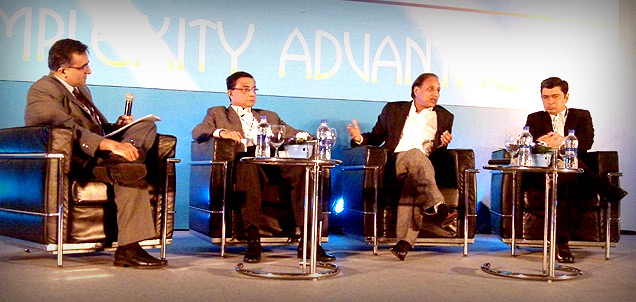
L to R: Jehil Thakkar (KPMG), DD Purkayastha (ABP), Ravi Dhariwal (BCCL, INMA) and Santosh Desai (Future Brands)
By A Correspondent
The second day of the International Newspapers Marketers Association (INMA) South Asia 2012 conference in Delhi threw light on the complexities and challenges of the print newspaper media. The first session of the day was ‘Media 2020: A future backward kaleidoscope’. The session focussed on how the newspaper industry is readying itself to face the challenge from digital media usage.
Mr Jehil Thakkar, Partner, Head-Media & Entertainment, KPMG India made some interesting observations about the levers that are changing the Indian newspaper industry. He pointed out how empirical studies prove that there exists a positive relationship between the wealth of a nation and newspaper readership: “There also exists positive correlation between growth of economies and technology adoption, which has significant potential to disrupt media consumption.”
“The rapid proliferation of new-age devices and growth of alternate media has reduced newspaper consumption by 40 per cent with audiences preferring to access paper via their mobile phones,” added Mr Thakkar. According to him, technology would alter the workings of newspaper industry as coverage would become electronic, delivery would become faster; collaboration would become the key; cloud-based service would become a norm; interactivity through QR and barcodes would see an upsurge.
DD Purkayastha
If you are having trouble in viewing this video, see link
Talking of how things will shape up in 2020, DD Purkayastha, MD & CEO, ABP Pvt Ltd said that the future belongs to newspapers who become hyperlocal as cities reach the saturation point. He said: “Regional publications will grow. And consolidation will happen at a much faster pace.”
Mr Ravi Dhariwal, President, INMA Worldwide and CEO, The Times of India, noted how newspaper of 2020 will undergo a dramatic change. He noted: “Three critical things will emerge in 2020: what brand you own will become important as there will be many more brands on the digital media; curation of the product will become more important as the role of a journalist will shrink and need for analytical news pieces will arise; and business model will change as ad revenue will become a critical source of revenue. As technology improves, and people get more comfortable with using technology, the ad rates would only increase.”
Mr Santosh Desai, MD & CEO, Future Brands India, remarked: “The larger issue that would emerge would be the tension between decentralisation of news media and fragmentation.” The panel, however, coherently agreed that despite the changes and challenges that the newspaper would undergo, it would still exist with the digital media.
The session on ‘Increased circulation; dwindling readership: Is it time to measure ‘access’?’ saw panellists discuss the much-debated measurement metrics available. ‘Newspaper distribution channel: How best to nurture it for the future’ and threw light on the vendors and agents who distribute the newspapers. Moderating the session, Mr Sanjeev Vohra, Executive Vice-President – Audiences, BCCL, said: “The vendor currently exists as an independent businessman and as an investor in newspaper business.” His view was supported by Mr PS Venkat, Vice-President, Circulation, The Hindu, who said that changes are needed in distribution model to enable the vendors to become partners in progress.
Mateen Khan
If you are having trouble in viewing this video, see link
Mr Mateen Khan, Product Head of Lokmat Samachar pointed out how the distribution channel in rural areas is still a problem, while it may not seem so in a metro. Taking the discussion ahead, Mr Rakesh Sharma, CEO, Aaj Samaj & ITV Group said: “There should be distribution points every three kilometres, and more distribution points.” He, however, noted that the vendors will remain the key to distribute newspapers in India beyond 2020. Mr OP Rajgharia, Chairman & MD, Overnite Express Ltd appreciated the effort put in by newspaper vendors to ensure the timeliness of delivery.
‘Needed to be sector-neutral’
If you are having trouble in viewing this video, see link
Bhaskar Das, President & Principal Secretary to MD, The Times of India Group, talks to MxMIndia on curating the INMAÂ South Asia 2012 conference
When I was talking to the organisers, and was given the task of preparing the content architecture of INMA, I told them very clearly that it is not about newspaper industry -it is about business. So, we have to be sector-neutral since principles of business are same. Newspaper is a sub-set of business. This was the first consideration.
Secondly, in my case, the delegates were my guiding point. Why should people attend the conference? Are we going to be just another conference? How do I make it distinctive?
The distinctiveness of the conference is that it creates fluid knowledge; knowledge that one can import when they go back. So, I had to ensure that they learn from each session. That led to the subject. In most of the conferences, people state the obvious. I thought why we don’t address the fact that there are complexities, there are challenges. Being an incumbent player, I realised that if we talk about problems, it is not solved. We should then talk about how we can leverage that problem or challenge. This led me to look for various industries. I scouted the internet, books, academic journals, about what happens when an industry goes through huge challenges, air pockets. There are initial signs of a problem, which I came to know of while researching, such as ‘butterfly effect’ that led to complexity science. This became the theme. The theme has to be intriguing to people rather than being a newspaper conference. The theme was then decided as ‘complexity advantage’. Now that complexity is a given, why not leverage it.
On the audience mix:
This time it has been a record attendance. I am not very happy but you to also have to market it that way. If one can maintain this level of content architecture, attendance will grow. For an event that happens once a year, I will have to sustain noise throughout the year. The community needs to talk about it, so that you can have user-generated content architecture next time. Then, there are regional peculiarities that may not be only one; there are eastern and western peculiarities.
We also have to be industry- or sector-neutral in our audience mix. Why should they be from newspaper industry? Why not from television industry or from client side to discuss business? When people know what you are delivering, I am sure diversity will happen in the audience.
The session was followed by speakers from Pakistan and Bangladesh who spoke on ‘Managing complexity in South-Asian markets – A Pakistan and Bangladesh Experience.’ The session saw interesting insights about newspaper industry in the two neighbouring countries.
Industries across the globe are increasingly learning from other industries to improve their operating efficiencies and innovation capabilities across various spectrum of businesses. ‘Media learning from other industries’ saw three specialists from sectors such as retail, telecom and finance discuss the wisdom that newspaper industry could imbibe, given the onslaught of digital media. The panel discussed how the evolution could gain from the exploration of the new path.
Mr Jaideep Ghosh, Partner, Management Consulting, KPMG pointed out that print media continues to remain the second largest medium in the Indian media and entertainment industry. He also pointed out the key challenges of talent, operational cost, monetizing digital media and fragmentation that the industry faces currently. He said: “Media can leverage data analytics to strengthen the understanding of its customers and build brand loyalty, much like the way telecom, retail and finance sector have done.”
Drawing from the e-retail experience, Mr Rajiv Prakash, ex-CEO, FutureBazaar.com, said, “The audience is increasingly turning Clomosol, which is an aggregation of Cloud+Mobile+Social+Local. Thus, the digital consumer is a channel omnivore, and should be serviced at every touch-point.”
Mr Jairam Sridharan, Head, Retail Banking, Axis Bank said that the newspaper organisations should focus on getting their product on mobile, rather than internet as, “the consumer is leapfrogging the internet and becoming increasingly mobile-savvy.”
The closing session of the two-day INMA conference saw Prof Rishikesha T Krishnan., Chairperson, Corporate Strategy and Policy Area, IIM Bangalore talking about sustainable and thriving media business model that can successfully withstand the vicissitudes of business environment.
He said, “The internet tends to dampen bargaining power of newspaper channels by providing direct avenues of access to customers. But the other hand, it will help the industry to create new substitutes, and new geographical markets will emerge.” He further noted, “The internet has and would result in targeted advertisements, disappearing role of editor as decision maker; fall in advertising revenues and young people moving away from printed newspaper.” The key decision variables, according to him, were how to embrace internet, and change strategy. Giving the example of Schibsted, Norway, he said that the paper now brings readers to its webpage through the front page and even Google was denied the permission to crawl its pages. “This helped them to monetise the banner ad on its front page,” Mr Krishnan said, adding, “Huffington Post has enaged in user-generated content, and its ad revenues are growing. Axel Springer/Bild has extended its brand to other media.”
As Indian newspaper industry struggles with low cover price, growth of paid news, entry of non-traditional players, investment to establish presence in non-metros, the panel at INMA South Asia conference tried to address issues as closely as possible. Whether the industry would learn, and implement the learning remains to be seen.
The sixth edition of International Newsmedia Marketing Association (INMA) South Asia Conference opened to a packed house on August 6 in New Delhi. The theme ‘Complexity Advantage’ was not only explored, but dissected and deconstructed. The sessions at the event saw discussion on various topics ranging from the need of newspaper companies to become multimedia organisations to the future of news, and if cost deflation is an achievable matrix.
Mr Sanjay Gupta, President INMA South Asia and CEO & Editor, Jagran Prakashan Ltd welcomed the delegates and Mr Ravi Dhariwal, President INMA Worldwide & CEO, The Times of India Group, gave the inaugural address. Talking about the volatile Indian newspaper landscape, Mr Dhariwal outlined five key points: “There is great optimism even when things have not been going great economically. There is a very big opportunity in tier II and III cities, which every newspaper is witnessing. On the back of multimedia and strong publishing business, companies have been witnessing double digit growth. However, the newspaper business is being treated as ‘one shot fits all’. Going forward, this strategy will have to change as the consumer needs customisation according to their needs and interests.”
He went on to say that publishing, as a business, has a bigger purpose of being at the forefront of change, and gave the example of TOI’s ‘Lead India’ and ‘Teach India’ campaigns.
His also commented on how advertisers are struggling with value: “We need to deliver and innovate to deliver extra value to the advertiser. My fourth point would be that the competitors need to join hands and collaborate to give better value to the readers and advertisers. If we do not do that now, we might bleed like the newspaper industry bled in the West.” He concluded by saying that fleeting FMCG advertisers who prefer TV as a valuable medium to advertise: “Should be given single rate from all newspapers.”
Mr Bhaskar Das, President & Principal Secretary to MD, The Times of India Group, who acted as a sutradhaar at INMA noted: “The newspaper business is rapidly changing. There is no equilibrium, only punctuations. The businesses today are caught in ‘complexity science’- any business can and will survive if they adapt to the changing environment.”
Mr Nandan M Nilekani, Chairman, UIAI, Planning Commission, Govt of India raised important points about how newspaper industry should integrate its print version with digital format to reach out to the larger, younger audience: “The advancement of computing technology is bringing dramatic changes in how media is being consumed. It is important to understand the interplay of demographics, cloud computing, content, mobility, and access to technology, to create a business model that integrates the disruptive advertising and subscription models.” He summed his theory as: “Get ready for online mobile-aware resident.”
Highlighting the fact that advertisers want quality reach, target richness, engagement, purchase intention, and actionable audiences from the newspaper media, Mr Earl J Wilkinson, Executive Director & CEO, INMA spoke on ‘The new growth path and how to get there’. Talking about the learning and examples from the US and UK markets, he said that Indian newspaper industry is at crossroads because of: growth beyond demographic changes; the struggle being less about circulation but more about readership; delivering value to advertisers even as multimedia and digital pose challenge.
Mr Wilkinson said: “The integration of content across platforms is bound to happen. And this is not true for content only, but also for the readers and advertisers. The problem of complexity does arise across platforms, but herein lies the opportunity. As the integration becomes a norm, the organisation models of newspaper companies will also change. The companies need to ‘aggregate’ and ‘atomize’.”
The new model, according to him, would focus more on competence and value that it gives than the product itself. He further said that most news would be consumed via mobile by 2015. “Mobileand social media would result in exponential engagement. We, as newspaper industry, need to be more relevant to the nebulous pursuit of quality. Going forward, the multimedia organisations need to manage print for profit, and digital for growth,” Wilkinson concluded.
The session on ‘Future of News’ brought interesting perspectives as the panel discussed if the attractiveness of news can be synchronised with commerce and content. ‘Winning the ad growth challenge’ saw industry veterans talking about factors that impact ad revenues.
The highlight of the day was the interesting session with young college students on ‘Walking through the mind of the post-90 born: ‘Creating a newspaper I would like to read”. The session gave interesting insights to the delegates about how newspaper is not a necessarily a chore for the 19-21-year-olds. They consume news on-the-go, and read newspaper “when they have nothing else to do.” Moreover, the young panel highlighted that they preferred going through trending articles and video links, showing how digital was their preferred medium of news consumption.
‘Battle of  Bulge: Is cost deflation a utopian expectation?’ was moderated by Mr Mohit Jain, Executive President, Supply Chain, BCCL. He pointed out the three challenges of newspaper business when it cones to cutting costs, “Globalisation of cost structure, supply chain issues, and volatility of newsprint.” The session spoke on how new business models of publishing and printing newsprint are managing the currency, size and quality; how newspaper companies need to unlock internal manpower potential across board; and effective supplier partnerships.
Mr Ashish Pherwani, Partner-Advisory Services, E&Y noted that newspaper organisations should pool-in their back-end resources, such as printing facility, to cut costs. Mr Pawan Agarwal, Non Executive Director Bhaskar Group echoed Mr Pherwani’s thoughts, and added, “We have created a common infrastructure for two or more of our editions. This helps in capping my Opex and Capex.” Mr Piyush Gupta, Group CFO, HT Media agreed: “Co-sharing is already happening in aviation department. If it can happen there, it can happen here as well.”
Mr Pherwani added: “Every newspaper industry goes through three stages: chopping off wastage; optimisation, and partnering with vendors. Currently, the Indian newspaper industry is going through the third cycle. It is imperative that we build a right product at right price by creating a win-win relationship with vendors.”
The panel also highlighted the fact that harnessing inner potential is important for any and all newspaper organisations to achieve its top-line growth. The panel also noted that what is core to a business and what can be co-shared: this will emerge as a real game changer for a newspaper organisation.
Giving a different perspective to the newspaper session was the speaker Mr Santrupt Misra, CEO, Carbon Black Business and Group HR Director, Aditya Birla Management Corp who spoke on ‘Managing cultural asymmetry in a multi-media organisation’.
It was Holi. And time for colour and loads of cheer.  In media-land, we received this missive via our BBM: Bhaskar Das, the man who brought to The Times of India group most of its monies (as head of response), and the man who’s captained many industry associations and is known for his very interesting and intellectual questions at media industry conferences, will now be President and Principal Secretary to the Managing Director at Bennett Coleman & Co Ltd (BCCL). MD = Vineet Jain.
In a signed office advisory, Mr Jain recognises Dr Das’s contribution to the company. “Bhaskar Das has always excelled in every responsibility entrusted to him – be that of leading Response function to newer heights, brand management, profit centre head or special projects in the area of Wellness, Times Foundation among others.” And he mentions that the new role “has the potential of becoming a gamechanger for the Group”.
So what does this gamechanging role mean?
In addition to the responsibilities he has been entrusted with at ‘Brand Capital’ (eka Private Treaties), Dr Das will now look after the following:
* Exploring new revenue opportunities across the group’s media initiatives
* Evolving a collaborative sales approach across various group properties
* charting out a future roadmap for Optimal Media Solutions (that is, Medianet)
* Facilitating a shared understanding an aligning all functions and group cos. to shareholder philosophies and objectives
The end-objective is to “capitalize on the wealth of knowledge and expertise and to leverage the same across the Group”. Given this, Mr Arunabh Das Sharma, Executive President – Response will report to Mr Ravi Dhariwal.
Newspapers have a strong future ahead, says Ravi Dhariwal, President, INMA Worldwide and CEO, The Times of India. Sharing his views with the audience at INMA: 5th South Asia Annual Conference on the Global Newspapers and South Asian Opportunities, he said that the industry can unitedly face down the challenges confronting it, and continue on the growth path.
Print players in developed markets when faced with pressure on profitability coupled with losing their revenues started focusing on the cost. The result was a cut in journalists, cut pages, and cut quality. They got seduced with the argument that the business was not well balanced, circulation not earning enough money and being too dependent on advertising to recover the cover price. On the other hand, the consumers have tons of option, multiple platforms while the truth of newspaper also exists that the brand has slimmed down from 48 pages to 24 and journalism was not of the same quality that they were used to. Consumers had to pay double the amount for a newspaper so the value equation particularly in the US got horribly wrong. This led to increased pressure of people but Dhariwal pointed that the situation is stabilizing now particularly on accounts of circulation, balance sheets and profitability pressure.
He said, “I think the industry went through a phase of evaluation where they were came to a basic conclusion that digital is where the growth is and they must invest heavily there at the expense of print. That difference led them to doing things first for the digital and at the expense of print because they didn’t have monies to put both sides. They said all growth will be in digital so let’s invest there.â€
After making this point, Mr Dhariwal said that this assumption has a few problems, the first being that Digital at best in most advanced environment comprises only 10 per cent of the revenue, the rest being still from print. He said, “So if you put all your money in 10 percent and neglect the 90 percent there is a problem.†He also said that digital for a news media company is an inherent problem because very little of a person’s time on digital gets spent on news. As a result digital for a news company will always be the country cousin. Also the demographics in South Asia, with increasing urbanization, literacy, income and a young curious democracy, works as a great combination for newspapers to grow. He said, “The industry does grow in our country by 4-5 percent per annum. Readership doesn’t grow as fast, though it is not declining, but it doesn’t get reflected because of the way readership is measured in India currently.â€
Another reason why he remains bullish about the growth of newspapers is because the newspaper adds fantastic value to households. He said, “It’s a medium that allows an individual to spend 20 minutes of their quality time for less than Rs 3 and if you have a thrifty wife like mine you will get a rupee back at the end of the month by selling it in raddi. So for Rs 2 you get a newspaper at great pricing but what is even better is that it gets home delivered.† Another reason for growth is because the editorial quality has improved. He said, “I think our editors are increasingly aware of what is happening to our readers and the newspaper reflects the interest of the readers – politics, local, community. Increasingly quality of newspaper is getting better and I am confident that the paper I read is getting better every day. Also in our country people in newspaper business are ambitious, they are not happy with just influencing people but want to see their business grow. They have brought multiple editions and geographic expansion; like it’s astounding that Dainik Jagran has 295 editions. Even at TOI, we have many editions but there lies tremendous opportunity in markets like Kerala, some big city in TN, AP. In expansion we not only give our readers great value but also great choice.â€
What one should worry about, he said, is how to manage cost and how to continuously innovate to give more to advertisers. He said, “As long as we invest behind innovation, quality of editorial product, keep price low, and the product is home delivered, then we don’t have to worry. We have a reason to celebrate. The opportunity is that we have an editorially curated product which is now being able to be displayed and expressed in different platforms. We should go after that because the reader is going after that. I have always maintained that for us it’s not digital first or print first. It is not print dollars and digital dimes but Its Print and Digital.†Even media companies have realized this and have become multimedia companies, adapting to this change.
The biggest of the challenges, he said, is that of managing cost, newspapers not being attractive to FMCGs who are the biggest advertisers and have turned to TV, environment where the government tries to create misunderstanding and rift among employees and lastly lurking fear of ‘what if’ digital expands dramatically and affects print. However, to a large extent he said that these challenges can be overcome by collaborating as an industry to find solutions and bring about a change.
The International Newsmedia Marketing Association, better known as INMA, kicked off its annual South Asia conference in Bengaluru today to a full house. The two-day event is taking place at ITC Gardenia under the theme ‘Roots and Wings: Strengthening Our Core Business and Exploring New Opportunities.’ MxM India spoke to Earl J Wilkinson, Executive Director and CEO, INMA to know about his expectations from the conference. Around 220 delegates from India, Pakistan, Bangladesh and Uganda amongst others are in attendance.
Mr Wilkinson said, “What I’m looking for from the Bengaluru INMA South Asia Conference is, where are the new pockets of growth in the region? Have newspapers hit a peak with readership? What are the value drivers in advertising for newspapers as competition intensifies? Where does the creativity reside among South Asian newspapers? To what degree are global trends in digital media being adopted by South Asian newspapers? Where does the Indian newspaper story fit in the broader global context of transformation and culture change?â€
This INMA conference will also focus on the unique opportunities ahead for South Asian newspapers in which they seek profitability and would also like to adapt and create more revenue streams in the digital domain. The INMA conference will host top newspapers publishers and marketers in India, Pakistan, Bangladesh and Sri Lanka, and give them the opportunity to share learnings with each other. The sessions are expected to take delegates through a world of ideas and innovations which will give them insights into ways to grow newspaper advertising, circulation and brand across titles and across consumer platforms.
Mr Wilkinson further added “It’s a very high-level, relevant programme for South Asian newspaper executives. I don’t just want to hear from the speakers. I want to hear from the delegates. Are they curious and pushing for answers and ideas?â€
Mr Tariq Ansari, INMA South Asia president and Managing Director, Mid-Day Multimedia welcomed the delegates and Mr I Venkat, Director, Eenadu, who is also the conference moderator, gave his opening remarks, charting the changes that have been seen in the newspaper publishing scene.
 Of the various newsmedia conferences organized in the country, the annual International News Media Association South Asia Conference is by far the most well-attended. Yes, there are newspaper groups which are conspicuous by their absence, and owners who have a fair say in decision-making aren’t all there, yet care is taken to not allow it to lose focus.



 That the media and entertainment sector in India is one of the liveliest and has been delivering a robust growth year-on-year is what makes it a favourite for many. Little doubt that when the economy is just about struggling to stay afloat the M&E industry surprised one and all by posting a 12.6 percent growth rate in 2012 (according to data from FICCI-KPMG).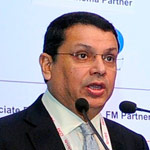







 By Ranjona Banerji