Tag: Ratan Tata

  • Crayon Data enters Indian market in alliance with GroupM / Mindshare

    By A Correspondent


    Mindshare, along with GroupM, announced that they will bring their global alliance with Crayon Data, among the most innovative global big data start-ups, to Indian enterprises.


    This comes hot on the heels of the announcement last week, of Ratan Tata’s investment in Crayon Data. Together, GroupM, Mindshare and Crayon Data aim to map the taste of millions of Indian consumers, which will allow enterprises to target consumers more precisely.


    “GroupM is changing the way marketers approach the business of media. Together with the WPP data alliance, bringing the Crayon Data proposition to India reflects our ambition to know more deeply than anyone else the tastes of Indian consumers and use that to help our clients target them better,” says CVL Srinivas, India CEO of GroupM.


    Commenting on this, Prasanth Kumar, CEO of Mindshare South Asia said, “Through this alliance, Mindshare’s proprietary data and research are further enriched with Crayon Data’s analytics. This will help us bring in both agility and adaptive solutions for our clients. Understanding the tastes and mind-set of consumers is extremely important and will be a great advantage for us especially since there is a strong focus on digital. In our journey to understand our consumers even better, this will be a great advantage.”


    Suresh Shankar, founder of Crayon Data, said, “As life goes digital, and choices proliferate in every aspect of our life, we will move to a world centred around personalisation, where companies understand tastes and preferences at an individual level, and use that to make choices simple and relevant for their consumers”.


    In India, the GroupM and Mindshare partnership with Crayon Data, will create a unique data coalition across media agencies and media owners, to deliver the vision of offering personalised choices to millions of Indian consumers.


  • Tata Trust & Google team up to launch ‘Internet Saathi’

    By Dyanne Coelho


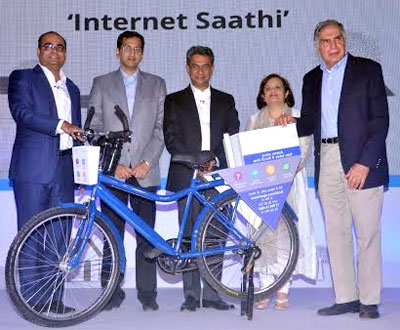
    Sandeep Menon, Country Marketing Director, Google, R Venkataramanan, Executive Trustee, Tata Trusts, Rajan Anandan, VP and Managing Director, Google South East Asia, Debjani Ghosh, Vice President SMG, Managing Director – South Asia, Intel & Ratan Tata, Chairman, Tata Trusts

    There was a time when one had to wait at least seven years to get a phone. Ratan Tata, Chairman of Tata Trusts, certainly remembers that time, and also acknowledges how far we’ve come today with the use of technology. Tata brought this up at the launch of ‘Internet Saathi’, an initiative put together by Tata Trusts and Google, and aimed at empowering rural women and their communities to use the internet to enable development. In fact, the initiative aims to bridge the rather large gender divide as well, when it comes to the use of technology.


    Studies show that only 12 per cent of internet users in rural India are women, according to Sandeep Menon, Country Marketing Director, Google.  said. He highlighted a study carried out in rural India to understand what it is that stops women from using the internet. The key findings were trouble knowing how to use it, the question of what’s in it for them, and lack of a point of access. “While women in the urban areas are making rapid progress using the internet, women in rural areas are getting left behind,” Rajan Anandan, VP and Managing Director, Google South East Asia pointed out.


    With enough statistics in hand to understand the urgent need of women empowerment in the rural areas, vis-à-vis technology, the team has designed a cart, built on the back of a cycle – akin to India’s traditional distribution system which is used to carry everything, from ice-cream to industrial supplies. The cart is fitted with internet-enabled Android One devices, tables and portable chargers, keeping in mind power cuts in many villages. Women will be trained to use these devices, but Menon highlighted that that is the most important thing as the women are curious to know more. “We’ve realised that all we need to do is spark curiosity, and then the women automatically take an initiative to learn the rest themselves and to teach others in the village as well,” he added.


    Debjani Ghosh, Vice President SMG, Managing Director – South Asia, Intel, quoted a UN report which said that across the world, about 25 per cent fewer women than men are using the internet, and the biggest reason for this is that women believe that it is not meant for them. Incidentally, Intel has been a long-term partner of Google India’s Helping Women Get Online (HWGO) initiative.


    Internet Saathi is set to kick off from Gujarat, Rajasthan and Jharkhand, and will eventually be rolled out across the country. It plans to reach 4, 500-odd villages and five lakh women and rural communities over the next 18 months. The internet cart will be available in the village for a minimum of two days every week for over a period of four to six months. It is aimed at creating awareness and will provide adequate training for using the devices. Once the cart has completed the training in a cluster of three villages, it will be moved to the adjoining cluster to complete a similar cycle. The initiative has roped in local self-help group federations and NGO members to help with the training programme.


    While many women in the rural areas still cannot read the language they speak, they use the internet to watch cooking videos or other such material that they find interesting, Ghosh explained, talking about previous initiatives undertaken in the rural areas.


    Asha Devi and Vimla Devi belong to a village called Varkheda in Rajasthan, and were present at the event. Clearly excited about the initiative, they said: “We will be able to get information that earlier we had to go to the city to get.” Added Vimla: “Even after they leave, we teach the other women [how to navigate the internet] and we try to spread the word.”


    “We have a commitment to educate [people] and create prosperity in the villages of India, and we will address it through education and expanding the knowledge base,” Ratan Tata said. “Philanthropy has changed in India over the years. Today, India is a different nation and people demand self-respect and want to be capable of enabling their own livelihood. There is a keen desire to be a part of the world that is today, not the world of yesterday. Digitisation is not only about opening up [a new] India to people, but it’s about connecting them to the rest of the world.” What better way than with the Worldwide Web.


  • It’s a deal! Ratan Tata invests in Snapdeal

    By A Correspondent


    Ratan Tata, chairman emeritus at Tata Sons, has invested in Delhi-based online marketplace Snapdeal. The company did not disclose the amount invested. The announcement comes a day after Snapdeal entered into a partnership with Tata Value Homes to sell apartment units of projects spread across five cities, namely, Bangalore, Chennai, Pune, Mumbai and Ahmedabad.


    Snapdeal’s cofounder and chief executive Kunal Bahl termed Tata’s investment a validation of the company’s growth. “An investment by a legendary and respected figure like Mr. Tata is an excellent validation of our focused strategy on building a long term enterprise and marks the start of a very important phase for the company,” said Bahl.


    This investment also underlines the growing interest shown by India’s traditional industries in the fast-growing ecommerce sector. Recently traditional retail majors like Reliance and Arvind have made forays online.


    The sector has also attracted large investments in the past few months. Snapdeal raised over $233 million this year in two rounds from investors like eBay Inc, Singapore-based Temasek and Wipro chairman Azim Premji’s family office Premji Invest. Market leader Flipkart too raised two rounds of funding this year. In July it raised $1 billion from existing investors and Singapore sovereign wealth fund GIC. Global major Amazon also announced a $2 billion investment for its India operations in July.


    Snapdeal, which is estimated to have crossed $1 billion in sales this year, is rapidly adding new categories of products. Apart from apartments, it has launched a catering supplies segment recently. In the next few months the four-year-old platform is planning to add 10 more categories.  Bahl has stated in the past that the company will focus on adding new merchants, new categories and focus on mobile commerce to ensure growth.


    Source:The Economic Times

    Copyright © 2014, Bennett, Coleman & Co. Ltd. All Rights Reserved

    Licensed to republish


  • Cyrus Mistry: Slow and Steady in Year #1


    By Suman Layak


    Signals from Cyrus

    Ok guys, it’s time for business: Mistry needs a few of those glamorous multi-billion acquisitions to deliver. Takes the call to abort Indian Hotels’ much-attempted bid for Orient Express.

    Wings for aviation: It was Ratan Tata’s dream, but it was Mistry who was at the forefront of the joint ventures with AirAsia and Singapore Airlines (with Tata’s support).

    Find some friends: Mistry has some 25 years ahead of him as chairman and needs people to grow old with him in the office. Much of the first year was spent in building his A team.

    Manage retirements: Tata Steel managing director HM Nerurkar retired in October. Choosing a successor in TV Narendran was one of Mistry’s key decisions this year.

    Get more women on board: Tata Sons is still a gentlemen’s club. But Mistry is signalling a change in attitude by inducting women on the Tata boards.

    Playing Mr Fix-it: Has identified the problem companies – Tata Motors, Tata Steel Europe, Tata Power – and their problem areas.

    Not yet ready for banking: Took the strategic call to withdraw Tata Sons’ application for a banking licence – for now.


    The Aviator’s Busy Flight Path

    For Ratan Tata, retirement may not necessarily have translated into less work and for sure has resulted in more than usual travel. A person familiar with his schedule indicates that Tata has been travelling a lot more since he retired. For starters, Tata serves on the Prime Minister’s Council on Trade and Industry, which means he continues to advise the top political leadership of the country.


    That apart he is also the president of the Court of the Indian Institute of Science and chairman of the Council of Management of the Tata Institute of Fundamental Research. He also serves on the board of trustees of Cornell University and the University of Southern California. Tata had graduated as a trained architect from Cornell. However, retiring from Tata Group companies - he is now chairman emeritus — is not the end of the corporate innings. For example, even now he continues to serve on the board of American aluminium major Alcoa. He is also on the international advisory boards of Mitsubishi Corporation, JP Morgan Chase, Rolls-Royce, Temasek Holdings and the Monetary Authority of Singapore.


    In September Tata also joined the board of trustees of Carnegie Endowment for International Peace. This trust is considered a premier American think tank. However, at the same time Tata has kept himself available to the Tata Group and in the beginning he had committed himself to fortnightly lunch meetings with Cyrus Mistry. Apart from that he is closely involved with the aviation joint ventures of the Tata Group, one with AirAsia and the other with Singapore Airlines. Tata himself had piloted a flight with the AirAsia team on board to Delhi.


    It is likely that some of the Tata companies may still consult him for his expertise, in specific areas like automobiles and aviation. He also heads the Tata Trusts which control a two-thirds majority of shareholding at Tata Sons and this must be taking up a lot of his time. He had also registered his own company RNT Associates with RK Krishna Kumar. But not much else is known about its activities. Not yet.


    Back in the ’70s, the families of construction magnate Pallonji Mistry and well-known legal luminary Iqbal Chagla were neighbours in Cuffe Parade. A happy consequence was that in 1992 Pallonji’s younger son Cyrus married Chagla’s daughter Rohiqa. On the wedding day, the father of the bride, Chagla raised a toast, starting with these words: “I was determined to dislike anyone who decided to marry my daughter.”


    Then he added a truism: “However, once you meet Cyrus, it is impossible to dislike him.” It still holds two decades later; everybody seems to like the 45-year-old Cyrus Mistry. Mr Mistry took over as chairman of Tata Sons on December 28, 2012. Since then, he has made all the right moves. “He has not taken any giant leaps, neither has he shaken the foundations of the group,” says Harsh Goenka, industrialist and chairman of RPG Enterprises.


    As Mr Mistry begins his 12th month as chairman of India’s largest conglomerate, in which his family led by father Pallonji Mistry owns an 18.5% stake, it’s time for him and his core team to prepare a rough and ready blueprint for the second year. That plan may call for a few larger leaps, and may indeed shake some parts of the foundation.


    Making the multibillion acquisition of Corus (now Tata Steel Europe) viable, for instance is one of them. Downsizing the business by mothballing some of its capacities, reckon analysts, may be the way to go. Back home Tata Motors – excluding the money-spinning Jaguar Land Rover ( JLR) – needs a refreshed portfolio to find its way back amongst India’s top 5 automakers. And the power, telecom and hospitality businesses too are in need of an overhaul.


    It’s a daunting task; more so for a man who’s still coming to grips with a 92-company group across 28 diverse sectors, even as it strategizes to enter newer businesses, like aviation. Ashok Basu, former bureaucrat and an independent director on the board of Tata Power, says: “I think he has the most formidable job in the country. But this mantle sits very lightly on his shoulders.”


    “Luckily, his health has held up. He has taken on a punishing schedule, whirlwind travel across the world, day trips to the Gulf countries and stuff like that,” says a person who knows Mr Mistry well. And Mr Goenka adds: “He doesn’t look stressed. But I asked him about his work-life balance and he admitted that’s gone for a six.”


    First, a Team

    One of Mr Mistry’s immediate priorities after taking over at the helm was to build a team of people who will, like him, be around for some time. Although Mr Mistry was appointed as executive deputychairman of the group in 2011 for five years, and was elevated in 2012, it is likely that Mr Mistry will have this job for more than a quarter of a century.


    Before retiring, predecessor Ratan Tata – who had the job for 21 years – had left a clean slate for Mr Mistry, even lowering the retiring age for non-executive directors, to ensure that the old guard goes away in two to three years. Tata’s first few years at the helm were spent consolidating his own position as the undisputed leader of the group and pushing out the veterans. He did not want such distractions for Mr Mistry (after all, Mr Tata had plenty of them when he took over and had to spend at least six of his initial years taking on – successfully – the group’s satraps).


    In Madhusudan Kannan, 39, Mr Mistry found his head of business development. Mr Kannan was the first member of team Mistry and joined the group in May 2012, seven months before Mr Mistry finally took over the reins. Mr Kannan is considered closest to Mr Mistry today. Mukund Rajan, 45 – younger brother of Reserve Bank governor Raghuram Rajan – was moved in from Tata Capital as custodian of brands and chief spokesperson as well as chief ethics officer. Mistry also brought in academic Nirmalya Kumar from the London School of Business to help with strategizing and NS Rajan from Ernst & Young as head of human resources. “In many ways it is like Rahul Gandhi’s team” says one uncharitable onlooker from corporate India.


    “It has more theoreticians than business managers,” he says. That may be unfair to both Mr Mistry and Mr Gandhi, but one cannot deny that Tata’s own lieutenants were either seasoned veterans from within the group (Syamal Gupta, NA Soonawala, Ishaat Hussain, to name three) or from other large companies (like R Gopalakrishnan from Unilever’s Indian subsidiary). Mistry has chosen his own horses, for surely he has to run on a different course.


    The Tata group did not participate in this feature. Also setting himself apart from the Ratan Tata-era is how Mr Mistry has sought to induct more women on the boards of Tata Sons. Vishakha Mulye, managing director of ICICI Venture, was the first woman inducted by Mr Mistry in February. She joined the board of Tata Power.


    He followed this up by bringing in Falguni Nayar on Tata Motors’ board and Ireena Vittal, a former McKinsey partner, on the boards of Indian Hotels and Tata Global Beverages (see Diversity Drive). With Vittal, Tata Global now has three women on its board (the other two being Mallika Srinivasan and Ranjana Kumar).</p>


    Ms Nayar, who now runs her own e-commerce venture Nykaa.com and a former managing director at Kotak Investment Banking is married to private equity fund KKR’s India chief Sanjay. Mr Mistry  asked Falguni to drop by for an interview and spent considerable time discussing her current venture before requesting her to join the Tata Motors board and bring her I-banking experience to the table.


    In May 2012, before he became Tata Sons chairman, Mr Mistry had joined the board of Tata Steel along with another lady, Mallika Srinivasan, chairman and CEO of tractormaker TAFE.


    However, these moves are only a beginning in creating gender-diversity at the house of Tatas, whose boards have traditionally been male bastions; for instance, the jewel in the Tata’s crown, TCS, has an all-male board; and even the Mr Mistry-created four-member general executive council is all male.


    There was one more quick response by Mr Mistry that pleasantly surprised many people. When a former executive of Tata Steel committed suicide and there were allegations of harassment by former colleagues, a committee was immediately set up with executive and non-executive directors of group companies to probe the allegations


    Plumbing the Numbers

    The Tata group today is virtually basking in the glory of a single outperformer – TCS, which accounts for roughly 60% of market value of all listed Tata entities and 80% of profits. To that extent, TCS managing director N Chandrasekaran, 50, stands tall – some observers say nearly as tall as Mr Mistry -in the top tier of leadership in Bombay House, the headquarters of the Tata group.


    Tata Sons owns almost 74% of TCS; and since Mr Mistry took over in end-2012, TCS’s market capitalisation has gone up by 58% adding Rs 1.4 lakh crore to the group’s market combined capitalization. The other clear outperformer is JLR, the $2.3-billion acquisition that more than makes up for Tata Motors’ dismal show domestically.


    JLR’s revenues in 2012-13 were 2.5 times that of the local operations, profits stood at Rs 10,406 crore as against Tata Motors’ domestic profit of Rs 302 crore, and, for good measure, the UK operation headed by Ralf Speth paid Tata Motors Rs 1,420 crore in dividend in June. Together Tata Motors and TCS account for roughly 80% of the group’s combined market value. The rest of the 26 listed group companies taken together have actually shrunk in combined market capitalization.


    The Indian operations of Tata Motors and European operations of Tata Steel may be the larger problems, but Mistry has more fires to douse. Mr Basu, for example, feels the biggest problem is at Tata Power. The company has posted a loss of Rs 39 crore for the first half of 2013-14 after a loss of Rs 85 crore for 2012-13.


    “Tata Power is probably his greatest headache – a problem created for no fault of the company. Take Mundra ultra mega power plant, for instance, which is suffering because the price of Indonesian coal has suddenly shot up and the state government cannot buy power at this price.”


    Then there is Indian Hotels, which was in the red to the tune of Rs 452 crore for the first half of 2013-14 on revenues of Rs 1,804 crore. The loss in this half year has exceeded the loss of Rs 430.24 crore of the entire previous year. The Tata Group is not a six-course meal but more like a tasting menu and there’s a lot more on Mr Mistry’s plate. The telecom business needs some decisions – especially as Tata Sons may need to buy back the 26% stake of Japanese partner DoCoMo in March 2014.


    Vatican Redux

    Clearly, taking charge of an illustrious company incorporated back in 1917 is not easy. In many ways Tata Sons reminds one of the Vatican. If you go through its archives and treasures, you come up with surprises. Like for instance, at Tata Sons, the equity capital with voting rights adds up to only Rs 40.41 crore.


    However, there are preference shares without voting rights that account for 100 times the amount at Rs 4,148 crore. These attract dividends at a fixed rate of 7.5% and the subscribers to the preference shares are mostly directors of the company and former directors and sometimes even unrelated professionals. In May 2013, Cyrus Mistry subscribed to preference shares worth Rs 1 crore (10,000 shares). R Gopalakrishnan, non-executive director invested Rs 6 crore in preference shares of Tata Sons in June 2013.


    In July Ratan Tata acquired Rs 8 crore worth of preference shares while NA Soonawala (also a former director) picked up Rs 1.5 crore worth of preference shares in July. Let us take the analogy of the Vatican of this day a little forward. The Catholic Christian church has a new Pope today, but the old Pope is not dead – and in fact is living in the vicinity. Mr Mistry heads Tata Sons, but Mr Tata is not very far away. He is available – as he was in the run-up to the aviation joint ventures with AirAsia and Singapore Airlines.


    Also, don’t forget that Mr Tata, now chairman emeritus, heads the Tata trusts that control around 65% of the equity shares of Tata Sons and by virtue of that holding controls the group while remaining in the background. Mr Mistry may well be the proverbial chip off the old block. Mr Basu says that while he brings in “youthful energy” to meetings he is very much similar to Tata in his manner, listening carefully and giving his opinion in the end. He has, for instance, suggested strong belt-tightening measures for the group and has also suggested that Tata Power seek a global footprint for itself.


    Nayar adds: “It seems right now he is listening and absorbing. I find Mistry to be very open and inclusive. He is also a very good listener and carefully evaluates everything before taking decisions. He also has a vision which he explains.” That is what Tata was known to do. And Mulye points to other similarities with Tata: “He has a unique capability in combining breadth of vision at one end and granularity of detail at the other. The other big quality he has is his sense of humility.” It would then appear that Mr Mistry has moulded himself in the cast of Tata, what with both of them evidently also sharing an aviation dream.


    A former senior executive at one of the Tata companies who did not want to be quoted says that the Tata influence on the group is still very strong – along with the influence of RK Krishna Kumar who retired in July 2013. Many of the CEOs of today are former executive assistants of the two senior pros, both of whom are trustees on the Tata Trusts (Mukund Rajan in the GEC and N Srinath, MD, Tata Teleservices aided Ratan Tata, while Avani Saglani Davda, CEO, Tata Starbucks and Govind Sankarnarayanan, CFO, Tata Capital were EAs to RK Krishna Kumar).


    But herein may lie the rub, point out analysts. The tough decisions that await Mr Mistry may be construed as going against Mr Tata’s legacy. For instance, what’s the future for the ultra low-cost car, the Nano, which was Mr Tata’s dream (although a few days ago he did clarify that his ambition was not to build a ‘cheap’ car but one that would be a logical step up for the country’s millions of twowheeler riders)? Similarly, the options for Tata Steel Europe – an acquisition that a section of analysts believe was overpriced but which Tata believes had to be made – are grim, with some analysts advocating sales of substantial parts of the business, if not all of it.


    Mr Mistry and Mr Tata have been on the same page – even before the former took charge as chairman. For instance, Mr Mistry bought a Nano as soon as it was launched, and apparently said: “It is a damn good car.” The question, of course, is for how long can Mr Mistry be on that same page. At some point he will have to differentiate himself in style and substance from Tata in key strategic decision-making. Mr Mistry has shown he is capable of those tough decisions.


    The $1.6-billion write-down of  Corus’ goodwill on Tata Steel books earlier this year – that contributed in a big way to the losses – the recent withdrawal from the race for a banking licence and the recent call to abort Indian Hotels’ bid for Orient Express are three instances. Expect a few more in the second year which, for Cyrus Mistry, will be more important than his first.


    Source:The Economic Times

    Copyright © 2013, Bennett, Coleman & Co. Ltd. All Rights Reserved

    Licensed to republish
     

  • What Cyrus Mistry inherits from Ratan Tata

    By A Correspondent


    Cyrus Mistry

    Cyrus Mistry will take over the chairmanship of the Tata group on Friday from Ratan Tata who led the transformation of the group from a conventional corporate house into a $100 billion global conglomerate with high-profile acquisitions abroad.


    Ratan Tata, who turns 75 today (Friday) will hand over the reins of the group to 44-year-old Cyrus Mistry, who was chosen his successor in 2011 and formally appointed chairman earlier this month. Let us look what the new Tata group chairman Cyrus Mistry will inherit from his illustrious predecessor.


    Headquarters: Bombay House in downtown Mumbai

    Operations: In more than 80 countries across six continents with exports to 85 countries

    Areas of business: Seven core areas – information systems & communications, engineering, materials, services, energy, chemicals and consumer products

    Group turnover: Rs 475,721 crore or $100.09 billion

    Turnover profile: 58 per cent of revenues from overseas

    Market operations: 32 companies publicly listed with a combined market capitalisation of about $88.82 billion

    Shareholder base: 3.8 million

    Top companies: Tata Steel, Tata Motors, Tata Consultancy Services, Tata Power, Tata Chemicals, Tata Global Beverages, Tata Teleservices, Titan, Tata Communications and Indian Hotels

    Foreign brands: Corus, Jaguar, Land Rover, Tetley, heavy vehicles unit of Daewoo Motors

    Number of employees: Over 450,000

    Foundation: Set up in 1868 by Jamsetji Nusserwanji Tata

    (With inputs from IANS)


    Source:The Economic Times

    Copyright © 2012, Bennett, Coleman & Co. Ltd. All Rights Reserved


  • Ratan Tata launches Lokmat tome on Aurangabad icons

    By A Correspondent


    It was a proud moment for the business community of Aurangabad when Ratan Tata, Chairman of the Tata Group, lauded their role in the growth and progress of Aurangabad – captured in the coffee-table book Business Icons of Aurangabad, which he unveiled.


    Congratulating the business icons of Aurangabad for their proud achievements and prosperity, Mr Tata urged them to “spread this prosperity to the whole country”.


    “There are many many people in Aurangabad and in the country who are not as fortunate or lucky as we are. It will thus be a mandate for all us to play a role in spreading the prosperity we enjoy, to others, because a prosperous India will be one whose future will be assured,” Mr Tata said.


    Happy with the progress that Aurangabad has made over the years, Mr Tata said: “I remember, as a school student, I used to come to Aurangabad to visit the Ajanta-Ellora caves. There was nothing other than Ajanta-Ellora then in Aurangabad, but today, it is a bustling industrial and tourism city!”


    “I wish that in the years to come, Aurangabad would see even better growth, and when Lokmat publishes a new book, it would take many volumes to include the personalities,” Mr Tata added.


    Videocon Chairman Venugopal N Dhoot too congratulated the business icons of Aurangabad, saying that it is because of them that Aurangabad has become so prosperous.


    Mr Tata unveiled the book – compiled and published by Lokmat Media – in the presence of Guest of Honour Venugopal N Dhoot, Chairman, Videocon, Mr Vijay Darda, MP Rajya Sabha and Chairman Lokmat Media, Mr Rajendra Darda, State Minister for Education, Mr Deven Darda, Director Lokmat Media, and Mr Rishi Darda, Joint MD Lokmat Media.


    Also present on the occasion were the business icons honoured in the book, along with several eminent public figures of Aurangabad and Marathwada region.


    Mr. Vijay Darda, Rajya Sabha MP and Chairman – Lokmat Media Pvt Ltd, said: “Business Icons of Aurangabad is our salute to the business leaders who have built modern Aurangabad brick by brick. I am grateful to Shri Ratan Tata and Shri Venugopal Dhoot for inspiring these business leaders with their presence here today. It is because of icons like these that this historic city has experienced such phenomenal growth.”


    The Business Icons series, introduced by Lokmat to serve as a guide for the future generations of the country, started with the release of Business Icons of Pune, at the hands of Pranab Mukherjee, on November 7, 2011 in Pune.


    Rishi Darda, Joint Managing Director – Lokmat Media, revealed that the selection of the business leaders profiled in Business Icons of Aurangabad was made by a distinguished panel of that included social entrepreneurs, presidents of industrial associations, and the senior editorial board of Lokmat.


    “Lokmat Media will continue the process of chronicling outstanding economic growth. Nagpur is next on the agenda,” Mr. Darda said


    Recognized over the last five decades as a major industrial destination, Aurangabad has been included in the ambitious Delhi-Mumbai Industrial Corridor which is expected to attract major investments. Industrial houses that have created wealth in Aurangabad represent a wide gamut of industry and trade segments such as automobile, education, real estate, white goods, pharma, steel, textiles and agro-products and include such eminent names as Bajaj Auto, Wockhardt, Videocon, Garware, Siemens, Nirlep, SkodaAuto India, RL Steels and many others.


    The book, which profiles 64 industrialists who have made major contributions to the spectacular growth story of Aurangabad, is priced at Rs3,000 and will be an immense value-add to any student, researcher or institution of industrial growth in India.


  • Shapoor Mistry seen within the Shapoorji Pallonji Group as a ‘big picture strategist’

    Shapoor Mistry

    By Kala Vijayraghavan


    Reclusive Indian-born Irish tycoon Pallonji Mistry, 82, officially bequeathed the chairman’s role of the $2.5-billion Shapoorji Pallonji Group (SPG) to eldest son, Shapoor Mistry, 47, in early June.


    The change of guard was in keeping with the way the low-profile diversified conglomerate and its promoters go about their task – without ceremony and any announcement from the rooftops.


    Shapoor will continue to be managing director, and Pallonji may take on the mantle of chairman emeritus, suggest two senior group officials on the condition of anonymity.


    When contacted, a group spokesperson confirmed the move. “Pallonji Mistry has stepped down as chairman of Shapoorji Pallonji Group and Shapoor Mistry has taken up this role. The group companies will continue to get Pallonji Mistry’s advice as and when required,” he said.


    Shapoor has taken charge as chairman & MD of SPG a little over six months before younger brother Cyrus Mistry, 43, is slated to succeed Ratan Tata, who will retire as chairman of the Tata Group at the end of the year.


    In November 2011, Cyrus was appointed deputy chairman and chairman designate of Tata Sons, the holding company of the over 100-company group.


    Prior to that, Cyrus was joint managing director of the SP Group, besides being a director on the Tata Sons board since August 2006.


    Pallonji is the single largest shareholder of Tata Sons, the holding company of the salt-to-software Tata Group, and was called the ‘Phantom of Bombay House’ (headquarters of the Tatas) for his reclusive nature. The patriarch had split his 18.5 per cent stake in Tata Sons equally between his two sons a few years ago. Cyrus’ shareholding has been moved into a trust as a part of an agreement between SP and the Tata Group before Cyrus was appointed deputy chairman at Tata Sons.


    Shapoor is seen by insiders within the group as a ‘big picture strategist’. Group officials point out that the new CMD has initiated a massive revamp of the SPG brand, which will soon complete 150 years.


    The rebranding – to SPG – is part of Shapoor’s ambitious plan to realign group companies to create a powerful combined entity that can compete globally, top group officials said.


    The rebranding exercise saw various group companies operating without the SP brand – like Afcons Infrastructure and Forbes Gokak, to name two – being brought under the mother brand.


    A new logo, with the slogan ‘Built to Last’ below it, seeks to convey trust and dynamism, and the group’s forward-looking nature even as it seeks to remind clients and consumers about its 150-year heritage, explains a company spokesperson. “The elements of the Shapoorji Pallonji brand have not changed. The group has rich values that have got re-emphasized with the new brand,” the spokesperson added.


    Shapoor is keen that the group, which is primarily B2B with businesses such as construction, engineering and infrastructure, show more of its consumer-facing side. The group has retail-driven businesses such as residential real estate (including luxury as well as affordable housing), home cleaning, security systems and air and water purifiers. Currently, construction and real estate account for over 60% of the group’s revenues.


    “Shapoor is looking at the branding and marketing aspect of the SP brand very closely. He wants the brand to be more visible as an interface to the consumer,” a top official said on condition of anonymity.


    Meantime, Shapoor has begun strengthening his management team by roping in professionals as part of his globalisation plan. He is working on consolidation of various group companies into manageable entities within the group’s core businesses. Along with mergers, he is also understood to be working on buying assets – overseas and local.


    Shapoor has identified a few global and domestic businesses for acquisition, officials close to the management said. SPG has also verticalised its various businesses such as real estate, construction and infrastructure according to the recommendations of management consulting firm The Boston Consulting Group.


    Source: The Economic Times

    Copyright © 2012, Bennett, Coleman & Co. Ltd. All Rights Reserved


    Photograph: Fotocorp.com


  • Anil Thakraney: Nano: Manufacturing success, marketing failure

    By Anil Thakraney


    Last night, I watched a very interesting documentary on Nat Geo. No, it wasn’t about lions or elephants, it was about all that went into the making of Ratan Tata’s dream car, the Nano. The programme was fascinating, as the producers went through all the challenges and problems the Tata group faced to bring the so-called ‘one lakh’ rupee car to life. And they also spoke to the designers and the engineers as well as to Ratan Tata himself. (A quick aside: Why Shri Tata prefers to speak only to firangi journalists and production teams is something I’ll never understand.)


    Must say I was left quite impressed with the manufacturing marvel little Nano is. Okay, so it isn’t really a one lakh rupee car on the road, but at its price point it does pack in a lot of goodies, is reasonably comfy for four passengers and is hugely economical on fuel consumption. And most importantly: because it’s tiny, the Nano can slip into any little parking space… a huge bonus in city conditions. And yet, the car hasn’t taken the market by storm. Sales have been below expectations, in both urban and rural areas. Strange? Well, not really. Because Tata’s marketing team screwed up a really good thing.


    The moment they positioned it as the ‘poor man’s’ car, they took the sex out of the equation. Even at a low cost, a car’s association with status and pride must be maintained. No one wants to be perceived as a loser when it comes to his car, a person’s most visible possession. This simple little consumer insight eluded such highly paid and experienced marketing minds.


    The bad news is that the damage is done. Whatever tricks the Tata Nano marketing guys have up their sleeves, it will be very difficult to erase the ‘poor man’s car’ image. I would like to meet Mr Tata and discuss this, but he seems to be allergic to desi journos.


    But here’s the good news for Tata. After watching the Nat Geo documentary, I have decided to buy the Nano. Because it’s a real value for money gaadi, and what people think of me has never mattered anyways. All that the Tata group can hope for is there are more misfits like me in this nation.


    * * *


    PS: ‘A Step From Zero’ is a cool web idea from Coke. The film features a youngster who turns his sad life around by practicing a new dance move. The film’s gone viral and the dude’s become famous. This was a web project where people were invited to shoot videos of their dance moves and submit them for selection. Nice web idea from Coke. A good case study for marketers struggling with the digital space.


  • Cyrus Mistry redesignated Tata Sons MD

    By Satish John


    In a quiet move, the board of Tata Sons has re-designated Cyrus Pallonji Mistry as the managing director of Tata Sons. The new designation became effective from April 1, 2012.


    On November 23, 2011, Tata Sons named Mr Mistry the successor to Ratan Tata, the current non-executive chairman of Tata Sons. Tata will retire by the end of 2012, when he becomes 75 on December 28.


    Mr Mistry is currently learning the ropes directly under Ratan Tata, shadowing the chairman as he prepares Mr Mistry to take on the mantle for bigger responsibilities within the Tata group.


    Mr Mistry’s induction is closely tracked within and outside Bombay House, the Tata headquarters. In recent times, he has met chief ministers of states such as Jharkhand and Gujarat, Union ministers and also been introduced to senior business captains of industry associations.


    Interestingly, when Ratan Tata took over from JRD Tata, he was appointed the executive chairman. Following the group’s policy, Mr Tata shed the executive role when he attained 65 years of age, but retained the post of non-executive chairman of Tata Sons and flagship group companies.


    In recent years, the Tata Sons board has seen senior board members shed their executive roles, even as they retained their role as a non-executive board member. The senior members include R Gopalakrishnan, Arun Gandhi and R Krishna Kumar.


    Legal circles say it is logical to appoint Mr Mistry as the managing director of Tata Sons. As a deputy chairman, Mr Mistry wouldn’t have the direct management role in managing the day-to-day affairs of the company. “Appointing him as the managing director gives him the legal authority and responsibility,” to manage the day-to-day affairs of the holding firm.


    Source: The Economic Times
    Copyright © 2012, Bennett, Coleman & Co. Ltd. All Rights Reserved