Tag: Ranjan Malik

  • Storming with Insights!

    The launch of the website Insight Buzzar- a platform for storytellers to share their stories with the world


    By Anuka Roy


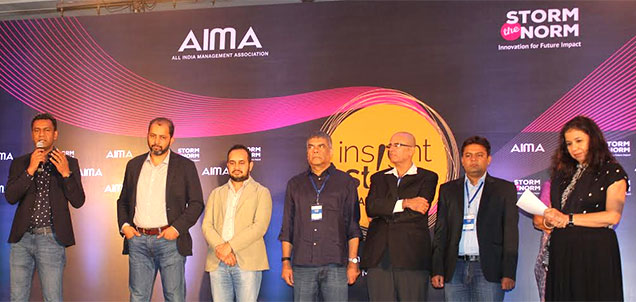
    The All India Management Association (AIMA) in association with Storm the Norm – a thinktank of passionate bunch of marketing, innovation and entertainment professionals hosted a conclave called ‘InsightStorm’. It was an interesting format where leading lights from art and business came together to share the insights from their respective fields and also get insights from each other.


    “The best insights are gained from conversations,” said Firdose Vandrevala, President, AIMA in his welcome speech at InsightStorm, the first edition of which was held on Wednesday, August 10.


    The Conclave was divided in to two halves. The morning half was called ‘Being Extraordinary’ and the post-lunch half was called ‘Doing Extraordinary’. These two broad categories were further divided in to sub-categories.


    In the ‘Being Visionary’ session, Indian film and television actor Kabir Bedi represented the art side and shared insights from his life and career. “Opportunity is a very strange thing and it does not come with marching brass bands,” he said. Bedi reminisced about the financial struggles he went through during his college days and which in turn helped him in being motivated to achieve and aim for bigger things. His concluding insight was, “Success is not an end. There are other worlds to conquer.” Ajay Bijli, owner of PVR Cinemas, represented the business side. But this session was a little different. Instead of Bijli sharing his insights straight away, he was asked three questions through which he explained the insights. He shared with the audience how his mini goal of offering something new to cinema goers gave birth to a bigger opportunity and more importantly the introduction of multiplexes in India.


    The next session was about ‘Being Pioneer’. Multidisciplinary artist and storyteller Raghava K K and Shabir Momin, MD and CTO at ZengaTV.com represented art and business respectively. This session was predominantly about the art of storytelling and how it can be used profitably for business purpose. “Live the best story you can create,” said the storyteller. Momin narrated a personal experience of how his talented sister-in-law was initially hesitant to commercialise her painting talent but now, with his help, she is an established painter. Momin’s insight: “Do not mind, I will convert your art in to movement.” Finally, they both had a common insight for the audience. “Story is the new money and the companies who understand it will flourish.”


    On one hand there was the national award winning film producer, screenwriter and director Vikas Bahl representing art and on the other side Ananya Birla, founder of Svatantra Microfinance, one of the youngest participants of the Conclave represented business. Birla spoke how at the mere age of 17 she wanted to be an entrepreneur and a catalyst for change in rural India. She said, “There are no finishlines, just milestones to be celebrated.” Bahl said that trust is a very important factor in being a leader. So, the trust on thoughts and people should always be maintained. He also added, success and failures should be embraced equally.


    In the midst of these insightful sessions, Anisha Motwani and Ranjan Malik, Co- founders and Managing Partners, Storm the Norm Ventures, launched their website Insight Buzzar, which will be live in the next few weeks. It is a platform for storytellers to share their experiences and stories, which can be under any category from business to entertainment or anything they want to share with the world.


    Actor, model, producer and social activist Dia Mirza and Neeraj Roy, MD and CEO, Hungama Digital Media Entertainment were the speakers in the ‘Being Innovator’ session. “When an individual’s thoughts are inclusive of humanity, then an individual’s happiness in benefitted by multiplicity,” said Mirza. She spoke about personal experiences and how sometimes most of us tend to think our personal problems to be much bigger than the real problem that exists in the world. Roy made the audience laugh by stating that he founded the company on April Fool’s Day and that is why his people do not take themselves seriously. According to Roy, “Storytelling will become more immersive, interactive and gamified, with video becoming like ‘Air’.”


    Two successful business stories were shared by Radha Kapoor, Founder and Executive Director, Indian School of Design and Innovation (ISDI) and Raj Nayak, CEO, Colors – Viacom 18 respectively. Kapoor described the journey of ISDI and shared her insights. She said, “Good design may not always make commercial sense but going forward every business must make great design sense.” “We wanted to jump out of the box, we wanted to break free,” said Nayak about how the channel was conceived. He explained the journey of Colors so far. He concluded by saying, “Breaking the status quo and finding a differentiating factor is the key.”


    The ‘Doing Extraordinary’ part of the conclave started with Arnab Goswami, Editor-in-chief and President, Times Network and Sam Balsara, Founder, Chairman and MD, Madison World and Madison Communications.  The session was on ‘Conceive’.“Go with your gut feeling,” said Goswami. He said that during the Commonwealth Games scam story, he was initially paranoid whether to break the story or not but ultimately he went with his gut and broke the story. A veteran marketing services professional, Balsara said, “It is an advantage to recognise that you are at a disadvantage. And, if it is safe, it is risky.” According to Balsara, many great ad campaigns do not see the light of the day because they could not be sold. Hence, the ability to sell is very important.


    The ‘Design’ session was initiated by Ashwin Sanghi, Author and Mahesh Murthy, Founder, Pinstrom and Co-founder, Seedfund. Sanghi narrated a funny story about his first book. When he went to a bookstore to see how his book was doing, he could not find it initially. Finally when he did find it, he purposely went and kept it in the best seller’s shelf. “An effective lie is one that stays as close to the truth as possible,” he said. Murthy described his investments in startups and how he noticed that the biggest brands in the world do not advertise. He said, “The dominant brand or name in a category is now the one who spends the least on advertising.”


    Rohan Joshi, stand-up comedian, writer and television presenter and Ashish Hemrajani, Founder-CEO, Bigtree Entertainment helmed the ‘Launch’ session. Joshi stressed on the obsession of clients about videos going viral and advised them not to think about the same since it takes away the essence from the larger picture. “A brand cannot demand a ‘viral’. It can only demand content. Virality is the internet’s decision, not the client’s,” he said. Hemrajani explained the rollercoaster ride of bookmyshow.com and how bid data helps them knowing their customers. He said, “Creating friction by asking information from users does not make for learning enough about your users.”


    The participants of the ‘Scale’ session were founder and blogger of MissMalini.com, Malini Agarwal and Radio Jockey, Actor, Anchor, Writer and Director Roshan Abbas. The common element between both of them was that both dared to dream and have been very successful in their respective fields. This session was predominantly about finding happiness in what you do and being happy in general. “It is great to scale fast but it’s ultimately about how long you last! Iconic brands are designed for longevity,” said Agarwal. Abbas stressed on the fact that it is important to find your replacement, so that you can focus on what has not been done. He said, “Start with spirit. Supplement with systems. And, find the balance between them.”


    Earlier in the day, painter and sculptor Jatin Das shared his story with the audience. He expressed his disappointment about the changing scenarios in terms of art and how commercialised it has become. “We buy more and see less, media celebrates the rich not the richness of our culture, change that at a primary level,” he said.


  • ‘This is the best time for innovations’


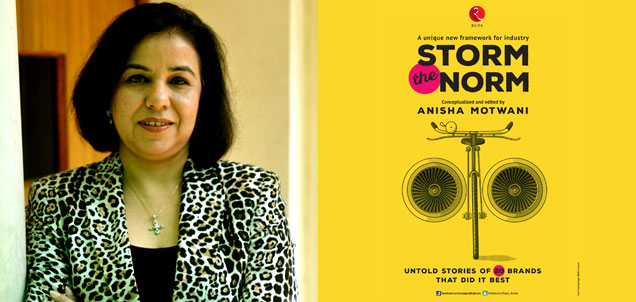
    Drawing from her rich experience with brands in India, marketing consultant Anisha Motwani has written and edited a book of 20 stories of brands that have been successes in more ways than one.  With a foreword by insight specialist Santosh Desai and an afterword by innovation specialist Ranjan Malik, Anisha Motwani speaks to Pradyuman Maheshwari as ‘Storm the Norm’ makes its way to leading bookstores and e-commerce sites. Read on…


    Your book cover says that it carries the ‘untold stories of 20 brands that did it best’. Many of these stories, or case studies, are known in the industry; some even discussed in B-schools. So how are these ‘untold’ stories?

    These are known brands [but with] partially-known stories and some completely untold details. The brief to the business owners — and my subsequent interactions with them — led to certain revelations that you won’t find in whatever has been shared till now. The stories are as much about strategic manoeuvres as they are about human endeavour: Stories about ordinary people pursuing extraordinary dreams and achieving them. It has details of not just what they did, but also why and how.


    We have 20 stories in the book… any brands that you would’ve liked to look at, but weren’t able to?

    These 20 stories are the final set that went into publishing. I did also want to look at brands like BookMyShow, Himalaya and Maggi.


    Having studied the 20 brands and various more while shortlisting these, would you say there’s anything common to all of them and their success stories?

    After having written these stories, Ranjan Malik and I decided to take a perspective-building step back and noticed something really interesting. There was a pattern in the way these brands had gone about ‘storming the norms’ of their respective industries.  So if there’s one truth that these success stories prove beyond doubt, it is that industry ‘storms’ aren’t purely accidental. They can be made to happen by design and, perhaps, at will. There is a method to the magic.


    While researching the success stories, we discovered a factor that economists have known for long but businesses don’t: The issue of Total Surplus. One big secret behind most business successes is the stormer’s ability to spot the invisible, sub-optimal in the industry, and conceive a breakthrough that unlocks new total surplus.


    Tell us more about the ‘unique new framework for the industry’ that your book promises…

    Most organisations just go from one project to the next, or are too busy celebrating their success to pause and look at what lead to that success. We’ve did just that, across 20 brands. And hindsight offers some amazing insights. We’ve tried to decode the method in retrospect, and to help organisations apply it by design in their most high-challenge projects. We have outlined a five-stage methodology called the Storm the Norm Framework.


    Clearly innovation and thinking out-of-the-box is something everyone wants to do, but is it easier said than done?

    This is the best time for innovation. We will see more innovations in the next decade than we did in the last century. And there are two reasons for it.


    First, we have hindsight so we now know what has helped organisations succeed with innovation in the past. Thanks to these learnings, the strike rate of innovation in the future will be much better than it has ever been in the past. Our reason for developing the Storm the Norm Framework was just that, to develop a methodology after studying different kinds of organisations: legacy, challenger and entrepreneur


    Second, every sector has evolved well and has developed amazing technologies. There is enough cross-industry inspiration available. Today you simply have to imagine a fantastic scenario, and someone somewhere has already cracked the solutions needed to realise it. You often only need to create creative combinations. Organisations often don’t look beyond their own industries. Our aim with this book is to trigger cross-industry learnings and inspiration.


    Do you think global giants find it tougher to be nimble and adapt to the times because they have to follow a certain way of doing things compared to homegrown players who are less rigid?

    Both kinds of organisations have their own strengths and their own ways of succeeding with innovation. Constraints aren’t always bad; they force you to unlock new value within the defined boundaries. We have included both kinds of organisations in the book. Every organisation must find its own unique way. That’s why this book – to get a more nuanced understanding of what stormers do differently, and initiate your own storm the norm strategy.


    If you had to identify one brand (from among the 20) that has achieved more than the others, which one would that be?

    Each brand in the book has had its unique context and unique challenges. Each one of them has been amazing in its own way. They achieved the extraordinary and ended up surprising, not just the world but their own selves too. I can’t pick just one.


    This interview first appeared in dna of brands on January 18, 2016


    The Story of Success


    Extracts from ‘Storm the Norm’, a new book that recounts the ‘untold’ stories of 20 leading brands


    By Anisha Motwani


    A diverse assortment of stories that give insight into what kind of levers can be used to create a winner brand. Take for example chocolate maker and market leader, Cadbury. Everyone has savoured the taste of Cadbury Dairy Milk, and nearly every marketer worth his/her salt would be aware of the brand’s successful integration into the traditional-sweet-eating habit of Indians. But what strategies and actions went into achieving this? The Cadbury story documents how it all began with a big shift in thinking about business and growth. It is a lesson at many levels: a lesson on how a large and potent target audience can slowly become a roadblock for future business; a reminder that the path to growth need not always be through growing market share; a story of how it is possible for a foreign brand to become part of the cultural fabric without localizing the product too much. Equally the story showcases the magic that ensued when the brand adapted itself and created new codes that fitted more seamlessly with category and culture.


    Let’s change gears to a challenger brand now. When you think of great products, bathing soap is hardly the first thing that comes to mind. However, that is exactly what the Indian Tobacco Company (ITC) aimed to do, when it decided to penetrate the category with Fiama Di Wills. A really late entrant into one of the oldest categories in the country, the brand was clear that its foremost intent was to challenge the typical soap and create a sensational new product–one that was differentiated not merely by form, colour or fragrance, but also a concoction of ingredients and technology that Indians had never witnessed before. The Fiama di Wills story illustrates how some companies are clear that first it is critical to create a hero product. The bells and whistles and propositions and campaigns can come much later. In its endeavour to deliver a new, unmatched experience to consumers, there were so many stumbling blocks that the Fiama team had to face, so many occasions when it could have given up and created a me-too product and just used the ITC muscle to push sales. But it didn’t. It persisted every time it was tested, to ultimately emerge with a winner.


    Moving to another league of brands altogether–the young entrepreneurial businesses. While there are plenty of such success stories in India today, I have selected a few that have made a mark in more ways than one. These are businesses whose success is not simply measured in terms of business valuation or the fact that they are media darlings, but those whose start-to-date journeys hold vital lessons in doing business for everyone. For instance, Make My Trip. This is an extraordinary story of pursuing the dream of forever changing the way Indians researched, planned and booked their travel. From the days where vacation planning was a tedious project and life without travel agents and long ticketing queues unthinkable, to now, when online travel planning and purchasing is common practice, this brand has had a pioneering role in shaping the change. By riding emerging trends, taking sensible decisions when a large bulk of the market was not ready for their dream and fostering deep relationships with allied partners, Deep Kalra and his team strategised their way to success. Like a great movie, the journey had several twists and turns and a few occasions when the founder was tempted to sell or shut shop but chose to keep faith instead. What adds to the excitement is that the Make My Trip story is packed with not one or two but so many innovations across product offerings, service standards, technology, marketing and operations that one is constantly looking out for what next they did differently!


    Such remarkable lessons continue across other entrepreneurial brands as well. What these kinds of brands do best is to open up refreshing ways of thinking and going about their business, so they naturally offer many valuable lessons along the way. Like PVR, where Ajay Bijli turned the whole expectation from cinema theatre upside down. Until the 1990s, cinema theatres were mostly just a destination, and movies were the real deal. The theatre itself was just a venue for stories to unfold. But he changed all that. Not only did he introduce the country to the multiplex, he created a new era in movie watching, where choice, comfort, luxury and entertainment all came together to take the movie-goer’s experience to a new high.


    There are several more examples of such category transformation. Radio Mirchi, for instance, is a story of a turnaround of the radio medium itself; of how a boring medium from which expectations had remained unchanged for decades, turned cool and irreverent; and how entertainment found a new source. It is also a great lesson on how you can win many fans by experimenting all the way through.


    Many of you may not know this, but Raymond’s ‘The Complete Man’ broke the conventions of fashion advertising in its time. Then there is Honda two wheelers–a fabulous story of storming the norm in scooters and making Activa a resounding success, and then of how it carried with it its winning strategies post its joint venture with Hero coming to an end. On a completely different note is the story of Sprite, a brand built on communication, on strongly marrying youth insights with product truth, of turning an absolutely niche lime category into a mass brand.


    Similarly, there are Ford Ecosport, Axis Bank, Kissan, MTR Foods, Saffola, Real Juices, Sensodyne, Tata Tea and Mahindra XUV500. Each of their growth stories provides insights into creating a storm in their respective categories and achieving outstanding results. Some successes are based on distribution, some on product, some on communication, while others are based on core business models. There are stories of reinvention, of strategies on market expansion, and some even of using weaker siblings in the brand portfolio to fortify overall business. 


    Published with the permission of the Author/Editor

    Storm the Norm: Untold Stories of 20 Brands that Did it Best

    Written and Edited By Anisha Motwani

    Hardcover, 320 pages

    Published by Rupa Publications India

    Â