By Anuka Roy
For the past few years we have hearing that ‘Digital has arrived’. That ‘Digital is the future’ etc. But how has it arrived and more importantly how will it be our future? So, on Wednesday (July 27) some top executives from the India’s motion picture and digital industries concluded that accessibility, affordability, quality content and online content protection will be the key drivers to sustain growth in India’s digital economy.‘Fast Track India: Bolstering Growth in the Digital Content Economy’, a knowledge series forum by the Federation of Indian Chambers of Commerce (FICCI) in association with the Los Angeles India Film Council (LAIFC), assessed the extent to which screen content acts as a key driver of the digital economy in India. The industry experts assessed the current regulatory and infrastructural challenges, reviewed future growth trends and underlined innovative ways of monetising digital content to stimulate growth in India’s digital economy.
Noted filmmaker and Co-Chairman, FICCI, Entertainment division, Ramesh Sippy started the conference by highlighting the fact that increased connectivity, technological innovation and new content delivery platforms all combine to increase growth. He said that government’s role is pivotal to enabling legitimate content delivery platforms to protect and monetise their content in order to achieve their full potential in a rapid changing marketplace. Digital India has the potential to create opportunities for businesses, promote innovation and create jobs. However online content theft, varying levels of broadband access and affordability in terms of data tariffs continue to present challenges for providers to deliver value to consumers. These factors will have a significant impact on how digital media evolves in the future.
Girish Menon, Director, Transaction Services, KPMG India moderated as well as introduced the first panel discussion. The first panel ‘Making Sense of the Economics of Digital Media’ featured a keynote presentation by KPMG. Menon said, “The advent of the OTT services and on-the-go content aided with competitive tariffs and falling average retail price of smartphones has helped to drive video consumption in India. However, profitability still continues to be a major challenge coupled with infrastructure and affordability of data tariffs and payments models. It is imperative for the OTT players to address these concerns through innovative means to achieve the medium’s full potential.†Speaking about the future of OTT content services, Ajay Chacko Co-Founder and CEO, Arre said, “As in the case of broadcast TV in India, the relatively infant digital content economy is showing signs of secular, organic growth driven by an increasingly young India. We already have more than 120 million consumers of digital content. As with every paradigm shift, audience shifts will be followed by a shift in advertiser preferences and finally consumer monetisation. So I am quite hopeful that the digital content economy will see the exponential growth that has been witnessed in the 2000-2010 decade in TV, in the next three to five years.†While film producer Vishesh Bhatt, expressed his concern about serious content makers still not understanding the digital ecosystem. However, Karan Bedi, COO, Eros Digital, was optimistic about the future and gave the example of Pokemon Go, about how the game has caught the attention of the consumers. He said: if consumers are compelled by content, they will eventually pay for subscription as well. Said Archana Anand, Business Head, dittoTV: “In light of the accelerated digital media consumption across the country, it is wonderful that FICCI and the LA India Film Council provides this much needed platform to discuss the market potential of this space and the innovations and challenges thereof.â€
Moving on from the concerns about monetising digital content, the other looming concern is around the rules and regulations of the digital media. The second panel discussion on ‘Regulatory and Infrastructural Challenges for Digital Media’, Abhishek Joshi, Head, Marketing and Analytics, Digital Business, Sony Pictures Networks India Pvt Ltd. said “The OTT industry has graduated from the innovators stage to the early adopters stage within the innovation diffusion curve, based on distinguished product strategies by players in the market. However to cross the chasm to gain the majority market, policy makers will have to play a very big role. Infrastructure and regulatory policies are going to be the biggest differentiators for industry growth for the next 18 months.†Akash Banerji, Head, Marketing and Partnerships, VOOT was very hopeful about the future. According to him, even though the industry is still learning, the consumers will be in a demanding position in the future and eventually mobile data will also come down. Siddharth Roy, COO, Hungama.com, stressed on the fact that branded IP (Intellectual Property) will be one of the key drivers of content regulation. But Rajeshree Naik, Co-founder, Ping Networks, had other concerns. She said that it is the collective responsibility of the industry is to see to it that government stays out of digital media regulations. This session was moderated by journalist and author Mayank Shekhar.
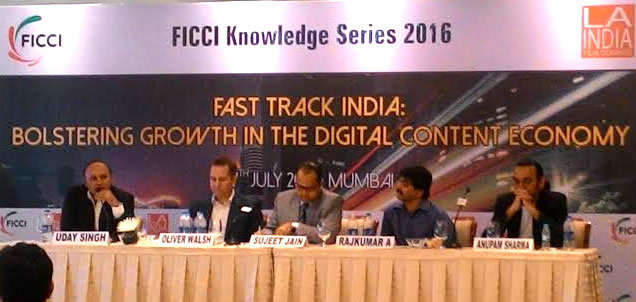
The final panel discussion was on ‘Building a Robust Enforcement Model to Protect Content In a Digital Economy’ and was moderated by Uday Singh, Managing Director, Motion Pictures Association, India Office. Oliver Walsh, Regional Director, Online Content Protection, Motion Picture Association- International(MPA-I) said, “The Indian film and TV industry supports 1.8 million jobs which are at risk because of rising online content theft. The future of legitimate content delivery platforms depends on effective enforcement measures supported by Indian State Governments. The Telangana Intellectual Property Crime Unit (TIPCU) is a great example of a dedicated law enforcement unit to tackle organised online film piracy and will set a gold standard approach to significantly reduce online infringement of films and television shows. I hope it is the first of many such enforcement units across India.†Rajkumar Akella, Honorary Chairman, Governing Council, Anti Video Piracy Cell, Telugu Film Chamber of Commerce said, “As we have been witnessing in recent days, the problem of online piracy is most urgent. The greatest threat now has become the pre – movie release leakages. Without real time interventions from the government and industry, it will go out of control. In this scenario, the latest initiative – TIPCU by the Government of Telangana, the Telugu Film Industry & the Motion Picture Association, India office, is a very significant step in tackling Movie Piracy, particularly Online Piracy. It is a collaborative, dynamic model,where the Government works seamlessly with the Industry and all stakeholders. The unit will be making optimum use of Technology besides policy, enforcement and outreach. This is a step in the right direction to root out piracy in India.†The General Counsel of Viacom 18, Sujeet Jain suggested the formation of digital courts to deal with piracy and protect online content. Anupam Sharma, Director, Film and Casting Temple, Australia was of the opinion that educating the consumers was the first step in stopping illegal downloading of content. He showcased a short video where the cast and crew of his movie are shown to be thanking the audience for not watching pirated videos and acknowledging the fact that the audiences are also a part of the film industry. This video was made to create awareness against video piracy.
Biren Ghose, Country Head, Technicolor India, in his concluding remarks, said, “Content is assuming new life in the emerging digital economy. Technology enables innovations in imagery that could hitherto neither be produced nor consumed. FICCI and LA India Film Council need to be complimented on encouraging the conversation for the Indian agenda in this space.†Panelists concluded that a combination of government and private initiatives would need to be rolled out to achieve the ambitious goal of a truly Digital India.