
Tag: Ramesh Chauhan

  • BTL Baatein: Ramesh Chauhan, Bisleri International… Powered by VISCOMM

    With a career spanning of around 52 years, Ramesh Chauhan, the man behind cola giant Thums Up and popular mineral water brand “Bisleri” holds a double major in Mechanical Engineering and Business Management. At the age of 27, he took the bold step of introducing bottled mineral water to the Indian market, at a time when buying it was unheard of. In this edition of ‘BTL Baatein’ which which is powered by VISCOMM, Santosh Jangid gets the views of Ramesh Chauhan, Chairman and Managing Director at Bisleri International Private Limited on Below The Line (BTL) advertising, the focus of the company and the balance between ATL (Above The Line) and BTL… it is indeed an honour to have one of India’s most celebrated entrepreneur as part of the BTL Baatein series..


    How important is BTL to your overall marketing plan?

    BTL advertising is more of one-to-one interaction with the consumers and gives them hands-on experience with a product or a service. BTL is precisely targeted for active engagement; once a consumer experiences a brand it helps develop a relationship with the brand thereby indirectly generating leads. It is of key significance to all our brands; and presently we are focusing more on BTL for our soft drinks range – Bisleri POP. It is important that the consumers try our products and become a repeat buyer. So far the response has been very encouraging for all the four variants – Spyci, Pina Colada, Limonata and Fonzo.


    Can you also specify the range of activities that you undertake as part of the below-the-line advertising and promotion?

    Bisleri is presently involved more in BTL activities in terms of mall activations, canter activities, sampling at select locations where we can touch base with our consumers. We also associate with events which go in sync with our products’ positioning so that we reach our target audience. We also talk to our consumers regularly via social media and digital activities and engage them through contests and rewards.


    Can you give a broad idea of your spends pie of ATL v/s BTL?

    FMCG remains the most dominant sector in terms of ATL expenditures. Bisleri has had several successful ATL campaigns in the past such as Veri Veri Extraordinari, Play Safe, Stay Protected, Kiss to Drink; these campaigns were very effective and are still remembered by the consumers. However, since a couple of years, we are taking a different approach and concentrating more on BTL activities which help us to get valuable insights by consumer interactions. Nevertheless ATL is not completely ruled out.


    Do you prefer to do this through BTL agencies directly or via your existing creative/media agency?

    BTL activities are usually conducted via agencies who have the right expertise to execute such activities, with inputs from our existing creative media agencies. Some activities are also conceptualised and executed independently by us.


    In terms of generating results especially from consumers and in B2B, do you find BTL a more sure shot avenue than ATL?

    BTL activities give you an opportunity to connect with your target audience and convert them into potential customers if you are able to create the right brand experience. It can certainly give you potential leads thereby enhancing sales; in our experience generally sales promotions give immediate results.


    While sales and salience are good indicators of its success, what are the attributes you look at to measure the success of a BTL campaign?

    BTL activities are primarily conducted to drive brand awareness among the target audience and create strong relationship between brand and consumer. BTL campaigns are also a very effective source of feedback and research.


    There are many organisations that often do new launches almost entirely on BTL aided with an outdoor and/or digital blitz? Your views on this. Given rising media costs, do you see BTL managing on its own, without ATL?

    ATL and BTL has their own pros and cons. While ATL activities create imagery around the brand, BTL gives relevant feedback and interaction opportunities with the consumers. Hence there needs to be the right balance between the two; we believe both ATL and BTL go hand in hand.
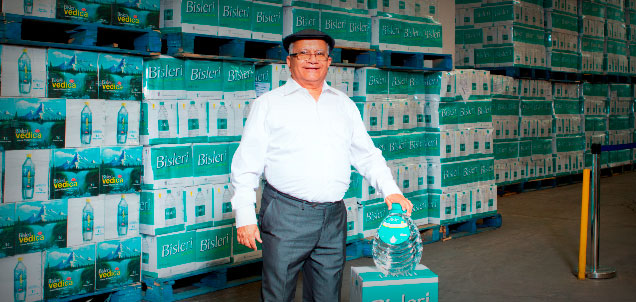

     

  • Thumbs Up to Ramesh Chauhan’s new innings!


    More than two decades after he sold Thums Up, Limca and Gold Spot to Coca-Cola, Ramesh Chauhan, founder of India’s largest bottled-water brand Bisleri, is planning a comeback with a new range of soft drinks. He speaks to Pradyuman Maheshwari about his latest offerings, his strategy and why incompetence and complacency are the silent killers for any business


    Some 23 years after you sold the famed Thums Up and other carbonated drinks, you are returning to soft drinks. How does it feel to get back to the market you loved so much?

    We are not entering the same market. I’ve been trying to impress upon everyone, that we are doing some variance. Our cola is different; it’s a spicy, masala cola. Someone who has a spicy cola would find it hard to switch to a regular one. A lot of people today take a cola and add some spice to it, some masala, so we observed that this is what we need to do. The Pina Colada is a completely novel product for most people in the market, and I would have thought that it would be difficult to sell it. It seems to be the hottest selling product.


    What’s your favourite flavour?

    I’ve said very clearly to everyone that nobody should have a favourite because I don’t want to have a bias. All four should be able to run in a parallel manner.


    Your non-compete clause with Coca-Cola ended in 2008, so what took you so long to enter the market?

    It’s not an easy thing to jump into any business. You don’t get into a business based on your past love and passion. You have to have infrastructure, a distribution system. The earlier infrastructure is gone, so we have had to start from scratch. In ’95 when we started building up Bisleri, and in the 20 years since, we’ve got a significant number of people in the field as well as contracts with retailers.


    You’ve been asked this question several times before, but as you look back, do you have any regrets about selling out to Coke 23 years ago?

    No.


    Tell us more about Bisleri Pop, the Limonata, the orange drink, the Pina Colada and the Spicy Cola. How did these come about?

    I have talked about the Spicy Cola, but the Limonata is different from any other lemon drink which is there in the market. This is a lemonade with lime, not a lemon, which is very different from a lemon. The Fonzo is a mixed fruit drink, it’s not just a mango or an orange. Are four are uniquely different.


    I still remember the old Thums Up, Limca and Gold Spot ads. Advertising paid a huge role in your products becoming as big as they did, so how do see the role of adverting in the soft drinks market?

    It’s very important. Without advertising, all these brands are meaningless. Today, advertising no longer means just television or print. You have the electronic and social media, which lends ample opportunity to promote your products in ways that are different from what you were doing before.


    And for these four flavours, you have a creative and a digital agency. So how big is the advertising offensive for this?

    Not as much as people think we should do. What we have seen is that the product acceptance in the market, with the retailer and the consumer is fantastic. We didn’t expect this kind of welcome from retailers, distributors and consumers. I haven’t come across a single person who says ‘I don’t like the flavour or taste’.


    But in this range, apart from the regular cola and the lemon drinks, there are a lot of variants in the market from not-so-well known brands. There are jeera colas and the like, so where do you think you fit into the market?

    The jeera cola is the one that got us talking about the spicy cola. But the jeera cola has got nowhere, with only one manufacturer and not much structure to support it.


    Rim-Zim your brand, right?

    Yes.


    So you have been in this kind of space before?

    Yes.


    And this cola is spicier than Rim-Zim?

    I wouldn’t say that. It’s different. It’s like a Rim-Zim and cola put together.


    How critical is advertising for the success of a product? A lot of people say it is the product’s quality, its taste, and finally it’s distribution that matter. Having tracked this business for so long, what do you think about advertising vis-à-vis distribution and product quality?

    Distribution is a must. Without distribution, you can’t sell. Your product must be available. Besides, the advertising can’t be the traditional kind only, it has to include digital and social media advertising. What is fantastic is retailers have a communication system among themselves as well. Like in Mumbai, we started around our plant in Andheri and Vile Parle, but retailers in South Bombay were asking ‘why are you are not talking to us?’. So communication within the trade is very high and especially now, with mobile phones. In fact, the people in Andheri probably have a branch or an associate running an outlet in South Mumbai.


    Thums Up as a brand has done very well in northern India. Do you anticipate any specific geographical domination of your current lot of drinks?

    We have four drunks, but we don’t know which will dominate in which part of the country.


    How is Bisleri doing? It’s been there for many years, and is a leader in the bottled-water segment. What are your plans for it?

    Bisleri is doing very well, it’s growing at a healthy 32per cent. We feel a bit guilty not spending enough time and money on promoting Bisleri, but we are struggling to get more and more outlets and more and more production to support the growth.


    And Urzza, which you launched as an energy drink?

    That is on the backburner now. We will take it up once we are comfortable with Bisleri Pop.


    You had once said, or written in your book rather, that our biggest competitor is our incompetence. Do you still believe that?

    Yes.


    So how do you ensure that in your company, you are able to overcome it?

    In India, the market is huge and the population is also so large that it gives us immense satisfaction to be growing at 22 per cent. But is there more we can do? The market is much bigger and we can do better, but people tend to say, ‘this is enough’.


    You have launched four drinks now. Is there a plan to launch more in the near future?

    Of course, but I think we need to see how these four drinks move. I don’t think we can think about adding anything for at least another three months. We first need to get feedback from everywhere.


    So assuming the feedback is good, would you look at adding expanding your portfolio of drinks?

    Not necessarily, because if the feedback is good, you are going to concentrate on making that product even more dominant. Sprite, 7Up and such are top-of-the-mind recall, and for us to reach that level of brand recognition and that kind of demand, it takes a lot of time.


    I know it’s an unfair question to ask, but can you comment on how the other drinks are doing now — the drinks that you sold versus the other drinks that have entered the market?

    The drinks which we sold, are doing very well. But you cannot leave it to the drink. It’s the people who drive it – how much attention they are paying, what are their inputs, because it’s a helluva job trying to sell so many different products of so many different sizes.


    With drinks such as yours entering the market and the fact that you are looking at achieving a fairly stiff target in the next five years, do you see the soft drinks market – which is around Rs 14,000-crore or so– growing to a bigger extent?

    That’s a big question. The market is now shrinking and the juice market seems to be growing much faster, and water even faster still. So it’s different. We haven’t paid attention to the soft drink market as such.


    One last word to people who are your observers, who have tracked you for so many years, and now your re-entry into soft drinks: What should they look forward to from you now?

    They should look forward to innovation and of course, a good, high-quality product. Because whatever we have introduced till now, was always of high quality and consistency.


    This interview first appeared in BrandStand on March 12 and 13 and in dna of brands on March 14


  • Bisleri to launch new soft drinks with Soho Square Mumbai as partner

    By A Correspondent


    In addition to the current portfolio comprising Bisleri, Vedica and Urzza, Soho Square, Mumbai will now also be guiding the fortunes of Bisleri’s new soft drinks, Spyci – the twisted cola, Limonata and two fruit flavored drinks – Fonzo and Pinacolada.


    Commenting on the new drinks, Ramesh Chauhan, Chairman, Bisleri International Pvt. Ltd. says, “The idea is to launch drinks in spaces familiar to but very different from existing taste palates. So while there is a cola and a lemony drink in the new portfolio, the effort has been to give them a lot of twists. Plus there are two new drinks altogether. The consumer is looking to experiment and we have given these options. Soho Square has been with us for around four years now; we feel they are best equipped for this launch.”


    Samrat Bedi

    On the partnership, Samrat Bedi, Head, Soho Square says, “This launch has been radically different from an agency point-of-view. As a strategy, there will be minimal ATL support at the beginning. Thus we are working doubly hard on other aspects like packaging, pricing and innovative means of communication.”


    Mohit Ahuja

    Mohit Ahuja, Senior Vice President, Soho Square added, “It is quite challenging to be in a space which is dominated by two big and numerous small players. These new drinks will benefit highly from the testimonial role of Brand Bisleri, as well as the mother brand’s reach. These are two big pillars of comfort for an agency to go about the launch.”


  • Eye on volumes, Coca-Cola to revive Citra after 19 years

    By Ratna Bhushan


    Coca-Cola will revive Citra, a clear-lime drink it bought from Ramesh Chauhan two decades ago but junked in favour of Sprite, in a move that analysts believe is more to target price-sensitive consumer segments than to unlock the brand’s heritage value.


    A person familiar with the top beverages maker’s plans said Citra will be priced about 20 per cent cheaper than existing lime-lemon drinks such as its own brands Sprite and Limca as well as PepsiCo’s Mountain Dew and 7 Up, to target a wider audience and take on smaller brands.


    A Coca-Cola spokesman confirmed the company is introducing Citra in “a few towns in Maharashtra and Gujarat” on a pilot basis. This will be followed by a staggered launch across other metros and bigger cities.


    The move has surprised industry watchers because Coca-Cola’s Sprite, the second-largest soft drink brand in the country after Thums Up, leads the lime-lemon drinks segment, which is the fastest-growing soft drink category in India’s Rs13,000-crore fizzy drinks market.


    Among those surprised is Ramesh Chauhan, who created brand Citra and made it popular in the late 1980s and early 1990s.


    “After keeping the brand in cold storage for so many years, it’s strange they want to re-introduce it now, especially when they have a strong presence in the clear-lime segment,” Chauhan said. “If they are looking for retention and heritage value, then logically even Gold Spot should be revived.”


    When Coca-Cola re-entered India in 1993, it bought out all Parle brands except Bisleri from Chauhan.


    Move aimed at mopping up volumes

    While Citra and Gold Spot were phased out to make way for Coca-Cola’s global brands Sprite and Fanta, respectively, Thums Up, Limca and Maaza were retained. Shashi Kalathil, CEO of management advisory firm Y-factor and partner at private equity fund Exponentia Capital, said the move may be aimed at mopping up volumes. “Coca-Cola probably doesn’t want Citra’s pricing to impact its larger brands. So this could be more of a pricing game and about treating Citra more as a trademark than a brand,” he said.


    Parle brand again

    It’s history that the US major sidelined Parle’s cola brand Thums Up to promote its own brand Coca-Cola for years before waking up to the potential of the Indian brand and backing it.


    Now it seems like deja vu for Coca-Cola as it is banking on a Parle brand once again to push market share in the lime segment. The Coca-Cola spokesman said Citra would not cannibalise its existing lemon drinks because there is ample room for multiple brands in a developing segment like sparkling fizzy drink in a high-potential market such as India.


    Devendra Chawla, president of food & FMCG segments at the country’s largest retailer Future Group, said the move will aid the growth of the clear-lime category, which is already seeing heightened brand activity. “To grow carbonated soft drinks’ per capita in India, apart from growing colas, it’s critical to activate flavours which have natural acceptance from Indian consumers such as lime and mango,” said Chawla, who formerly worked with Coca-Cola.


    India’s per capita consumption of carbonated drinks is just 11 litres a year compared to 34 litres in China and 675 litres in Mexico.


    The lime-lemon category in India has been growing 16-17 per cent a year, ahead of colas at about 11-12 per cent and orange drinks at 8-9 per cent. Apart from being a familiar flavour that Indians consume at home (in the form of nimbu paani), lime-lemon drinks are considered ideal thirst quenchers.


    Both Coca-Cola and PepsiCo have been promoting their brands aggressively in this segment. PepsiCo has Bollywood star Salman Khan endorsing Mountain Dew and actor Sharman Joshi for 7 Up, while Coca-Cola pushes clear-lime drink Sprite and cloudy lemon drink Limca on the irreverent and freshness platforms, respectively.


    Source:The Economic Times

    Copyright © 2012, Bennett, Coleman & Co. Ltd. All Rights Reserved