Tag: Rakesh Jhunjhunwala

  • When I-Day celebrations were almost overshadowed….


    By Ranjona Banerji


    Ranjona BanerjiThe death of stockmarket investor Rakesh Jhunjhunwala on August 14 almost overshadowed India’s Independence Day celebrations.

    Media outlets were lavish in their praise of the late billionaire. They informed readers and viewers who may not be up on stockmarket that Jhunjhunwala was “India’s Warren Buffett”, that he was the “Big Bull”, and that he “always believed in India” (whatever that means) and he was a big “philanthropist”.

    Jhunjhunwala also invested in companies and that often meant that those companies did very well and made a lot of money for their owners. He apparently was not a big investor in internet startups. He had recently started an airline.

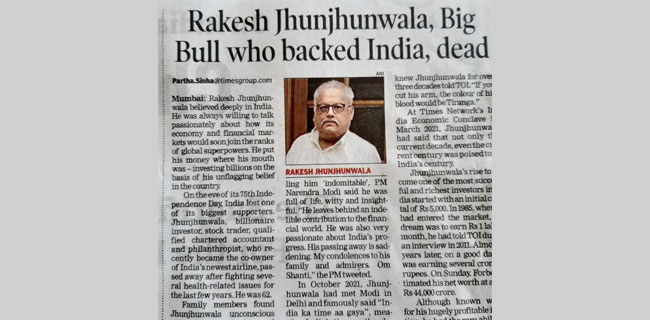
    And let’s not forget that he “believed in India”. Some clarified that he believed in the Indian stockmarket. Or that he felt that the Indian stockmarket had not been given its due. I quote from the Times of India’s front page: “Rakesh Jhunjhunwala, Big Bull who backed India, dead: …always believed deeply in India… unflagging belief in the country…” (see screenshot).

    Of course in today’s newspaper rules, the news part (how and when) is left out or comes later on the assumption that the internet and TV got there first. So, news about what happened to the gentleman comes in para 3, after all the commentary and praise. Obviously there was no mention of Jhunjhunwala’s comment that democracy was a hindrance to growth. India’s doesn’t do obituaries, only eulogies. And to be fair, no article claimed that the late investor believed in Indian democracy.

    I was however somewhat saddened by the “Big Bull” name, by just about every news outlet, because I belong to that generation where the Big Bull was Harshad Mehta. One article even said the first Big Bull was MJ Pherwani. Given the whole stockmarket scam of 1992, “Big Bull” had become a somewhat pejorative term. Clearly, times change.

    I was also intrigued by the philanthropist bit. I have a crazy interest in the overall general lack of generosity of big Indian business. Belief in India or not.

    An internet search for philanthropy informed me that he had invested in Asoka University. Am not certain that qualifies as philanthropy exactly.

    He had also planned “in a candid admission” said Business Today, though I am uncertain why candid has been used in this context, to set up a foundation. The article from 2021 candidly admits that Jhunjhunwala did not specify what this foundation would do but that it would have a starting capital of Rs 500 crore.

    https://www.businesstoday.in/latest/in-focus/story/rakesh-jhunjhunwala-lays-down-charity-plans-to-set-up-foundation-with-over-rs-500-cr-capital-301672-2021-07-18

    America’s Warren Buffet of course has planned to give away 99 per cent of his wealth ($103 billion) to charity. And has already given away a lot.

    Of the Pledge that Buffet and Bill Gates started, Wipro’s Azim Premji was one of the first Indian businesspersons to sign up, the Nilekanis, and Anil Agarwal of Vedanta have also signed up.

    The news that Jhunjhunwala ($8.5 billion) wanted to give his money away is great news.

    One would only wish that the media would tell us exactly what, in a few candid admissions.

    Instead, we have speculation and guff.

    https://www.forbes.com/sites/naazneenkarmali/2022/08/14/billionaire-investor-rakesh-jhunjhunwala-known-as-indias-warren-buffett-dies-at-62/?sh=2cfccd4e7378

    https://www.india.com/business/rakesh-jhunjhunwala-as-a-philanthropist-big-bull-donated-approx-rs-13-69-lakh-per-day-5571664/

    Perhaps Jhunjhunwala’s family will fulfil his wishes.


    **

    Meanwhile, as journalists and their newsrooms forget all about Jhunjhunwala by next week, on to India’s 75th year and 76th Independence Day celebrations.

    The usual high praise minus context for the Prime Minister’s speech. Uncontested were his comments on ending corruption (am certain I heard that in 2016 on the eighth of November to be precise), how women should not be insulted (also on the day, rapists and murderers of Bilkis Bano and her family were granted early freedom for Independence Day), and how family favours or dynasty and nepotism were wrong (shhh, not a word about the Union Home Minister’s son and the BCCI).

    That India’s first Prime Minister Jawaharlal Nehru was left out of several official government released and photographs did not get as much traction as it should have, in the mainstream media. Barring perhaps from The Telegraph.

    Aaj Tak has to win the award here for trying to follow the BJP government diktat in erasing Nehru by sticking an anchor right in front of Nehru, while showing a film from August 15, 1947. Apparently, they later “corrected” this.

    Get fooled by this if you really want to be a fool.


    Ranjona Banerji is a senior journalist and commentator. She writes on MxMIndia on Tuesdays and Fridays. Her views here are personal


  • Rakesh Jhunjhunwala acquires minority stake in Nazara


    WestBridge Capital-backed Nazara Technologies announced that Rakesh Jhunjhunwala has acquired a minority stake in Nazara for approximately Rs 180 crore.


    Commenting on the recent investment made by Rakesh Juhunjhunwala, Nitish Mittersain, Managing Director & Founder, Nazara Technologies says, “We are delighted to have Rakesh Jhunjhunwala as an investor in Nazara and it is a great validation of value augmentation delivered by Nazara for its existing shareholders.”


    Added Sandeep Singhal MD & Co founder West Bridge Capital: “WestBridge has had a fantastic journey with Nazara and Nitish for 14 years and we welcome Rakesh Jhunjhunwala as an investor to join us on Nazara’s future journey.”


    Said Jhunjhunwala: “I am always on the lookout for promising companies which are leaders in high growth verticals. Nazara is a leading company in the mobile games business. Nazara has a consistent track record of delivering profits, cash flows, along with efficient use of capital and high ROE. I see a growth potential in the company.”


  • Hungama raises $25mn in funding round led by Xiaomi

    By A Correspondent


    Digital media entertainment company Hungama, has raised an investment of US$25mn, led by leading smartphone company Xiaomi, along with existing investors Intel Capital, Bessemer Venture Partners and ace financial investor and Indian billionaire, Rakesh Jhunjhunwala.


    With this round of funding, Hungama will expand the content library and further invest in world class technology on its mobile app platforms Hungama Music for music and Hungama Play for premium video including movies, television and original series. Hungama will soon add over 1500 hours of television content along with original content to its current Hungama Play offering of over 8000 movies in English and 12 Indian languages


    Speaking about the funding round, Neeraj Roy, Founder & CEO – Hungama Digital Media Entertainment said: “India is adding 8 MN new consumers to the Internet each month with 90% of digital consumption being driven by mobile. Young Indians love their music and movies and the mobile will be the most used screen for this generation. Content will drive the next phase of Digital India and we are delighted to partner with Xiaomi as we prepare to bring premium and original digital entertainment to a 100 million Indians before the end of this year.”


    Hugo Barra, Vice President, Xiaomi said: “We think of smartphones as a platform for us to deliver Internet services, and this includes content. We are investing in Hungama not only to start integrating content into our smartphones, but also to grow together with them and deepen our understanding of the content sector in India. We have carefully selected Hungama because of what they are doing in terms of aggregating large amounts of content and delivering an amazing user experience.”


    Rakesh Jhunjhunwala, Chairman, Hungama Digital Media Entertainment said: “I have been invested into Hungama for several years and participated in this new capital raise as I believe they have built an unique leadership position with the most compelling music and movie OTT service for South Asians globally that is ripe for growth as India will embrace broadband and 4G. We welcome Xiaomi as one of our partners.”


    Vishal Gupta, Managing Director, Bessemer Venture Partners, said “We are excited about the leadership position that Hungama has built as being the one stop OTT platform across music, videos and movies. We are delighted to have Xiaomi as our partners and will accelerate our growth and leadership.”


    Citi acted as exclusive financial advisor to Hungama on this transaction.


  • How ‘Fake Jhunjhunwala’ writer Aditya Magal impressed the ‘real’ Jhunjhunwala

    By Sruthijith KK


    On Tuesday, 26-year-old Aditya Magal nervously walked into the Nariman Point offices of billionaire investor Rakesh Jhunjhunwala. Most people who looked up from their terminals didn’t glance a second time, possibly concluding that the boy-faced youngster must be an internship-seeker at Rare Enterprises. But Jhunjhunwala himself took a keen interest in Magal, seating him in his private office, enquiring about his background, his family, his stylish haircut and his girlfriends.


    As word about the young visitor spread, Jhunjhunwala’s colleagues – hardnosed traders and analysts – streamed into his office to meet Magal. They shook hands with him. Everyone smiled. Some said they were fans. Magal’s stock was on the rise. The encounter, facilitated by ET, saw uproarious moments.


    For four-and-a-half years, unknown to everyone, Magal has been Fake Jhunjhunwala, the anonymous writer behind ‘The Secret Journal of Rakesh Jhunjhunwala’, a popular parody blog that tore into people in the news – politicians, actors, journalists, other stock market players, anyone – with biting sarcasm.


    He caricatured the identity of Jhunjhunwala, an opinionated ace stock picker with interesting quirks, into a loud, wildly entertaining character who spared none. His blog gets 30,000 unique visitors a month.


    Magal’s Twitter account is followed by more than 45,000. Even his online fan club has 2,500 followers on Twitter. Well-known people on Twitter, such as Gul Panag and Pritish Nandy, are amused by his writing.


    Not everyone’s amused though. Like some journalists, who were mercilessly taken down by the Fake Jhunjhunwala, who then called the real Jhunjhunwala to complain. “I told them I don’t write it,” the real Jhunjhunwala said. “Then they wanted to know who wrote it. Arrey, how do I know?”


    Kingfisher boss Vijay Mallya once told Jhunjhunwala that he liked to start his day by reading his tweets. “The first time I didn’t say anything. Then, another time he again said, ‘Rakeshbhai, you are very funny, what all you keep tweeting?’ Then I told him I don’t write it,” Jhunjhunwala said.


    In his column in The Indian Express, editor-in-chief Shekhar Gupta mistakenly attributed Fake Jhunjhunwala’s tweet to the real Jhunjhunwala, to illustrate the prejudices and dominance of the “upper caste, creamy layer of our society”. The newspaper later apologised.


    Magal carries clear disclaimers on both his Twitter bio and his blog. And as long as he does that, Jhunjhunwala says, he has no problems with what he writes. “Who am I? You have a right to express yourself. And you are saying you are not me. Then what is the problem?” In a country where people compete to take offence, Magal picked the right man to parody.


    As it happened, Magal didn’t pick Jhunjhunwala. The blog was started in 2008 by Mark Fidelman, an American who then worked in Indian real estate. Inspired by the success of the Fake Steve Jobs blog, Fidelman created the blog as a platform to vent his frustrations with India after his business here suffered. After three months, Fidelman told Magal, who he knew through a business association, about the blog, and asked him to take over. Magal says he started laughing.


    “I have been following Rakesh sir since the time I was 20 or so. I was following a number of investors and gradually, what Rakesh sir said started making the most sense for me.” Magal dabbled in the stock markets and like countless retail investors before him, was taken in by Jhunjhunwala’s knowledge and his uncanny ability to make the right bets.


    If he was a follower before, writing the blog for four years turned Magal into something of a devotee. He has read and watched nearly every interview the investor has given. He knows everything there is to know about Jhunjhunwala, from the year his sister got married to the architect of his Lonavala home. From the brands of cigarettes and whiskeys he prefers to the Mercedes S Class he drives. “Why, I also have a Bentley,” Jhunjhunwala helped along, amused by Magal’s grasp of J-trivia. But Magal knows not just trivia about Jhunjhunwala. He also knows his investment portfolio closely.


    But Magal’s natural funny side is more often on display. At lunch with this correspondent, he recited a poem: “Jhunjhunwala goes to Lonavala to live in a house by Killawala.” Nitin Killawala is the architect. In Jhunjhunwala’s office, as his colleagues gathered around to meet the famous blogger, Magal parodied Jhunjhunwala’s TV appearances. His habit of talking up the India story, the peculiar way in which he says ‘humongous’. Everyone laughed.


    When Jhunjhunwala lit another cigarette, Magal told him that he should cut down on his smoking. “What is this sir? Earlier in interviews you used to say you smoked 10-15 cigarettes. Now you say 20-25. And you have stopped doing yoga.” Jhunjhunwala demonstrated some yoga-style breathing for him.


    The atmosphere was warm and convivial. When Magal sought permission to click some pictures of his office, Jhunjhunwala readily agreed. “Please, please, do. Click whatever you want Aditya, we are simple people.”


    Jhunjhunwala found Magal so funny that he saved his number as ‘Aditya Joker’ on his phone. “You are a natural joker. You have a talent for humour,” he said.


    Niraj Dalal, who works with Jhunjhunwala, said he was relieved to meet Magal. “People used to suspect it’s me!” Jhunjhunwala said he also thought the writer was someone who knew him closely or worked with him. “There were things only seven or eight of us would know and that would be on the blog. That used to unnerve us,” Dalal said.


    Jhunjhunwala asked Magal what he wanted to do in life. “Write books and help people. The moment I have a plot ready in my head, I’ll drop everything and write a book,” he said.


    Jhunjhunwala wished him the best. Magal invited Jhunjhunwala to visit his Bangalore home sometime. “Surely. Will you invite me for your wedding?” Certainly, Magal said. “Will you come in a helicopter, sir?”


    Magal told Jhunjhunwala that he would love to write his autobiography if he ever considered writing one. The investor was hesitant. “Why should we self-glorify? Let’s see when it comes to that.”


    Magal gifted him two Ganesha idols, which Jhunjhunwala is known to collect. He asked a colleague to place the brass idol alongside dozens of idols on a shelf in his office. The other one, a sandalwood idol, he placed right in front of him, along the five monitors on his desk that he uses to watch the movements of his empire of wealth.


    Before Magal left, Jhunjhunwala asked him if there was anything he could do to help. “I’d be foolish not to ask you for investment advice. But then I’m not a pretty girl and you are not tipsy,” Magal said, referring to a wisecrack Jhunjhunwala made during an interview regarding his rule about stock tips. Jhunjhunwala made an exception, and gave him a stock tip. “Buy.”


    As he rode the elevator down and got into the waiting cab, Magal was overjoyed. When he walked in, he didn’t know what to expect. “I can now cross off one item on my bucket list,” he said.


    Source: The Economic Times
    Copyright © 2012, Bennett, Coleman & Co. Ltd. All Rights Reserved


  • Awards have no relevance to advtertising: Balki


    By Anil Thakraney


    It’s always fun meeting the big boss of Lowe Lintas. Since we have worked together before and since Balki is always forthright and politically incorrect, one is assured of an exciting but meaningful exchange. Here is he, speaking his mind on various issues. Movies, advertising, the challenges facing the industry, the kind of people he’d like to hire, and yes, about his continuing allergy to advertising awards.


    You have to respect the man for the wonderful work he’s been doing on both, the small and the large screen. And more so for being that rare individual in the ad world who has the balls to stand up for something he believes in.


    Still around in advertising? Shouldn’t you be busy making big films with Big B?

    I am making a movie a day, it’s the same thing. An idea is an idea whether it’s three hours or thirty seconds. The day I stop tripping on getting the high when one gets an idea, that’s the day I will stop. In fact, I haven’t done a film in the last two years, I have been caught up with Lowe Lintas. I do have an idea for a film which I will work on towards the end of this year.


    And it will back to Bachchan, I suppose.

    Not back to, WITH Bachchan. I haven’t gone away from him.


    What’s with the Bachchan fetish?

    When you work with the ultimate guy it becomes difficult to work with somebody else. He’s phenomenal. Such hunger and greed for performing at the age of 70… it’s truly inspirational. I can keep on making films with him for the rest of my life.


    Are you a fan of Abhishek Bachchan too? His career isn’t going anywhere.

    Actually I found his performance in ‘Paa’ the best. It was the most difficult role. I think his problem is more the choice of films rather than the quality of his acting. He’s got his niche, he’s very good at certain things. He’s also a good friend.


    So that’s why you keep using him in the IDEA commercials, often when he’s not even needed.

    He’s a better friend of IDEA than he’s of mine. I didn’t choose him, IDEA chose Abhishek.


    What are the learnings from movies you’ve taken to advertising?

    The biggest thing that happens when you come back from cinema to advertising is that you are even more impatient. Because cinema takes so much time to execute, you want to make the ads even faster. That’s the reason I like making ads. You make them fast and you move on. There’s an idea a day, and that’s an addiction which is difficult to escape.


    Your wife’s directing ‘English Vinglish’. Are you the producer? And what’s it about?

    Rakesh Jhunjhunwala has co-produced it with me, along with another investor. It’s about the insecurities of a middle class woman who doesn’t know English in today’s context. It’s about how she overcomes the fear of English. It’s a very relevant issue to a lot of people in this country. In India, it’s money, fame and (knowledge of) English which determine the class and quality of a person.


    Let’s cut to Lowe. Are you still as hands-on as ever?

    I am. There’s so much of work, yaar. Today, Arun (Iyer) and Amer (Jaleel) have taken on a hell of a lot, they handle 50 percent of the business. My travel has come down but my ideation hasn’t. So yes, I am still involved in major things, I know what’s happening. This is not a profession where internal structures and motivations of the agency can dictate solutions for a client. The client comes to an agency for a solution and we have to get it, by hook or by crook. Gone are the days when creative directors would sit on a revolving chair and give motivational advice to people on how to crack things.


    Piyush Pandey said to me the reason he isn’t making movies is because he’s not bored of advertising.

    It’s about the number of things you can do, it has nothing to do with being bored of advertising. So maybe some people are capable of doing a lot more and some people are not.


    Significant changes you’ve observed in the ad world in recent times.

    It’s the same, in so far as it’s still a problem/solution business. What I find is that the clients today are hungrier for more interesting solutions. I find that clients don’t want to waste an idea. And because of the complexities of the marketing issues, the problem articulation is no longer simple. You can no longer say this is small, this is big or that is cheap. It’s about understanding the complexities and simplifying them. And I find that fewer and fewer people are able to do this. Therefore far more is expected of a creative person today than it ever was. The creative person is now seen as the solutions provider. Planning is now playing a big role in the articulation of the problem. Planners are now working more for the clients than for the agency. This shift is something I don’t quite agree with, but it’s happening. This situation requires more discipline, rigour and understanding from a creative person than ever before.


    And I guess this impacts your hiring policies.

    It impacts that hugely. The three Cannes Gold winners don’t make sense any more. Today a lot of senior creative people have to grow within the current system. So you hire junior people who are clever and intelligent and then groom them into the system of understanding problems. It’s very dangerous hiring very senior people from the outside. We went through a phase in advertising where we said we are losing our respect as an industry. That’s changed. Today the clients respect the advertising agency for providing solutions.


    Both, Prasoon Joshi and Piyush Pandey told me that the industry is losing talent. There seems to be too much pressure from clients, they no longer pamper creative people. And opportunities have opened up for agency personnel in other industries.

    I don’t agree with this. I actually think there’s never been a better time to be in advertising. You are no longer respected for your whacky ideas, being a maverick won’t get you any special respect. The problem isn’t that the industry is losing talent, the problem is it’s not attracting talent. It’s damn difficult to find talent to address today’s problems. In fact, today there are a lot of people in marketing who want to join advertising. Where we are not attracting the right talent is at the junior level. We as an industry haven’t been able to articulate what is the kind of people we want.


    As an old-world creative director, do you find yourself struggling with the new media?

    No. Clients want you do virals in the new media, but it’s still film. The video will never die, though the medium for broadcasting it may have changed. The production methodologies may also have changed. But the idea is the key to it all.


    You are not even on Twitter and Facebook. How will you ever understand the digital world?

    The reason I am not on it is that I don’t want the world to know what the fuck I am doing. That’s a personal choice, it has nothing to do with the new media. In fact, today if I am on Facebook, I am a fuddy duddy cock.


    The problem, Balki, is that all you uncles are obsessed with the TV commercial.

    I approach a problem very simply. There is a solution, and there is an idea. And if the solution demands a certain kind of medium, you use that. Nobody knew how to make films before or how to make a digital programme. So it’s all about expression. And you go into that particular medium and do it. I didn’t know how to shoot a film earlier, so I went to the experts to do it for me. I don’t watch television at all, but that doesn’t mean I am fuddy duddy on television.


    Small shops are springing up. People like Aggie are doing very well. Does that worry you?

    It’s always been happening. What do you think Mohammed Khan and Ravi Gupta did? If Ogilvy and JWT don’t worry me, then why should they? They are all competition. In fact, the more the merrier, it means more people are doing better ads, and that’s fantastic for the ad industry.


    Why are so many creative directors branching out on their own?

    In some cases they believe their talent is far superior to what a large agency can harness. The other reason is there are only so many people who can grow to a point in an agency. So it could be the frustration of not being able to grow beyond a point. They have to start their own thing to be what they want to be. The third thing of course is money. Some people want to be richer than what they are.


    Words of wisdom for young creative people.

    I think if you like sport, you should come to advertising. There is a hurdle to be crossed every day, there is a goal to be scored, there is a wicket to be taken, there are problems that come your way. It is like a game. The moment you start taking it too seriously, it’s very difficult to function in this business. A lot of things don’t make sense out here.


    Shashi Sinha tells me he’s cleaned up the GoaFest judging process. All the scams have been dealt with. But you still won’t take part.

    I believe the advertising industry needs credible awards. But how do you judge advertising? You say, ‘Haha, this is so funny! Oh, what a technique in this one!’ And based on that you award some ads. And two months later the agency loses the business. So obviously it doesn’t work. What the fuck are we doing in advertising? We are supposed to solve a problem interestingly. You are supposed to state the problem and the judges are supposed to ask if that ad could have solved that problem. I judged at Cannes once, and I refused to judge after that. I’ll give you an example of what happens: Those Coke print ads, where someone is sleeping under the shadow of Coca Cola bottles, has been hailed as the greatest piece of creativity. And then you have those great TVCs of Coke with Aamir Khan, which the nation loved, but which they (the Cannes jury) didn’t understand! This kind of judging has no relevance to what the purpose of advertising is. Basically the award show is a game and you play it. So it’s not about cleaning it up, I don’t value what you award.


    And you also have a problem with your peers doing the judging.

    Some of them I respect and some I don’t.


    So what sort of jury will satisfy you?

    Having some respected marketers on the jury would help. And some very good advertising people. Right now they ask anybody who’s free to come and judge, and that’s not the way to do it. You can’t choose people just because you want representation from various agencies. Thing is, before I give you a piece of work to be evaluated, before I give you the right to say if I am good or bad, I need to be assured you are a person who’s capable of telling me that. We need to first judge the judges.


    What disappoints you about the ad world?

    What pains me is the amount we try to market the barometers which decide who’s good and who’s bad in the Indian industry. The Gunn report, the Asian awards, etc, they tom-tom the barometers rather than the advertising itself. And all this has absolutely no relevance to what we do here. It’s time we found a barometer or an evaluation process that tells India which is a good agency. A method through which clients can credibly choose agencies beyond just the surveys and the awards. And this lack of a proper barometer has led to personality driven agencies. This propels a lot of false media management. PR for advertising people happens because of this.


    Why don’t YOU work on that barometer?

    Piyush Pandey and I have had many whiskies discussing this, but we only walk away promising that we should drink some more, and that’s about it. (Laughs.)


    Click here to view all Goafest 2012 stories