In an attempt to encourage women to continue and reach top positions inside corporate India and also to create an environment where theycan grow and flourish, Dentsu Aegis Network (DAN)has established the DAN Women’s Council.
Rajni Menon
Chaired by Rajni Menon, Executive Vice President, Carat India, the advisory committee will have Nipun Kapur, COO, WATConsult, Divya Karani, CEO, Dentsu Media, Sunita Prakash,Senior Vice President, Dentsu Marcom, Neha Mayekar, Vice President, Finance, Dentsu Aegis Network, Dimple Maheshwari, Director – HR, Dentsu Media, Harsha Joshi, Executive Vice President – Group Trading, Dentsu Aegis Network, Komal Verma, Associate Vice President-Human Resources & Administration at Fountainhead-MKTG and Simi Sabhaney, CEO, Dentsu Communications as its key members.
Ashish Bhasin
“Our women leaders and managers will continue to play a very crucial role in taking us forward as we move ahead to become the No. 2 marketing communications agency group in India by the end of 2017. Today, we are already the leading network when it comes to creating a balanced and uniform work-environment for our women workforce in India. Now, our ambition is to surpass global standards and makeDAN the gold standard for encouraging the women talent force. I believe our women managers are second to none,†said Ashish Bhasin, Chairman & CEO South Asia – Dentsu Aegis Network and Chairman Posterscope & MKTG – Asia Pacific.
“Though at an overall level the DAN numbers are significantly healthier than the industry average, we felt it was time to take a proactive step as leaders of the marketing communications industry to ensure that in a growing network, the environment and policies are conducive to grow the women numbers at all levels,†Menon added.
The DAN Women’s Council will primarily focus on helping women reach their highest potential based on merit, facilitate a path formore women occupying leadership positions in the organization, provide an avenue for a structured mentoring process and create an environment which is safe and equal.
Continuing its investment in delivering the best consumer understanding, Carat India has launched CCS (Consumer Connection System) 2015. This proprietary and in-depth research has been conducted across 23 cities, covering a sample of over 12,000 respondents across All adults SEC A – C, 15 – 65 years and is also programed to work with the NCCS classification in India. Overall, CCS has a global sample size of over 400,000, making it the world’s largest research of this nature.
Through this large scale research based system, Carat and Dentsu Aegis Network will continue to provide the most advanced understanding of the consumers’ behavior in terms of buying across several categories, with a deep understanding of the capabilities of over 60 media touch points, thereby enabling the most efficient selection of media focused on delivering to marketing KPIs.
Ashish Bhasin
Speaking on the launch of CCS 2015, Ashish Bhasin, ‎Chairman & CEO South Asia Dentsu Aegis Network, said “CCS is a global system which we brought to India in 2012. Through the active use of this research, carried out on an ongoing basis every year, we are able to focus our clients’ investments on the most effective media generated by a deep insight into the consumers’ behavior. It is a huge investment of over Rs. 1 crore annually and it demonstrates our commitment to get the best understanding of the complex Indian consumer for our clients. The next steps in the pipeline include the fusion of the consumer data to digital and TV viewing data thus making it the only single source system in India. It is investments like these which have been pivotal in making Dentsu Aegis Network the powerhouse that it is in such a short time. This will only be exclusively available to Dentsu Aegis Network clients.â€
The survey threw up numbers which are more reflective of the current Indian scenario especially when compared with other large scale industry surveys. Car penetration has doubled in the last 3 years from 8% to 16% with markets like Chandigarh (at 34%), Gurgaon (at 43%), Noida (at 55%) and Pune (at 30%) topping the surveyed markets.
All the buzz about how the Indian consumer is now digitally connected more than ever is clear from the 53% penetration up from 8% in 2012. Amongst the various segments surveyed, students stood out with 68% ownership of smartphones.
Multiscreen consumption varies across markets but the difference is not as stark as one would assume. While in Metros 42% of the population uses smartphones / tablets while watching TV, the number in Non Metro markets drops only to 36%. Chennai, NOIDA, Mumbai & Pune populations take the lead in this behavior.
Access to Internet is at 48% with 90% of this audience also accessing it through their mobile phones.
Rajni Menon
Rajni Menon, Exec VP Carat, who leads Insights and Strategy for Carat and the Media Agencies of the group has been spearheading this project since its inception. Speaking on the research, she said “CCS is the most comprehensive single source study available in our market. Apart from having an extremely granular level of touch-point data, it studies the interaction consumers have with media in detail. With increasing ad-avoidance, media engagement, incidence of cross-screen consumption etc. are far more important metrics than reach & time spent.â€
“It also answers the most important question that any marketer looks to the media agency for, which touch-points impact the different stages of a consumer’s purchase journey, be it awareness, consideration or advocacy. And this is just scratching the surface of what the study offers.
We already work with our clients on replicating their consumer segments through bespoke research overlays to enable more effective solutions. We are also in the coming months fusing the CCS data with social consumption data & TV viewership data to enable a comprehensive planning stackâ€.
The research design is based on CCS globally, while the field was managed through IPSOS using the CAPI methodology with the questionnaire available across 10 languages and rendered on tablets. Extensive use of technology with aspects like GPS tracking of field teams, daily quality checks, audio recording of field interviews ensured that the data quality & authenticity was maintained. Since the questionnaire is intensive, global best practices and techniques were used to ensure that the data doesn’t get compromised by respondent fatigue.
Kartik Iyer
Kartik Iyer, MD Carat India adds “CCS has been a true revolution in media planning. Starting not from a demographic but from an attitude, the tool enables us to target behaviors across demographics which enables a much sharper result oriented planning process. The progression of CCS to CCS planner also enables us to plan to client KPIs which therefore means that our planning has become that much more result oriented. We are delighted with the value that CCS has been able to add to our planning process and look forward to creating business solutions for our clients that are in line with the current consumer behavior of consumers.â€
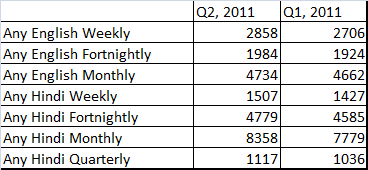
Magazines have been witnessing a bit of rough weather of late. It is not an Indian phenomenon but is being witnessed worldwide. However, this IRS Q2, 2011 shows an increase in readership of both Hindi and English magazines as compared to Q1, 2011. Here is a quick look at AIR for the same:
Readership in this duration has increased for Kannada and Telugu publications also. For Assamese, Gujarati and Marathi it has gone down – while for other languages the response is mixed.
Keeping the focus on English and Hindi magazines for the purpose of this article, is it safe to assume that this IRS marks the revival of magazines? Says Anita Nayyar, CEO – Havas Media, India & South Asia, “This IRS certainly indicates better health for magazines but not necessarily revival.â€
Rajni Menon, Associate Vice President, Carat Media India, too believes that it is not really the revival of magazines and mentions two reasons for marginal upward trend for the magazines. She said, “The Week and Business World have been actively working towards increasing readership and it has had an impact in the market. Secondly, new magazines which were not captured in IRS earlier, eg 2010 Q2 IRS did not cover the following magazines – Outlook Profit, Economist, People, Life Positive. The biggies like India Today, Outlook have seen only marginal shifts only.â€
However the experts believe that there is definite scope of growth in niche and special interest publications, which have shown an upward trend. Ms Nayyar said, “Niche magazines are doing better than mass magazines.†Ms Menon endorsed this, “There has been growth in numbers for niche magazines : India Today Travel Plus, Good Housekeeping, Femina WTW, so that could show an indicative trend along with the fact that one does see more new magazines on the stands every few months. Travel, Women, Lifestyle. “
However, a major issue faced by media planners and buyers is that a number of niche magazines are not tracked in IRS. As per Ms Menon, “We still can’t make a definite decision on magazines because there are so many in the market which are not covered by IRS. Mainline magazines like Open and Tehelka are yet to be covered, so seeing new niche magazine get covered is a long shot.
Ms Nayyar too stated that niche and special interest publications are set to grow, but most niche magazines are not tracked.




 Readership in this duration has increased for Kannada and Telugu publications also. For Assamese, Gujarati and Marathi it has gone down – while for other languages the response is mixed.