Tag: Rajasthan Patrika

  • The More you Succumb, the More Dangerous the World Becomes


    By Ranjona Banerji


    Ranjona BanerjiOn July 22, the Income Tax department carried out a series of raids on the offices of the Dainik Bhaskar group across India.


    Even for those sleeping under a rock to avoid criticising the Modi government, these raids were a sign that someone up there in the higher reaches of power was angry. Very angry.


    The anger could be two-fold: The revelations this week of the Pegasus Project and that Bhaskar covered it widely.


    And that this Pegasus coverage only added to the rage the government had felt at the relentless manner in which this large chain of newspapers had covered the Covid-19 pandemic. Government lies on Covid cases, lies on the number of deaths, on the lack of oxygen in hospitals, on the dead bodies floating in the Ganga and other rivers and buried in shallow graves in riverbanks were exposed every day in both Gujarat’s Divya Bhaskar and Dainik Bhaskar editions elsewhere.


    National Editor Om Gaur took DB’s coverage even further in his edit page piece for the New York Times about the dire Covid situation during India’s second wave, which was headlined: “The Ganges is returning the dead”. As ever, negative international exposure enrages an image-conscious Prime Minister and his government.


    Whatever has irked the government more, it is clear that it is riled. And when that happens, there is a malicious, vindictive reaction. Perhaps for almost seven years, the Modi government has got so used to the lavish praise piled on it, for all its transgressions, mistakes, lies, aggressions, disasters, any resistance is seen as unacceptable. Okay, cut that “perhaps”. We know that this is a government, more than any other until now, which cannot handle dissent, disagreement, questions, opposition. And has been enabled by a captive mainstream media.


    Between the Pegasus Projects and its revelations, and these raids on a media house, where does the rest of the media stand? The old days when all newspapers ignored each other and operated in their separate silos have gone, and for the better, together with that ivory tower editor who barely comprehended what was happening in his own newsroom forget the nitty-gritties of the world itself. The media has to comment on itself and allow others to comment on it.


    The revelations that someone within the government of India was using/ had used Israeli-made military-purpose malware to both hack into people’s electronic devices, run surveillance on them and possibly also implant material into their devices has shaken the world and forced the media not involved in the investigation to take notice. But the voice of the media has been far from uniform and at times, shockingly pro-government even though journalists, citizens, businesspeople, activists and others have been targets.


    So how did we respond to the Dainik Bhaskar raids.


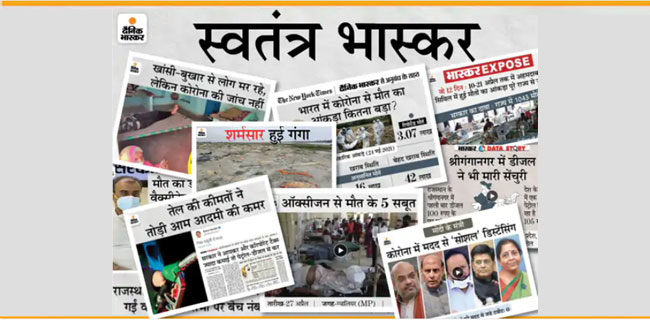
    Bhaskar itself called itself “Swatantra Bhaskar” or Free Bhaskar and announced on its front pages, with a series of images of its Covid and other coverage, that the government had to do what it had to do and the media group what it had to do.


    The Mumbai edition of the Times of India, July 23, had an article on Nation pages 11, the focus of which was the Opposition’s reactions to the raid. Shooting from the opposition’s shoulder, rather than straightforward coverage.


    The Economic Times, Mumbai, July 23, covered the possibility that industrialist Anil Ambani’s phone had been hacked as well as the corporate reaction to Pegasus on Page 6. But page 2 had Union minister Meenakshi Lekhi’s lies that Amnesty had distanced itself from the Pegasus Project, minus the clear clarification to the contrary that Amnesty had issued soon after.


    The Dainik Bhaskar raid was on Page 8.


    Hindustan Times, Mumbai, July 23, did better than its rival TOI. The first two pages were dedicated to the Olympics. Therefore, the Pegasus uproar in Parliament and the Ambani phone hack were on page 3. City page 5 had a single column on the DB raid in Mumbai. Nation page 5 ran with the raid as the lead, above the fold. And Nation page 7 had more Pegasus coverage. However once again, Lekhi, was allowed to run with her lie.


    The Indian Express, Mumbai has upped its game (although in the days to come expect more government ministers pushing Modi/BJP propaganda on their oped pages). The Dainik Bhaskar raid and Pegasus were on Page 1, continued on 2 as is the paper’s style. On Page 8, the Amnesty rebuttal to Lekhi’s claim made an appearance and Pegasus found space on the economy and world pages.


    The Hindu, Chennai had a much better showing, despite the photo of group head Malini Parthasarathy in Modi’s “illuminating” presence, which she put up on Twitter on July 22. Both the raid and Pegasus were on the front page, on page 10 in further detail. Pages 11 (nation) and 13 (world) had further Pegasus coverage.


    Of the English language papers MxM looked at, The Telegraph, Calcutta stood out. Both the raid on DB and Pegasus ran as the lead. The Ambani phone hack also found space. The lead story quoted DB National editor Om Gaur about why he thought the group was raided – the strong Covid coverage – as well as his NYT piece.


    Of the Hindi papers, Amar Ujala, Delhi had the best coverage: The raids on Dainik Bhaskar as well as the independent UP-based news channel Bharat Samachar were second lead, above the fold. No one else mentioned Bharat Samachar, which has been increasingly critical of the government.


    The Pegasus uproar in Parliament was the lead. Amar Ujala also mentioned prominently how Lekhi had called protesting farmers “mawalis” or hooligans. Most English newspapers ignored this stroke of genius from the Union minister.


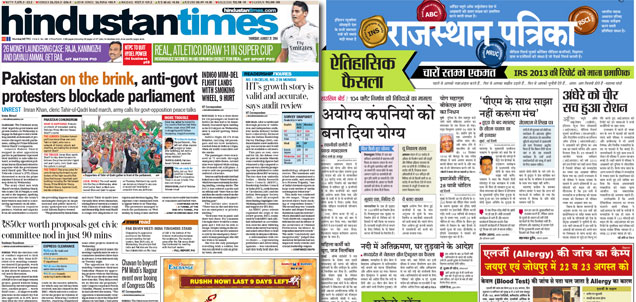
    Rajasthan Patrika, Jaipur, carried the raid on the front page and also had an edit.


    Hindustan Delhi: Had the Pegasus arguments in Parliament, but focused on the IT minister as the lead. A small mention of the DB raid on Page 1 sent the reader to page 11, where Pegasus was also covered.


    Dainik Bhaskar’s biggest competitor, Dainik Jagran Delhi, carried a tiny mention of the raid on page 4.


    Regardless of the extent of the coverage we went through, all media owners and editors know what all journalists also know: that the more you succumb, the more dangerous the world becomes. You may think I was going to say that the more you resist, the more you are under threat. That is true. But unless you want the threat to last forever, you have to resist.


    Kudos to Dainik Bhaskar for its stand so far.


    And to those who have not been too afraid to cover the actions of a vindictive government.


    For those who cover up, well…


    Ranjona Banerji is a senior journalist and commentator. She is also Consulting Editor, MxMIndia. She writes on MxMIndia every Tuesday and Friday. Her views here are personal
     

  • Patrika refreshes with ‘futuristic edginess’

    By A Correspondent


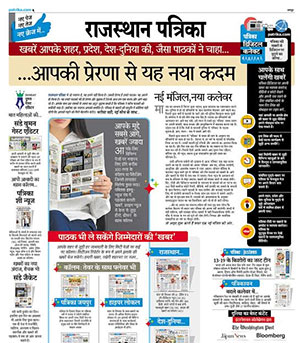
    Patrika, the Jaipur-based leading newspaper group with Rajasthan Patrika as its flagship offering, has remodelled its news structure, including its design and layout, to make the news “more relevant and readable while keeping the readers at the forefront of information and knowledge in this era of instant news”.
    Notes a communique: “The changes have been made after in-depth research and surveys of readers at various levels. The reader’s survey highlighted that people want to know the correct information and Patrika has always stood up to the expectation of readers when it comes to the accuracy of facts. The editorial content was overhauled after conducting regular interviews, webinars and detailed research in past six months on over 6K readers of different catagories, age-groups and regions of Rajasthan, Madhya Pradesh, Chattisgarh and other metro cities.”

    “At a time when Coronavirus has hit the businesses hard and most newspapers are struggling with their circulation, Patrika has gained its momentum back with its strong editorial content, leading to recover more than 90 per cent of its pre-Covid circulation,” the communique added.


  • Rajasthan Patrika invites entries for KC Kulish International Award

    By A Correspondent


    The Rajasthan Patrika Group has announced entries for the KC Kulish International Award for Excellence in Journalism, instituted in memory of the Founder of the group, late Karpoor Chandra Kulish. Entries for the award will be accepted from today, March 20, the birth anniversary of the late KC Kulish, short for Karpoor Chandra Kulish, the founder of Rajasthan Patrika.


    Entries are invited for both the years 2018 (12th) and 2019 (13th) respectively. The last date for the entries is May 15, 2020.


    Any article or campaign published in any newspaper or national/international magazine across the world between January 1-December 31, 2018 and January 1-December 31, 2019 are eligible for the award. Separate entries for both the years would be accepted.


    The annual international award carries prize money of US$11,000 and a certificate, making it the biggest prize money to date for an awards for journalism. Merit awards will be given for 10 other noteworthy entries. Information related to the award and entry is available on the website: http://kckawards.patrika.com/. Award will be decided by an independent panel of jury from various fields, including journalism.


  • Rajasthan Patrika announces contest to guess the Top 9 members of Team Modi

    By A Correspondent


    Rajasthan Patrika has announced a contest for people to guess who are the Top Nine MPs who whill constitute the core Narendra Modi cabinet.


    The contest title ‘Flashbag Namo9’ will see like a car, refrigerator, LED TV, Scooterette, mobile phones, and the like being given away.


    Users – from the advertising, marketing and media fraternity – can apply online at Flashbag.Patrika.com/namo9 or download the Patrika app to participate. To enroll for the contest, participants will have to fill an online form with details such as their name, mobile number, etc. and predict names of MPs with nine ministries (Home Affairs, Defence, HRD, etc) that the PM will select. If a participant’s choice matches the actual portfolios decided they stand a chance to win prizes worth lakhs of rupees through a lucky draw.


  • Rajasthan Patrika to launch Catch News with Shoma Chaudhury at helm

    By A Correspondent


    What’s with the hinterland media groups and their desire to get into the English language. Bhopal-based Dainik Bhaskar group jved with the Zee group to launch news daily DNA in 2005. A few years later – in May 2010, to be precise – the Jagran group acquired Mid-Day, but this was not before launching a hybrid newspaper called ‘iNext’.  And now the third biggie from the region – Rajasthan Patrika – has announced its entry to the big world of English media with ‘Catch News’.


    Catch, as per a note put up on a LinkedIn announcement inviting applications for various positions, has been described as an “ambitious new media platform that combines the solidity of traditional journalism with a new-age approach to storytelling”. And it adds: “Catch will have a distinct voice. Informed. Questioning. We believe the time is ripe for an Indian digital news platform that at its core has three beliefs: journalism matters; quality matters; individuality matters.“


    A communiqué was reportedly issued, but MxMIndia didn’t receive it. The announcement though is juicy enough to give out some info. “We live in a complex, highly interconnected world where events, people and decisions both within India and elsewhere impact our lives every day. To navigate what it all means, people need not just information, but interpretation, insight and analysis. Our challenge is to provide that insight in a way that is engaging, relevant, entertaining and inventive.”


    So, Catch will be based out of New Delhi (note: not new media capital Noida) and will be run by former Tehelka grande dame Shoma Chaudhury.  Catch’s team of astute, experienced journalists and hardcore digital natives are a perfect reflection of its intriguing duality, the announcement says.


    Ms Chaudhury is known to be a tough editor, and one doesn’t know whether the Tehelka experience has softened or hardened her. But who we are to add our ‘vishesh tippany’ on anyone?!


    The Kotharis (who own the Patrika group) are fine with it, the journos who’ve joined her are cool with it, so we should just await the entry of another exciting publication in the ‘breaking views’ category. In no specific order: Scroll, Quartz, HuffingtonPostIndia, DailyO, FirstPost, Quint… uff, did we miss out on any?


    The story goes that the MxMIndia boss was also contemplating a HuffPost-like site four years back, but the lack of a revenue model then took him away to set up MxMIndia. Sigh.


    Chalo, chalo. If you are interested in working with Ms Chaudhury, apply to jobs@catchnews.com. You could well be their Prize Catch. If you are not, just wait for it to happen. Catch eeeet!


  • Now, will newspaper publishers opt out of IRS?


    By A Correspondent


    Now that the MRUC and RSCI have decided to lift the abeyance on the IRS 2013 numbers released in late January this year, there is mixed reaction from stakeholders. While media agencies and advertisers are happy that they have data to base their buying decisions, a large number of publishers have express shock and dismay.


    Although none of them have done so in public, in the quiet, a majority of the big media groups – save the Hindustan Times and Rajasthan Patrika – are mulling their next steps.


    But first let’s read the press release that has been issued by the MRUC:

    “The Indian Readership Survey, 2013 was released on January 28, 2014. The release attracted differing views on the accuracy of the data and therefore the Readership Studies Council of India voluntarily requested subscribers to hold the study in abeyance and decided to undertake a revalidation exercise.


    Subsequently a sub-committee for revalidation was established with two co-chairs representing publishers and advertising agencies. The sub-committee unanimously concluded that the methodology used to conduct IRS 2013 was in order and decided to commission a Process Audit.


    This committee, after viewing several proposals unanimously agreed to award this audit to Mr Praveen Tripathi, (Magic 9 Media) India’s foremost expert on large-scale studies of media consumption behavior.


    The finding of the revalidation sub-committee and audit report, it was decided, would be discussed by the Heads of four industry bodies i.e. Chairman-MRUC, Chairman-RSCI, President-INS and Chairman-ABC, and a decision taken by them.


    The said Heads of the four bodies received and deliberated upon the report submitted by Mr. Praveen Tripathi and discussed the same with the chairman of RSCI – Technical Committee as well as the two co-chairmen of the revalidation committee.


    The Audit was conducted in two stages. Stage one involving direct back checking of respondent homes after which a much broader and deeper Forensic Statistical Analysis exercise was carried out to indentify and isolate both fieldwork compliance deficiencies and incidence of the occurrence of Unusual Publication Incidence (UPI) in respondent interview records. By sieving the aggregate data set for these issues, the audit was able to judge unequivocally whether the statistical deviations systematically changed any of the crucial readership output. The outcome was conclusive and unequivocal. The study results had not been impacted.


    After intense deliberations and careful examination of the audit report, Chairman-MRUC, Chairman-RSCI, President-INS and Chairman-ABC, have arrived at a unanimous and unambiguous decision to lift the voluntary abeyance placed on The Indian Readership Survey, 2013.


    The voluntary abeyance placed on The Indian Readership Survey 2013 is lifted with effect from 20th August, 2014.


    As has been reported, a large section of newspaper and magazine publishers had grouped together to take on the MRUC in February 2014. Among the actions proposed then were law suits and pulling out of subscriptions to the MRUC.


    According to an industry person in the know, there was a wide scale agreement that there is need for measurement data. Newspaper publishers which were earlier fighting the onslaught of television have in recent times been facing the heat from activation and OOH and the digital media. “With competition staring in our face, there was need to work things out. What’s worrying is that the crossfire we may see. It shouldn’t become a Times of India v/s Hindustan Times and a Dainik Bhaskar v/s Rajasthan Patrika duel.”


    A media agency captain who MxMIndia spoke to said: “Although IRS 2013 was kept in abeyance, we knew what those figures were and factored them in our decision-making. However, we must also say that we were not too convinced about the findings.”


    The newspaper industry marketer wasn’t too happy with the views of media agency professionals. “It’s fine for them to sit on their high horses now, but how will they react if they are subjected to a similar study. We should not forget we are part of the same ecosystem. This whole display of fiendish delight is unpalatable. We don’t want cowboys in the system!”


    Given that various the heads of various associations – Chairman-MRUC, Chairman-RSCI, President-INS and Chairman-ABC – took “a unanimous and unambiguous decision to lift the voluntary abeyance” as the MRUC press release states, there is little chance of any of the industry bodies crying foul. But it’s the news publishers are key components of the ecosystem and if they decide to dismiss the system or pull out of the IRS/MRUC or decide to have a competiting measurement body, we could see trouble.


    But, of course, one is expecting some fireworks.


    Watch this space.


  • IRS 2011Q4: Not much change in rankings but dailies witness significant growth

    By A Correspondent


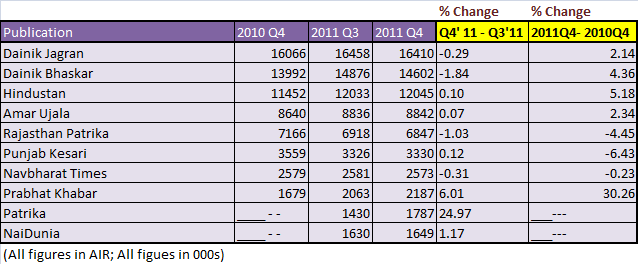
    Top 10 Hindi Dailies:

    IRS Q4, 2010 v/s IRS Q4, 2011

    There is not much of a difference in the rankings of the Top 10 Hindi Dailies. Dainik Jagran, Dainik Bhaskar,Hindustan, Amar Ujala and Rajasthan Patrika continue as the Top 5 Hindi Dailies. When compared to IRS 2010 Q4, IRS 2011 Q4 reveals the Top 4 Hindi Dailies, namely Dainik Jagran, Dainik Bhaskar,Hindustanand Amar Ujala have further strengthened their readership.


    A look at percentage change from Q4, 2010 to Q4, 2011 finds that Dainik Jagran has witnessed a growth of 2.14 per cent, Dainik Bhaskar grew by 4.36 per cent,Hindustanby 5.18 per cent while Amar Ujala grew by 2.34 per cent. The only Hindi daily to have witnessed double digit growth is Prabhat Khabar with a whopping 30.26 per cent growth in Q4, 2011 as against Q4, 2010. A total of five Hindi dailies have witnessed growth Quarter on Quarter.


    Q3, 2011 Vs Q4, 2011

    But the results for IRS Q4, 2011 Vs Q3, 2011 have a slightly different story to tell. The top two most read Hindi dailies – Dainik Jagran and Dainik Bhaskar – have witnessed a decline in Average Issue Readership (AIR), the decline is however marginal. Besides Dainik Jagran and Dainik Bhaskar, the Hindi dailies to have recorded growth in Q4, 2011 v/s Q3, 2011 are Hindustan, Amar Ujala, Punjab Kesari and Prabhat Khabar.


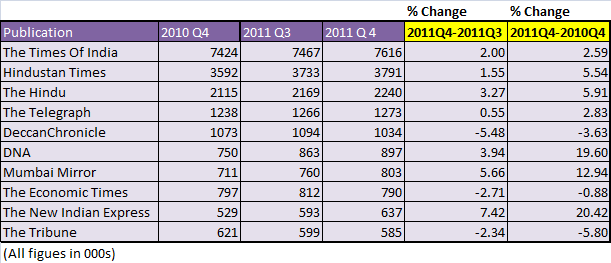
    Top 10 English Dailies:

    IRS Q4, 2010 Vs IRS Q4, 2011:

    The English dailies have performed exceedingly well in Q4, 2011. Seven out of the Top 10 English dailies have registered growth in their AIR. While DNA, Mumbai Mirror and The New Indian Express have registered growth in double digits, the top four English Dailies: The Times of India, Hindustan Times, The Hindu and The Telegraph have also witnessed growth quarter on quarter.


    IRS Q4, 2011 Vs Q3, 2011:

    The results for Q4, 2011 in comparison to the previous quarter also highlight the growth for most of the top Ten English dailies.


    Top 10 Language Dailies:

    IRS Q4, 2010 Vs IRS Q4, 2011:

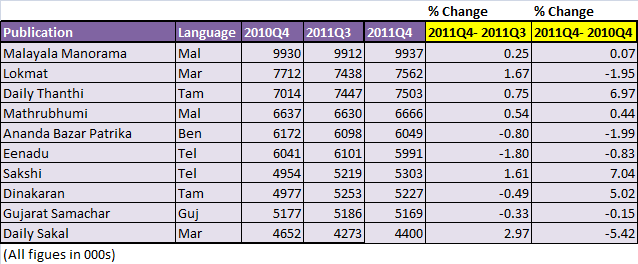
    The Q4, 2011 results as compared to the Q4, 2010 results have shown mixed reactions for Language dailies as only five publications witnessed growth since Q4, 2010 to Q4, 2011. Malayala Manorama continues to be the number one publication among the Language Dailies. According to IRS Q4, 2011 v/s Q4, 2010 findings, the Malayalam daily grew 0.07 per cent.


    Ranked second is Marathi daily, Lokmat which saw a decline of 1.95 per cent. The other Language dailies to have registered growth in their AIR are Daily Thanthi, Mathrubhumi, Sakshi and Dinakaran.


    Unlike the top two dailies, Daily Thanthi, ranked as third Language daily, grew by 6.97 per cent in IRS Q4, 2011 when compared to IRS Q4, 2010.


    It has been observed that the Malayalam dailies – Malayala Manorama and Mathrubhumi and the Tamil dailies – Daily Thanthi and Dinakaran have recorded growth in their AIR. Malayalam, Marathi, Tamil, Telugu, Gujarati and Bengali are some of the popular language dailies to have found a place in the Top 10 Language dailies.


    IRS Q4, 2011 v/s Q3, 2011:

    The top four Language dailies: Malayala Manorama, Lokmat, Daily Thanthi and Mathrubhumi have registered growth in their AIR numbers in IRS Q4, 2011 v/s IRS Q3, 2011. Besides the top four language dailies, Sakshi, the Telugu daily and Daily Sakal, the Marathi daily have also witnessed growth in their readership numbers.


    AIR or Average Issue Readership is defined as the readers of an average issue of a publication i.e. the estimated number of those who have read or looked at any issue of the publication within a specified time interval, which is equal to the periodicity of the publication (excluding the day of the interview). This is the preferred currency of media agencies across the country though often publications quote Total Readership (TR) when their AIR numbers are not impressive. MxMIndia only uses AIR in its IRS reportage.