
 Cred has evolved from its previous style of communication, which was often misunderstood but has been effective. Though forced, there has always been an attempt at being humorous and there is a storyline that delivers the message. Here is the recent ad, sharing the longer version of the Rajamouli ad. The other ads featured Illa Arun and Leander Paes. The Cred way of advertising indeed has a history of consistency.
Learning from Cred
TheCcred way of advertising has a history of consistency. Remember Govinda and other star auditions, the Goof for Great, Cred bounty and even something I just discovered and had not watched earlier- typical Cred- the claw (is that really Cred?!).
Meanwhile, many brands have learned from the Cred Institute of Advertising and are attempting to make advertising simple.
Have a message.
Maybe have a celebrity.
Create communication that repeats what you want to say.
Say it simply enough.
In the name of creativity and humour – try a condescending tone.
And most likely, there will be enough consumers who will try you out.
If you have the budget, you can attempt multiple edits or celebrities. However, that is not an essential requirement.
Make My Trip
Have you seen the Real Hero campaign of Make My Trip, where celebrities are hinted at but don’t show their face? It is where Cred was ages back. I am surprised at the campaign- which keeps spraying bullet point statements from a PowerPoint presentation – and even has to point out that Make My Trip is the real hero. So they have their Moves Don’t Lie, Breathless, Steamy and Bhidu Shakespeare- Jackie Shroff. Why, when you have such a great pair of Alia and Ranveer Singh doing a great job? Not that I liked their latest ad for first international travel. But every brand is allowed some goof-ups.
HDFC PayZap
HDFC is one of these advertisers that uses the Cred strategy of plain, iterative, repetitive, simplified, and no-storyline advertising. I must agree that Cred always had a storyline holding its creativity, and hence, the HDFC PayZap act with Virat for its payment platform is an innovation. However, one can cite the various restrictions one faces while using IPL association for advertising, and really making a good ad is sometimes difficult.
MRF ZLX
Talking of Virat, MRF, another brand endorsed by the celebrity, has recently made some friendly additions to the message, but it is still MRF ZLX or whatever that is supposed to meet.
Many brands have believed that the punch line- an end dialogue that can be repeated sticks and makes the brand memorable. Well, the SBI ads are trying to do the same – ‘I will upgrade to Cred’ with ‘Janata hai uska Bank kaun hai’ almost like ‘Mera baap kaun hai’.
Net-net
Now, before you get me wrong, the ads may be working, or the metrices must be showing them to be working. Maybe Cred-isation is the need of the hour in the shortened attention span and fragmented media reach. I am not sure, but I would love to know your point of view. However, I must say that the excitement, the humour, the smile and the aha moments are missing from these communications- maybe that is not what advertising is expected to do anymore.
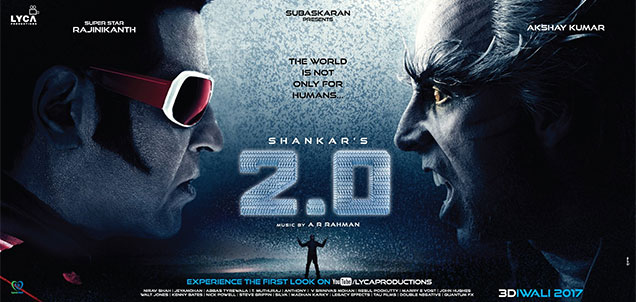
 The teaser promo of Shankar’s 2.0 was released last morning. The film, to be released in Tamil, Hindi and Telugu (besides other dubbed versions), is a sequel to the much-successful 2010 Tamil film Enthiran, which released in a dubbed Hindi version titled Robot.