Tag: Rahul Kansal

  • [RECALL] Inside the Times 175 years’ celebrations


    It’s celebration times in Indian media as The Times of India completes 175 years of existence. The exercise was kicked off in right earnest last fortnight with much fanfare. We posed a few questions on the celebrations to Rahul Kansal, Executive President of BCCL. And since it was Mr Kansal who was giving us a low-down, we also spoken on branding issues and asked him for finer details… beyond what’s already carried in the announcements.

    A veteran adman (Deputy Managing, Leo Burnett – 2000-02; Exec Director, Mudra 1994-2000 and Exec Director, Ogilvy 1989-94), Mr Kansal has been with BCCL since 2007, initially as CMO and since last year as Exec President.


    Excerpts from an interaction of Mr Kansal with Pradyuman Maheshwari:


    Q. One still remembers the 150 years sesquicentennial celebrations of The Times of India. What can one expect from the 175 years’ celebration? We’ve been seeing a celebration in the paper in the form of culling the best of the last 175 years…. Could you share a few specifics?

    Well, we’ve started with celebrating India’s journey over the past 175 years, and of giving readers a glimpse of how we’ve helped lead the change in the country over this period. We’re doing daily editorial spreads mining the best material from our archives and presenting them in a contemporary context.


    We’re also doing seven books on various themes, covering the defining moments over the past 175 years in sports, cinema, society and politics. The books are being anchored by acclaimed journalists and authors like Bachi Karkaria, Jug Suraiya, Santosh Desai, Boria Majumdar, Sandipan Deb and others. The first, Sporting Times, authored by Boria is being launched on May 23 in Mumbai, by some of India’s sporting luminaries like Sachin, Abhinav Bindra and Mary Kom.


    In a few weeks from now we’ll get into the heart of the 175 years’ celebration: a powerful activation programme called ‘I Lead India’. Being launched on a scale bigger than any of our earlier such interventions, the programme is basically an exhortation to India’s youth to stop whining about all that’s going wrong in our society, and instead start doing something about it. It asks our youth to say: Enough of pointing fingers, of blaming the ‘system’, of wanting them to change. I must be the change I wish to see in the world. I (will) Lead India.


    ‘I Lead India’ will peak in early November. This will be followed by a round of celebrations covering 25-odd cities, including, hopefully, some marquee programmes in some of the larger cities.


    Q. It started on April 23…. Till when will it continue (given that the ‘birthday’ is in November).

    The ‘I Lead India’ programme will reach a crescendo on November 10 – the actual birth date. And then we’ll go into a month-and-a-half of celebrations (musical and other cultural events across various cities of India)


    Q. Other than the ads in TOI group publications, we see a Ranbir Kapoor TVC, hoardings across Mumbai . Could you share some details of what the playout is going to be? Any more TVCs being planned?

    For the 175 years’ celebration there are several print ads, the Ranbir Kapoor film, various radio and outdoor messages. Besides, we are developing seven books, some very interesting merchandise (t Shirts, mugs etc) and some other interactive ideas. There will also be a stamp from the Government of India.


    ‘I Lead India’ will have an extensive communication package including 3 TVCs and an intensive package of print, radio and outdoor advertising.


    Q. It was good to see a TOI 175 years’ celebration ad take the HT Delhi Page 1 solus (and HT granting that to TOI). Do we see similar ‘tie-ups’ elsewhere?

    HT and we always agree to take each others’ ads in our papers, so long as they are not directly competitive or denigrating the other’s brands


    Q. The sesquicentennial had in many ways seen The Times of India (the paper) take a quantum leap, turning into a modern-day newspaper publishing company. Do you wish the 175 years celebrations to help you achieve a similar transformation?

    In the past 25 years, the TOI has already become a very robust brand, at the cutting edge of technology and of modern journalistic and management practices. The 175 years’ celebration is more to dedicate ourselves to the future rather than wallow over the past. It will seek to further cement its position as ‘The Masthead of India’, and in particular, as the voice of young India.


    Q. The Times of India footprint (@150) has increased much in the last 25 years. Do we expect a nationwide celebration or restricted to the publishing centres?

    Well, our publishing centres are ‘nationwide’ now. We will have ‘I Lead India’ chapters as well as the subsequent celebrations in 26 centres around the country.


    Q. While at one level you will be obviously talking of the 175-year history and heritage and at the same time you want to portray an image of a young, dynamic, forward-looking newspaper… is there a problem doing that? How are you looking at achieving the best of both?

    To our mind, modernity and heritage must go hand in hand, if either of them is to be meaningful. A first-generation industrialist may be dismissed as nouveau riche; an aristocrat old patriarch as a bore. ‘Money’ needs ‘class’ to become a well-rounded whole; ‘success’ needs ‘breeding’. Neither is complete in itself.


    Our 175 years’ campaign looks ahead even more than it looks back. Our archival stories are presented with a contemporary context. Besides, the centrepiece of the programme ‘I Lead India’ is entirely forward-looking.


    Q. You are a brand specialist… if one were to build a brand personality for The Times of India brand, what would it be?

    a. Sachin Tendulkar: old (in sporting terms), yet young and agile
    b. Ranbir Kapoor: young, energetic, hardworking, flirtatious
    c. Virat Kohli: young, brash, aggressive, streetsmart, a wtf-attitude to life
    d. Any other


    – Sachin’s track record is unparalleled, but his age is taking him to the end of his illustrious career. The TOI will hopefully go on for another long, long time.

    – Virat is probably India’s brightest new cricketing star. But he still has some way to go to reach the stature of some of the greats that preceded him.


    Amongst the above three, Ranbir represents perhaps a more balanced mix of proven achievement, heritage and a promise that ‘the best is yet to come’. To that extent I’d say he represents the values of brand TOI a little more closely.


    Q. And lastly, some finer details:

    How many people from BCCL working on the 175 years project. How many full-time on this? And at what levels?

    The TOI Brand and Edit teams are anchoring the programme, but the whole company is actively involved. Each department is creating its own interventions and celebrations.


    We saw the print ad was crafted by Taproot. Any other agencies?

    Mainly Taproot. Shop (Freddy and Naved) will also do some bits later.


    Any agencies for activation/digital/social media/etc.

    Gopika Chowfla designs for our books, stamp and merchandise.
     

  • IRS Q4 2011: Dailies flourish Year-on-Year


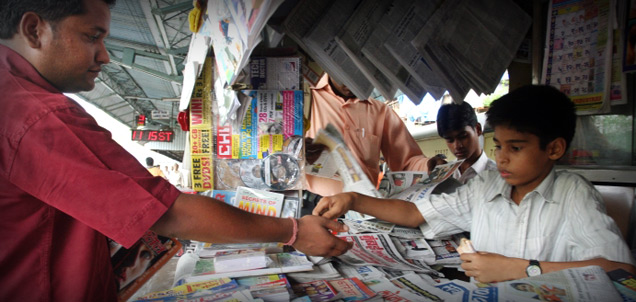
    The fourth quarter results of 2011 for the Indian Readership Survey were published on Monday and a quick look at comparing the numbers of IRS Q4 2011 versus Q4 2010 data, eight of the Top 10 publications – Dainik Jagran, Dainik Bhaskar, Hindustan, Malayala Manorama, Amar Ujala, The Times of India, Daily Thanthi and Mathrubhumi ­- have grown in their AIR (Average Issue Readership) Year-on-Year (YoY). Tamil daily Daily Thanthi and Marathi Daily Lokmat and Hindi Daily and the second most popular newspaper, Dainik Bhaskar  have registered the highest growths in AIR.


    When we compare Q3 2011 V/s Q4 2011, Dainik Jagran, Dainik Bhaskar and Rajasthan Patrika witnessed a slight decline in their readership. Dainik Jagran, Dainik Bhaskar, Hindustan, Malayala Manorama and Amar Ujala have retained their spots as the top five publications.


    After looking at the numbers, MxMIndia spoke to some of the publications for their views on the IRS Q4 2011 Topline numbers. Mr Rahul Kansal, Chief Marketing Officer, Times of India Group said: “Overall, I am quite happy with results, we have done pretty well in most of the markets including Delhi, Mumbai and Chennai, where we have seen very good growth.”


    However, Mr Rajiv Verma, CEO of HT Media Ltd, is disappointed with the IRS numbers but said in a statement, he will continue with investments in various markets. “While Hindustan Times has for long been No 1 in Delhi and No 2 in Mumbai, and Hindustan and Mint have consolidated their positions in their respective markets, as a group we are disappointed that these IRS numbers don’t reflect the full picture of our growth, and the reality of our investments and our efforts in the various markets across the country. However, we will continue to invest in various markets, to meet the needs of our readers and our advertisers, and will hope that the readership growth will be fully captured going forward.”


    Mr Sanjeev Kotnala, Vice President, Dainik Bhaskar Group said: “The IRS figures justify our focus on the urban, non-metro cities. Dainik Bhaskar is the only Gujarati newspaper to have a readership of more than 10 lakh in cities like Jaipur and Ahmedabad. If you see the figures for only the urban, non-metro cities, then you will realise that Dainik Bhaskar dominates the list. As far as the overall figures are concerned, we feel that it is a minor fluctuation, nothing major as far as our own perspective is concerned.”


    Speaking on trends from IRS Q4 findings, Mr Gautam Dalal, Vice President, Marketing, DNA said: “We observe that within Mumbai there is an increase in the overlap of English dailies readership – for every two readers there are three dailies being read. Mumbai, therefore, is seeing more penetration of English dailies and the trend of reading multiple newspapers is on the rise. Having such a high overlap percentage is a positive sign.”


    “In Mumbai we have had the highest number of growth for DNA, and these numbers are a testimony to our stand of having a high level of copy supported by the cutting edge editorial and by a focused market programme,” he added.


  • From agency maverick to ‘khadoos’ client…


    By Shubhangi Mehta


    Switching jobs is an avenue for growth. But how does it work when the switch is drastic – such as going from an agency which creates a communication for a brand, to becoming a part of that brand? With increasing numbers of agency heads moving towards the client side, it looks like a trend.


    A mix of work and pleasure is what agency life promises an individual. With that also follows a pattern of sleepless nights, tight deadlines and the pressure to impress the client. What happens when one moves to the client side? How does life change, and do the switchers miss the agency days?


    We have an ample amount of such examples already in front of us. Rahul Kansal, Sunil Lulla, Ajay Kakar, Abraham Alapatt and Sheran Mehra are some such examples.


    Kamal Basu, Head of Marketing, Skoda, who was working with Saatchi & Saatchi is the most recent example of such a move.


    On his new role, Mr Basu said, “Moving to the client side is all about trying something new for me. I personally feel that advertising agency and brands work very closely and cannot do without each other hence the changeover is fairly easy as compared to moving from an agency into banking. For me right now, the most important thing is to have the mindset of a student eager to learn new aspects of the business.”


    Ajay Kakar, CMO – Financial Services, Aditya Birla Group who has worked in a creative agency environment as well, said, “The grass is always greener on the other side. Having been on both sides of the table, at the agency and client ends, I can now relate and empathize with this sentiment. Throughout my 14+ years experience at the agency side I shared the sentiment of every colleague, ie, ‘Hum kaam karte hain, while clients aish karte hain’. And during my more recent six-odd years at the client end, I can’t deny having heard or felt the sentiment, ‘Yeh agency waale kya jaane, what pressure we face’!”


    On the agency side, one is usually thought to be a lot more casual about ideation, creative, deliverables etc and the perspective is that it changes completely when one becomes a client.


    Rahul Kansal, CMO, Bennett, Coleman and Co, said, “I moved to the client’s end nine years ago. I had experienced agency life for approximately 20 years and was itching to implement my own ideas rather than just being an advisor. Though the two lives or work culture cannot be compared, yet as a client there is an ownership of the brand which leads to a personal connect.”


    Certainly an agency person enjoys agency life. But an invitation to partner a client is a thrilling mandate which might be quite enticing.


    Abraham Alapatt said, “After 10 years in the agency business, I was keen to grow into a more complete ‘marketing’ professional (as opposed to remaining a pure advertising man) and when I was offered my first head of Marketing role in 2005 with Reliance Mutual Fund, I took it most eagerly.”


    For those in the agency, the universe tends to revolve around advertising and agency imperatives. But as a as a marketer, one comes to understand that advertising and the agency are key cogs in a very large wheel.


    Sheran Mehra, Head of Marketing and Corporate Communications at Dhanlaxmi Bank, said, “I had planned my career in such a way that I wanted to move to the client side after working with an agency, since I wanted to play a larger part than just being an advisor for the brand. The agency setup is more informal, and more like a family. Not that here it isn’t like family, but it’s more formal, more of a corporate environment.”


    Alapatt further explains, “In terms of effort and pressure, being on the client side is as challenging and difficult, because the line of responsibility and accountability, especially when it comes to ROI, budget accountability etc, is a lot more definitive. If earlier at the agency, I spoke to my clients every morning and then planned my day’s priorities before catching up with my team and then breaking up jobs to meet expectations – now as a client I have to plan my day ahead (based on current business and leadership priorities) and then along with my team, chart out tasks/timelines/deliverables. I also have a lot more information available to help prepare an annual plan, review it regularly, and then make more meaningful contributions to overall marketing and business strategy then when I was on the agency side. Overall it is a lot more organised, planned, systematic, and accountable.”


    A client initiates a brief. And his job is not complete till long after the agency hands over its input and output.


    The most obvious change after moving to the client side is that one can now plan a day or a schedule and prioritize a lot more, and there are far fewer firefighting situations than when working with an agency. This is probably because ad agency teams (who work with multiple clients) need to constantly re-align their priorities in line with their clients’ changing needs.


    Mr Kakar further adds, “Today I feel like the ‘complete man’, because I now have a realistic perspective from both ends. Having been on the agency side I believe that I can be more sensitive to the agency’s needs and constraints. But on the other hand, I am more demanding on what I know is possible. But life in an agency is what I miss… the masti and the laughter in the corridors, the camaraderie, the training sessions, et al.


    “As a client we can say that one is responsible for one’s team delivery (besides your own KPIs). These are directly linked to the company’s overall performance targets and plans, and every idea, plan, activity, campaign needs to be very clearly defined and measurable as one is accountable for every rupee spent to the CEO and the board of directors.”


    Most of the people who have made a move have stuck to the client side, which seems to indicate that working as a client is more enthralling.


    “I am not sure I yet have an answer to which part I enjoy playing more. But I do believe that the agency and client are two sides of the same coin. A marketer’s success depends on his agency partner, just as an agency’s existence depends on its clients. And only when both of them come together in harmony, is there real value in the form of fun, fame and fortune, adds Mr Kakar.


    While Mr Alapatt muses, “Looking back, I am glad I made the shift for the growth, learning and opportunities it has afforded me. But I can confidently say that the first 10 years of grounding/experience that I enjoyed with ad agencies like Ogilvy and the exposure to multiple clients/categories has been invaluable to my growth, both personally and professionally.”


    The big picture seems to be that the transition from one side to another is a natural evolution and part of the growth process. And this part of the journey as a client can be said to mature one as a person and marketing professional.


  • Independents rule adland in 2011


    By Shubhangi Mehta


    Looking at 2011 and how well the independent agencies have performed this year, it can be said that this has been the year of independence for the independents who have managed to attract some big ticket clients.


    Law & Kenneth has excelled this year in terms of business wins, Anil Nair, CEO and Managing Partner, Law & Kenneth, said: “As an independent agency, we have everything and give appropriate solutions to our brand. Our services are not restricted to just creative campaigns for a brand. We can offer all that a bigger agency can do. The advantage that we have over them is that we focus on the task in hand without any bias. Bigger agencies need larger income, hence the client has to spend big. For us honesty and integrity are high currencies, hence we have the courage to call a spade, spade.”


    Most of the independent agencies these days let their work talk for them. Ideas@work won the creative mandates for Big Rock, Gelusil, Rustomji and managed seven awards at Goafest.


    Saints & Warriors and Scarecrow have done equally well and bagged some good businesses. Ditto with Creativeland Asia which has excelled.


    Mahesh Chauhan, Salt Brand Solutions, said: “In my opinion 2011 can actually be known as the year of independence for smaller agencies. Larger agencies offer infrastructure, whereas we, as independents, go to a client and say we’ll work for them, which a bigger agency cannot do. We partner with our clients and this has motivated the transition. As for me, working as a founder of an independent agency means being a player of the team and not the captain.”


    SALT has won the creative mandates for Kaya Skin Clinic, BSE and Big RTL this year.


    Early this year ‘Hum mein hai hero’ came across as a clutter breaker. Similarly Pepsi ‘Change the Game’ and the Airtel’s latest ‘Har friend Zaroori hota hai’ have made one feel that there is a change in the thought process of the client as well.


    Happy Creative, a creative boutique, managed to cull out a name for itself in terms of awards and has done some great work for Flipkart.


    Rahul Kansal, CMO, Bennett & Coleman, said: “As a client, we are looking for less of strategy and more of creative input, hence we want to deal directly with the creative person who is more readily available in smaller/independent agencies. We no longer want to work with middlemen. Second, if we are comfortable working with a particular individual, then we prefer working with him, it doesn’t really matter if it his own startup.”


    Agnello Dias, Taproot India said: “This year has been reasonably good for independent agencies. Clients are looking for a fresher take, hence they are moving towards agencies who can give them personalised service as they have lesser work.”


    It can be said that when we sell something, even if it is an idea, there has to be a personal touch. And that’s exactly what these boutique agencies are offering to their client. Right from suggesting a brand name to designing and packaging, a lot of these agencies are providing services beyond the creation of a brand communication for a brand.


    Sandeep Bomble, founder director, Palasa said: “The business we won this year was Iball mobile phones, Housefull Furniture and Rawwar Fashion. We also won 3 Goafest awards last year for different categories like Best Packaging, Best Art Direction and Best Direct Marketing Event. One-to-one client interaction, cost effective and lesser process driven are the primary reasons for survival of independent agencies. The people working in the agencies will come and go, but in a small set up, the head that drives remains forever. Which is why, a client enjoys personalised attention without losing out on quality in the long run”.


    The bigger agencies have always been big, but it is a striking fad to see that creativity more than anything is getting the utmost importance in India, just like it is in other countries.


    What we can figure out from the views of the experts is that in the end, it isn’t about being big or small, instead it’s more about being ingenious and impeccable.