Tag: Rahul Gandhi

  • Rahul Gandhi, Arvind Kejriwal steal the show at Press Club Mumbai’s ‘Ouch Awards’

    By Dyanne Coelho


    Ouch! The Press Club Mumbai organised the the ‘Ouch’ Awards, a satirical awards show that felicitated the blunders made in the media industry. The event hosted by stand-up comedian Anuvab Pal, featured trophies given out on a humorous note to known names who t some point or the other stood out for the wrong reason. The ‘Ouch’ Awards was a prelude to the more serious RedInk Awards organized by the Club scheduled for April 30, which applauds excellence in journalism.


    “A lot of media is made up of people making asses of themselves and that’s getting a lot of readership and viewership. This is just a way to laugh at ourselves, to recognize the milestones of stupidity,” said Gurbir Singh, Chairman of the Mumbai Press Club.


    The award for Transparency in Public Life went out to none other than Arvind Kejriwal for his tweet; ‘Running 102 fever since yesterday. Severe loose motions. Sad that I won’t be able to attend office today.’Seems like he’s taken transparency in politics to a whole new level.


    Following this award was the ‘Global Ouch for Leadership in Absentia’ award; which, no prize for guesses here, went to Rahul Gandhi.


    There was a long list of nominees for the ‘Golden Ouch for Advancing the Cause of Women’ including Abu Azmi, Sharad Yadav, Mulayam Singh, Giriraj Singh, Tapas Pal and many more. Finally it was a tie; Giriraj Singh walked away with the award for advancing the cause of women and furthering relations with foreign nations, while Sharad Yadav bagged the award for his racist remarks on the skin of South Indian women. “I massage him with Fair and Lovely,” said Yadav’s massage man who picked up the award on his behalf.


    For the joint effort of furthering the cause of women’s safety in our country and highlighting a supposedly male-dominated society, the ‘Silver Ouch for Advancing the Cause of Women’ undoubtedly went to A.P. Singh and M.L. Sharma, the defense lawyers in the Nirbhaya gang rape case, who made their thoughts very clear to the world in the BBC documentary, India’s Daughter. Speaking of BBC, the news channel received a special Ouch for ‘Best Science Reporting’, for turning the ‘hadron’ collider into the ‘hardon’ collider. A dressed up Prince Charles received the award from Mr. Ayaz Memon.


    The Ouch for ‘Confession of the Year’ went to Coast Guard Officer B.K. Loshali for shooting down a Pakistani boat, once again using biryani as a metaphor for Indian hospitality. Part two of this award went to Public Prosecutor, Ujjwal Nikam for his biryani lie in an attempt to build public opinion against Kasab.


    The Golden Ouch for Best History Reportingwent to Capt. Anand Bodas for his insistence that Indians, and not the Wright Brothers, were the first to fly planes between countries, continents and even planets, and that too in all directions, forward, backward and sideways as well.


    The Ouch for ‘Labors in Family Planning’went to none other than BJP MLA, and RSS member, Sakshi Maharaj for putting forth the suggestion that all Hindu women have four kids. In his absence, a woman with 11 kids stepped forward to pick up the award on his behalf.


    The ‘Golden Ouch for the most Non-Violent Statement’ for his sweeping accusations on Mahatma Gandhi and Subash Chandra Bose went to former SC judge and former PCI Chairman, Markandey Katju.


    For a blooper in a newspaper image, the Ouch went to the Hindustan Times for the PTI image that showed a Chinese trade delegation, but was captioned as convicts of the Shakti Mills gang rape being taken to prison. The newspaper had printed the wrong image.


    The Golden Ouch for the best criticism of the press was bagged by Gen. VK Singh and Justice Markandey Katju jointlyfor the coining of the term ‘Presstitutes’ which is a combination of people of the press and destitutes.


    For her tweets on Marathi Cinema, and for uplifting the American popcorn over the taste of the Indian Vada Pao and Misal, the Golden Ouch for food Critic of the year went to Shobhaa De.


    The final award of the night and the most prestigious of the Ouchies, the Lifetime Achievement award was awarded to Indian politician, Subramanian Swamy, for his consistency in continually delivering provocative comments on both enemies and friends alike. In his absence, the award was received by none other thanShri Narendra Modi, or maybe just a lookalike.


    It seems that no stand-up comedian can walk off stage without taking a crack at Arnab Goswami. Anuvab Pal concluded the award ceremony by sending squeals of laughter and giggles through the audience with his imitation of the Times Now journalist’s on-screen manner.


    Happy with the outcome of the first ever Ouch Awards Ceremony, Gurbir Singh proposed making the event a regular one, “We have received a positive response this time, and we look forward to making this an annual event on a larger scale next year onwards.”


    1. Golden Ouch For Transparency in Public Life.

    Citation: For his evangelism in pursuing transparency and detoxification of self andthe’body politic’ – and for his great progress from singing to stinging and some very surprising mud-slinging!

    Winner: Arvind Kejriwal for his tweet on loose motions.


    2. Golden Ouch For Leadership in Absentia

    Citation: For going on extended vacation when the ‘party’ needs him most, for staying away from parliament at its most critical moments, for his enormous vocabulary of two key words: ‘women’s empowerment’!

    Winner: Rahul Gandhi.


    3. Golden Ouch For Advancing The Cause Of Women.

    Citation: For excelling in the field of gender prejudice in the face of enormous domestic competition, and for successfully hurting the sentiments of a friendly African nation.

    Golden ‘Ouch’ for Advancing the Cause of Women (and For Improving Foreign

    Relations)

    Winner: HONOURABLE MINISTER OF STATE FOR MICRO, SMALL AND MEDIUM
    ENTERPRISE GIRIRAJ SINGH 

    AND JOINT GOLDEN OUCH WINNER

    For crudely changing the complexion of parliamentary discourse by his racially-charged comments on the skin of South Indian women and his response to the criticism of HRD Minister SmritiIrani 

    Winner: HONOURABLE JD(U) CHIEF, SHARAD YADAV


    4. SILVER OUCH FOR ADVANCING THE CAUSE OF WOMEN.

    Citation: For their consistent, unstinting commitment to the cause of misogyny and patriarchy despite the valiant battles being fought for independence and respect by the women of India and their supporters.

    WINNERS: Tie between two defence lawyers M.L.Sharma and A.P.Singh in the Nirbhaya case.


    5. GOLDEN OUCH FOR CONFESSION OF THE YEAR.

    Citation: For either shooting down a Pakistani boat or simply shooting his mouth off – using ‘biryani’ again as a new metaphor for Indian hospitality.

    Winner: COAST GUARD DIG, B.K. LOSHALI


    6. GOLDEN OUCH FOR CONFESSION OF THE YEAR – PART 2.

    Citation: For his extraordinary morality and misplaced sense of pride in cooking up a ‘biryani lie’ to build public opinion against a prisoner on death row and thus expediting his execution.

    Winner: SPECIAL PUBLIC PROSECUTOR, UJJWAL NIKAM


    7. Golden ‘Ouch’ for Best Science Reporting (Rising to the Occasion!)

    Citation: For provoking and arousing laughter and embarrassment around a serious scientific phenomenon by alluding to a male sexual phenomenon that is best not talked about

    WINNER: THE BBC for calling the Large Hadron Collider the “Large Hardon Collider”


    8. Golden ‘Ouch’ for Best HISTORY Reporting

    Citation: For insisting that Indians flew planes centuries before the Wright Brothers (and Air-India), that these planes flew between nations and planets, that they flew forwards, backwards and sideways –– and above all, that these were no flights of the imagination.

    WINNER: Captain Anand J. Bodas for Educating the Masses on India’s Aeronautical Achievements in Vedic Times


    9. Golden ‘Ouch’ for his ‘labours’ in Family Planning

    Citation: For asking women of a certain religion to labour’ their entire adult lives producing babies and thus working tirelessy for the cause of resurgent majoritarianism.

    Winner: SAKSHI MAHARAJ FOR URGING HINDU WOMEN TO HAVE MORE

    CHILDREN


    10. Golden ‘Ouch’ for the most Non-Violent Statement

    Citation: For having an instant opinion on every issue and for his sweeping attacks as ‘imperialist collaborator’ on the father of the nation, Mahatma Gandhi, and of the founder of the Indian National Army, Subash Chandra Bose.

    Winner: FORMER SUPREME COURT JUDGE and FORMER CHAIRMAN, PRESS

    COUNCIL OF INDIA, MARKANDEY KATJU, ON GANDHIJI


    11. Golden Ouch For A Newspaper Blooper

    Citation: For the best caption in the print media that outlines the care and detail that goes into addressing the photographs that accompany news items.

    WINNER: HT for referring to the Shakti Mills rape convicts and showing a Chinese trade delegation photo.


    12. Joint Golden ‘Ouch’ for the best criticism of the press

    Citation: For hurting the sentiments of commercial sex workers by calling media people “presstitutes”. General V.K. Singh for hastily coining the word, and Justice Katju for endorsing it with his usual efficiency.

    Winner: GEN VK SINGH & JUSTICE MARKANDEY KATJU


    13. Golden ‘Ouch’ for Food Critic of the yer

    Citation: For a remark in delightful poor taste, elevating the lowly American popcorn above the thundering all-conquering indigenous warrior taste of VADA-PAO and MISAL.

    Winner: SHOBHAA DE


    14. Lifetime Achievement

    Citation: For consistently and eloquently delivering highly provocative statements with exquisite sophistry, confounding both enemies and allies alike

    GOLDEN OUCH for Lifetime Achievement

    Winner: SubramaniamSwamy


  • Ranjona Banerji: Election of the Trivial & Telegenic


    By Ranjona Banerji


    If this general election is indeed a watershed moment for Indian polity then it is no less a groundbreaker for the Indian media. Television has dominated this election practically setting agendas and leading the battle from the frontlines when it comes to chosen candidates and parties. The battle is won by the trivial and the telegenic. The smaller India grows in terms of communication thanks to telephony and technology, the larger the disconnect from reality: or so it appears.


    If the media is going to play such a significant role from here on, then the elements within the media must come out and identify themselves by their ideological and philosophical bearings. The old argument used by journals that they are all things to all people cannot stand any longer. It is in many cases patently untrue. Further, it has reached a stage where you are taking readers for a ride.


    Television has no such argument at all and instead has created an atmosphere of rumours, allegations and gossip to thrive. Even within the media fraternity, there is a constant stream of stories about which channel has been sold to which political party or who favours which candidate. Some parties are barely being mentioned when it is evident that they will have some bearing on these elections. Thrown a few corporate houses into the mix and you have a great Indian muddle which barely resembles a delicious homemade khichdi.


    Who has financed all these opinion polls to project election results for instance? What is the consumer of news to make of them when ground reports from journalists are at odds with those surveys? In a two-month long voting schedule, a constant stream of opinion polls amounts in fact to trying to influence those who have not yet voted, even if the Election Commission has not cottoned on to it yet. The figures for conducting these polls which are going round the grapevine are astronomical.


    It is time therefore for all newspapers, news channels and websites to declare their political leanings. There is no shame in this. All over the world, the reader and viewer knows what their chosen media outlet stands for. This is not just about individual columnists to declare their leanings. This is about the organisation itself. Given the growth of the influence of the media – and these are strong words – to fool your consumer any more is tantamount to fraud.


    It is evident that it is not just a nudge from one corporate house and a wink from another that dictates media flow. We have seen epic and sudden changes of direction from left to right to centre and back. What most newspapers do to cover this up is provide a variety of columnists on their opinion pages to portray first one point of view and then another to prove that they are “neutral”. It no longer cuts it.


    TV of course is another jungle with its own rules, quite distinct in some cases from print. Editorialising and on the spot opinion-making is now par for the course. As a very senior editor who has a career in both print and television pointed out to me, if a star anchor, who is also the editor, asks a young reporter on live television, “Isn’t the political rally proving what I say?”, what is the young reporter to do? Disagreeing with the boss is not an option. And so news is created, not reported.


    For a long time in India, journalists were more left of centre than right but that was not an absolute truth. For instance Girilal Jain, a colossus in the Times of India was distinctly right of centre and the Indian Express was distinctly anti-establishment in the days when the only establishment was Congress.


    One must distinguish between the need for media outlets to declare their politics and the accusations and muck thrown at individuals on social media. Gutter language and threats will continue. But now the target will be clear and much larger. And in the interests of fairness, everyone will have a target!


  • Ranjona Banerji: The Rahul Gandhi interview was more about Arnab Goswami

    By Ranjona Banerji


    Am I a serious journalist? After last night’s interview of Rahul Gandhi conducted by Arnab “I am a serious journalist” Goswami, I have come to the conclusion that I am emphatically not. My understanding of being a journalist is less me and more you. An interview has to draw out the interviewee. It has to place them on the spot, yes, but it cannot be about the interviewer. And an interview has to move along – if it’s getting stuck, you have to step back and come back to that unanswered point later. The reader or the viewer has to be your first priority.


    In this case, the unanswered point was the 1984 riots in Delhi where thousands of Sikhs were massacred by Congress members and others after Indira Gandhi’s assassination by her Sikh bodyguards. The horror of the killings was exacerbated by Rajiv Gandhi’s comment at the time that the ground shakes when a big tree falls. The point is important. The problem was that Rahul Gandhi was not the person to answer it. He was a child when it happened. The party has apologised since then as has the current prime minister. Why badger Rahul Gandhi endlessly on this issue when you can take him up on so many others.


    Then there’s the issue of corruption. Instead of talking about the sea of allegations against the Congress Party and issues like the coal allocation scam, Goswami got stuck on allegations against Virbhadra Singh, chief minister of Himachal Pradesh, based on some investigation that Times Now had done. Much as the nation apparently wants to know what Goswami thinks every weeknight at 9 pm, there is an India beyond Times Now. Really.


    Moreover, the number of times Rahul Gandhi mentioned “RTI”, “youngsters”, “women” and “empowerment”, anyone else would have taken him up on those issues and questioned him on what he had done about it. There are a number of problems with RTI in the states, including Congress-ruled states. Why not bring those up? What about the brother-in-law Robert Vadra? Not a single question on that.


    Bringing up Subramaniam Swamy’s allegations about Rahul Gandhi’s education was ludicrous. The kindest thing one can say about Swamy is that he is a “maverick” and he is infamous for throwing allegations all around, hoping something somewhere will stick. He is hardly the gold standard for information.


    The endless questions on Narendra Modi and the Gujarat riots became tedious after a point. And just to inform journalists in general, Modi did not get a “clean chit” from anyone. The SIT report said “no prosecutable evidence” which is quite a different matter.


    The whole interview sounded too structured. There was no flow and there was no charm. As of now, Rahul Gandhi does not stand accused of anything except being seemingly reluctant to take on too much and vanishing after making declamatory statements.


    I for one learnt little new about Rahul Gandhi except that he has some good artwork on his walls.


    However, the funniest thing about this interview was the “discussion” later with Vinod Mehta, editor emeritus of Outlook magazine and Siddharth Vardarajan, former editor of The Hindu. This was a first for me: an interviewer holding a discussion on how his interview went. If this is how serious journalists behave, well, thank the lord there are so many of us non-serious ones around!


    I hear that tonight there’s going to be even more discussion, from 8 to 11 pm. Luckily I have found itvchoice on my HD set top box so I shall watch some British reality TV shows about dancing on ice, dancing in your house and dancing in general. As it is I missed Elementary on AXN because of this interview.


    Or there’s always the BBC’s Hard Talk series on India…


    **


    Twitter not unnaturally was abuzz with the Rahul Gandhi speech and suddenly, Modi and Arvind Kejriwal (have I got the order wrong?) were off the grid, except when mentioned with regard to Gandhi.


    Now that was funny. May not last too long though.


    Ranjona Banerji is a senior journalist and commentator based in Mumbai. She is also Contributing Editor, MxMIndia. She can be reached via Twitter at @ranjona. The views here are her own


  • Anil Thakraney: The Feku/Pappu tamasha

    By Anil Thakraney


    Two stories from last week caught my attention. One, as the battle of Feku (NaMo) and Pappu (RaGa) got raging on the social media, with both their followers (many of them fake) getting into a mudslinging match, the television media got busy discussing the social media’s impact on politics. On whether all the fan following (or hatred) on Twitter will affect the fortunes of the netas in the next elections. Well, all they had to do was ask me, and save themselves a lot of precious airtime. The answer is a big NO. And I don’t say that because a vast majority (over 95%) of Indians aren’t connected on social media, that would be the obvious explanation.


    I say that because a vast majority of those who are, are likely to be from the Great Indian Middle Class. The class that cribs heavily but never goes out to vote (me included!). The kind of people who have opinions on politics but don’t wish to engage with the process. These people are having fun on the internet, and all they want to do is outsmart each other on the ‘retweet’ value, have a good laugh, and then forget all about it. The people who will actually queue up to cast their votes will, as usual, come from the lower or very lower classes. They have no interest in the social media chatter, they give a damn about who tweeted what. They will vote for the same reasons they always vote: Regularization of their bastis, a new bore well, electricity connection, etc. And they will vote keeping caste, religion, language, etc, in mind.


    In short, enjoy all the outpouring on the internet. It’s fultoo time pass, and nothing more.


    The other story was that ‘super exclusive’ on Times Now. Which involved bowler Sreesanth giving the channel a soundbite, which had him ranting about the ‘Slapgate’, an incident that happened five long years ago! What was funnier was Arnab babu excitedly announcing that ‘this is the biggest cricket controversy’. Wow, Mr Goswami, you call a slapping incident post an IPL match a bigger controversy than the assorted match fixing scandals? Anyway, Sreesanth is upset it’s still being called ‘Slapgate’, he claims he was never actually slapped. Apparently, our man was struck by Bhajji, with the latter using the back of his palm, and not the front. Therefore, according to Sreesanth, that can’t be called a slap. Haha. Two things: One, Arnab babu needs to dig harder for real stories if trash like this is getting him fired up these days. Two, mental Sreesanth needs urgent help.


    ***


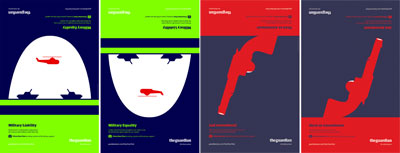
    PS: Interesting campaign by The Guardian for its US launch. Using graphic design, each ad puts out two sides of a heated political debate. The flip side of the ad reveals the flip side of the argument, so to speak. Fantastic work by the art director.


  • Anil Thakraney: Brand Modi versus Brand Rahul

    By Anil Thakraney


    Human beings are brands too. The same principles of product quality, marketing effort, positioning and consumer image apply. Which is why we must evaluate them in terms of pure marketing logic. Today, let’s take up the case of Brand Gandhi Junior and Brand Narendra Modi.


    Brand Modi is a powerful brand, and we already know that. Consumers are crystal clear on the positioning, and the brand consistently delivers what it promises. Brand Modi primarily appeals to the emotion, and backs that up with rational logic. The ‘Hindu Fighter’ image appeals to the majority in the state of Gujarat. And for the fence-sitters, it’s the ‘development’ platform that works. In that sense, Brand Modi is perceived to be a complete brand. Therefore even if the rest of India does not favour the primary image of this brand, the saleability increases on account of the secondary promise. This dual positioning will be of immense value for Brand Modi in 2014. What makes this brand even stronger is its charismatic personality, which is supported by aggressive marketing and promotion. Consumers like to be associated with the brand, and this further strengthens saliency.


    In short, a clear market positioning, consistent delivery, powerful brand values and a huge consumer connect. Clear winner.


    The case of Brand Rahul is the exact opposite. There is no perceptible brand positioning, therefore the consumer is unclear on what it stands for. What makes things worse is that the house from which this brand emanates, its USP, has lost saliency over the years. In addition, Brand Rahul seldom gets promoted in the market place, therefore consumers are kept in the dark on its efficacy. And no one puts money on an ‘enigmatic’ brand, unless it’s a top-end perfume. In addition, on the few occasions Brand Rahul has been made visible in the market, its performance has been a disaster. Therefore, the brand connotes negative values.


    In short, vague brand imagery, lack of product performance and poor marketing effort. Clear loser.


    So if the battle of 2014 is going to be fought between these two brands, simple marketing logic tells us who’s the favourite one to win. Unless, of course, Brand Rahul does a complete turnaround in the coming period, and I doubt that’s going to happen. It’s a hopeless brand.


    ***


    PS: Incredible stuff. It’s impossible to believe these are illustrations, not photographs. Now this is art I truly adore. Hope to find such talent in India… imagine the millions of rupees advertisers can save by avoiding over-paid photographers.


    Link: http://www.creativebloq.com/illustration/realistic-pencil-drawings-11121172


  • The Anchor: Asif Syed on 5 Things that are getting hotter in New Delhi

    By Asif Syed


    1. Manmohan Singh – Will the sardar become asardar?

    For a while now, many observers of the Delhi durbar have felt that the real Prime Minister wasn’t Manmohan Singh, (no, not Sonia Gandhi, she’s the super PM) but Pranab Mukherjee. Whether it was with government work, party work, troubleshooting for the UPA sarkar or heading 13 Groups of Ministers that deliberate on government policy, Pranab was the man. The joke is that the PM (Manmohan) spoke so little is because the real PM (Pranab) didn’t let him.


    Now with Pranab on his way to becoming President of our republic, many ministers in the Union Cabinet have found some additional breathing space, but none so much as Manmohan Singh. So much so that the very day he took over the Finance Ministry, the sardar ordered the government to go looking its lost “animal spirits!”


    So will the sardar become asardar or will the real number 2 – P Chidambaram, who was second only to Pranab in the GoM count with 12 in his kitty – muscle in and fill in the vacuum.


    2. The Summer of 2012

    The venerable Times of India has reported that Delhi has had the hottest summer in the past 33 years with the average temperature frizzing the mercury to an average of 41.25 degrees. Interestingly, and what is probably a sign of the times, the data for this investigative story was sourced not from the Metrological Department of India but from the website of the National Climatic Data Centre (NCDC) in the United States.


    Unlike Bombay and (ahem) some other parts of the developed world that have uninterrupted power supply, Delhi seems to have introduced the new concept of uninterrupted power cuts. Add to this the severe water shortage – basically no water at all from the MCD – and one gets situation where residents who are out on the streets to protest the lack of bijli get into a scuffle with each other over tankers delivering water.


    Of course, Lutyens Delhi, home to national level politicians, bureaucrats and businessmen has no bijli or paani problems. The air conditioners in the MPs homes are humming and sprinklers keep their lawns achingly green.


    There is fervent hope that the monsoon rains will bring some respite but they too seem to be avoiding Delhi and are stalled somewhere over central India. Maybe the ToI can talk to the NCDC about what to do…


    3. The most modern thing in Delhi

    Not all is bad in Delhi and the Delhi Metro Rail Corporation is the best thing going on the ground, below the ground and above the ground. It has changed the face of Delhi for the better like nothing else and with every phase of expansion it is bringing the spread out city of Delhi and the other parts of the National Capital Region closer to each other. It is the one thing that works in the city of a thousand hindrances and works very well.


    With two phases completed and almost 200 km of track laid and services running, the DMRC has commenced Phase III which it aims to complete by 2015 and Phase IV by 2021. By then the Metro will have more than 400 km of track and will reach every corner of the megapolis. It is already one of the most advanced metros in the world and soon will also be one of the largest. (check out this map – http://en.wikipedia.org/wiki/File:Masterplan_of_Delhi_Metro.png)


    Like Vicky the eponymous sperm philanthropist of the move Vicky Donor says to his nani, “Dill mein sirf do cheezein modern hain, ek hai metro aur ek tu.” I can’t vouch for the old lady, but he is bang on with the metro.


    4. News Capital

    For a city where the large majority of the people have at best only a passing acquaintance with the English language (or as they say in Delhi – bus sirf hi/hello hai), it is home to more English language newspapers, magazines and television news channels than any city in India.


    At last count there are more than 15 mainstream general and business daily newspapers being published from the city in English. The Millennium Post was the latest of the blocks and a couple more are reportedly in the pipeline. At this rate we run the risk of soon having more English newspapers than readers who read English.


    Throw in Hindi and other language publications and Delhi is probably host to the largest print news industry, with more print journalists than any city in the world. And in no other city can one find such a large number of journalists that speak, report and write in such a range of Indian languages.


    Sucking in all the content produced everyday and spitting it out in a physical form is a robust contract printing industry that is centred largely in neighbouring Noida. The printing industry there probably has the distinction of having not just the largest number of printing presses of all shapes and sizes of any city but of also printing newspapers not just in English in Hindi but also a number of other languages. For example, Vibha Printers (in NOIDA obviously) print newspapers in six languages.


    Never mind the lack of revenue, let alone profits, the news business inIndiais growing faster than ever before.


    5. Rahul Gandhi – naram but still garam

    As ever, Rahul Gandhi remains the hottest politician in India and with talks of an impending Cabinet reshuffle he is hotter property than ever.


    There is now talk about him finally finding a seat in the Cabinet as the Deputy Prime Minister, no less. The logic goes that this will be a suitable post for him to make his entry into the government as it won’t be decried as nepotism at its most obvious and it will still be a prominent enough to position him as the next leader of the party and the government. Party pundits feel the results of the next general election in 2014 will be determined by the ‘Youth Vote’ and who is better to capitalise on this demographic dividend than the youthful Rahul Gandhi.


    His middle-of-the-road pragmatism and firm resolve to stay away from the politics of caste and religion give him a universal appeal. And that, the thinking goes, will lead to a windfall of young urban and rural votes for the Congress and its allies.


    Though it would be wise to recall the ‘Rahul Effect’ in recent elections. Beginning with Bihar and followed by Pondicherry and most recently Uttar Pradesh, the last three assembly elections where he has played a significant role, it has become clear that Rahul’s presence alone does not bring in electoral results for the Congress party.


    However, the party, and specially dye-in-the-wool Congressmen, can’t stop gushing about him like schoolgirls with a crush on Ranbir Kapoor.


    Asif Syed is Editor and Publisher of Current and www.CurrentNews.in. He toggles between New Delhi, Mumbai and Buenos Aires


  • UPA tenure sees surge in attempts on media curbs

    By A Correspondent


    Last month, Congress MP Meenakshi Natarajan, reportedly close to Rahul Gandhi, the party’s general secretary, proposed a legislation that sought to regulate the media. The private member’s bill, subsequently disowned by the ruling Congress after uproar, sought to empower the government to ban coverage of an event that may pose a threat to national security. The bill also prescribes detailed ‘standards’ that the media should follow.


    Late last year, communications and IT minister Kapil Sibal famously sought to regulate the social media. The itch to regulate the media is not new but ever since the United Progressive Alliance (UPA) returned to power in 2009, attempts to do so have become alarmingly frequent.


    “The problem started when media organisations across the country began reporting on political issues aggressively,” said IBN7 managing editor Ashutosh. This was in late 2009 and 2010, when a series of scams were exposed by different sections of the media, including the alleged 2G spectrum scam in which former minister A Raja and a clutch of bureaucrats and industrialists are on trial.


    When questioned, political parties and media groups across the board agree that the government should stay away from media regulation, but that has not stopped the government from trying at various levels.


    During the time Anna Hazare’s campaign was gathering steam last year, there were reports of impending curbs on the social media, which was being used to garner support by the Anna camp. “At some stage we were told that the mainstream media was instructed not to report on the Anna Hazare campaign,” said former top-cop Kiran Bedi, who is also a member of India Against Corruption. “People voice their opinions through the media and the moment government gags that, you are abusing people’s vote,” she added. However, no such curbs were eventually imposed.


    For a country that prides itself on its status as the world’s largest democracy, the years under the UPA government, which came to power in 2004, have seen an alarming slippage in press freedom. This is ironical, political observers say, as the Congress-led UPA had benefited from the media’s aggressive exposure of scams during the NDA era. The media’s extensive, and overwhelmingly negative coverage of the Gujarat riots had also helped turn public opinion.


    The 2011-2012 Press Freedom Index compiled by Reporters Without Borders shows that India has dropped on the index from the 80th position held in 2002 to the 131st position in 2011-12 among 179 countries.


    “There is a complete absence of confidence and lot of insecurity among the elected representatives today, which is adding to the problem,” said Abraham Koshy, professor of marketing at IIM, Ahmedabad.


    In recent years, a number of politicians have invested in media businesses across the country, which some say, is another way to restrict the media.


    “The politician-corporate nexus too has grown further over the years and that is also impacting freedom of the media as some of these corporate own parts of the media. The government should not try to impose restrictions on the media,” said Nilotpal Basu, central committee member of the Communist Party of India (Marxist).


    There is a school of thought that politicians and political parties should not be allowed to own media companies under the law as that could lead to media being used as a tool for propaganda.


    “TV channels and newspapers are watchdogs of the government but if they are owned by the politicians themselves, there is a conflict of interest and that is what should be regulated,” said an editor of a news channel, who did not wish to be named. “We must sit down and discuss these issues,” said Vinod Mehta, former editor-in-chief of Outlook India. While most of those quoted in this story are also concerned about the quality of reporting in the country, which needs to be improved, most prefer self-regulation.


    Mr Ashutosh said: “Self-regulation within the media is working. Media needs to improve the same way the functioning of the Parliament, the judiciary and the executive need to improve in the country.”


    Ms Bedi said the media needs to be more independent and non-partisan but it is a fact that “media plays the roles of a visual and verbal Lokpal. Without media exposing the scams, India would have been a Banana Republic.”


    Source: The Economic Times
    Copyright © 2012, Bennett, Coleman & Co. Ltd. All Rights Reserved


  • Freaking News: Much ado about Time’s Modi cover?

    By Ranjona Banerji


    Finally got my hands on the Time magazine featuring Gujarat chief minister Narendra Modi and all that springs to mind in Shakespeare. Much ado about nothing in fact. For all that Modi is on the cover, the text is a double spread. It appears to have been started when Modi was on his “Sadhbhavana mission” and contains some interaction between the writer, Jyoti Thottam, Time’s New Delhi correspondent, and him.


    What do we learn from it? That Modi is not remorseful about the 2002 riots, that he grew up as a pracharak, that industry in Gujarat is booming and that Muslims may not be better off in this state but they are certainly not worse off. Nothing that we did not already know. The hypothesis that Modi could be the next prime minister of India is tenuous at best – the article displays a very superficial interpretation of Indian politics and how it functions. The comparisons with Rahul Gandhi are specious and Modi did not campaign for the BJP in UP, we do not know how he would have affected the vote. The larger picture in which this profile is based is that the UPA is finished. Perhaps someone convinced Thottam that the BJP could win the next general election with Modi’s help?


    Why Time decided to run this story is what is interesting but since Time has done away with that little publisher’s note in the first few pages and no one seems to have asked them, we have no idea. Instead we have to wonder why Hindustan Times decided that the Time story was front-page worthy and why channels like NDTV thought the issue needed a debate.


    In any analysis, Time is will within its rights to do what it wants on its pages. Incidentally, Danish super-chef Rene Redzepi gets a four page spread in the same issue. Also, we are talking about the Asia edition of the newsmagazine, not the international or American editions. (Though according to comedian supreme Jon Stewart, the American edition of Time is most likely to have a cover story on whether pets like to wear matching clothes with their owners.) There is no significance to the timing – except that after the article appeared, the BJP lost a significant Lok Sabha by-election to the Congress in Gujarat.

    Enough said about nothing, I think.


    **


    The hysteria on TV over the allegations that two BJP MLAs were seen watching porn in the assembly by a senior journalist was vastly annoying and much less amusing than the jokes on twitter: “One Gujarat MLA to another: came cho?” (Thanks to Peter Griffin of Forbes).


    As usual TV lost the plot – the issue is about the appropriateness of watching porn in the legislature. Instead we went into screams and shouts about banning or legitimising pornography. Rahul Kanwal on Headlines Today though was quite sharp about stopping Shaina NC and Yatin Oza of the BJP making the debate about Narendra Modi!


    **


    Congratulations to CNN-IBN for being the most watched channel (it says) for the election results and the budget. They were certainly less annoying for most of the day on both days.


    **


    This bit is personal. When I complained a few months ago that Indian newspapers (particularly the Times of India) were not giving enough due to tennis star Roger Federer’s remarkable recovery after he won the yearender in London 2011, a young person commented (sounded young to me anyway) that Federer’s achievements were unremarkable or words to that effect. Now suddenly, according to the media, Indian and international, he’s the hottest thing on the tennis firmament and he’s everywhere.


    That’s vindication on two counts!!


  • Noosemaker: The fable of Rahul Gandhi & the other chap

    By Ranjona Banerji


    Pity poor Rahul Gandhi. There he was riding around Uttar Pradesh on his white charger, eating with a Dalit family here, saving a Dalit village there, quite the prince of India, promising deliverance from the evil dragon. In the strange twists that best illustrate fairy tales, the dragon was a damsel – but contrarily, a damsel who was causing distress.


    The media sometimes liked the young prince and sometimes it didn’t. The opposition all hated the young prince. And the Congress Party tried every sycophantic trick to woo the young prince. The prince himself was so involved in saving the state from the damsel that he paid no attention. The queen and the princess were clear that the prince was only interested in helping and wanted nothing for himself. The biggest advantage that the prince had was that he was better looking than most of his courtiers or indeed than the upstart wannabe princelings, who belonged to other, lesser parties.


    Little did the prince know that the damsel would be vanquished not by him but by another putative heir – one who blindsided him with a cycle which was obviously more effective than his horse as a dragon-slaying device. Suddenly everyone counted. The prince of India travelled so many thousand km and delivered so many speeches. But his quiet rival did more of everything. Had the prince failed? Was he a hoax? Had he missed the woods for the trees? Did he have any dragon-slaying and state-saving abilities at all? Would he ever become king emperor?


    After all, the other chap has been made chief minister of Uttar Pradesh by his grateful father and the sulking dragon has retreated behind a statue.


    In India, it must be noted that while sons may replace fathers and daughters may take over from mothers, there is only one dynasty. So the prince of India did what he did best. He dimpled his apology to the people of India and his mother, the queen, said they would live to fight another day.


    Awwww, said the people, that’s so noble and sweet.


    Damn said the white horse, no rest for me.


  • Anil Thakraney: TV media is out of sync

    By Anil Thakraney


    TV media is out of sync

    So then why did Rahul baba get egg on the face in Uttar Pradesh? There are many reasons being flung around, and they’ve been discussed to death on the various news channels. Do allow me to add my two-bits: the single biggest reason is that Rahul baba’s suave appeal works only in the urban areas of India, particularly in New Delhi. For the small townies, he means NOTHING. They don’t connect with his jet-setting lifestyle, the voters know he’s a fly-by-night dude. That, even if they voted for his party, Rahul baba will not be seen again till the time of the next elections.


    If this is the case, and at least I think it is, then we have to question the excessive coverage our chap got in the TV news media all through the UP elections. If I recall correctly, on one show, BJP’s Ram Shankar Prasad accused a television anchor of being unfairly biased towards Rahul baba. He was right, of course. Compare the footage winner Akhilesh Yadav got with the Gandhi scion’s coverage right before the elections, and you will be stunned by the skew.


    And this totally lopsided coverage happens because the news channel editors and their crew happen to be from India’s urban areas. And their mindset is therefore very urbane. They don’t get India’s small towns and villages, and just because they find Rahul baba to be a charismatic figure, it gets wrongly assumed that the rest of India does too. Well, that’s obviously not the case, as we just witnessed in UP (and in Bihar in the recent past). Media’s darling was shown the door.


    The Rahul baba saga is actually a pointer to a large problem with our television news media. There is just too much attention given to the urban Indian middle class and their issues. To the cost of the rest of India. A girl who gets molested at Bandra station will become a sensational story. But a girl gang raped in Latur will get an apologetic mention. A small fire in a building in Bangalore will send TV anchors into a tizzy. But an entire colony burning down in Ranibennur will be covered reluctantly.


    [youtube width=”400″ height=”200″]http://www.youtube.com/watch?v=qkaZdjfyht8[/youtube]

    And this is why television studio views and discussions have little relevance to ‘non-shining’ India. No amount of frothing and fuming in the news rooms will make any difference to vote swings. By the way, even as I write this, all the news channels are very worried about Rahul baba’s future. Lagey raho!


    ***


    PS: Wow! Pakistan TV sounds like great fun. “Gadhe! Bewakoof! Stupid! Sharaabi!” All this on live television. Makes our Arnab’s chat show appear heavenly in comparison. Hello, we have a thing or two to learn from our esteemed neighbour.