Tag: Rahul Chandawarkar

  • Day2@Goafest2019: Creativity takes centrestage

    By Rahul Chandawarkar


    BAMBOLIM (Goa): Creativity took centrestage on Day 2 of Goafest 2019. Senior advertising professionals from across the globe reiterated the fact that creativity still ruled the roost despite the advent of high technology in the making of advertising commercials.


    Gordon Bowen, founder and global chairman of McGarryBowen was of the opinion that creativity would always outlast data. Bowen who was speaking in the morning session of the Knowledge Seminar sponsored by Colors Marathi said that contemporary advertising was creativity led, data supported and technology driven. Driving home his point, Bowen said: “Even the Bible says that God is the creator. Creativity will always remain relevant.”


    Day2@Goafest2019: Key Takeaways

    :: Creativity would always outlast data

    :: Majority of the Fortune 500 companies were stagnating and losing the battle to smarter, swifter, digitally savvy companies.

    :: Speed was of essence in the transformation process.

    :: The three key stages of transformation were business transformation, experiential transformation and marketing transformation.

    :: The #Women Not Objects campaign initiated by Badger and Winters agency had made a positive impact in the USA.

    :: The youth in metro and non-metro India no longer thought differently.


    Rahul Chandawarkar, a former newspaper editor, is a communications strategist and active triathlete based in Goa. He has been covering the Goafest for mxmindia.com since 2017.


    Bowen shared several video clips of award winning advertising campaigns designed by his company for United Airlines, Chrysler, Hallmark cards and Chevron where the common thread clearly was the high level of creativity.


    Bowen, an unabashed fan of the Indian advertising world, complimented it for its ‘three-pronged’ strengths of being collaborative, humane and passionate.


    The same thread was carried forward by Barry Wacksman, vice chairman and global chief strategy officer at R/GA in the afternoon session of the Knowledge Seminar sponsored by MX Player. Pointing out how majority of the Fortune 500 companies had stagnated as they had lost the marketing battle to smaller, more digitally savvy companies, Wacksman said that transformation was the need of the hour for all of them.


    Wacksman, who stressed the need for speed in the transformation process, said that it constituted three stages, namely, business transformation, experiential transformation and marketing transformation. He further explained each stage with an advertising intervention created by his company which had helped the client manifold.


    For business transformation, Wacksman gave the example of how a banking app (Next Bank) was created in Brazil to encourage the younger generation to use banking services. In the example on experiential transformation, Wacksman explained how his company had used a video of basketball ace Michael Jordan taking a dunk shot wearing a particular model of Nike shoes. This resulted in record sales within two hours of the video being uploaded on the Android platform. Similarly, by introducing a gaming character called ‘Galaxy Skin’ on the Samsung Galaxy Note Pad 9 mobile phone, sales of over 240% was achieved for consumers in the 18-24 age group.


    Earlier in the day, Madonna Badger, Founder and Chief Creative Officer, Badger and Winters grabbed everybody’s attention when she spoke of her company’s highly visible, #Women Not Objects campaign across the USA. Badger who showed the audience multiple, contemporary product advertisements in which women have been portrayed as mere objects said, “This is an unacceptable situation. Women cannot be portrayed as mere objects.”


    Badger also shared a video survey undertaken by her company across the USA which showed how this advertising was having a negative impact on school-going children. Badger has even taken her campaign to the Cannes Lions International festival of creativity to reach out to the advertising fraternity at large.


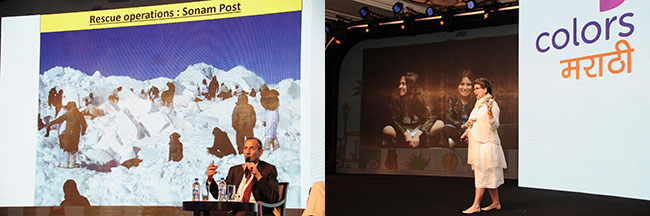
    In the afternoon session, Navin Shenoy, marketing head, youth, music and English entertainment at Viacom 18 made a presentation on the topic of ‘MTV Youth Insights’ giving the audience a peep into MTV’s research wing.


    Quoting research figures, Shenoy pointed out the youth in metro and non-metro India no longer thought differently. A significant takeaway of Shenoy’s presentation was that youth from non-metro India was increasingly comfortable living and working in his/her hometowns.


    According to Shenoy much of this transformation was because of the reach of television, the internet and social media across the length and breadth of India.


    Day 2 at Goafest 2019 was also highly entertaining owing to some very interesting sessions like the one featuring Bollywood actress, Kalki Koechlin and emerging actor, Siddhant Chaturvedi of ‘Gully Boy’ fame and cricketer Virender Sehwag, who had the audience in splits with his easy-going humour.


    Child prodigy Harshwardhansinh Zala, all of 16 years old and founder of the Aerobotics 7 technology company had the audience awestruck, while Lt Gen DS Hooda ( retd), the Northern Army commander during the 2016 surgical strikes into Pakistan occupied Kashmir (POK) stirred patriotic emotions and Bollywoood singer Jonita Gandhi had everybody tapping their feet and clapping their hands with her peppy music.


  • Day3 Goafest 2019: Mary Kom, CSR and social sector rule conversation

    By Rahul Chandawarkar


    Corporate Social Responsibility (CSR) and the social sector was the common thread that bound most presentations together on the final day of the third day of Goafest which concluded at the Grand Hyatt hotel in Bambolim, Goa on Saturday, April 13.


    Matt Eastwood, global chief creative officer, McCann Health who spoke in the National Geographic knowledge seminar in the afternoon said that while the world was going through tough times, it was also a time for advertising professionals across the world to be agents of positive change.


    Day3@Goafest2019: Key Takeaways

    :: Increased involvement by corporates in CSR projects had given rise to the concept of ‘return on doing good’ (RODG).

    :: Hi-end technology platforms like Artificial Intelligence (AI) were helping creativity reach new heights.

    :: The United Nations were keen that 50 per cent of its sustainability development goals (SDG) should emerge out of India.

    :: One of the speakers redefined the four Ps of marketing as purpose, people, passion and physical.


    Rahul Chandawarkar, a former newspaper editor, is a communications strategist and active triathlete based in Goa. He has been covering the Goafest for mxmindia.com since 2017. 

    Eastwood said that in a competitive world, business enterprises had realised that if they made a positive impact on society though the corporate social responsibility route, their brands stood to gain. Eastwood went on explain how increased involvement by corporates in CSR projects had given rise to the concept of ‘return on doing good’ (RODG).


    Citing an India example, Eastwood explained how the Kwality Dairy milk company had chosen to address the problem of Vitamin D deficiency among Indian school children through a very innovative CSR project.


    Kwality Dairy had managed to convince 50 schools in the Delhi region to shift their open-air assembly timings to 1130am, so that children could be exposed to peak sunlight for at least 20 minutes of the day. Several hundred more schools had shown interest in implementing this idea. According to Eastwood, this innovative initiative on the part of Kwality Dairy would directly benefit the brand, as the brand would have top-of-the-mind recall when parents made a decision to buy milk for their children.


    Among the several, international CSR examples that Eastwood shared with the audience, was the one initiated by Microsoft where, they created an information technology supported game which enabled physically disabled children to play video games. According to Eastwood, this ‘let everybody play’ philosophy of Microsoft would positively impact the brand.


    Earlier in the day, Ross Jauncey, Head of Create at Google spoke along similar lines in the Google keynote address and said: “The best time for creativity was now.”


    Jauncey was of the opinion that hi-end technology platforms like Artificial Intelligence (AI) were helping creativity reach new heights. Demonstrating this through a video clip, Jauncey showed how the recently launched Kupu app was helping people shoot photos on their android phone and learn the aboriginal, Maori language in New Zealand.


    Similarly, Jauncey pointed out to a Nike advertisement campaign on multiple digital platforms which supported the anti-racism movement by featuring several sporting champions across the various continents of the world.


    Society and the social sector once again resonated in the joint presentation made by Navi Radjou and Jaideep Prabhu, co-authors of the popular books, Jugaad and Frugal Innovation. Radjou and Prabhu who spoke in the Lokmat Knowledge Seminar maintained that while the spirit of ‘jugaad’ or innovative business practices was ingrained in the Indian business person’s psyche, the concept of doing business with less had spread across the globe.


    Citing some examples, the authors said that a major consumer clothing brand like Levis had recently launched their ‘wasteless jeans’ created from plastic waste. The company had also promoted their ‘go water-less’ campaign where they recommended that their jeans did not have to washed regularly and that you could even shower in your jeans, the next time you want them washed to drive home the recycle-reuse mantra.


    Turning their attention to India, the authors said that the United Nations were keen that 50 per cent of its sustainability development goals (SDG) should emerge out of India. The authors were confident that this was completely possible as they discussed chapters from their latest book, ‘Do better with less!” which showcased many an example of Indian innovative entrepreneurship (jugaad) across India.


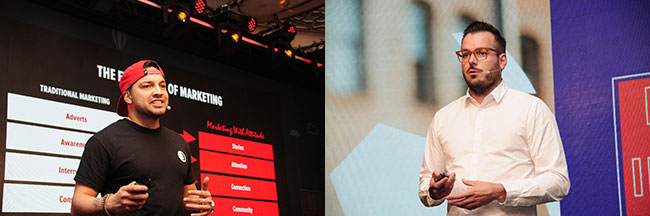
    Later in the early evening, Phil Kemish, co-founder of Disrupt Marketing speaking at the MTV knowledge seminar redefined the four Ps of marketing as purpose, people, passion and physical.


    Exemplifying some of these Ps, Kemish stated how UK’s new chocolate brand, Tony’s Chocolonely had launched their product by pointing out that they were against all cocoa farms in Africa which employed children. Kemish pointed out that the brand had mentioned their values and beliefs on their wrappers and had launched their product solely on the basis of word of mouth publicity.


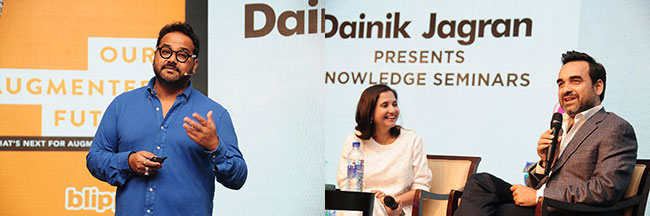
    Finally, Ambarish Mitra, co-founder of Blippar who spoke at the Jagran Knowledge Seminar had the audience in awe as he introduced them to the relatively new, hi-tech concept of augmented reality (AR). Mitra did this by virtually creating a retail store on stage complete with garments etc which he could literally sift through. According to Mitra, AR and visual reality (VR) were the fourth and latest stages in the evolution of computing interface.


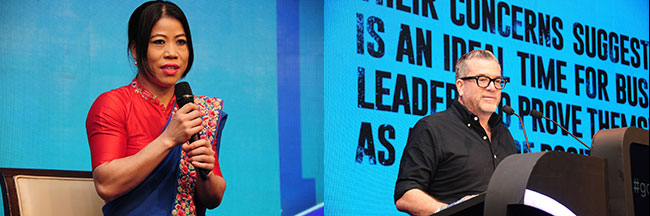
    The final day also stood out with India’s boxing icon, Mary Kom surprising everyone by giving a near-professional rendition of the popular, Alanis Morissete song, “What’s going on!”. Likewise, Bollywood singer Mohammed Irfan and actor Pankaj Tripathi entertained everyone with their songs and anecdotes respectively.


  • Day1@Goafest: E-commerce calls the shots at Industry Conclave

    By Rahul Chandawarkar


    E-commerce held centre stage on Day 1 of Goafest 2019 which kicked off at the Grand Hyatt hotel in Bambolim, Goa on Thursday, April 11.

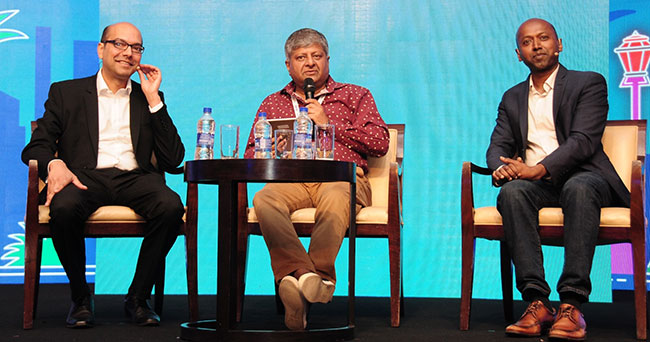
    Sponsored by Discovery Channel, the Industry Conclave had the marketing chiefs of the leading e-commerce brands, Amazon, Flipkart and Myntra explain to the audience the dramatic changes that have taken place in the field of digital marketing.

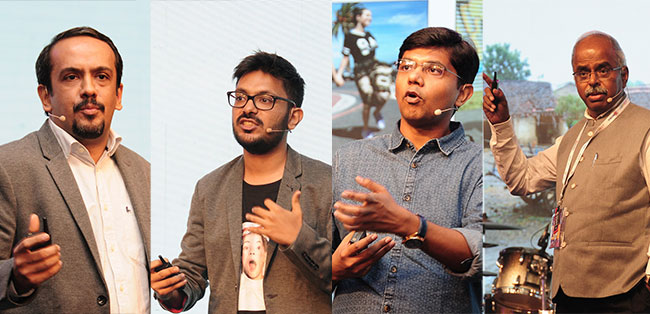
    Ravi Desai, Vijay Sharma, Achint Seti and Velumani

    Ravi Desai, director, mass and brand marketing, Amazon India explained how the old system of ‘pen portraying’ a customer was completely passé now. Desai said that Amazon India had created a mind-boggling 1,00,000 digital advertisments during Diwali 2018 to address hundreds of customer-types across multiple segments.

    Desai explained how primetime TV advertising was also passé. According to the senior executive, the modern-day, urban consumer was consuming content in very different ways. Desai demonstrated with the help of a video clip, how consumers were comfortable directing Amazon’s artificial intelligence device, Alexa to play songs of their choice on Amazon’s Echo, smart speaker system. “If consumers are hooked to this, we need to devise ways and means to catch their attention on this platform,” Desai said.

    Citing the example of his teenaged son and his friends, Desai said that multiple TV channels did not interest these teenagers anymore. “They were more keen to play PUBG ( Player Unknown’s Battleground), the popular, online multiplayer game and live streaming video games. Our advertising needs to cater to these new trends,” Desai said.

    Quoting Amazon founder Jeff Bezos, who said, “Focus obsessively on customers,” Desai explained how building customer loyalty was a prime objective at Amazon. According to Desai, the ‘Amazon Prime’ programme where a customer paid INR 129 every month to avail of a free and fast delivery, advertisement free video streaming, audio streaming and exclusive deals was a step in this direction.

    Likewise, Vijay Sharma, associate director, brand marketing and head digital media, Flipkart said that digital marketing and digital brands had changed the face of modern-day marketing. According to Sharma, fast moving consumer goods (FMCG) like Coke and Pepsi had made way for brands like Apple and Google as the world’s leading brands.

    Explaining the challenge of digital marketing, Sharma said that artificial intelligence was being used extensively by Flipkart to run its latest advertising and marketing campaign, ‘The Big Billion Days’.

    Multiple celebrities and models were roped in to run the popular, ‘Ab Hoga (name of city) budget se mukt!’ digital marketing campaign, which was made to reach a wide audience across the entire country.

    In a similar vein, Achint Setia, vice president – marketing, Myntra, explained how the modern-day customer was consuming information across a wide variety of platforms like the internet, television and the android phone. “In such a scenario, we necessarily have to use artificial intelligence to make a customer experience a joyful moment with the mere touch of  button,” Setia said.

    Explaining that Myntra was a cool and youthful brand, Setia said that the company had put a customer loyalty programme titled, ‘Myntra Inside’ in place. With the help of a video clip, Setia demonstrated how the programme treated the customer to a personality make-overs, gifted new dresses and curated the experiences of the customers using cutting edge technology. Myntra also gifted select customers overseas trips.

    Earlier in the afternoon, popular singer Shaan regaled the audiences with many of his hit Bollywood songs and also sang several English-Hindi medleys.

    The audiences were also regaled and kept spellbound by a very peppy presentation made by Dr A Velumani, creator and managing director of Thyrocare, the company which has made a mark in the field of healthcare. Velumani touched many a chord when he narrated his rags to riches story. Advocating the philosophy of frugality, Velumani explained how he did not own a home despite being very rich. “As an entrepreneur I feel it is more important to grow my business and create more employment,” Velumani said.


    Rahul Chandawarkar, a former newspaper editor, is a communications strategist and superactive triathlete based in Goa. He has been covering Goafests for MxMIndia since 2017.


  • Conference round-up:A paisa vasool show!

    By Rahul Chandawarkar


    The best Bambaiyya term to describe Goafest 2018 would be ‘paisa vasool’, as both the knowledge seminars and leadership summits were of high quality and provided ample knowledge enhancement.


    While the two-and-half day, annual event began with a rousing session by yoga guru, Baba Ramdev, it ended with an equally interesting session with Bollywood actor, Nawazuddin Siddiqui.  These two events were interspersed with sessions on Facebook, artificial intelligence, Swedish and Korean advertising, interactions with sporting icons, Jonty Rhodes, Rajyavardhan Rathore and Sania Mirza and two exhilarating sessions by teenagers Sparsh Shah (14), a gifted,wheel-chair bound youngster and Amelia Conway (15) a talented advertising film-maker.


    However, it was the yoga guru, who gave the event a rousing start with his aggressive statement, ‘Hum MNC companies kodhoolchatayenge’(we will make MNC companies bite the dust).


    Stating that the main objective of the Patanjali brand was to defeat and vanquish MNC companies, Ramdev said, “The East India company looted our country for centuries. The MNCs are doing the same now. This must stop. This why, we formed Patanjali to compete and beat them.”


    Expressing his confidence in the Indian economy, Ramdev said, “The Indian economy is growing at 10% as compared to the US and UK markets which are struggling at an abysmal 2%. There are opportunities galore in our own country.”


    Predicting that Patanjali would become the No 1 consumer products company in India very soon, Ramdev said, “We plan to introduce a wide range of dairy products, a complete range of apparels and even a drinking water brand called Divyajal next year.”


    Day two began with some scientific crystal ball-gazing, when Dean Donaldson and Jonathan Tavss, transformation strategists and digital futurologists from Kaleidoko predicted that artificial intelligence would become common place and that robots would dominate our everyday lives. They also explained how geno media would be the new frontier after social media and how countries across the world including India were investing in genomics.


    Cameron Worth of Sharpend took the technology discussion further when he demonstrated how the popular liquor products could be ordered, billed and consumed remotely with the use of technology like the ‘internet of things’ (IoT).


    Later, little, Sparsh Shah, just 14 and wheel chair-bound, afflicted with the rare, congenital disease osteogenesis imperfecta (brittle bone disease) sang, spoke and clapped and touched everyone’s heart. There was scarcely anyone with dry eyes, as this teenager from New Jersey, USA mesmerised everybody with an articulateness and a maturity beyond his years.


    Speaking on the twin topics of self-responsibility and social responsibility, Shah urged the audience to adopt a ‘can-do-will-do’ attitude to life. “All of us must be completely positive in our outlook. This is self-responsibility,” Sparsh said. Likewise, he urged the advertising fraternity to give back to society by taking up socially relevant campaigns. “There is an urgent need for inclusive advertising campaigns, where we help the less fortunate among us also make the journey,” the teenager said to thunderous applause.


    Later, young Bollywood actor Sidharth Malhotra displayed a remarkable yen for branding and marketing, as he answered questions with aplomb.To begin with, he asked the Goafest organising committee: “Have you allowed advertisements on the Goafest App? If not, then I would like to advertise my latest film on it!” to much laughter and amusement.


    Having thus set the tone, Malhotra in response to one, brand related question said that it was the brand that chose a personality and not vice versa. “This is the way it is working for me and I am happy with it,” he said. Expressing satisfaction at being able to endorse brands such as Brylcreem, Metro shoes and Pepe jeans, Malhotra said, “The Pepe jeans campaign has been particularly pleasing to me, considering that I was the first Indian to endorse this multinational brand of jeans. I was familiar with the product and hence enjoyed the campaign even more.”


    Malhotra singled out advertising campaigns for Amul milk, Cadbury chocolates and Bajaj electrical appliances as being very memorable. He even attempted to hum the Amul milk campaign jingle to drive home his point. According to the young star, it was important for advertising agencies to give back to society with socially relevant advertisments. “People like Aamir Khan and some advertising agencies have been doing a great job on this front,” Malhotra said.


    Later, Olympic silver medallist and minister of state for sport and youth affairs, Rajyavardhan Rathore expressed confidence that his government’s ‘Khelo India’ campaign of encouraging school level sports would go a long way in ushering a sports culture in the country.


    He also expressed satisfaction that the Prime Minister’s MUDRA (Micro Units Development & Refinance Agency Ltd) scheme had disbursed loans worth Rs 4.5 lakh crores  to micro entrepreneurs across the country in a very short span of time. “These are very positive developments for our nation,” Rathore said.


    Day Two concluded with South African cricketing icon Jonty Rhodes throwing light on the recent ball tampering incident in world cricket, stating, “Most cricket teams try to rough up the cricket ball in Test match cricket to generate reverse swing. Only thing, the Australians did it illegally and got caught!”


    On the final day, Rapha Vasconcellos, Head of Creative Shop, APAC Facebook explained why brands must focus on telling stories and use the social media as a platform to build meaningful interactions.


    Vasconcellos explained how short videos could be made for the mobile handset to drive home a brand’s message. “Small brands are teaching us to rethink our own craft. They are showing us the possibility of building a storyboard using your phone,” Vasconcellos said.


    In the same vein, Samuel Akesson, Art Director, Forsman&Bodenfors turned the entire concept of advertising on its head. Forsman&Bodenfors, an agency famous for its world renowned campaigns like Volvo Trucks – The Epic Split and Nike #Breaking2, is also the advertising agency which works very differently from any other agency in the world. They do not have any hierarchy and work as a collaborative team.


    Akesson said: “What we do is ‘human’ mostly. Perhaps there is a lack of humanity in advertising, which is why sometimes advertising is bad at making people feel anything.”


    Indian tennis icon, Sania Mirza later explained how advertising was more mature now than it was when she was a teenager. “Previously, I was asked to pose with the tennis racquet in a particular way and mouth some dialogues. Now, they are far more subtle and creative,” she said.


    In the post-lunch session, yet another prodigious teenager, Amelia Conway, just 15 and an advertising film maker (director, Adolescent) explained why it was important for teenagers to conceptualise and execute advertising campaigns for teenagers. “I am happy that advertising agencies in my country are waking up to this fact and providing us with the opportunity to work,” Conway said.


    Later, Wain Choi, chief creative  officer at the South Korean company, CJK-Valley explained how some inexpensive advertising campaigns had reaped very high dividends for brands. Burger King for example offered free coffee to anyone who volunteered to wake up sleeping commuters on Seoul metros at their designated stops, the message being printed on their eye patches!


    Similarly, the company, Uniq Flo got a lot of free mileage when they offered branded, cold resistant bubble wrap papers to shoppers to fix on their windows.


    The curtains were brought down by popular, Bollywood actor, Nawazuddin Siddiqui who spoke about his early days of struggle and how he considered the lead role in the under-production, biopic, Thackeray, as the most challenging role of his life.


    Rahul Chandawarkar is a former newspaper editor and presently a journalist, columnist communication strategist and triathlete based in Goa.


  • Ramdev: “Hum MNCs ko dhool chatayenge!”

    By Rahul Chandawarkar


    Yoga Guru and founder of the Patanjali g​roup of companies, Baba Ramdev predictably gave  Goa ​fest 2018 a rousing start when he took the battle into the MNC camp with his spirited and energetic, inaugural address in Goa on Thursday evening.


    With his aggressive statement, ‘Hum MNC companies ko dhool chatayenge’ ( we will make MNC companies bite the dust), Ramdev lambasted the business policies of fast moving consumer goods (FMCG) companies.


    Baba Ramdev’s Mantras

    :: Only when knowledge, skills, emotions, research and innovation gets converted into WEALTH does it make any sense.

    :: You only learn 1% in classrooms. The rest, you learn in ever day life.

    :: One must complete the task at hand despite all obstacles.

    :: No dishonest business can last more than 10 years.

    :: Health is wealth. Exercise One hour every day.

    :: Good diet, good thoughts, good exercise and good sleep is the only truth.

    Stating that the main objective of the Patanjali brand was to defeat and vanquish MNC companies, Ramdev said, “The East India company looted our country for centuries. The MNCs are doing the same now. This must stop. This why, we formed Patanjali to compete and beat them.”


    Pointing out his major grouse against MNCs, Ramdev said, “MNC brands have blatantly used chemicals in their products, made fun of our traditional raw materials like turmeric and tulsi, made an unfair distinction between dark skinned and fair skinned people in their product advertising and made obscene amounts of profits. All this hurt me and motivated me to start Patanjali to counter this MNC scourge.”


    Stating that Patanjali had been registered as a not-for-profit charitable institution, Ramdev said, “We want to offer our country’s people with completely organic and indigenous products at affordable prices. This is because our motive is not profit. We are service oriented instead.”


    Lambasting the popular advertising practices of MNCs, Ramdev criticized toothpaste and soap advertisments which had sexual overtones. “Why do we need to use young men and women in a glamorous setting to sell these products. We at Patanjali keep it simple. We simply speak about the strength of our products and it is paying us rich dividends. We avoid wasteful expenditure on advertising this way,” Ramdev said.


    Driving home the point, Ramdev claimed that the Patanjali toothpaste had captured  50% market share of a prominent, MNC toothpaste brand. “Likewise, our Aloe Vera brand is now a Rs 5,000 crore brand with less than Rs 10 crores of investment,” Ramdev said.


    Expressing his confidence in the Indian economy, Ramdev said, “The Indian economy is growing at 10% as compared to the US and UK markets which are struggling at an abysmal 2%. There are opportunities galore in our country.”


    Predicting that Patanjali would become the ​No 1 consumer products company in India very soon, Ramdev said:​ “We plan to introduce a wide range of dairy products, a complete range of apparels and even a drinking water brand called Divyajal next year.”


    Sharing his thoughts on human resource management, Ramdev stressed the need to compensate employees fairly and also creating an emotional connect to retain good quality human resource.


    In conclusion, the yoga guru stressed the need for working professionals to keep themselves fit and healthy. “Everybody must devote one hour every day to exercise and fitness. You must either do yoga, running, swimming, cycling or some exercise to keep healthy and fit,” the yoga guru said before proceeding to perform a string of yogic asanas on stage including a headstand!


    Rahul Chandawarkar is a former newspaper editor and presently a communication strategist and freelance journalist based in Goa​