Tag: Raghav Bahl

  • Bloomberg|Quint begins live streaming facility across its digital assets

    By A Correspondent


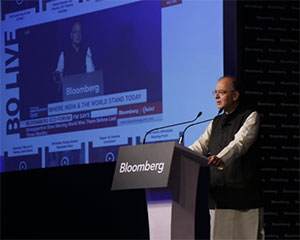
    Bloomberg|Quint announced the launch of its digital live streaming service in India, available on its website, the Bloomberg Terminal and Bloomberg Quint social platforms. At launch, Bloomberg|Quint live streamed the Bloomberg India Economic Forum, which featured Finance Minister Arun Jaitleyas keynote speaker.


    A panel discussion followed with Amitabh Kant, CEO of NITI Aayog (National Institution for Transforming India); Rashesh Shah, Chairman and CEO of Edelweiss Group; Shanti Ekambaram, President – Consumer Banking of Kotak Mahindra Ltd and R. Shankar Raman, Whole-time Director & Chief Financial Officer of Larsen & Toubro Ltd.


    The live streaming service is now available on www.bloombergquint.com and top social platforms, and pending regulatory approvals, will debut on leading cable and DTH platforms.


    Said Justin B. Smith, Bloomberg Media Group CEO: ”We set out to create India’s premier digitally-led multi-platform media company, so the launch of Bloomberg|Quint’s live streaming video content on our website is a step in achieving this,As global investors’ interest in India continues to grow, we look forward to extending our reach to bring high quality news programs on India to the global community, and international news to India’s increasingly digital audience.”


    Added Raghav Bahl, founder of Quintillion Media: ”Over the last few months, we have combined the best of Bloomberg and Quintillion Media to create what we think is the gold standard in news programming for India. Consumers can look forward to compelling video content on key India market developments and top business news and views, which they can watch in the office, at home or on the go on their mobile phones.”


  • Raghav Bahl on exiting Network18 and setting up Quint…


    Beyond jugaad, that great Indian tradition of short-term fixes, what does innovation mean in Indian business? That is the question ‘Innovation Stories from India Inc: Their Story in Their Words’ by Vijay Menon addresses through a collection of standalone stories that describe sustained innovation at a cross-section of companies that include conglomerates, MNCs, large and midsized companies, and start-ups.

    The book has first-person accounts by some of India’s leading business leaders on the innovation journey in their companies. Filled with anecdotes and real-life examples, the book would be of interest to anyone interested in Indian business. It would also be an ideal gift to showcase India to customers, trade delegations, investors, and other stakeholders.

    The organisations and stalwarts featured are:

    Ratan Tata, Adi Godrej, Suresh Krishna (TVS), Munesh Makhija (GE India Technology Center), Suresh Narayanan (Nestle India), Dilip Khandelwal (SAP Labs India), A M Naik (L&T), Aditya Puri (HDFC Bank), N R Narayanamurthy (Infosys), K B S Anand (Asian Paints), G V Prasad (Dr Reddy’s Laboratories), Bhaskar Bhat (Titan), Harsh Mariwala (Marico), Kiran Mazumdar-Shaw (Biocon), P R S ‘Biki’ Oberoi (Oberoi Hotels), Meraj Manal (Himalaya), Dr Devi Shetty (Narayana Health), William Bissell (Fabindia), Kiran Khalap (Chlorophyll), Vijay Shekhar Sharma (Paytm), Raghav Bahl (Quintillion Media), Team Indus

    Vijay Menon author of ‘Innovation Stories from India Inc: Their Story in Their Words’ is a Bengaluru-based marketing and communication consultant. Menon has previously worked as a marketing leader in the IT industry, as a journalist with India Today, and as a nuclear engineer. He holds an MTech from the Indian Institute of Technology Kanpur, and has attended the Duke-Infosys executive programme


    By Vijay Menon


    After I exited Network18, I could have turned angel investor andplayed golf. But that is not me. I also had this strong feeling that Ihad sold myself short the first time around and wanted to do it all

    over again, this time without committing the mistakes I made then.

    When you are a first generation entrepreneur you don’t reallyunderstand the full implications of what you do. It’s easy to getcarried away by the excitement of building the business. We ended

    up not having the balance sheet strength to support our ambitions.That would not have been disastrous in many other industries.

    What did me in was a draconian government rule that made itcompulsory for the promoter in a TV news broadcast company inIndia to maintain 51 per cent ownership at all times. In hindsight,that was the bullet that killed us.

    We went from 100 crore rupees revenue in 2005 to about6,000 crore rupees in 2014. We grew so much so fast that westarted challenging industry leaders like Zee that had grown overtwenty-five years. But the 51 per cent ownership clause meant thatfor every rupee someone else put in the company, I had to matchit with a rupee of my own. So I was always in debt and that turnedout to be debilitating. You can’t manage a weak balance sheet. Theonly way to come out of it is to either dilute aggressively or sell.

    Since we couldn’t dilute, I sold.

    So I exited and emerged with a much better capitalised personalbalance sheet—something I never had previously. I was now betterprepared to start all over again. The balance sheet constraint wasn’tthere, the learnings were.


    The Quint

    So that’s why we started The Quint. Print, of course, is dying. Televisionrequires scale, and in any case, the business has consolidated. Wehad built thirty-five TV channels from scratch atNetwork18 andthey continue.Zee has forty TV channels, Star has forty TV channels.

    The top four or five networks control 80 per cent of the market.But digital was exciting because it was disruptive. Digital alsoexcited me personally because it was a chance to learn somethingnew. At Network18 we had built a good digital business, but I wasn’thands-on then, I was more a strategy person there. So The Quint wasan opportunity to build something from the scratch.

    The Quint that you see today isonly ten per cent of what it can be. There is so much more potential.

    The other big insight we’ve had over recent months is that thefuture of content is a mix of digital and television. But—and this isimportant—the challenge is to repurpose television content, which

    is a linear and sequential medium, to the non-linear, time-shiftedway that content is consumed on the web.

    Let me explain. When the news breaks, the first port of callis television. Television will do a complete 360-degree coverage ofwhat’s happening: reportage, analysis, live video, drone cameras,talking heads, all of it. It can also incorporate social media contentthat people start putting up on the net immediately after an event.

    So if digital is just going to be a dump of what’s happeningon TV, it’s going to lose the plot. Instead, digital must differentiatethrough instant crowd sourcing for text and video content, provide

    immediate analyses and perspectives, dig into history, and providethat instant last mile connectivity that TV cannot match. TV requirestime to generate and disseminate content and it can only show onething at a time. On the internet, you can open multiple windowssimultaneously, hyperlink extensively, and provide each viewer withperspectives relevant to him or her.

    Some of this is happening already. A good international examplewould be cnn.com and an Indian example would be ndtv.com.

    Our joint venture Bloomberg Quint combines both our beliefs—that media companies would need to go deep vertically, and wouldneed to integrate TV and digital. Bloomberg Quint is a digital mediaproperty that that has a vertical focus (business), combines text andvideo content, and is a possible template for our future. One of mystrengths was in forging partnerships and I see no reason why weshould not develop many more partnerships as we explore otherverticals.


    Quintype

    Creating a compelling TV plus digital news medium requires astrong technology platform. And that is where Quintype, ourtechnology startup comes in.

    Television technology is fairly simple. You produce something,you uplink it, it gets bounced off a satellite, you downlink througha box, send it into households, and that’s it.

    But digital is not just content; it’s also a lot of technology. Indigital, you are in a one to one conversation with the consumer.The consumer can write back to you, can talk to you. And this

    means that you can map the consumers’ habits and predilections.

    The platform has algorithms to monitor audience behaviour andtastes, and to serve personalised content depending on their habitsand predilections.

    But—and this is where you need to make a judgment call—youneed to be careful not to go overboard on technology. For example,based on a reader’s stated preferences and reading habits, thealgorithm can determine that you like cricket and Bollywood. Butwe would be very stupid if we then offered the reader a newsfeedbased on that cohort or even its complementary cohorts such asother sports or entertainment and some political and business news.

    Because that’s not how people consume news. Sure, people havelikes and preferences but as a reader, you also depend on serendipityto read news that you stumble upon at random. You enjoy thediscovery.

    That’s the eternal challenge in any media organisation and digital doesn’t change that. You cannot be hidebound. There willalways be a need for an editor to make judgment calls and curate a

    newsfeed.

    What digital does is to enable a level of personalisation thatwas not possible in conventional print or television media. It boilsdown to this.

    Technology is changing the way people consume media and asinternet connectivity andsmartphone penetration improves, moreand more people will get comfortable with, and demand, highquality, non-linear, personalized newsfeeds.

    But the need for high quality editorial judgment will never goaway. In an era where we arebombarded with unfiltered informationthrough social media and slanted news, people still crave for theauthority of a New York Times or a BBC for authenticity.

    The challenge for any media organisation is to understand anduse digital technology intelligently. We need to balance the siren callof big data and analytics driven algorithmic programming with itspromise of delivering personalised content with the old fashionedjudgment calls that editors need to make day in and day out.

    The Quint is an experiment towards that goal.


    Republished with permission from Bloomsbury Publishing India, the publisher of

    Innovation Stories from India Inc: Their Story in Their Words

    By Vijay Menon

    Paper, 154 pages

    Price: Rs 399

    Published by Bloomsbury Publishing India
     

  • Barkha Dutt now partners with Quint

    By A Correspondent


    Barkha Dutt

    Senior journalist Barkha Dutt, who left NDTV earlier this month, has partnered with The Quint to cover the Uttar Pradesh Assembly polls. On The Road with Barkha will map the UP elections and bring extensive ground reports from the state.


    “I am really excited to collaborate with The Quint on this, and push the boundaries of this new and exciting digital medium,” said Dutt.


    Quintillion Media, a digital media company, was co-founded by Network 18 founder Raghav Bahl and his wife Ritu Kapur.“The combination of Barkha Dutt and The Quint is a powerful one. It will bring a completely new brand of journalism and media experience to India’s increasingly sophisticated digital consumer. This combination of immersive journalistic storytelling, social media and the interactive user will redefine this space,” Kapur said.


  • Raghav Bahl and Ronnie Screwvala keep industry in splits at IAA KnowledgeSeries

    By A Correspondent


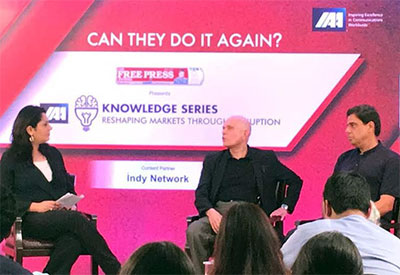
    When two people who have been successful entrepreneurs decide to exit their already successful businesses that they built and hit the‘restart’ button to build something different and new, that makes a good story and discussion. And, that is what IAA Knowledge series held on September 16 was about. With the core theme ‘Reshaping Markets Through Disruption’, the topic of discussion was ‘Can they do it again?’ The gentlemen in question, Raghav Bahl, Founder, Quintillion Media Pvt Ltd and Ronnie Screwvala, ‎Founder UTV Group, Unilazer Ventures and Swades Foundation, are known for disrupting the media business and now they have gone separate from the respective media empire they built and have started a new chapter in their lives. The moderator of the discussion was Mini Menon, ‎Co-Founder & Editor at Indy Network Pvt Ltd.
     

    The question that everybody had and was perhaps one of the important questions in everybody’s mind to Bahl was asked by Menon at the start. The time he founded CNBC TV18 to now, a lot has changes, so, what is his plan for disruption? “I do not think you can reinvent the model but you have to do better content. When we started CNBC TV18, our revenue line was about Rs 5-6 crores. Today, the business news market is roughly an Rs 550 crore market. As this equity literacy grows, investors will come in. The USP has to be content,” said Bahl.


    Screwvala pulled a fast one by saying, “We crossed paths during the launch of UTV-Bloomberg channel.” “And when the UTV ticker went out through CNBC channel,” he added.


    Bahl believes that our country is a late adapter in everything. He is of the opinion that you cannot disrupt an already established model but you have to come up with better content.


    Another popular belief that we keep hearing is ‘Digital is the future and it has arrived’. But Screwvala feels that the OTT is a tough model. According to him, platforms like Netflix will figure out that India is a local market and expensive series will not be successful here. “At the core of this is, if the consumer is willing to pay? So, that is the real disruption which will again only happen by the people who really want to shake up this market,”


    One popular opinion which was popping up time and again during the discussion as well as during the Q and A session with the audience was the timing of their exit. Many still feel they exited earlier than they should have. “One of the reasons we left the business is due to the regulations. There are still Draconian regulations in place,” said Bahl. “Exits cannot be timed. You cannot rewind the clock whether in media or in life. I have no regrets. The things are exactly exhilarating now as to when I started UTV,” explained Screwvala.


    And, finally what would their advice to the upcoming entrepreneurs? Bahl said, “Just go by your balance sheet. Do not go beyond it. Young entrepreneurs should not get seduced by the media. You guys have not become superstars. Be resistant to changing times because it is not a sexy, glamorous field to be in, but very stressful.” “You build what you want to build and stay constant about it and your vision. Today’s ecosystem is forcing you to grow a little bit horizontal, but do not go by what investors want. If you are not curious, then this is Netflix and Amazon have figured out that India is a local market and expensive series will not be successful not the space for you,” advised Screwvala.


  • The Quint completes impactful one-year run on Facebook

    By A Correspondent


    Leading digital content platform, The Quint, completed its first year on Facebook on January 9, 2016. First launched on the social media platform before its website was unveiled in March, The Quint, has had a good run in India. The platform enjoys over 3 million dedicated readers on Facebook having pioneered publishing concepts like Instant Articles, created calls-to-action and championed several meaningful and impactful campaigns through the innovative use of technology.


    Led by Raghav Bahl and Ritu Kapur, co-founders of Quintillion Media, The Quint on Facebook has made its presence felt since its very first day a year ago when it coloured the social media site with the shades of yellow and purple. Besides being driven to bringing news to the fingertips of readers, the platform has successfully leveraged the power of Facebook to invite readers to participate in its campaigns and create change with it.


    Speaking on the first Facebook anniversary celebrations, RituKapur, CEO, The Quint said, “In this exciting one year, we have experimented with content, formats, technology and different ways of engaging our readers meaningfully. Throughout this ride, we’ve broken news (and parameters) as well as our own expectations, but most importantly, we’ve broken the perception that only print or television can rule information. We dreamt of a platform where we could interact with our readers and they’ve overwhelmed us with their response. It is indeed a time of celebration for the entire team for what we’ve managed to achieve together!”


    Amongst several campaigns that garnered a lot of attention on Facebook was the #MakeOutInIndia campaign that talked about breaking away from the hypocrisy that is associated with sexuality and discussions on sex in India. #SayYesToWeed was another high-impact initiative where The Quint took the onus of breaking the myth that weed is harmful. The #BiharMobile campaign grabbed a lot of eyeballs as The Quint went out to become the first digital-only platform to cover an entire election on smartphones.


    Facebook was where the platform began to test waters and tried to understand what its readers expected and wanted. From its first 500 likes to now more than 3 million fans, from the ‘first’ piece of breaking news to the ‘first’ 1,000 shares, the first taste of going viral with the `BuriLadki’ poster which broke gender stereotypes in India, The Quint has displayed tremendous growth in this one year which it plans to continue building on in the year ahead.


  • Edu-channel Da Vinci Learning takes off

    By A Correspondent


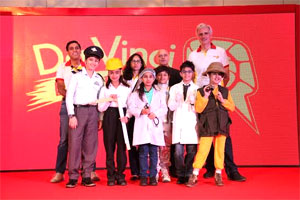
    Da Vinci Learning announced its formal launch in India, building further on its global footprint extending across 100+ territories spanning three continents. Da Vinci Learning is a fun educational television channel for the whole family and will offer award-winning knowledge programming and documentaries to Indian audiences, with a special focus on curious young minds. The channel aims to offer safe and quality entertainment for the entire family.

     

    Da Vinci Learning is entering the market with a joint venture (50: 50) between Da Vinci Media GmbH and Quintillion Media Pvt. Ltd. (The Quint). The Quint is a digital venture founded by Ritu Kapur and Raghav Bahl, stalwarts of the Indian Media and Entertainment industry.


    Speaking at the launch, Ferdinand Habsburg, Founder and CEO of Da Vinci Media said, “It is an exciting phase in the journey of Da Vinci Learning. India has always been a key priority market for us and the time has now come to showcase our differentiated programming, aimed at triggering creative young minds bubbling with talent and curiosity to do more. Our association with The Quint will help the channel to effectively increase and strengthen our foothold in the country by offering meaningful and creative content to the Indian audiences.”


    Da Vinci Learning is targeted at the 6-12 year olds and their families; the channel aims at offering programming and content that makes “astounding scientific ideas understandable, arouse curiosity, spark conversation and motivate viewers to continue uncovering the mysteries of the universe.”


    The channel’s programming covers a wide array of topics, ranging from physics and chemistry to history and nature, and makes complex subjects understandable in an entertaining way. Da Vinci Learning turns TV watching from passive observation into a meaningful experience, helping children develop various skills early on, encouraging older viewers to keep asking questions and inviting families to take their learning journeys together. With its non-violent programs, Da Vinci Learning creates a safe environment for younger viewers.


    Commenting at the launch, Raghav Bahl, Co-Founder and Chairman of The Quint, said, “While Da Vinci Media brings expertise in knowledge-based programming content, this Joint Venture helps us to further expand, drive synergies and diversify our digital content portfolio’’.


    Ritu Kapur, Co-Founder & CEO, The Quint, said: “The Quint will help consumers access Da Vinci Learning content through our digital distribution capabilities. I am confident that the differentiated content of Da Vinci Learning will bring about a transformation in the knowledge and education based content space in India; and I look forward to seeing this transformation take shape.”


    Mohit Anand, Managing Director, Da Vinci Learning, India, added, “Arousing the curiosity of our viewers is our mission and we take pride in offering completely safe, non-violent, soft skills-based knowledge programming for the whole family. This has been our USP and we believe that there is a huge demand for such content in India as well. Our commitment is to find the best knowledge programming and make it available to Indian viewers because we understand “the rush of inspiration, the thrill of discovery and the pleasure to know.”


  • Da Vinci Learning ready for India sojourn

    By A Correspondent


    Da Vinci Media, the parent organization for Da Vinci Learning – the fun educational television channel for the whole family, announced a 50:50 joint venture with The Quint for the channel’s much awaited launch in India and for a complete horizontal digital multimedia edutainment platform. The Quint is the digital venture founded by Raghav Bahl along with his wife, Ritu Kapur. Continuing with its commitment to provide the best in educational entertainment, the Da Vinci Media has associated with the popular digital content platform – The Quint, which provides a combination of compelling content, technology and distribution, coupled with high value digital journalism, storytelling, and advertising at scale.

     

    Da Vinci Media through Da Vinci Learning brings to India high quality knowledge programming that entertains and brings young minds of all ages together, celebrating the life long journey of learning. Da Vinci Learning targeted at 6 -12 year olds and their parents, is known for turning television watching from passive observation into a meaningful and fun experience. This helps children develop various skills during the early years, encouraging older viewers to keep asking questions and inviting families to take their learning journeys together.


    This association with The Quint will enable Da Vinci Learning to effectively amplify the channel’s presence across the country along with developing widespread and integrated relationships with leading media platforms and advertisers. This strategic move for developing the channel’s foothold in the Indian television and digital media industry just before its launch will definitely help in creating awareness about the meaningful and innovative content that the channel will offer to its Indian audience.


    Commenting on the launch Ferdinand Habsburg, Founder & CEO of Da Vinci Media said, “We are delighted to partner with Raghav Bahl and The Quint, a brand renowned for its strong digital media presence. We are confident that this engagement will definitely help us carve a strategic roadmap to increase visibility in the Indian market. We aim to provide innovative and engaging educational content to children helping them to think productively while simultaneously developing their thinking, reading and self -confidence skills through a meaningful and fun experience.”


    Raghav Bahl, Founder, The Quint, said, “While Da Vinci Media brings expertise in programming content, this JV helps us to further expand, drive synergies  and diversify our digital content portfolio. The Quint will aid consumers in accessing Da Vinci Media’s Da Vinci Learning channel’s content through our digital distribution capacity.”


  • Mediaah! Will CNN-IBN survive without Rajdeep Sardesai?


    Mediaah! By Pradyuman Maheshwari


    Rajdeep Sardesai’s decision to quit CNN-IBN isn’t like that of an employee leaving any organisation. Had he not quit NDTV in 2005, he wouldn’t have not gone on to team up with Sameer Manchanda and Raghav Bahl and set up the channel.


    In Bahl, Rajdeep found an able ally and his teaming up with Manchanda, one of the sharpest brains in the business, ensured that the new channel started operations near-instantly. Rajdeep quit NDTV in April and CNN-IBN went on air in December 2005, and its instant success contributed much to Bahl’s fortunes as well as image of being a television news tycoon.


    Until early 2008, Rajdeep and his channel were the clear leaders. They had trounced NDTV early and the year 2006 and 2007 belonged to them. Rajdeep was voted ‘Impact Person of the Year’ in 2006 and was clearly the toast of town and the must-have guest in the capital’s political circuit.


    However, from 2008, after much fumbling and a really terrible take-off,  Times Now started gaining ground. This columnist, then writing on exchange4media.com, commented much to the annoyance of many how Arnab Goswami was a better, more aggressive, news anchor.  If Rajdeep would frown on his shows, Arnab would ask the tough questions. He was bratty, and often abrasive, and represented the mood of the viewing masses.


    The November 26 Mumbai terror strike changed things dramatically for Arnab and Times Now.  It was the undisputed leader. Simultaneously there was a sense of outrage against Barkha Dutt, though not as much against Rajdeep, who was equally shrill in his coverage from the terror zone. But then so were most other television journalists, including Times Now staffers.


    What emerged from Arnab’s show right then and the scene hasn’t changed dramatically ever since is that there’s little else other than the Newshour on Times Now. The other popular programme is Total Recall, but that’s Bollywood nostalgia.


    NDTV has established a huge second and third layer, though other than Prannoy Roy and Barkha Dutt, the rest of the cabin crew  – Vikram Chandra, Sonia Verma Singh and Sreenivasan Jain – pale in comparison even as they can hold fort for a month or two. Quite like CNN-IBN where Bhupendra Chaubey was an excellent stand-in for Rajdeep on the days he took off, but is he the man who can steer the channel to the top slot amongst English news offerings? Can his interviewing skills match those of Arnab?  The answer is a clear No. Read that in 200 points, all caps.


    So will CNN-IBN survive after Rajdeep Sardesai’s exit? Oh, yes, it will. Just as India not just survived but thrived after Indira, the Tatas after JRD, the Aditya Birla group after Aditya Birla etc etc. Also, remember, we have had channels which have meandered directionless for years. Headlines Today, for instance. Or even NewsX.


    Headlines Today has seen a fresh lease of life after the entry of Karan Thapar and it will gain more respectability with newly appointed vice chair and editor-in-chief  Shekhar Gupta on air.


    There were rumours that both Arnab Goswami and Barkha Dutt were approached by Reliance Industries for the top editorial job at CNN-IBN. Barkha is said to have spent a few days in Mumbai recently and even though she denied the news posted by Sahara Samay on its website last week, many believe she may well accept the job now that it’s clear that Rajdeep has exited. A well-known face like Barkha’s will ensure that Rajdeep’s absence is not felt by viewers.


    Meanwhile, a new top deck is reportedly assuming charge at Network18 and an announcement is likely to be made on who will lead the company in the absence of most biggies in the organisation.


    Will Rajdeep join the India Today group, as was speculated? Or is he taking time off to write a book? Since MxMIndia doesn’t revel in breaking news or carrying wild gossip , we recommend you look up other trade sites for that. What we would like to reinforce are three things.


    1. Had Rajdeep Sardesai not existed or not quit NDTV, CNN-IBN would’nt have been around or at least not happened as early as December 2005. Of the various news channels, CNN-IBN has an excellent reporting team, even though many were retrenched last year.


    2. The success of any leader is indicative by how it manages operations after he or she leaves. Prannoy Roy has ensured that. Arnab hasn’t. You don’t want to watch the 9pm bulletin when he’s not on air. Rajdeep has a good B and C team but none of them with the same profile has him


    3. CNN-IBN (and IBN7) will survive for sure. But it’ll need a new face soon.  Clearly, money is not going to be the constraining factor for this recruitment. For Mukesh Ambani and Reliance Industries Limited, that’s hardly a worry. What the master and his advisors have to convince the big and famous editors is that they will be allowed to operate in a free and frank manner.  That they will be allowed to carry news which may be negative on them. Now will that will be a tough ask?


    There are many who  believe news journalism is doomed with the active entry of Reliance Industries in news media. That, as I have written earlier, is an incorrect assumption. Most of our big publications were set up by business houses – large or small.  Moreover,  we do know of some well-known media conglomerates indulging in corrupt or incorrect practices.


    If in the true spirit of business, Mukeshbhai and Reliance Industries do not devalue the brand, there is no stopping CNN-IBN and the rest of the media empire from attaining greater heights. If considerations of the rest of their businesses impact the editorial policies, the Ambanis know what happened to TheSunday Observer and the Observer of Business and Politics in the 1990s.


    Interesting times ahead for sure.


  • Network18 loses Group CEO Sai Kumar, COO Ajay Chacko

    By A Correspondent


    Sai Kumar

    It’s been doing the rounds for a while. That post the elections, there would be a huge churn at leading media conglomerate Network18.


    This one though is huuuuge. B Sai Kumar, Group CEO, has put in his papers. Having worked with the group for over 14 years and propelled it to the status it enjoys today, Sai has been part of all key ventures of the group. From business channel CNBC to the jv with Viacom, the partnership with A+E Networks, the formation of IndiaCast, the licensing deal with Forbes and the very ambitious digital foray. He was also on the board of the Group’s various joint ventures. In his role as Group CEO, Sai charted out the company’s business turnaround and return to profitability.


    Raghav Bahl

    Commenting on the development Raghav Bahl, Founder & Editor of Network18 said; It’s not easy to describe Sai’s role and contribution to the Group. He has been one of the key pillars of the Network18 story. I am truly privileged to have been able to work with someone like Sai who has, I daresay, given the prime of his life to the growth & development of our baby called Network18, right from the days when it was a fledgling single channel operation to its evolution as one of India’s largest and most diversified and respected media companies. But there comes a time in  life when one takes a heed to one’s calling and wish Sai all the best for that.


    Said Sai: “Network18 has been an extension of my family. I take with me very good memories and I will always cherish the time spent here. It has been a tremendous learning ground and I thank all my colleagues for the support, passion and hard work they brought to work every day. While all good things come to an end, I see it as a new beginning and I am positive and hopeful that Network18 scales new heights here on.”


    Ajay Chacko

    Meanwhile, it is learnt that Network 18 COO Ajay Chacko has also handed in his papers. There are rumours that IBN Editor-in-chief Rajdeep Sardesai may also be leaving the organisation, though there is no confirmation of the same.


  • FICCI Frames turns 15, 2014 edition to focus on how M&E influences social change

    By A Correspondent


    The Federation of Indian Chambers of Commerce and Industry (FICCI) has announced the 15th edition of its annual Frames convention for the media and entertainment industry.


    FICCI Frames 2014 will be held from March 12 to 14, 2014 in Powai, Mumbai. Nearly 2000 Indian and 600 foreign delegates are expected to attend. The theme of Frames 2014 is “Media and Entertainment: Transforming Lives” highlighting the role of media and entertainment as a vehicle for social change (*See Disclosure).


    The convention will discuss reforms and regulatory endeavours along with working on ideas on socially meaningful and quality content. The inaugural keynote will be by FCC Commissioner Ajit Pai who will touch upon content in the regulatory landscape in the US. Raghav Bahl, Controlling Shareholder and Managing Director of the TV 18 Group will make the theme keynote address on Media and Entertainment as  a Vehicle for Social and Economic Change.  Aroon Purie , Chairman India Today Group,  will deliver the keynote on Print Industry: Surviving All Odds in the Digital Era. Justin Osofsky, VP – Media Partnerships, Facebook will talk on ‘Establishing Social Networks as the Primary Online Forum for Public Conversations ‘.


    Apart from the core theme, Frames 2014 will focus on key avenues for monetising the sector such as Talking Numbers: Hard Facts about M &E’s Economic Contribution; TV 3.1: Content, Strategies and the Future of Broadcast; De-bottlenecking the Regulatory Hurdles, The Changing Dynamics of the Film Exhibition Landscape.


    Stakeholders and thought leaders such as Uday Shankar, CEO, Star India and Chairman FICCI Entertainment committee, Karan Johar, Chairman , Ficci Frames, Punit Goenka, MD & CEO , Zee Entertainment, Sudhanshu Vats, Group CEO Viacom 18, Mathieu Bejot, Executive Director, TV France International, Roger Fisk, Presidential PR Guru from President Obama’s electoral campaign; Jim Egan, CEO, BBC Global News, Andrew Lack, Chairman, the Bloomberg Group; Bill Livek , CEO, Rentrak,  Kim Dalton, Chairman, Asian Animation Summit; Hiromichi Masuda, Vice Chairman Business Committee, The Association of Japanese Animations,Todd Miller, the CEO of Celestial Tiger Entertainment, a Lionsgate joint venture and former head of Sony Pictures Television, are slated to speak at Frames 2014.


    Frames 2014 has been planned with some off-the-cuff sessions to broaden the conventional boundaries of the summit. Sessions such as “Internet & Democracy: Interloper or Catalyst?”, “The Film that Changed My Life” and “The Indian Electronic News Media: On Fine Balance?” will be held.


    A discussion specific to attracting the influx of private equity for the sector has been planned and film funding is a subject which will be deliberated upon. A Producers’ Masterclass wherein producers like Andy Paterson and Guneet Monga will discuss the overarching role of a producer in taking a film from start to finish. Masterclasses with acclaimed Hollywood VFX supervisors such as George Murphy , Oscar winner and Chief Creative Officer, Reliance Media works , Jon Cowley and Ben Murray  of Prime focus world are also in the offing. The cinema exhibition sector will be dealt with at the “Cinema Advertising & Alternative Models: The Changing Dynamics of the Film Exhibition Landscape” session. Creative sessions on “The Past Present and Future of Good Cinema: Film-making for a Cause” and “Cuts so Deep: Are we Sacrificing Creativity at the Altar of Morality” will focus on ‘meaningful cinematic content’.


    Australia is the partner country and Karnataka the “Partner State” at FICCI Frames 2014. Srivatsa Krishna , Secretary, Deptartment of IT , BT & S and T , Govt. Of Karnataka will touch upon how Karnataka has been doing much to promote growth and development of its M&E industry


    An innovative feature of this year’s edition of Frames will be the FICCI-Ink Salon, an exclusive by-invite only daily hour-long session with speakers from the Indian part of TED talks. The BAF award show and networking evenings will as usual be the hallmarks of the after-hours.


    *Disclosure: MxMIndia is a Media Partner of FICCI Frames 2014


  • Raghav Bahl: The Colors of Trailblazing

    By Raghav Bahl


    “Where is the ‘u’”, I exclaimed at our regular fortnightly update meeting in January 2008. An economic cloudburst was about to crush the globe in an unprecedented landslide, but our mood was flush and excited. Sitting across me were Haresh Chawla, Rajesh Kamat, Ashvini Yardi, Sanjay Ray Chaudhuri (RayC) and Vandana Malik. Ashvini had just turned the laptop’s screen towards us, revealing the logo of “Colors”, resplendent in purple, blue and white hues, levitating on a striking flute. “C’mon Raghav, the ‘u’ is so old-fashioned and ‘your’ generation. Today’s Google kids spell it the way the Americans do. It’s Colors, without the ‘u’!” A trail-blazer was born.


    Six months earlier, we had spotted a wafting opportunity. The reigning market leader over the last decade had crashed to less than 200 GRPs. The extant Number One was cruising unchallenged in the 800 GRPs’ stratosphere. There was a yawning gap, reaching out and luring a challenger to dive into the treacherous blue sky in between the two. Another contender, called Imagine, had strung out its sails. Viacom and TV18 decided to take the plunge too. May the best woman win!


    TV18 was just emerging from another heady launch two years earlier, in 2006. We had taken the battle to the utterly monopolized English general news market. Within months of its launch, CNN-IBN had dethroned the leader, proving all naysayers wrong. And that victory had taught us a seminal lesson – if you want to enter an arena which is totally dominated by a single player, just do not pussyfoot your entry. Enter with the mindset of a leader. Enter with a full FPC, with drama, comedy, crime, mythology, clutter-breaking reality and big film premieres. Spend a dollop to hurl the brand in the faces of millions and millions – and back it up with a distribution plan which puts you right “next” to the leader.


    Yes, it would cost hundreds of crores, but we were clear that we would rather burn hundreds of crores in a high voltage launch and win or flame out, as against die a slow and painful death with a hundred small cuts, struggling every day in the Number 4 or 5 position, draining away cash and energy, shoulders drooping, simply waiting for the inevitable closure. We were sure that we had to enter with the mind-set of a leader.


    So when Ashvini said that our flagship show was a socially progressive drama set in rural Rajasthan, classically shot, with folk music, telling the poignant and uplifting story of a child bride, we said “go for it”. Balika Vadhu was born. Then we said that we will trot out little Krishna in the mythology genre, in place of the muscular and mustachioed cardboard characters that ruled there. While the others were doing urban saas-bahu dramas, we plumped for socially relevant, suburban, semi-rural tales of human spirit and suffering.


    An expanded TV audience, now residing in “non-metro” India, resonated with our stories. We piled on the pressure by commissioning the reigning star of Bollywood – Akshay Kumar – to helm Khatron Ke Khiladi. I still remember the day I authorized that 9-figure payment to sign him up. My fingers trembled, but our resolve was steely. While every channel was tucking reality away on the weekends, we decided to disrupt with a daily one-hour strip at 9 pm. The women loved Akshay, the men loved him as much as they loved the lissome ladies, and the teens rediscovered GECs to enjoy the youthful Khatras and Khiladis. Even as the economic cloudburst destroyed the world economy in 2008/9, we kept the faith. The rest is history!


    Five years on, I now watch the mounting energy of Colors from a relative distance, totally sanguine that Prashaant, Manisha, Raj and Sudhanshu have caught the gale – we still have the mindset of a leader.


    Raghav Bahl is Founder & Editor, Network18


  • R Jagannathan is Network18’s ed-in-chief for web & print

    By A Correspondent


    Network18 group has strengthened the editorial structure at its web and publishing arms by elevating veteran journalist R Jagannathan (“Jaggi”) as Editor-In-Chief. Mr Jagannathan will be responsible for leading editorial strategy and driving content synergies across a bouquet comprising some of the country’s leading news and special interest brands. This is part of the group’s progression towards an integrated publishing and digital editorial operation.


    This mandate includes Moneycontrol.com and Firstpost.com, Forbes India and Network18 Publishing, which spans a portfolio of 18 B2C and B2B titles such as Overdrive, Better Photography, Chip, T3, Entrepreneur, Search and Auto Monitor.


    Mr Jagannathan had taken charge of Moneycontrol.com and Firstpost.com at the time of joining Network18 in 2011. In this expanded role, he will be additionally responsible for Forbes India and Network18 Publishing. Editors at each of these brands will now report to him with immediate effect.


    With a career spanning over 36 years, Mr Jagannathan has been the editor of several print and digital publications across the general and business news space. Prior to joining Network18 Group in 2011, he was the Executive Editor at DNA. Earlier, he was the Executive Editor at Business Standard and he has also been the Editor at Financial Express, Indian Management and Business World. He was the founding Executive Editor of Business Today in the early 1990s and Business Editor of India Today before that. His first foray into the digital world came when he became Editor at Myiris.com at the height of the first dotcom boom.


    Raghav Bahl, Founder and Editor, Network18 said, “Platform neutrality in publishing is almost a truism now and as one of the country’s largest news and digital players, we’re best placed to lead this broadening trend. It’s critical that our brands access the best expertise across the group while they continue to fulfil their distinct content mandates and they do so through a structure which mirrors the new digital reality. We have entrusted the task of leading this effort in the able hands of Jaggi.”


    B Sai Kumar, Group CEO, Network18 said, “In Jaggi, we have one of the finest editorial minds in the industry with an unmatched breadth of experience and a proven track record, which includes the stellar performance of our digital brands under his command, Moneycontrol and Firstpost. We’re confident that in this expanded mandate, he will help us further enhance our editorial product and deepen audience engagement and market leadership.”


    Mr Jagannathan remarked, “Network18 has some of the country’s most loved brands which enjoy the highest levels of trust and credibility with audiences and each represents a unique editorial voice. I look forward to working with the teams to ensure that we strengthen our proposition across platforms.”