Tag: Radio Mango

  • Mirchi maxes IRF awards, Red FM is best station

    By A Correspondent


    The much awaited Excellence in Radio Awards (ERA) was held in Mumbai on May 22. Although the turnout at the IRF (India Radio Forum) 2012 was dismal, the awards concluded with fanfare. A total of 40 awards were given out this year and three new categories were introduced – Best Radio Programme (Marathi); RJ of the Year (Marathi); and Best Radio Promo – Inhouse (Marathi).  The award winning radio stations at ERA this year include – Radio Mirchi, Red FM, Big FM, Radio City, Radio Mango, Club FM, MY FM, Suryan FM and Fever FM.


    Digital Radio Broadcasting Ltd or Red FM won 7 Awards including the awards for the ‘Best Radio Station’ and ‘Best Breakfast Programme/ Show (Hindi)’ to name a few. Suryan FM won one Award for ‘Best Radio Promo (In house) Tamil’.


    Reliance Broadcast Network Limited or Big FM also won 7 awards, including the award for the ‘Best Programme Broadcast after 11am (Hindi)’ and ‘Best Programme Broadcast After 11am (Tamil)’. Big Magic Pvt Limited won an award for ‘Best Use of Music / Song / Jingle by an Advertiser in a Radio Spot’.


    Radio Mirchi won a total of 12 awards, making it the most awarded radio station at the Excellence in Radio Awards 2012.


    Speaking to MxMIndia, Mr GG Jayanta, National Marketing Head, Radio Mirchi said: “Winning 12 awards is in itself a matter of pride, innovation always wins and good work will always be recognized. These awards will most certainly encourage us to deliver better work as it is a great motivational tool for us.”


    Mr Rajat Uppal, General Manager- Marketing stated: “We saw good participation from the industry, we are glad to have won the Best Radio Station, The RJ of the Year, the Best Breakfast show and others. It shows the kind of work we do is high on quality and high on innovation as well. We won the awards that matter the most to us and our aim will be to continue delivering quality work for listeners and advertisers.”


    Music Broadcast Pvt Ltd or Radio City won a total of 3 Awards, Radio Mango also won 3 awards, Club FM won 2 awards, Fever FM and MY FM won one award each.


    Mr Praveen Scheruchari, Senior Creative Manager, Radio Mango said: “For a regional station like us, winning these awards and that too at a national level is a huge achievement as well as a great opportunity for us. These awards will encourage us to deliver better work for our clients and listeners.”


    The awards for the ‘Most Effective Use of Radio in an Activation Campaign’ and ‘Most Outstanding Use of Radio in An Ad Campaign’ were the winners from ‘The Radio Pitch Challenge’.


  • Industry gears up for India Radio Forum 2012

    By A Correspondent


    It is that time of the year, when radio players across the country meet to discuss issues pertaining to the industry, listen to ideas from advertisers and agencies, celebrate creativity in radio advertising and commemorate the medium itself. The seventh edition of India Radio Forum (IRF), organized by Partners in Media Asia (PIM), will be held on May 22 at JW Marriot Hotel in Mumbai.


    Amitabh Srivastava, Country Manager – South Asia, Radio Netherlands Worldwide who has been attending the IRF since the last four years and plans to do so this year, explained that radio is still at a nascent stage, thus such forums on radio are good for the industry as it discusses critical issues, it provides a good platform for all stakeholders, and in the long run, such forum on radio will benefit the industry. He further said that in the last four years that he has attended the annual event, he observed that IRF has ensured that every stakeholder participates in the event. He also said that smaller stations have been given their due weightage and their issues have also been discussed at various events.


    George Sebastian, COO, Club FM and GM Marketing, Mathrubhumi and Ravindran Nair, Director Programmes, Radio Mango would also be among the attendees at IRF 2012. When asked whether smaller stations have been isolated at the IRF this year, Mr Sebastian said that he has been attending the IRF since its inception and found that even the issues of smaller stations are addressed at the IRF. “IRF used to be a full day event, now it has been reduced to a little more than a half day. This is the only regret I have towards IRF. Such events most certainly benefit the industry, particularly the awards which recognizes good talents.”


    Mr Nair of Radio Mango said: “IRF helps maintain the vitality of radio stations, it gives one insights into how radio has developed in other parts of the world; it also provides ideas and new ways to monitise contents as well as gives us the client perspective about the medium. The only irony, however, is that the IRF has been reduced from a two day event to merely one day.”


    Unlike previous years, Mr Naval Toshniwal, CEO Tomato FM and Vice President, Pudhari Publications will not be attending the IRF this year. Ms Monica Nayyar Patnaik, Joint Managing Director at Eastern Media Ltd is also among the few industry veterans who would not be attending the IRF this year for personal reasons.


    Speaking to MxMIndia, Ms Patnaik was of the view that such forums do benefit the industry as it helps one learn from each other, helps find solutions to overcome issues and challenges, provides creative ideas and that awards also contribute in a bigger way in recognizing ones creative talents.


    Another industry player who did not wish to be mentioned was of the view that such events do help the industry positively, however, it all depends on implementing the lessons learnt from the various presentations made and panel discussions. “IRF is a good forum, but the industry must learn to implement what is discussed at such events, which has not happened so far. There has to be an action plan to implement all that is discussed at such events, only then will we see the industry grow even further.”


    Anurradha Prasad, President of Association of Radio Operators for India (AROI) and Chairperson cum Managing Director, B.A.G Network will also not be able to attend the IRF this year due to prior commitments. She, however, added that right now everything boils down to the passage of the Copyright Bill in the Lok Sabha. It has already been passed in the Upper House (Rajya Sabha), and once it is passed in the Lower House (Lok Sabha) too, and becomes law, it will significantly improve the growth of the Indian radio industry.


    The speakers list at IRF 2012 comprises of industry veterans not only from the radio industry, but also advertisers, and veterans from the creative and media agencies. IRF 2012 will kick-start with the CEO Roundtable, wherein industry biggies will discuss the current strength and weaknesses of the radio industry, and strategic options to improve the business and their vision for the industry in the coming three years. The panelists will include Apurva Purohit, CEO, Radio City; B Surendar, Sr. VP & National Sales Head, Red FM; Harrish Bhatia, CEO, My FM; Harshad Jain, Business Head, Fever FM; Joy Chakraborthy, CEO, Oye FM; Prashant Panday, CEO, Radio Mirchi and Rabe Iyer, Business Head, Big FM. This session will be moderated by Atul Phadnis, CEO, What’s-On-India.


    The second session at the forum – ‘It’s the Message, not the Medium: Growing your Advertising Revenues,’ will delve on important creative attributes that make radio commercials more effective and the unique qualities of radio as an advertising medium. Jason Brownlee, Founder, Dollywagon Media Sciences will be the speaker of this session.


    Another interesting session at this year’s IRF is ‘Radio and Social Media’, a panel discussion on the effect of social media on the listeners and the radio industry. This session will be moderated by Suman Srivastava, Founder & Innovation Artist, Marketing Unplugged. The panelists of this session include Premjeet Sodhi, COO, Lintas Media Group; Raj Nayak, CEO, Colors – Viacom18; Satbir Singh, Managing Partner and Chief Creative Officer, Euro RSCG; and Tushar Vyas, Managing Partner, GroupM South Asia.


    There will also be a session on ‘Maximising Radio’s Asset: How to Gain Share of Market Spend’. This session will be moderated by Apurva Purohit, CEO,RadioCity. The panel members are Ajit Varghese, Managing Director – South Asia, Maxus and Motivator; Arpita Menon, Head – Media Planning & Buying, STAR TV; and Shubha George, COO, MEC. This session aims to provide the client point of view and that of media planners and buyers on radio’s critical role in meeting market challenges and opportunity it presents in achieving a better ROI and sales goals.


    ‘The Radio Pitch Challenge’, the last session just before the 2012 ‘Excellence in Radio Awards’, will see planning teams from media agencies invited to pitch a compelling and effective presentation to the judges. Each team will talk about a product or service in five minutes or less. They will present 16 slides with only 15 seconds per slide, ending with a radio promo not more than a minute long. The winning team will be awarded two tickets worth over Rs1,00,000 to the 2012 Singapore Formula1 Grand Prix.

  • FM Radio rocks in South India… and how!

    By Robin Thomas


    The FICCI-Deloitte report on Media and Entertainment in South India says that radio in South India will grow with a CAGR (Compounded Annual Growth Rate) of 20 per cent by 2015. The reach of FM radio is said to be far higher in South India than its counterparts in other parts of the Country. According to Ms Nisha Narayanan, Senior VP Projects and Programming Red FM, South India has 28 per cent share of existing radio channels and it will have 28 per cent representation in FM phase III as well.


    Besides the larger FM stations like Red FM, Big FM, Radio Mirchi and Radio City, there are many local or smaller FM stations as well, such as Radio Hello, Club FM, Best FM, Suryan FM and Radio Mango, to name a few. Unlike the North, FM radio stations in the South play music in multiple languages as prominence is given to the local language. Big FM for instance plays only Kannada music in Bengaluru whereas in Hyderabad it plays Telugu and Hindi music. Club FM, a Kerala-based FM station, plays mainly Malayalam music with a mix of Tamil and Hindi music whereas Red FM in Andhra Pradesh mainly plays Telugu.


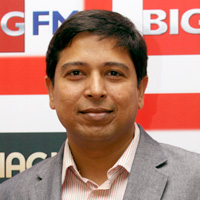
    Rabe T Iyer
    Nisha Narayanan

    Rabe T Iyer, Business Head, Big FM, the radio arm of Reliance Broadcast Network was of the opinion that compared to the rest of the country, the reach of radio in south India is much higher. Mr Iyer was also quick to point out that in some key markets like Bengaluru, Chennai and Hyderabad the reach of radio is significant, higher than most news channels, and is on comparable terms with leading GECs.


    “Given the inherent strengths of the region backed by a strong film and music Industry, added to its rich cultural diversity, it is not surprising that radio in South India has relatively higher penetration than other regions. The south of India has done some innovative radio over the years. It continues to be a huge focus area for all players given that it has three big metros which are important from both listenership ratings and revenue perspective,” he added.


    Nisha Narayanan of Red FM said, “South has been an integral part of radio and its growth in India. Radio is more close to people’s lifestyle here than any other part of India. Radio Ceylon had created a strong base for radio even before the advent of FM radio in India. FM radio penetration is the highest in South India, particularly in Tamil Nadu. In the long term, obviously there is tremendous growth and we are in the early stage of that growth.”


    Shaan Menon, Manager Content, Club FM noted, “FM in South India is going to take a huge leap as it is waiting for the next bidding. Even the smaller cities and small townships in Kerala will get a chance to taste the feel and warmth of FM culture. South Indian film music is the strongest music industry in terms of production. Although CD sales are deeply affected due to rapid downloads, FM industry is full of the new genre of music and music directors.”


    Challenges and Opportunities

    Some of the key advertisers in the south are retail, textile, jewellery, real estate, hospitality, FMCG, consumer durables etc. Big FM claims its advertising and content ratio to be 1:4, while Red FM says it plays 45 minutes of music and 15 minutes of ads every hour during off peak season whereas in peak season the inventory time is slightly more. One of the reasons why radio is said to be doing well in the south is because of its strong regional film and music industry. “Given the diversity, there is tremendous potential for localization which radio can capitalize on and deliver. The opportunities to create a unique brand identity in this market are immense,” explained Mr Iyer.


    He further said, “A challenge any product faces in its life cycle is finding the ‘differentiating quality’ after the market matures. The same applies to the radio industry and its many players. With a market that has matured and grown manifold and poised to grow further, novelty and innovation in content will be a key component for success and will decide further growth of the category.”


    Ms Narayanan on the other hand observed that time has come for radio to look for new revenue streams. She was also of the view that radio stations must experiment beyond the traditional programming formats, and that music royalty still remains a challenge. “Content has to evolve a lot as most of the programming strategies are music based. We are still into traditional programming formats and the time has come to take it to the next level. The ability to create new revenue streams is ideally needed at this hour, as the only source of revenue for radio stations has been advertising sales. Music royalty is another area of concern as we pay needle per hour, whereas the international markets follow the revenue sharing model. These are the challenges faced nationally too.”


    The road ahead

    The much awaited FM Phase III policy seeks to extend FM radio services to about 227 new cities. Phase III will cover all cities with a population of one lakh and above, simultaneously there will be a total of 839 new FM radio channels in 294 cities. The local players in particular expect to further expand their radio station into the southern markets. However, one of the possible challenges after FM phase III is launched could be to attract listeners to the medium and then to sustain its listenership.


    Mr Iyer of Big FM observed, “We foresee huge growth in the radio industry in the coming years. There will be more stations leading to more innovation in content and communication. This will result in more revenues and hence more profitability for all players.”


    Ms Narayanan remarked, “South India has 28 per cent share of existing radio channels and it will have 28 per cent representation in phase III as well. Radio will be a national medium and the true mass medium with the number of channels coming in Phase III. In the south 75 to 80 per cent of the licenses are for the ‘D’ and ‘C’ cities which will be a great boost for advertisers as a medium breaking across demography.”


    Mr Menon stated, “The challenge during FM Phase III is to convince the small town public that FM radio is equally or more entertaining than TV. It will be difficult to make them taste the sample, but the current popularity of FM industry in the main towns will definitely help to fight the difficulty of convincing the new public.”


  • Radio Mango in 4th anniv mode, to consolidate in Kerala for Phase III

    By A Correspondent


    Radio Mango, an FM radio venture by Malayala Manorama, a Malayalam daily, aims to consolidate its position in Kerala once FM Phase III is officially rolled out. It is however not known which cities the FM station would bid for as they are currently awaiting clarity on the phase III. “We would definitely look to consolidate our position in Kerala. We are still unclear about the reserve price calculations and await clarity before finalising our phase III plans,” said Ravindran Nair, Director Programmes, Radio Mango.


    He further said, “We are confident of growth in 2012 since we have been steady since the last 4 years. The key factor in the quantum of growth, of course, would be phase III.”

    In Kerala Radio Mango is aired in Kochi, Trissur, Kozhikode and Kannur. Red FM and Club FM are its main competitors in these cities besides the All India Radio (AIR) FM stations. On November 29, 2011 Radio Mango will celebrate its fourth anniversary however the FM station seems to be in no mood for big celebrations.

    Radio Mango claims that its national and local advertising ratio is almost 50:50. Some of its national advertisers are Maruti, Hero Motors, Nokia, Blackberry, Max Bupa, Kenwood, Airtel, Docomo, Belkin, Ford, Hyundai, Sharp, and Philips etc. Nearly 80 per cent of songs aired on Radio Mango is Malayalam film songs and the rest 20 per cent from non-Malayalam music ie Hindi and Tamil songs. Besides its on-air activities, Radio Mango is quite active online too. It has over 5,700 likes on its Facebook page and nearly 300 followers on Twitter.


    In conversation with Ravindran Nair, Director Programmes, Radio Mango.


    Q: Since November 29, 2007 when Radio Mango first went on air, until the year 2011 how has the journey been for Radio Mango? 
    Radio Mango has had a great period of sustained growth since launch. We have been consistently No.1 in the state and have been figuring in the top 20 nationally in terms of reach. In IRS Q2, Radio Mango is 16th nationally, in terms of reach (11th if AIR stations are excluded). In terms of reach within a state, Radio Mango ranks 5th nationally! Radio Mango has grown by 45 percent in Yesterday’s listenership over the last one year. Within Kerala, Radio Mango leads the no 2 station by 81 percent in terms of reach. (All figures are from IRS Q2 2011).


    We have won several national and international awards including New York Festival silver and bronzes, Wow Experiential Marketing Award golds, ERA golds etc. In fact, we are the only radio station in India to have won Mirchi Kaan Award golds for two years running.  We also figure in the Limca Book of Records for our musical reality show ground event.
    Q: How do you plan to celebrate Radio Mango’s fourth anniversary?
    We don’t look at months and years as landmarks. We would rather have our achievements be the milestones. Hence, all our anniversaries are private internal affairs and we don’t tom-tom in public.
    Q: Can you throw some light on your phase III plans? Will the FM station expand in cities/ towns of Kerala or will the expansion be beyond Kerala i.e. other parts of India?
    We would definitely look to consolidate our position in Kerala. We are still unclear about the reserve price calculations and await clarity before finalizing our phase III plans.


    Q: How has the response from advertisers been? What is the national-local advertising ratio?

    The response from the advertisers has been good so far. The national and local advertising ratio is almost 50:50. Some of the national advertisers are Maruti, Hero Motors, Nokia, Blackberry, Max Bupa, Kenwood, telecom majors like Airtel, Docomo, Belkin, Ford, Hyundai, Sharp, and Philips etc.


    Q: For 2012 what are your growth targets? How will you sum up 2011 for Radio Mango? 
    We are confident of growth in 2012 since we have been steady since the last four years. The key factor in the quantum of growth, of course, would be phase III. 2011 has been a great year and we are very pleased with our overall performance. The Radio Mango brand has never been more robust and recognised.


    Q: Who is your creative and media agency?
    Our creative and media agency is Stark Communications.