Tag: Radio Audience Measurement

  • RAM Ratings for Week 5 & 6 – Jan 27-Feb 2 & Feb 3-9, 2019

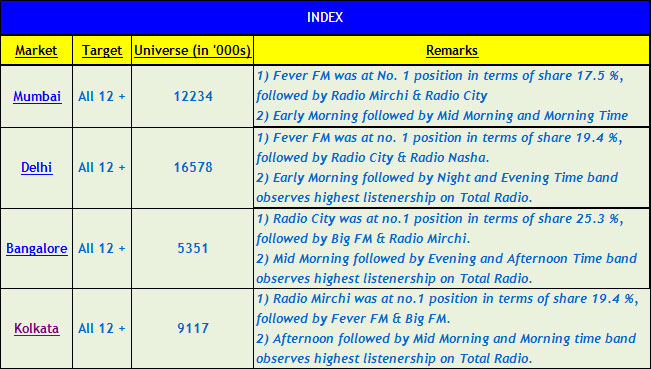
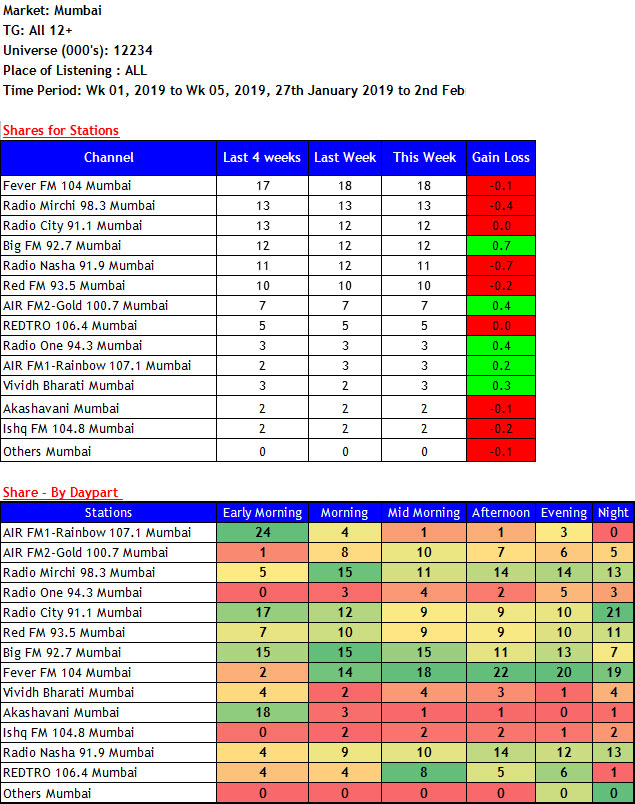
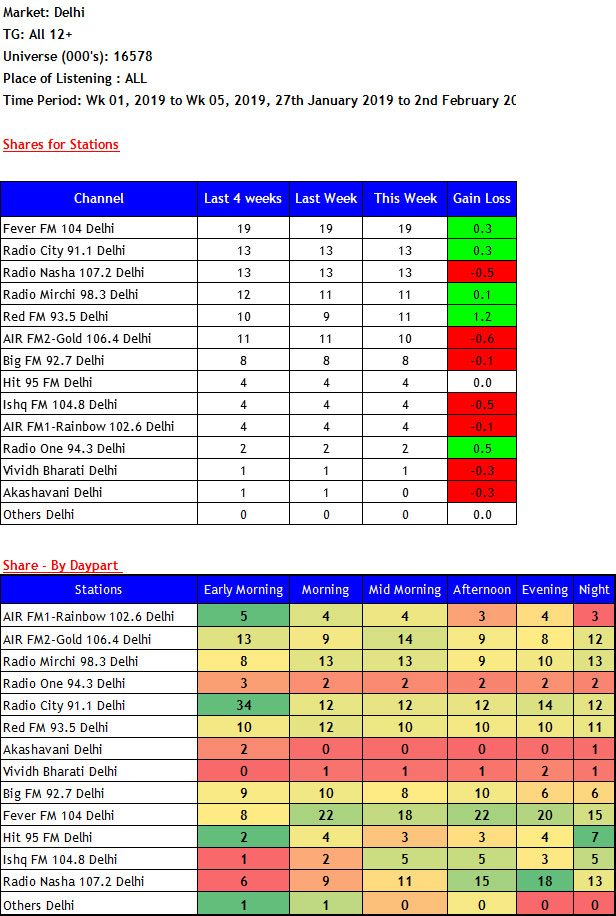
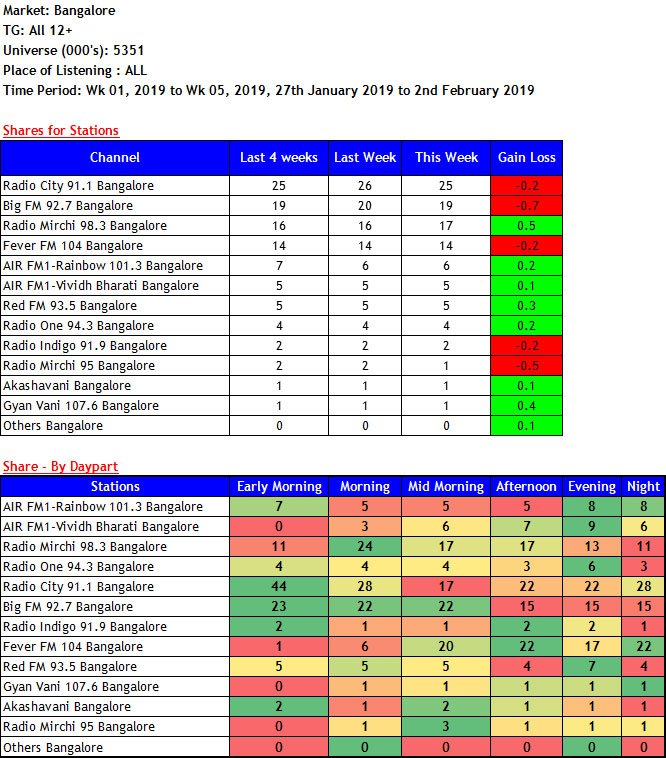
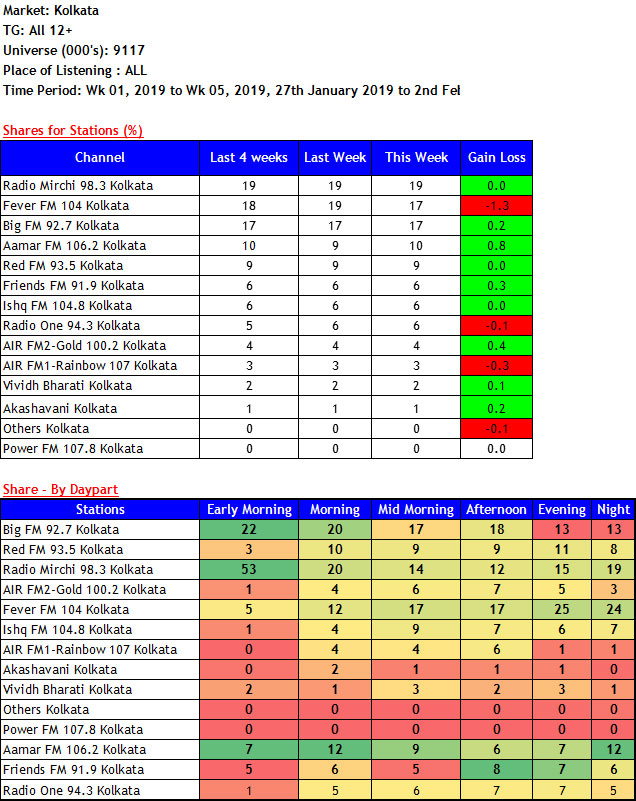
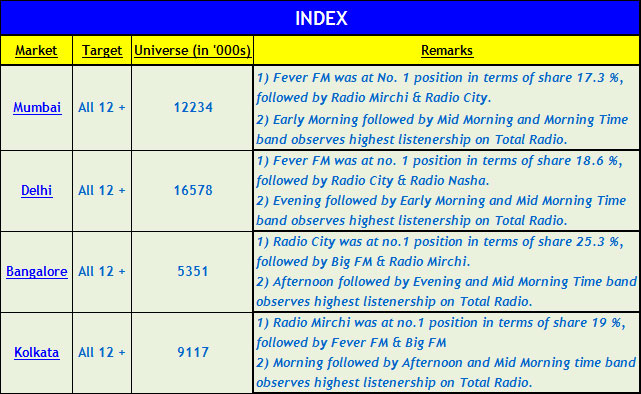
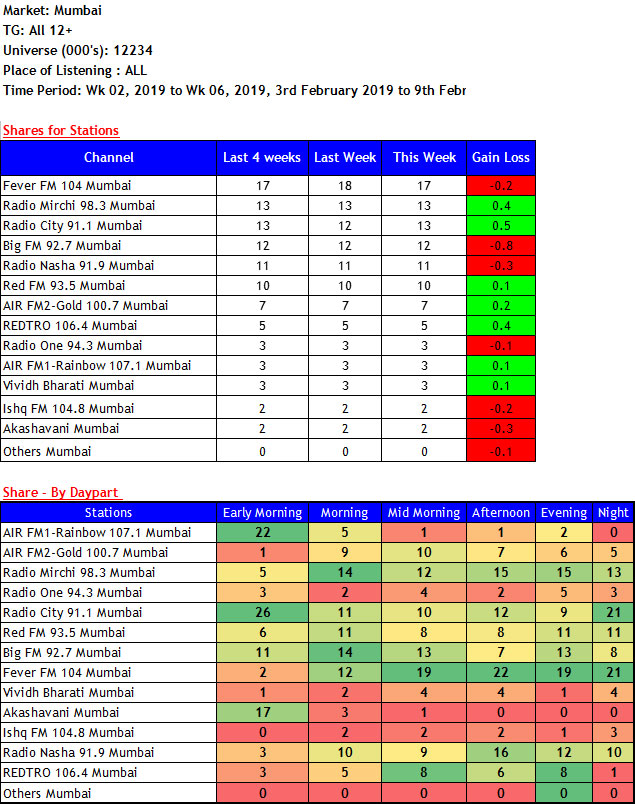
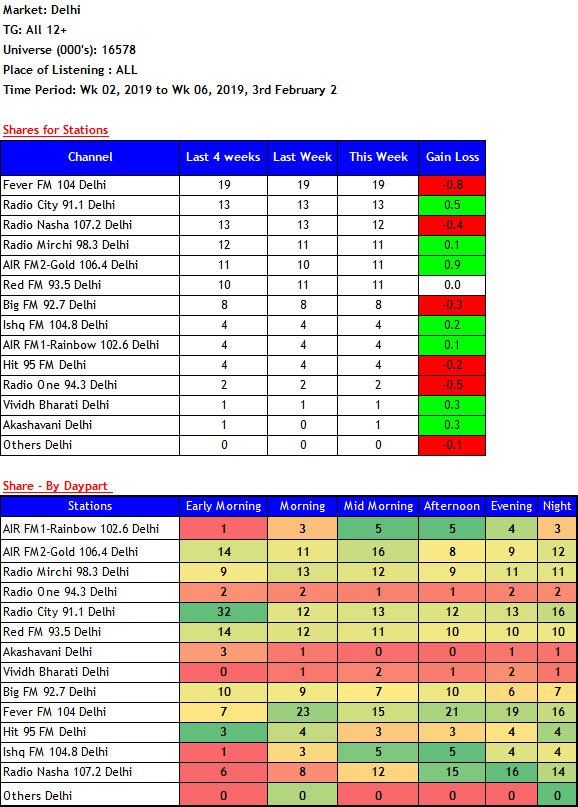
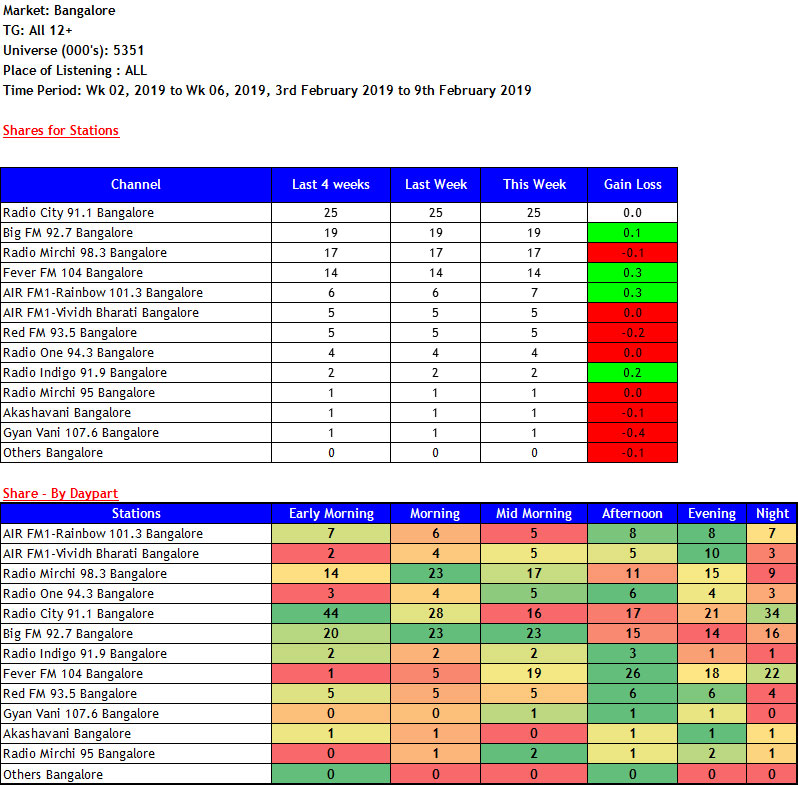
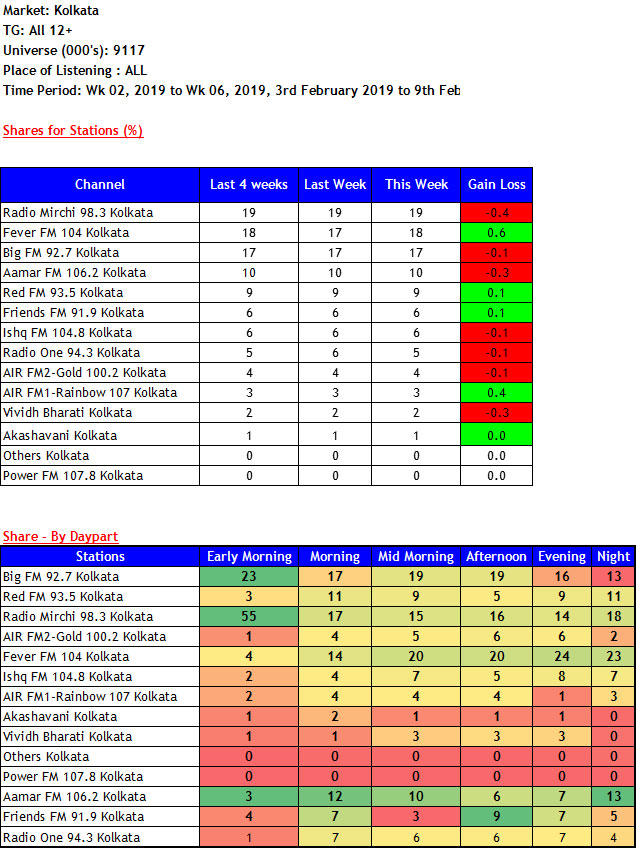
    Here are the Radio Audience Measurement (RAM) Ratings for Weeks 5 and 6 of 2019… that’s January 27 to Feb 2, 2019 and Feb 3 to 9, 2019. Sourced directly from RAM. It may be noted that this is topline data which may be insufficient for taking business decisions on booking (or not booking) ads on radio stations. We urge advertisers to buy the research findings or ask radio stations and/or media agencies for detailed numbers
     

    Weekly RAM Report Wk 05’19


    Weekly RAM Report Wk 06’19

  • RAM Ratings for Week 4 – Jan 20-26, 2019

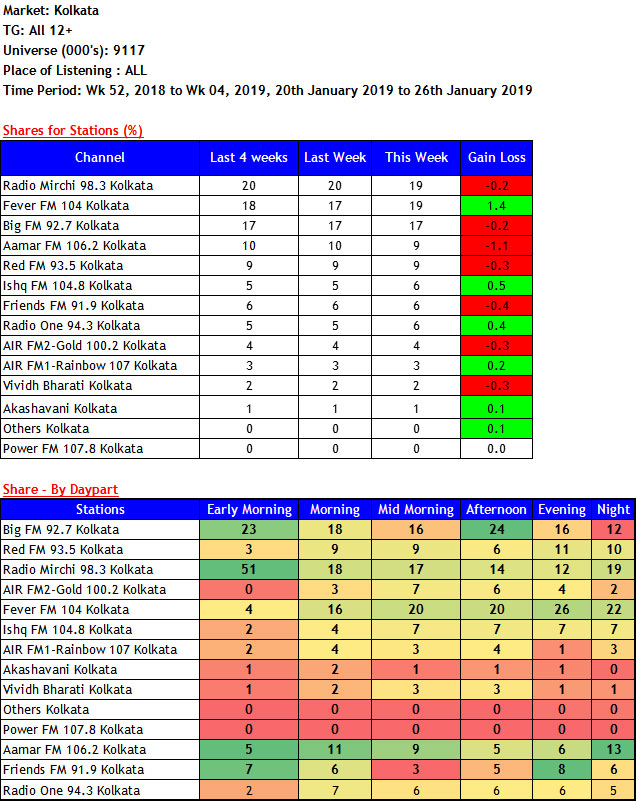
    We are back to carrying of RAM numbers every week. Here are the Radio Audience Measurement (RAM) Ratings for Week 4 of 2019… that’s January 20 to 26, 2019. Sourced directly from RAM. It may be noted that this is topline data which may be insufficient for taking business decisions on booking (or not booking) ads on radio stations. We urge advertisers to buy the research findings or ask radio stations and/or media agencies for detailed numbers.
     

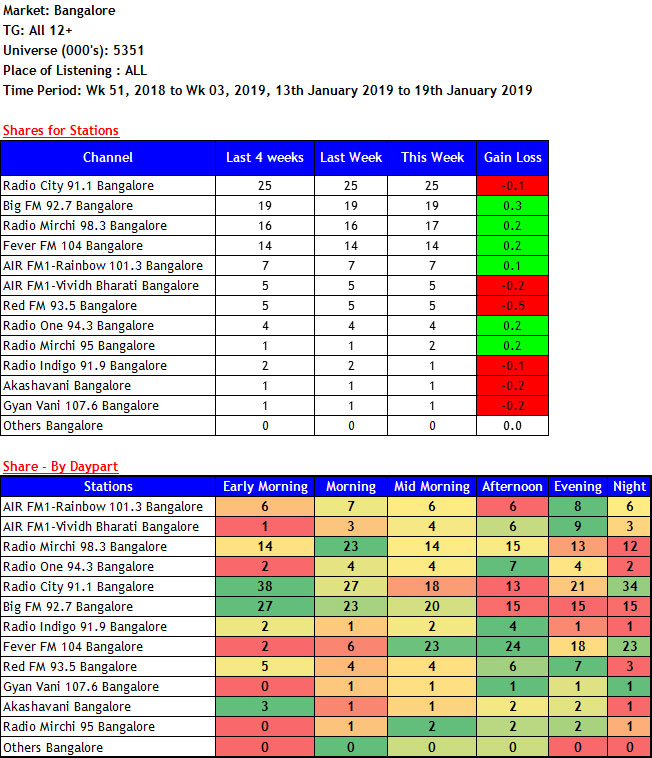
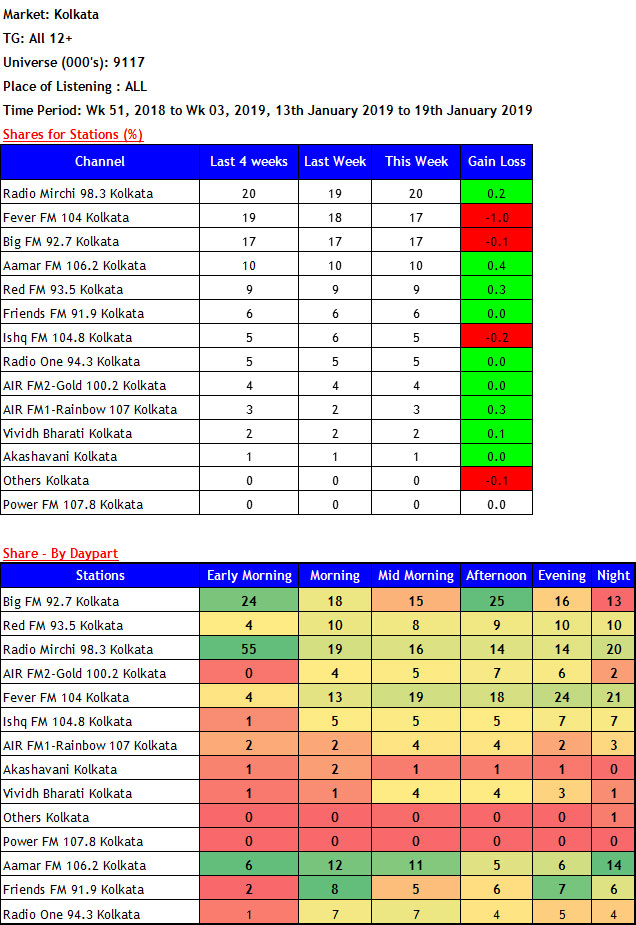
  • RAM Ratings for Week 3 – Jan 13-19, 2019

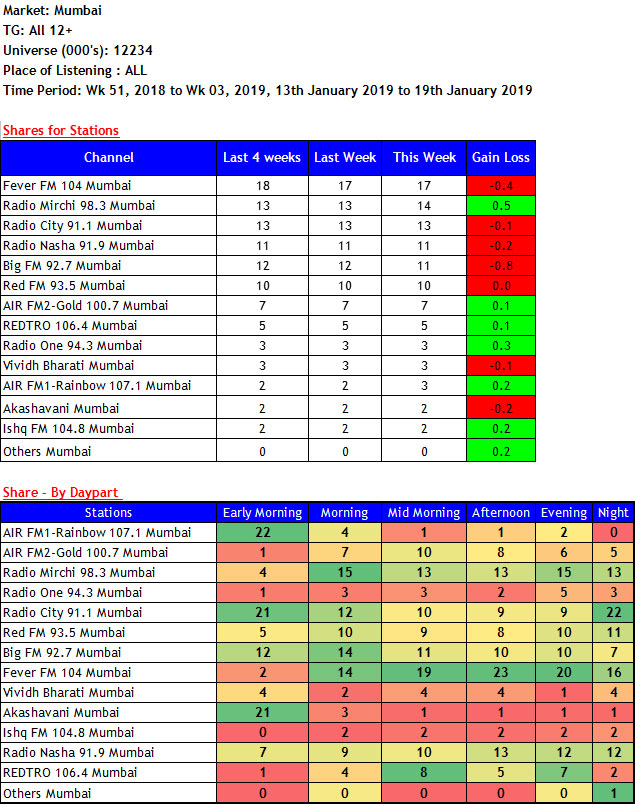
    We are back to carrying of RAM numbers every week. Here are the Radio Audience Measurement (RAM) Ratings for Week 3 of 2019… that’s January 13 to 19, 2019. Sourced directly from RAM. It may be noted that this is topline data which may be insufficient for taking business decisions on booking (or not booking) ads on radio stations. We urge advertisers to buy the research findings or ask radio stations and/or media agencies for detailed numbers

     

  • RAM Ratings for Week 52 – Dec 23-29, 2018

    We are back with carrying of RAM numbers every week, starting from last. Here are the Radio Audience Measurement (RAM) Ratings for Week 52 of 2018… that’s December 23 to 29, 2018. Sourced directly from RAM. It may be noted that this is topline data which may be insufficient for taking business decisions on booking (or not booking) ads on radio stations. We urge advertisers to buy the research findings or ask radio stations and/or media agencies for detailed numbers.


  • RAM Ratings for Week 51 – Jan 16-22, 2018

    We are back with carrying of RAM numbers every week, starting with Week 51. Here are the Radio Audience Measurement (RAM) Ratings for Week 51 of 2018… that’s December 16 to 22, 2018. Sourced directly from RAM. It may be noted that this is topline data which may be insufficient for taking business decisions on booking (or not booking) ads on radio stations. We urge advertisers to buy the research findings or ask radio stations and/or media agencies for detailed numbers.

    Market: MUMBAI
    Demographic: All People 12+ Filter Demographic: None
    Week: Week 51-2018 [16DEC to 22DEC]
    Daypart: Whole Week Daypart
    Place of Listening: All
    Rank Stations Share % T.S.L.
    1 Fever FM 104 Mumbai 18.2 6.17
    2 Radio City 91.1 Mumbai 13.7 5.42
    3 Big FM 92.7 Mumbai 12.1 5.06
    4 Radio Mirchi 98.3 Mumbai 11.8 3.35
    5 Radio Nasha 91.9 Mumbai 11.6 5.43
    6 Red FM 93.5 Mumbai 9.7 3.43
    7 AIR FM2-Gold 100.7 Mumbai 6.7 4.23
    8 REDTRO 106.4 Mumbai 4.3 5.5
    9 Radio One 94.3 Mumbai 2.8 2.06
    10 AIR FM1-Rainbow 107.1 Mumbai 2.5 3.31


    Market: KOLKATA
    Demographic: All People 12+ Filter Demographic: None
    Week: Week 51-2018 [16DEC to 22DEC]
    Daypart: Whole Week Daypart
    Place of Listening: All
    Rank Stations Share % T.S.L.
    1 Radio Mirchi 98.3 Kolkata 20.1 4.38
    2 Fever FM 104 Kolkata 18.7 6.5
    3 Big FM 92.7 Kolkata 16.6 5.02
    4 Aamar FM 106.2 Kolkata 10.4 4.37
    5 Red FM 93.5 Kolkata 9.2 3.1
    6 Friends FM 91.9 Kolkata 5.4 3.19
    7 Radio One 94.3 Kolkata 5.4 4.42
    8 Ishq FM 104.8 Kolkata 5.2 3.1
    9 AIR FM2-Gold 100.2 Kolkata 3.9 3.19
    10 AIR FM1-Rainbow 107 Kolkata 2.7 4.01


    Market: DELHI
    Demographic: All People 12+ Filter Demographic: None
    Week: Week 51-2018 [16DEC to 22DEC]
    Daypart: Whole Week Daypart
    Place of Listening: All
    Rank Stations Share % T.S.L.
    1 Fever FM 104 Delhi 18.9 5.22
    2 Radio City 91.1 Delhi 13.7 4.24
    3 Radio Nasha 107.2 Delhi 13.1 4.34
    4 Radio Mirchi 98.3 Delhi 11.6 3.27
    5 AIR FM2-Gold 106.4 Delhi 10.8 4.47
    6 Red FM 93.5 Delhi 9.6 3.36
    7 Big FM 92.7 Delhi 7.6 3.08
    8 Ishq FM 104.8 Delhi 4.3 2.35
    9 Hit 95 FM Delhi 3.4 2.43
    10 AIR FM1-Rainbow 102.6 Delhi 3.2 2.06


    Market: BANGALORE
    Demographic: All People 12+ Filter Demographic: None
    Week: Week 51-2018 [16DEC to 22DEC]
    Daypart: Whole Week Daypart
    Place of Listening: All
    Rank Stations Share % T.S.L.
    1 Radio City 91.1 Bangalore 25.6 9.31
    2 Big FM 92.7 Bangalore 19.2 7.37
    3 Radio Mirchi 98.3 Bangalore 17.4 6.48
    4 Fever FM 104 Bangalore 14.3 8.19
    5 AIR FM1-Rainbow 101.3 Bangalore 6.4 5.3
    6 Red FM 93.5 Bangalore 5.3 3.53
    7 AIR FM1-Vividh Bharati Bangalore 3.9 4.1
    8 Radio One 94.3 Bangalore 3.7 3.44
    9 Radio Indigo 91.9 Bangalore 1.4 2.18
    10 Radio Mirchi 95 Bangalore 1.3 3.17
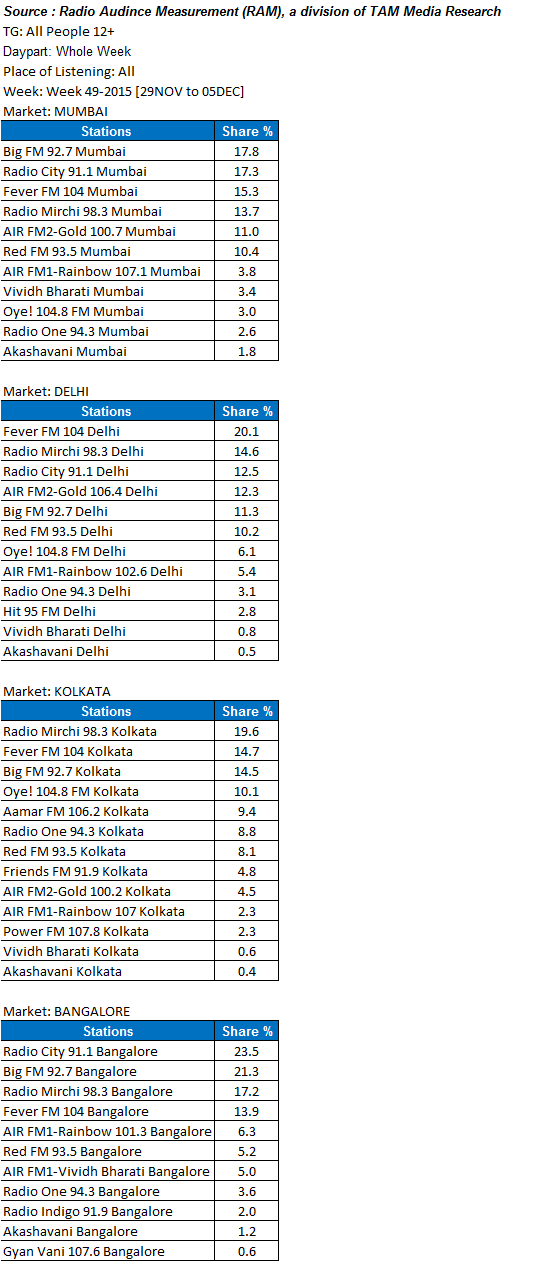
  • RAM Ratings for Week 49 – Nov 29-Dec 5, 2015

    Here are the Radio Audience Measurement (RAM) Ratings for Week 40 of 2015… that’s November 29 to December 5, 2015. Sourced directly from RAM. It may be noted that this is topline data which may be insufficient for taking business decisions on booking (or not booking) ads on radio stations. We urge advertisers to buy the research findings or ask radio stations and/or media agencies for detailed numbers​.


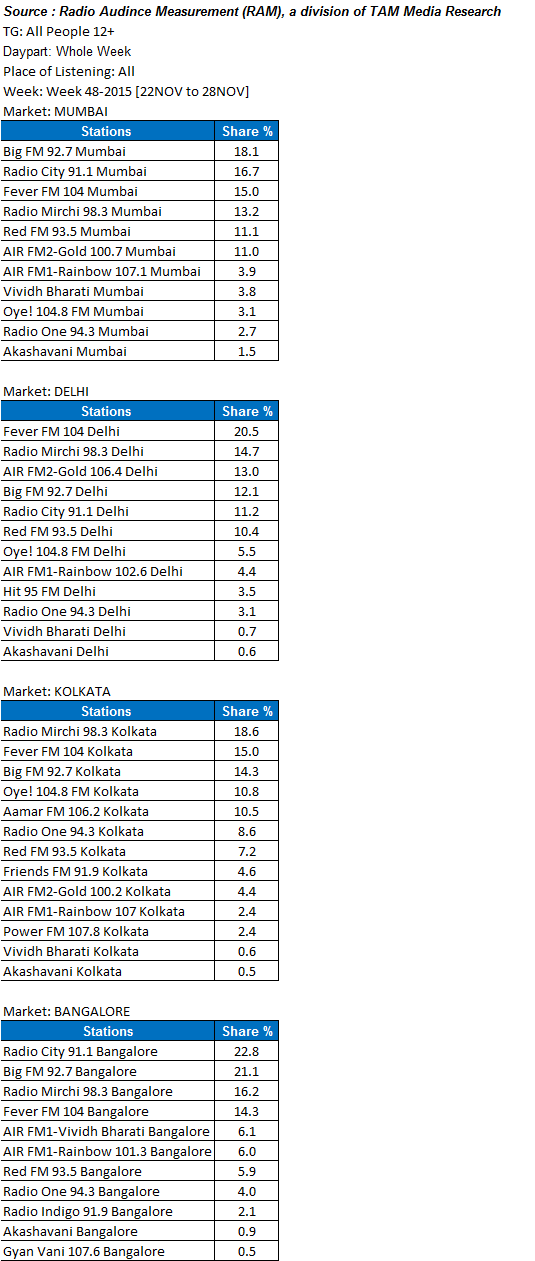
  • RAM Ratings for Week 48 – Nov 22-28, 2015

    Here are the Radio Audience Measurement (RAM) Ratings for Week 48 of 2015… that’s November 22 to 28, 2015. Sourced directly from RAM. It may be noted that this is topline data which may be insufficient for taking business decisions on booking (or not booking) ads on radio stations. We urge advertisers to buy the research findings or ask radio stations and/or media agencies for detailed numbers​.​​​​​​​​​


  • RAM Ratings for Week 44 Oct 25-31, 2015

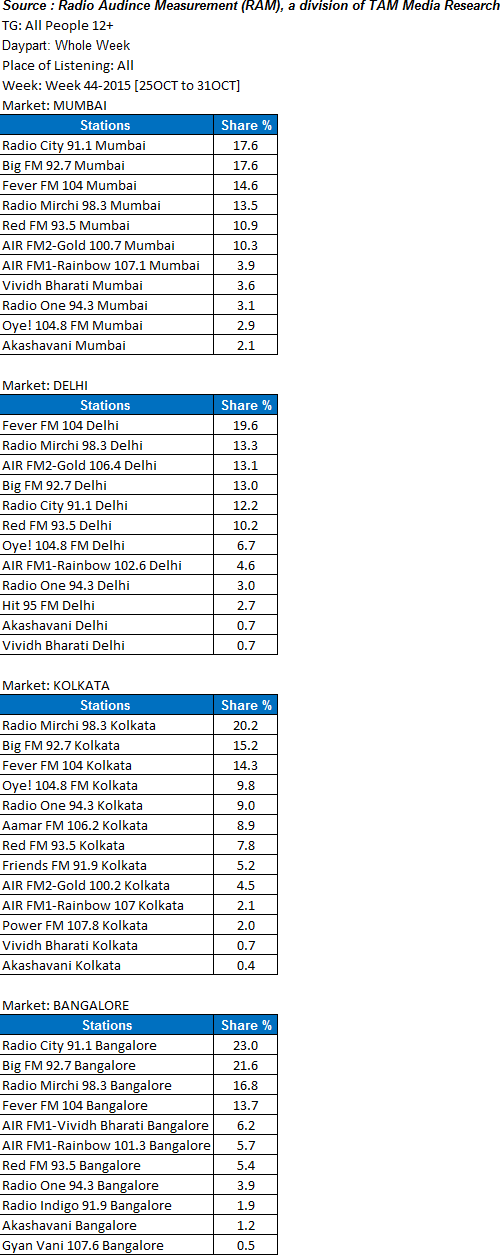
    Here are the Radio Audience Measurement (RAM) Ratings for Week 44 of 2015… that’s October 25 to 31, 2015. Sourced directly from RAM. It may be noted that this is topline data which may be insufficient for taking business decisions on booking (or not booking) ads on radio stations. We urge advertisers to buy the research findings or ask radio stations and/or media agencies for detailed numbers​.


  • RAM Ratings for Week 37 Sept 6-12, 2015

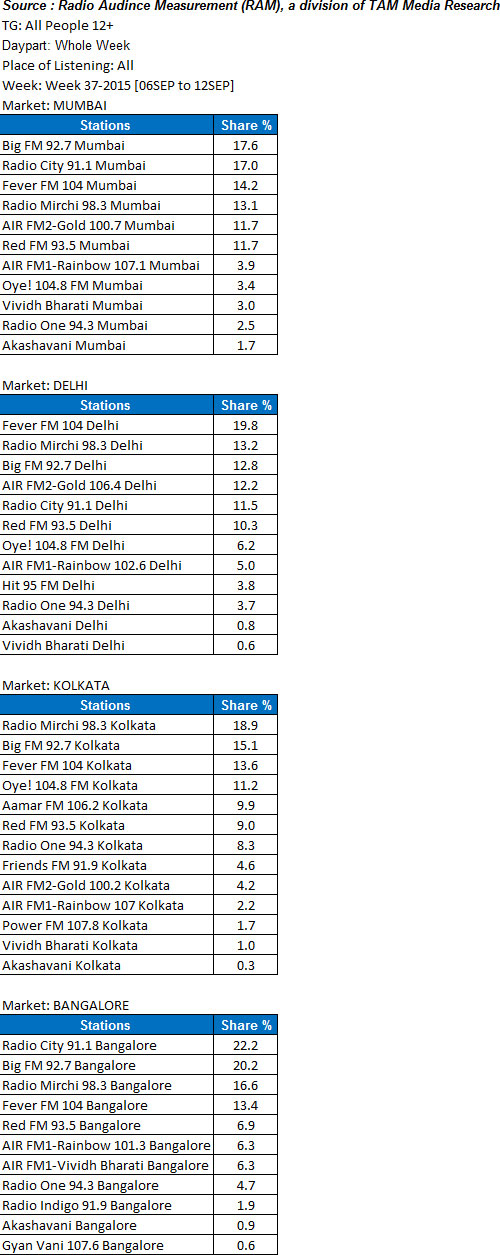
    Hello. This should’ve appeared yesterday, but we were full up with stories so couldn’t accomodate it. So here we are again with Radio Audience Measurement (RAM) Ratings for Week 37 of 2015… that’s September 6 to 12, 2015. Sourced directly from RAM. It may be noted that this is topline data and is insufficient for taking business decisions on buying inventory on radio stations. In fact many even damn us for carrying it because it gives insufficient data. We urge advertisers to buy the research findings or ask radio stations and/or media agencies for detailed numbers​.


  • RAM releases the second Radio Listenership sweeps for 9 cities

    By A Correspondent


    RAM (Radio Audience Measurement) service, launched by TAM Media Research in 2007 for the radio industry, has released the second round of its 9 cities Listenership Sweeps. The first round was released in October 2012, along with the announcement of the news on RAM panel coverage expansion to 9 additional cities – Ahmedabad, Chennai, Hyderabad, Indore, Jaipur, Kanpur, Lucknow, Nagpur and Pune. Prior to that, RAM operated out of the four Indian metros – Bangalore, Delhi, Kolkata and Mumbai only.


    As planned and announced, the second sweeps data is for the period of February-April 2012. This sweeps, released by RAM, will help the radio industry: broadcasters & media planning agencies, to assess the impact that radio medium is having on audiences in towns other than the major metros.


    Commenting on this release, LV Krishnan, CEO said: “The second roll out is as per timelines committed by us. After the first sweeps in October last year, the second one shows interesting changes in radio consumption patterns. While in some markets, radio consumption base itself has seen an increase, in others, granular trends like Out Of Home (OOH) listenership has seen an encouraging increase.”


    RAM’s second sweeps highlights certain interesting changes in radio consumption behaviour, not only across the 9 cities, but also in comparison to the October 2011 sweeps release.


    Some highlights are:

    • Ahmedabad, Chennai & Hyderabad are the growth markets. Southern metros have seen more than 30 per cent growth in listening thresholds while Ahmedabad has witnessed 15 per cent growth
    • Pune,Kanpur,IndoreandNagpur, have remained almost the same levels as the previous round


    Ahmedabad:

    • Average audience has seen a significant increase in morning while other day parts, remained at the same level. The peak at 9am has grown by 70 per cent.
    • The increase in morning day part is due to 10 per cent growth in cume reach levels.
    • Share of Out of Home listening has grown significantly. Particularly during travel/conveyance with share of listening growing from 9 to 16 per cent
    • Cume reach levels have gone up across all the days, while Sunday has seen a significant growth
    • Time spent levels have seen a very marginal drop across the days. Sunday remains the day with highest time spent level
    • While 90 per cent of cume reach build up was achieved by afternoon earlier, now 95 per cent of the audience can be targeted by the morning day part alone at a weekly level


    Chennai:

    • While cume reach levels have dropped across all the day parts, time spent levels have significantly increased. The maximum increase in time spent being in the morning day part.
    • The audience build up has got spread through the day. It takes up to afternoon day part to cover 95 per cent of all audience.
    • Share of SEC C’s listening has grown from 37 per cent to 43 per cent
    • Share of in-home listenership grows from 76 per cent to 87 per cent
    • While Saturday had the highest listenership thresholds the previous round, Sunday has grown beyond Saturday in round 2 – both in terms of cume reach and time spent


    Nagpur:

    • The weekly listenership levels have remained at the same levels as the previous round
    • The daily cume reach has gone up, with Sunday being the maximum, but time spent levels are down across all the days.
    • Share of In-home listening grows from 82-87 per cent


    Jaipur:

    • Drop in listenership thresholds across the day
    • The same reflects in the cume reach levels across the day parts
    • Dominance of SECDE in Jaipur’s listenership contribution is normalized. Proportionate contribution from all SECs to listenership
    • Morning day part continues to be the one where listenership peaks, though at a lower threshold
    • Sunday emerges as the one with highest cume reach and time spent levels
    • The audience build up has got spread through the day. It takes up to afternoon day part to cover 95 per cent of all audience


    Indore:

    • The listenership peaks have interchanged between mid morning and morning, morning peak emerging as the highest. Other day parts are more or less are at the same threshold
    • At a weekly level, morning day part emerges as the highest in cume reach and time spent
    • Mid-morning day part saw a reduction cume reach levels.
    • TSL level growth in night day part
    • Share of In-home listening significantly drops from 94 per cent to 71 per cent. Maximum growth in Car share of listening at 22 per cent
    • Saturday loses audiences as Sunday emerges as the destination of maximum listening
    • Faster cume reach build up across the day as 95 per cent of the audiences are reached by the mid-morning day part


    Hyderabad:

    • Across the day parts TSL has almost doubled
    • Evening and night day parts have grown significantly while morning has witnessed a drop in listenership levels.
    • The drop in morning day part is primarily due to drop in cume reach levels, while TSL has grown.
    • Contribution from SEC A & B increases
    • 6 per cent drop in share of in-home listening, reflected in the growth of listening share from car/travel/conveyance
    • Equal and high threshold of listenership across weekdays and weekends
    • Evening and night day parts add significant amount of audiences to cume reach build up


    Pune:

    • Similar listenership thresholds across the day parts
    • Mid-morning to night, there is a drop in cume reach levels, but across the day parts there is a growth in TSL levels
    • Contribution from different places of listening remains the same
    • Sunday emerges as the destination of highest listenership
    • Audience addition from afternoon grows in the current year


    Lucknow:

    • Listenership thresholds drop across the day parts, while night primetime holds the thresholds
    • While there is cume reach growth in some of the day parts, there has been TSL drop across all of them
    • Share of listening from 35+ age group comes down
    • Contribution from in-home listening grows from 89 per cent to 93 per cent
    • Cumulative audience on Sunday grow from 82% to 94%
    • Weekdays and weekends have similar thresholds of TSL


    Kanpur:

    • Marginal changes in day part wise preferences
    • Growth in consumption share fromSECABand 45+ age group
    • OOH share of listening grows from 23 per cent to 29 per cent, majority of the growth coming from car/travel
    • Sunday emerges as the clear leader in listening thresholds


    TAM is a joint venture between Nielsen Company and Kantar Media Research. Besides measuring TV Viewership, TAM also monitors Advertising Expenditure of Television, Print & Radio through its division AdExIndia. Since 2004, it extended its presence in the PR Measurement & Analysis space for Corporate/Marketing Clients by setting up a separate division – Eikona PR Measurement.


    In 2007, the joint venture introduced RAM (Radio Audience Measurement) service to track Radio Listenership for the Indian Radio Broadcast Industry. In year 2009, TAM launched a division, called TAM Sports that specializes in monitoring Sports Sponsorship ROI.


  • Differentiation & Innovation key to success, says Harshad Jain

    As Business Head – Radio and Entertainment of HT Media, a role he assumed last year, Harshad Jain has his role tailormade for excitement. The FM Radio market may be small when compared to television or print, but given the nature of competition is a challenging play. In conversation with MxMIndia’s Robin Thomas, Mr Jain spoke about Fever 104 FM’s radio play – Gandhi, the consistency of the FM station’s leadership position in Delhi, Phase III plans and much more. Prior to joining Fever 104 FM, Mr Jain worked with companies like Pepsico, Worldspace and Airtel to name a few.


    Fever 104 FM recently launched radio play – Gandhi… What is the kind of response you have been receiving?

    The radio play, Gandhi, has done extremely well. It is currently aired at three different day time slots, and we have extremely good sponsors – Maruti Suzuki, Union Bank of India and Tata chemicals. We have been inundated with thousands of SMSes and calls, along with over 3,000 plus responses on Facebook wherein people have appreciated our initiative. And I do believe this has been one of the finest innovations in the radio industry.


    Do radio plays still strike a chord with listeners?

    Absolutely, because it drives a lot of appointment listenership. Today, the issue with the radio industry is the fact that it is tough to create differentiation. A radio drama like Gandhi or Ramayan is a high end production which drives appointment listening and, it is very relevant for any target group.


    According to RAM, Fever 104 FM Delhi consistently claimed the No 1 spot… What, would you say, are the factors that led to this success?

    Today, we are the single largest radio station in Delhi, not only among the private FM radio stations, but we have managed to go ahead of AIR FM Gold – we are the undisputed number one FM radio station in Delhi. The key reason for our success in Delhi is because we are a station which is very much integrated in Delhi. We believe that we have got a differentiated product offering in Delhi, we do a very high level of innovation and we’ve got an extremely strong local connect which makes us very powerful competition.


    IRS, on the other hand, seems to have a different story to tell… What would you say are the takeaways from IRS Q4 numbers?

    IRS is a readership survey; it is not a survey for radio. Radio Audience Measurement (RAM) on the other hand is an exclusive survey only for Radio. Second, IRS is a quarterly survey whereas RAM is a weekly survey. Third, the detailing in terms of RAM is excruciating as it provides time-band listenership, number of listeners by show, cumulative listenership, time-spent listening, therefore RAM is a measurement system meant to track a certain kind of medium. IRS is principally a tool for print media, it is about readership survey and a readership survey cannot do justice to a listenership survey.


    What, according to you, worked in Delhi but did not work in Kolkata and Bengaluru? What is the learning from Delhi for the remaining markets?

    The learning from Delhi comes from the fact that we need to be high on innovation, we need to have a differentiated product, and a very strong local connect.


    How has the Fever 104 FM Digisound impacted listenership?
    We used to be a distant number five in Mumbai, now we are a dominant number three player in the city. This proves that the strategy has worked positively for the station.


    What are your FM Phase III plans? Do you plan to expand to newer markets? Any specific cities or towns you are eyeing?

    We will participate in FM Phase III, we are still strategizing and only after thought through consideration, will we do what is required. We do have our expansions plans as to which markets we need to expand and depending on the how the viability and economic model works, we will expand.


    How active is you online presence – your website, Facebook and Twitter? How do you engage listeners off air?

    We do a lot of activities online, a lot of our RJ promotions and other engagement activities are done online. Digital is, therefore, a key part of our strategic mix in terms of reaching out to a larger audience, and we use it very effectively.


    How has the year been so far for Fever? And what would you say are the challenges and concerns facing the radio industry today?
    It has been a good year for us so far. We have entered the year very well, and we are looking at very strong sustained growth. As far as the challenges are concerned, there are couple of challenges – lack of differentiation in content is one of them. Second, the size of the advertising category is relatively small which needs to grow dramatically in the next couple of years, and third, the licence fees needs to be reduced.


  • Will Marathi content be a shot in the arm for FM in Mumbai?

    By Robin Thomas


    What’s common between radio stations in Kolkata, Bangalore, Chennai, Hyderabad, Ahmedabad, Kolhapur, and Kochi? They give almost equal prominence to local music along with the Hindi or Bollywood songs. This is in direct contrast to the Mumbai market where FM stations mainly play Bollywood songs which are quite popular with the Mumbai listeners.


    According to RAM’s (Radio Audience Measurement), Radio Establishment Survey 2011 findings, although the mother tongue of 51 per cent of FM device owners in the city is Marathi, an overwhelming 80 per cent of them prefer Hindi music and RJ talks on radio. Nevertheless, the survey also revealed that as compared to 2007, the preference for music and RJ Talk in Marathi has witnessed an increase in 2011.


    It’s not that the all the FM stations in Mumbai have ignored the Marathi speaking audience. Big FM, Radio Mirchi and Radio City play Marathi songs, but only on Sundays and they are the only radio stations to do so.


    Big FM, for instance, has been airing Masala Chaha every Sundays between 7am to 9am since 2009, much before Raj Thackeray’s diktat to the radio stations to play Marathi music. But even then, a Big FM spokesperson was of the view that although there is a market for Marathi music, Mumbai being a cosmopolitan city, most Mumbaikars prefer listening to Bollywood music. “There is surely a market for Marathi music, given the high population of Marathi speaking public. However, Mumbai is a cosmopolitan city with a wide audience base, and a mass channel has to play the music that appeals the most… which is Hindi, a lot of it being Bollywood. Phase III will unleash the true potential of radio and will allow for more differentiation in content, along with newer genres and radio stations that will cater to a more specific audience base.”


    Radio Mirchi airs ‘Mumbai Dhol’ every Sunday, between 12 noon to 3pm, hosted by RJ Rohit. ‘Mumbai Dhol’ covers the culture of the city, the happenings and plays back to back Marathi music, contemporary and the classics.


    Indira Rangarajan, VP, Programming, West & Central, Radio Mirchi stated: “The response to our Marathi show – ‘Mumbai Dhol’ has been very good. Following the resurgence of Marathi films and music, we had decided to experiment with a slot specifically for Marathi songs and it has worked well. I believe there is plenty of scope for Marathi music in Mumbai and over the years this popularity will increase further.”


    RadioCitytoo plays Marathi retro songs every Sunday evening between 5pm to 6pm during ‘Sandhikali Aasha’, a radio programme hosted by RJ Vishaka.


    After looking at the Marathi content being offered by these three stations, one wonders if there scope for more Marathi content on Mumbai radio stations? Or will the Marathi music lovers have to wait a little longer for a radio station that caters to their tastes?


    Unlike the private radio stations, the government-owned FM stations, AIR FM2 Gold and AIR FM1 Rainbow, play a mix of Hindi and Marathi songs every day. The private radio stations would do well to take a lesson from these government-owned radio stations.


    Naval Toshniwal, CEO, Tomato FM, a Kolhapur-based FM radio station, was also of the view that although the potential for Marathi music is huge, Mumbai being a cosmopolitan city will play more Hindi or Bollywood songs. “Yes, there is a huge scope for Marathi music in Mumbai. However, no private FM station would want to play only Marathi music, it will have to play Bollywood or Hindi songs too because of the cosmopolitan listenership. Looking at the current FM scenario where every station sounds the same, I believe that a radio station which plays a little more Marathi music will create some amount of differentiation in the market.”


    FM stations in the city play Marathi hit songs during prime-time, especially on occasions like Maharashtra Day or Gudi Padwa. For instance, Big FM Mumbai will be playing Marathi songs during the breakfast show from March 19 to March 23, celebrating the occasion of Gudi Padwa.


    According to Janardhan Pandey, Associate VP, Mudra Max: “Although the market may not be big, the potential for Marathi listenership is huge in Mumbai. The issue, however, is that there has not been any serious attempt by FM stations to woo the Marathi listeners. Awareness about Marathi programmes aired on radio stations seem to be non-existent, the Marathi programmes or music are played during mostly non-prime time. However unless a FM station does not aggressively promote its Marathi programmes, and plays Marathi songs more frequently, it will neither add new listeners nor will it attract new advertisers. There are a lot of retail advertisers in the city catering to the Marathi audience.” Ajay Rao, Vice President, Dentsu stated: “There is a huge scope for Marathi listenership in Mumbai as Marathi generates high level of passion.”


    The good news is that increase in the frequency of Marathi music on radio stations could mean attracting new listeners to radio, and perhaps even new advertisers. Moreover, multiple frequencies may bring some good news to the Marathi music lovers as it will bring new genres of radio stations.