Tag: PwC India

  • BT Mindrush 2023 to be held today

    By Our Staff


    Business Today magazine is conducting BT Mindrush 2023 in Mumbai today.  This year’s discussions will feature a line-up of prominent leaders from the business world, including N Chandrasekaran, Chairman of Tata Sons; Nandan Nilekani, Chairman of Infosys and Ajay Piramal, Chairman of Piramal Group, among others. Jyotiraditya Scindia, Union Minister of Civil Aviation & Steel, Government of India, will represent the policymakers.


    The conference will begin with a session titled ‘The Entrepreneur’s Playbook: Managing Conflict. Grooming the Next-Gen. Innovation,’ by Sougata Ray, Professor of Strategy and Entrepreneurship (Practice); Chair Professor and Executive Director, Thomas Schmidheiny Centre for Family Enterprise, Indian School of Business.


    A deep dive conversation on ‘The World as India’s Oyster: The Reshaping of Global Supply Chains. China Plus One. India’s New Fortune. Or Missed Opportunity,’ will feature Praveer Sinha, CEO & MD of Tata Power, Shashi Kiran Shetty, Founder and Chairman, Allcargo Group, S. Suresh, MD of EID Parry, Sajjan Bhajanka, CMD of Century Plyboards, and Parmod Sagar, MD & CEO of RHI Magnesita.


    Ajay Piramal, Chairman of Piramal Group, will share his thoughts on “Animal Spirits: The Investment Drought. The Growth Binge. The Skill of the Entrepreneur.”


    A session titled Leverage Play: Appetite for Growth, Lure of Easy Debt, Managing Leverage Risks: How India’s Best Corporations Strike the Right Balance will focus on the balance between growth and debt management, featuring insights from Suresh Narayanan, CMD of Nestlé India, T.V. Narendran, CEO and MD of Tata Steel, Suneeta Reddy, MD, Apollo Hospitals Enterprise and Sanjeev Krishan, Chairman of PwC India.


    The Business Today Mindrush 2023 will also host Nandan Nilekani, the Chairman of Infosys, who will speak on “The Transformer: National Identity Creator. E-commerce Evangelist. India’s Tech Conscience.” Later in the evening, N. Chandrasekaran, Chairman of Tata Sons, will share his perspective on “Reinventing Tata: Redirecting the Colossus. Connecting with the Consumer. Successes and Failures.” The session will delve into how Tata Sons navigate the rapidly changing business landscape and build a stronger connection with consumers.


    The “The Path to the Trophies” session at the Business Today Mindrush 2023 will explore India’s journey to becoming a global economic power. Vivek Prasad, Leader-Markets at PwC India, will provide insights into the economic factors contributing to India’s growth with a talk on ‘The Path to the Trophies.’


    Minister Scindia will speak on the platform to provide a policymaker’s perspective.


    The conference will conclude with a special address from Aroon Purie, Chairman and Editor-in-Chief of India Today Group, followed by the ‘India’s Best CEO Awards’ that is presented in partnership with PwC India.


  • Indian M&E to grow at 8.8% CAGR by 2026: PwC


    By Our Staff


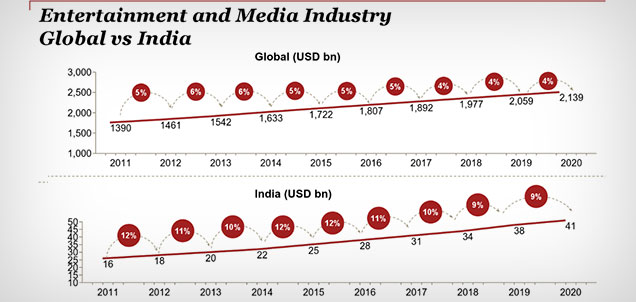
    India’s media and entertainment industry is expected to reach INR 4,30,401Cr by 2026 at 8.8% CAGR. These figures come from PwC’s Global Entertainment & Media Outlook 2022-2026, the 23rd annual analysis and forecast of M&E spending by consumers and advertisers across 52 territories.


    Said Rajib Basu, Partner & Leader – Entertainment & Media, PwC India: ”The Indian Media and Entertainment outlook for the next few years is quite unique. There is an exciting pace of growth of digital media and advertising led by the deeper penetration of internet and mobile devices in our market. At the same time, traditional media will hold their steady growth rate over the next few years. We shall see a very different profile of media and entertainment related businesses and revenue models emerging in the digital space once we have the rollout of 5G.”


    Key findings for India in this year’s Outlook include:

    OTT Video: Total OTT revenue more than doubled in 2020, partly driven by the absence of public entertainment and additional time at home. This trend continued in 2021, with revenue nearly doubling again. While growth rates will slow, the market will still expand at an impressive 14.1% CAGR to reach INR 21,032Cr in 2026. It is subscription services that are driving this rapid growth, accounting for 90.5% of revenue in 2021 and set to account for 95% in 2026.


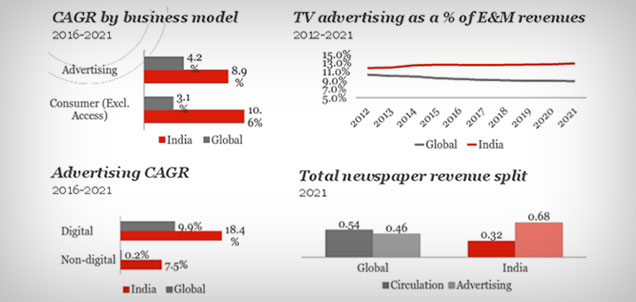
    Newspapers & consumer magazines: India will see an increase in total newspaper revenue at a 2.7% CAGR from INR 26,378Cr in 2021 to INR 29,945Cr in 2026. India, which will leapfrog both France and the UK to become the fifth-biggest newspaper market by 2026, will also be the only country to grow total newspaper print revenue consistently across the five-year forecast period. India will also be the only country in the world to grow daily print newspaper copy sales (by volume) during the forecast period. The increase at a 1.3% CAGR – to an average of 139mn daily average print newspaper sales in 2026, one-third of the global daily total – will mean that India will overtake China as the biggest world market for print edition readership in 2025.


    Out-Of-Home Advertising: India’s out-of-home (OOH) advertising market is demonstrating one of the strongest comebacks globally and is predicted to grow at 12.57% CAGR to reach INR 5,562Cr in 2026. Total OOH revenue recovered by 63.4% in 2021 over the 2020 levels which was one of the steepest downturns of any market and the biggest fall in revenue among the world’s major economies. In 2021 total OOH revenue was up to INR 3,076Cr. The momentum of this rebound will carry over into 2022, and by year-end the market will be at the value INR 4,084Cr.


    Video games & esports: India’s total video games and esports revenue was INR 16,200Cr in 2021, and is forecasted to reach INR 37,535Cr by 2026, increasing at a 18.3% CAGR. While still a fairly small market for the country’s size and population, India is the third fastest-growing video games market in the world, after Turkey and Pakistan. India’s video games market is predominantly geared towards social/casual gaming. With revenue of INR 13,244Cr, social/casual gaming made up 83.9% of India’s total video games and esports revenue in 2021. Expanding at a 20.6% CAGR, social/casual gaming revenue is expected to reach INR 34,581Cr by 2026. A big enabler of this segment will be the emergence of 5G technology in the market.


    TV advertising: After several years of rapid expansion, India’s TV advertising market was hit by the Covid-19 recession in 2020, causing a -10.8% decline over the 2019 levels. This proved to be a temporary setback. With the country’s return to economic growth in 2021, this segment grew by 16.9% to INR 32,374Cr. The market will expand further at a 6.3% CAGR to reach INR 43,410Cr by 2026. At this time, India will be the fifth-largest TV advertising market globally, after the US, Japan, China and the UK.


    Cinema: India is the third-biggest market globally in terms of admissions after China and the US in 2021 and is set to grow at the highest growth rate amongst all the segments at a staggering 38.3% CAGR in the forecast period to reach INR 16,198Cr by 2026. In 2021 more than 379mn cinema tickets were sold in India, a healthy increase year-on-year on the 278mn admissions in 2020 (and higher than the 226mn admissions in the US in 2020) though that had been a huge (-85.4%) drop as compared to the 1.9bn tickets sold pre-pandemic.


    Internet advertising: India’s Internet advertising market is set to increase at a 12.1% CAGR to reach INR 28,234Cr by 2026. Given India’s mobile-first Internet access market, the mobile sector dominates the country’s Internet advertising market, accounting for 60.1% of total revenue in 2021, rising to 69.3% by 2026. Display advertising dominates the mobile sector, accounting for 90.7% of revenue in 2021 though its share will fall to 88.9% of the total in 2026. India’s wired Internet access revenue amounted to INR 6,379Cr in 2021 which is predicted to increase at a 6.3% CAGR to reach INR 8,829Cr by 2026.


    Music, Radio & Podcast: India’s music, radio & podcast segment grew at 18% in 2021 and is set to grow at 9.8% CAGR to reach INR 11,536Cr by 2026. India’s Recorded Music industry (which is a key sub-segment) is making steady progress at a CAGR of 13.6%, thanks to streaming models. Here the revenue has grown from just INR 1,663Cr in 2017 to INR 2,568Cr in 2021, and is expected to continue on this path to INR 4,849Cr by 2026.On the other hand the country’s Live Music industry remains small, and it shed two-thirds of its revenue in the first year of the COVID-19 pandemic. Revenue ticked up in 2021 to INR 434 Cr and is forecast to grow to revenues of INR 1,052 Cr in 2026, increasing at a 19.2% CAGR.


    Other factors impacting the global M&E sector:

    Global Revenue – Fastest growing segments

    After a stellar 2021, virtual reality (VR) continues to take steps towards becoming a mass-market proposition. VR gaming content is the primary contributor to total revenue, bringing in US$1.9bn in 2021 and highest CAGR for the forecast period. Total cinema revenue will rise globally over the forecast period, and the pandemic-driven losses experienced in 2020 will be reversed, with the market hitting new heights in 2023. Box office revenue is set to reach US$49.4bn in 2026. Internet advertising comfortably leads the way as the largest advertising segment. An exceptional 31.6% year-on-year rise in 2021 put total global Internet advertising revenue at US$468.4bn, up more than US$112bn in absolute terms in 2020.


    The metaverse awaits

    In the not-too-distant future the metaverse could become a stunningly virtually realistic world where individuals access immersive virtual experiences, through VR headsets or other connecting devices. Because the metaverse is an evolution that may profoundly change how businesses and consumers interact with products, services and each other, its potential financial and economic value goes far beyond VR. In time, much of the revenues associated with video games, music performances, advertising and even e-commerce could migrate into the metaverse.

    How big is the E&M opportunity in the metaverse? The fast-growing market for VR is a starting point to consider. It is currently one of the smaller segments tracked, but the 36% rise in global spending over the past year is a hint of its long-term potential. The global installed base of stand-alone and tethered VR headsets is projected to grow from 21.6m in 2021 to 65.9m in 2026.


    Werner Ballhaus, Global Entertainment & Media Industry Leader, PwC Germany, said: “Industry press tends to focus on the companies that have dominated the E&M industry. But it is the choices that billions of consumers make about where they will invest their time, attention and money that are fueling the industry’s transformation and driving the trends.  We are seeing the emergence of a global E&M consumer base for the coming years that is younger, more digital and more into streaming and gaming than the current consumer population. This is shaping the future of the industry.”

     

  • M&E expected to grow at CAGR of 10.1%: PwC


    By A Correspondent


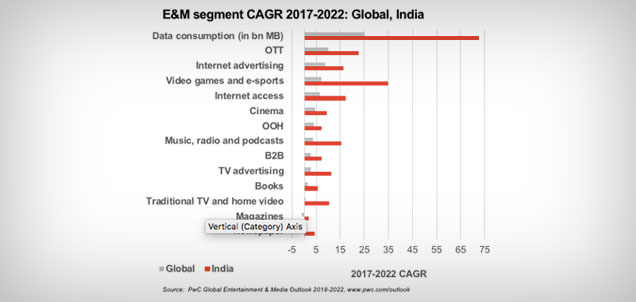
    According to PwC’s Global Entertainment & Media Outlook 2020-2024, the Indian M&E industry’s long-term outlook remains robust as it is expected to grow at 10.1% CAGR to reach 55 billion USD by 2024. A K-shaped bifurcated recovery is on the horizon in which sectors like OTT, internet advertising, video/games/e-sports, and music and podcasts are expected to spearhead growth in the industry. Globally, Digital revenue is expected to contribute 60% to the total E&M revenue by 2020, alone.


    In terms of individual segment market size as a percentage of total E&M revenue, OTT video in India is expected to see the largest gain and reach 5.2% by 2024, closely followed by internet advertising. Segments like advertising and those dependent on physical locations are likely to be further impacted in a negative manner whereas digital E&M spending will increasingly be regarded as a non-discretionary expense. While globally, newspapers and magazines are dropping the free online model and starting to ask readers to pay for quality content online, digital paywalls are yet to become commonplace in India. Furthermore, while India will remain the world’s biggest cinema market in admission terms, cinema revenue in India will contract at a -2.6% CAGR to total US$1.5bn over the next 5 years.


    Said Rajib Basu, Partner & Leader – Entertainment & Media, PwC India: “We find ourselves in extraordinary times, and the pandemic has accelerated ongoing shifts in consumers’ behaviour, pulling forward digital disruption and reaching industry tipping points that wouldn’t otherwise have been reached in the next few years. Our research shows that India will be the fastest growing entertainment and media market globally in terms of pure consumer revenue. Coming out of Covid-19, a K-shaped bifurcated recovery  is expected in which some sectors rise while others fall. Over the next five years, the outlook remains highly positive for digital led segments such as OTT, Internet Advertising, Online Gaming and Music & Podcasts that were perfectly positioned to meet consumers where they are in 2020 – predominantly at home and online,” adding: “However, companies simultaneously have to prepare to meet them where they will be two years from now. They will need to build and maintain direct-to-consumer relationships, offer enough differentiation or scale to compete, and unlock greater value using the right technologies. This is a unique window of opportunity for E&M businesses to transform and make themselves more resilient and relevant for the future.”


    Top 4 segments to advance rapidly:

    1. OTT Video: India holds the most potential of any market in the world and its breakneck rate of growth will see total OTT video revenue overtake South Korea, Germany and Australia to jump to being the sixth-largest market in 2024. Subscription video on demand will be the prime driver of revenue, increasing at a 30.7% CAGR from US$708mn in 2019 to US$2.7bn in 2024. OTT video growth is coming from both inside and outside the home as Internet-connected devices proliferate as the new ‘at-home’ environment has led to the rise of direct-to-consumer apps, local ‘bite-sized’ entertainment platforms and user-generated content (UGC) formats

    2. Internet Advertising: India is now the sixth-largest Internet advertising market in the Asia Pacific region. Mobile will be the primary driver of revenue in the Internet advertising market revenue due to increased data affordability, new mobile-first formats, ability to measure, and strategic targeting. Nonetheless, from a global perspective, Internet advertising in India remains underdeveloped and has massive headroom for growth

    3. Video, Games & E-sports: Gaming and e-sports are capitalizing on the need to bring live experiences into the home in more personalized and more engaging ways. E-sports represented less than 1% of overall market in 2019, but has become one of the fastest growing segments today with a projected 33% CAGR by 2024. However, despite surging growth and enormous potential, the sector tackles with the biggest challenge of low levels of app monetisation

    4. Music, Radio & Podcasts: Podcast industry was already experiencing rapid growth prior to the COVID-19 outbreak. Fuelled by the uptake of music-streaming brands, the overall space is expected to grow at a 13.5% CAGR, to total revenue of nearly US$1.7bn in 2024. India will also see strong increase at a 30.4% CAGR in its monthly podcast listener base over the next five years, supported by entry of foreign players and original content on topics including news, society and culture


    As the industry navigates into the post-pandemic world, one can witness new opportunities for capturing growth:

    > Players bolster subscription offerings – With consumers increasingly paying a monthly fee to access a library of entertainment content, such as films, music, content, fitness etc., media and entertainment industry players are catching on to the value of subscription based models to bring in business. Optimising revenue mix or pricing models to emerge more resilient and capture a bigger share of the wallet will be the focus


    > Physical events look for digital alternatives – Another opportunity made more compelling by the pandemic is bringing live experiences into the home in a more personalized and engaging manner. Digital spaces—e-commerce platforms, virtual event spaces, gaming channels, podcasts—are evolving into powerful new platforms for marketing. Creating new content propositions will help realise new revenue streams


    > OTT will thrive in 2020 as cinema and traditional TV degrow – OTT sector will directly benefit from the closure of cinemas, as some film studios choose to fast-track new releases to home video platforms. Since OTT platforms offer convenience and accessibility to consumers who are likely to hold on to their new habits of streaming ‘at home’, global SVOD revenue may overtake box office spend very soon


    > Landmark acquisitions are out; buying growth and cash flows are in.  – As companies look for ways to navigate barriers, strategic investments & alliances in search of scale and growth will be crucial to determine success in the E&M media industry

  • M&E to grow 11.6 in 2018-22: PwC


    By A Correspondent


    The Indian entertainment and media industry is expected to reach Rs353,609 crore by 2022, growing at a compound annual growth rate (CAGR) of 11.6% between 2018 and 2022, according to PwC’s Global Entertainment & Media Outlook 2018-2022


    Said Frank D’Souza, Partner & Leader – Entertainment & Media, PwC India: “It is not surprising that India continues to be one of the fastest growing entertainment and media markets globally. However, what is encouraging is how non-linear media is expected to grow on the back of increase in device penetration, lower Internet prices, consumer content demand and portability preferences. This will manifest in significant growth in OTT, e-sports and Internet advertising.”


    Key highlights of the report:

    Cinema: Total cinema revenue is expected to rise at a 9.4% CAGR over the forecast period.Average admission prices in India will move up over the forecast period and are set to reach INR 78 by 2022, up from INR 55 in 2017 and representing an increase at a 6.9% CAGR. The number of screens in India are also expected to increase to 12,775 screens in 2022, up from 11,672 in 2017 at a 1.8% CAGR. The main area of growth in exhibition is in digital screens as the sector modernises. There are expected to be 5,532 digital screens in 2022, a significant addition to the 2017 figure of 3,524 and representing an increase at a 9.4% CAGR.


    OTT (Over-The-Top) Video: Despite problems with piracy, OTT video revenue has grown rapidly in recent years and reached INR 2019 Cr in 2017. Further strong growth at a 22.6% CAGR will see India move into the top ten largest global OTT video markets in 2022 with revenue of INR 5595 Cr.The growing competition among international and regional Subscription on Demand Video (SVOD) platforms is evident with over 70% of revenue in 2017 attributable to subscription services. This trend will grow and by 2022, 79.4% of total market revenue is expected to be from SVOD.


    Video gaming: Indian traditional gaming is growing relatively slowly at just a 4.0% CAGR, but the social/casual gaming category will represent 82.2% of all Indian consumer gaming revenue by 2022. The segment is expected to grow by a 55.9% CAGR over the forecast period from INR 1645 Cr to INR 14772 Cr by 2022 (surpassing the traditional market in 2018). India was relatively late to the social/casual boom, but over the next five years better connectivity, better telco offerings and a competitive handset market are expected to propel apps and games to the fore.


    Internet advertising: Total Internet advertising revenue hit INR 6513 Cr in India in 2017, up a healthy 25.4% on 2016. Over the next five years, total revenue will more than double to INR 13500 Cr, driven by strong growth in mobile and paid search Internet advertising.Mobile video advertising is the fastest-growing sub-segment of India’s Internet advertising market, rising at a 32.8% CAGR to 2022, when revenue will total INR 2155 Cr.


    Drivers of the new ecosystem

    So, what are the forces behind the latest wave of convergence reshaping the industry? The Outlook pinpoints five key drivers:


    :: Ubiquitous connectivity: The number of high-speed mobile Internet connections will increase by 2.2 billion globally by 2022, vastly expanding the market for mobile content consumption at faster speeds. A symbolic tipping point will occur in 2020, when total global data consumption via smartphones overtakes fixed-broadband data consumption.

    :: The mobile consumer: The worldwide explosion in mobile access is seeing the connected mobile device become consumers’ primary means of accessing content and services across virtually all markets. This makes mobile an increasingly important focus for advertisers. And again, a key tipping point underlines this shift: 2018 will be the first year in which global mobile Internet advertising revenue will exceed its wired equivalent.

    :: Need for new sources of revenue growth: E&M companies are looking to expand beyond traditional revenue sources, which in some cases are declining. At the same time, telecom companies are targeting entertainment and media content to revitalize their growth.As a result, every player in the ecosystem is racing to develop new revenue streams. Consider that OTT spending will grow at a CAGR of 10.1% through 2022, compared with just 2.3% for broadcast TV advertising. 

    :: Value shift to platforms: Social media and technology platforms are outpacing traditional content creators in capturing consumers’ attention and a rising share of their spending, trends that have fuelled the rise of super competitors. Now some traditional content companies are fighting back by developing their own platform-like businesses. 

    :: Personalisation: Today’s empowered consumers reject one-size-fits-all content experiences. As a result, it’s vital for companies, ranging from super competitors to fan-focused niche players, to use data analytics and AI to personalise their offerings. And the appeal of the live experience endures. For example, ticket sales for e-sports events will rise at a CAGR of 21.1% through 2022.


    Winning – and then retaining – trust is vital

    Across all the drivers and trends examined in the Outlook, one overarching imperative emerges: the absolute need to earn and sustain the trust of consumers and ecosystem partners. We’re in an era in which trust in many industries is at a historically low ebb and regulators are targeting media businesses’ use of data. As a result, a company’s ability to maintain trust is becoming a vital differentiator. This can be especially challenging for entertainment and media companies, because they must demonstrate their trustworthiness across many dimensions, including content, data, monetisation, social impact and the appropriateness of advertising content. When building trust, content and brand form the foundation, starting with delivering on the promise of quality.


    Given the vision of the industry’s future presented in the Outlook, how can companies position themselves for sustained success?


    Said Christopher Vollmer, Global Advisory Leader for Entertainment and Media, PwC US: “To succeed in the future that’s taking shape, companies must revisit every aspect of what they do and how they do it. This means going ‘above and beyond’ in how they envision their business, generate revenues, create and organise their capabilities and build and retain trust. And given the pace and scale of change underway, speed is vital. For many companies, the models, assets, practices and capabilities that support their businesses today will simply not be enough in the future. Standing still is not an option.”


    Presentation_India’s entertainment and media industry to clock over INR 353,609 Cr. by 2022 PwC Report

  • Indian M&E to grow 10.57% over next 5 years: PwC


    By A Correspondent


    India’s media and entertainment sector is expected to grow steadily over the next four years as per PwC’s Global entertainment and media outlook 2017-2021 released on Wednesday. The industry is expected to exceed Rs 291,000 Cr by 2021 growing at compound annual growth rate (CAGR) of 10.5% between 2017 and 2021.


    Said Frank D’Souza, Partner & Leader – Entertainment & Media, PwC India: “Unlike the global economy, which will see a shrinking contribution from the Entertainment and Media sector over the Outlook period, in India the sector’s growth rate will outpace the overall GDP growth rate. Being a relatively under-developed market in terms of per capita spend on entertainment and media, will allow India to grow at 10.57% over the next five years to an overall size of INR 290,539 Cr. Also, being the least digitised market, will allow the traditional media to grow without being disrupted by digital competition. Whereas one may be tempted to conclude that India’s growth in this sector is divergent from the world’s, it will do well for Indian players to keep their eyes on changing landscape globally and prepare for its eventual impact on the Indian market.”


    Key highlights of the report:

    Television: TV Subscription revenues are expected to grow from INR 52,755 Cr in 2016 to INR 90,713 Cr in 2021 at a CAGR of 11.6%. Though subscriber numbers are still growing, explosive growth levels of the recent past will not be replicated in the future. The cable market is approaching a saturation point but will still account for over 55% of the total pay-TV market in 2021. In terms of advertising, TV will continue to hold the larger share of the pie from INR 21,874 Cr in 2016 to INR 37,315 Cr in 2021, even though Internet advertising is expected to growth a much faster rate of 18.6% as opposed to TV advertising at 11.1% from 2017-2021.

    Cinema:India’s cinema sector is expected to experience strong growth throughout the forecast period. Box office revenue will rise from INR 10,957 Cr in 2016 to INR 18,047 Cr in 2021, at a healthy CAGR of 10.4%. Admissions will rise from an estimated 200 Cr in 2016 to 230 Cr in 2021 (at a CAGR of 2.4%) and ticket prices will rise at a CAGR of 7.9% in the same period. This is one of the few major cinema markets in which 100% digitisation of screens has not yet been achieved – and it is not expected to occur over the forecast period.

    Publishing: Publishing in India is expected to grow from INR 38,601 Cr in 2016 to INR 44,391 Cr in 2021 at a CAGR of 3.1%. Book publishing is projected to grow at 6.1% CAGR over 2017-2021 whereas Magazines are expected to grow at a CAGR of 3.3% for the same period. The Indian newspaper industry continues to grow from INR 23,161 Cr in 2016 to INR 24,447 Cr in 2021, but the growth rate is tailing off as the effects of digital disruption begin to be felt in a market that had long enjoyed print expansion.

    Internet: In terms of Internet advertising revenue, India is ranked eighth in the Asia Pacific region. One reason for the immature online ad market is the lack of Internet access among Indians – fixed broadband penetration remains low at just 6.9% in 2016.Today, mobile Internet advertising only comprises 27.6% of total online spending, marking a clear gap between Indians with mobile access and brands reaching out to the mobile audience. India’s internet video segment has produced revenues of INR 560 Cr in 2016 and will grow at 22.4% CAGR to reach a new high of INR 1540 Cr in 2021. Transactional video-on-demand will account for over 61% of total Internet video revenues in 2021, with many households not wanting to commit to the regular payments of subscription video-on-demand.


    Major digital tipping-points are occurring or in prospect across all segments globally…


    > Internet advertising now generates more revenue than TV advertising globally. In 2016 an important tipping point was reached in the global advertising industry, with revenue from Internet advertising exceeding that generated by TV advertising for the first time. That lead, thanks to the rapid growth of mobile ad revenues in particular, is set to increase significantly in the next five years.

    > Internet video revenues will overtake physical home video in 2017. The Internet video segment has expanded rapidly in recent years, and will overtake the physical home video market for the first time in 2017. Internet video revenues are projected to grow at a CAGR of 11.6% to reach USD 36.7bn(INR 236,111 Cr) in 2021, while the terminally declining market for DVDs and Blu rays will have fallen to USD 13.9bn (INR 89,426 Cr). Demand has shifted towards the more immediate and convenient video-on-demand (VOD) market, with content accessible via a wide range of connected devices allowing consumers to view when and where they desire.

    > Global newspaper circulation revenue overtook global advertising revenue in 2016. While newspaper circulation revenue has been on a downward trajectory since 2015, publishers have had the useful lever of cover price rises to partly offset the rapid fall in units. However, the year-on-year falls in newspaper advertising revenue have been more pronounced – reflected in the overall de-growth in the newspaper segment.

    > Virtual reality video revenue will exceed interactive application/gaming revenue in 2019. The consumer virtual reality (VR) content market will grow at a CAGR of 77.0% over the forecast period to be worth USD 15.1bn (INR 97,147 Cr) by 2021. Of this, USD 8.0bn (INR 51,468 Cr) will be spending on VR video (rising at a CAGR of 91.2%), surpassing interactive experiences and games in 2019. This is one segment to look out for in the future.

    > Smartphone traffic will exceed fixed broadband data traffic in 2020. Although mobile usage is a key driver of growth in overall data traffic, fixed broadband will continue to account for the majority of data traffic in the 19 markets for which we have developed detailed forecasts. Many consumers still prefer to access data-heavy content – notably high-quality video – via fixed broadband rather than their mobile device. But the shift towards the smartphone will continue.


    PwC’s 18th annual edition of the Global entertainment and media outlook2017-2021 has covered the following segments: Books, Business-to-business, Cinema, Data consumption, E-sports, Internet access, Internet advertising, Internet video, Magazines, Music, Newspaper, Out-of-home advertising, Radio,Traditional TV and home video, TV advertising, Video game and Virtual Reality.


  • M&E to clock > US$40k mn by 2020: PwC


    By A Correspondent


    India’s entertainment and media sector is expected to grow steadily over the next four years as per consulting firm PwC’s Global Entertainment & Media Outlook 2016-20. The industry is expected to exceed US$40,000mn by 2020 growing at compound annual growth rate (CAGR) of 10.3% between 2016 and 2020.


    Said Frank D’Souza, Partner & Leader – Entertainment & Media, PwC India:  “Given India’s overall growth in GDP and PCI, it is not surprising that India is amongst the top 10 markets for growth in the Sector. Although, in India traditional media like newspaper publishing and cinema has always shown strong growth, we expect that even in terms of absolute total US$ spend, it should get into the top 10 in the early part of the next decade. What would be more interesting, however, is how rapidly India would catch up with global trends, where traditional media is finding it hard to remain relevant, and the digital sector is leading the growth trajectory and consequently bringing in continuous disruptions. That will all depend on how quickly the Indian digital/broadband ecosystem matures, and how the Indian players adapt and drive business models in what would be a rapidly changing environment for consumption of data/content fashioned largely by India’s under 35 population.”


    Key highlights of the report:

    Cinema: China expected to be close to overtaking India as the biggest cinema market by 2020

    In terms of admissions, India is currently the biggest cinema market in the world. It will remain so until the end of the forecast period, although China is expected to be close to overtaking it at that point.In 2015 admissions were at an estimated 2.04bn, and in 2020 are predicted to be at 2.80bn, rising at a 6.6% CAGR. Box office revenue in India stood at an estimated US$1.64bn in 2015 and will rise to US$2.74bn in 2020, at a 10.9% CAGR.There is still considerable room for expansion. In terms of multiplexes, India remains underserved. At the end of 2014, there were around 11,20 0 screens in the country as a whole — a small number given the population and the appetite for cinema-going. The thousands of single-screen cinemas that have traditionally dominated are beginning to disappear as a result of the multiplex boom. Multiplexes will provide better facilities — and should allow exhibitors to raise prices, within limits.


    Internet Advertising: Cost-conscious advertisers embrace paid search

    Paid search Internet advertising revenue is, and will continue to be, India’s largest Internet advertising sub-component over the forecast period.Paid search grew 26.7% year-on-year in 2015, reaching revenue of US$211mn. With a forecast of 18.5% CAGR over the next five years, paid search Internet advertising revenue will rise to US$492mn by 2020.Online spend on display ads in India has witnessed strong growth in the historic period and revenue has almost tripled since 2011, reaching US$200mn in 2015.


    TV Advertising: Digital upgrades are focused primarily on the cable and satellite sectors

    Indian TV advertising revenue has consistently grown throughout the global recession and India will be one of only seven countries to achieve double-digit growth over the forecast period at an 11.7% CAGR. This will generate revenue of US$5.54bn in 2020, compared with US$3.19bn in 2015.The pace at which TV’s reach has increased is seeing a shift in overall advertising budgets towards television. With no DTT (Digital Terrestrial Television) launch, TV advertising revenue is driven primarily by the subscription sector. Multichannel TV advertising revenue reached US$2.91bn in 2015 and will grow at a 12.1% CAGR to generate revenue of US$5.13bn in 2020.


    Publishing: Indian publishing growth bucks global trend

    Where global trends in magazine, books and newspaper publishing combined are at a near flat or negative growth trajectory, Indian publishing remains one of the fastest growing the world.  Demographics, ever increasing literacy rates, educational needs, and strong desire to consume news and content in local languages, combined with nascent digital/broadband penetration, would fuel the growth and keep it relevant over the 2016-20.  In 2015, the overall publishing revenues were at US$6133mn, an increase of US$302mn over 2014.


    Five key shifts emerge amid the continuing disruption globally

    Shift 1. Demography: Youth will be served

    Our analysis of national entertainment and media markets globally reveals an almost perfect correlation between the relative size of the under-35 population and growth in entertainment and media spending—confirming that younger consumers are now the primary drivers of global growth.


    Shift 2. Competition: Content is still king

    In a world where Netflix can launch in 130 new countries in a single day, it’s easy to assume that content is becoming more globally homogeneous. But the reality is that content is being redefined by forces of globalisation and localisation simultaneously—and that while much of the industry is growing more global, content tastes and cultures remain steadfastly local.


    Shift 3. Consumption: The joy of bundles

    The ability for consumers to design and curate their own media diet has been one of the most powerful trends to emerge in the industry. But the bundle is far from dead, with video and cable incumbents—which were initially slow off the mark—now fighting back by offering their content on an integrated omnichannel basis, on TV, laptop, tablet, and smartphone.


    Shift 4. Geography: Growth Markets

    Generally, entertainment and media companies had one set of expectations about developed markets (slow growth, low regulation, easier to access) and another about developing markets (rapid growth, high regulation, harder to access).


    Shift 5. Business models: Transforming with trust

    Today’s entertainment and media market includes technology companies racing to become hybrid content companies, and traditional publishers evolving the other way to emerge as hybrid technology companies. This underlines how the growth of technology and digitisation is acting as a centripetal force—breaking up existing relationships; pushing large, generalist entities to give way to smaller specialists; and allowing smaller, nimble competitors to beat out incumbents.


  • Indian consumers moving towards omnichannel way of shopping: PwC

    By A Correspondent


    PwC’s annual global total retail survey 2016 has tracked consumer behaviour across retail channels, bringing to light the changes brought about by multichannel retailing. From choosing between channels to being channel agnostic, Indian consumers today are moving with pace towards the omnichannel way of life.


    According to PwC’s latest total retail survey, the value conscious Indian shopper believes that price is just a part of the larger value story. Convenience offered by the retailer also plays a major role in determining value. Consequently, our survey data shows that Indians buy online primarily because of convenience (65 per cent), followed by price (31 per cent). Unconventional product categories like furniture, grocery and jewellery are finding takers through the online channel. Further, shoppers are demanding a service-focussed in-store experience and want to interact with a knowledgeable store employee.


    These findings are part of the PwC report ‘Building retail businesses for tomorrow today’ that gives insights into the changing buying behaviour of consumer across retail channels. Indian shoppers are redefining what it means to shop in today’s information-driven environment. The stakes have definitely been pushed higher for both retailers and consumer goods companies. This report was launched at the Retail Leadership Summit 2016 organised by the Retailer’s Association of India.


    This year, the report looks at how consumer shopping trends, which have been percolating over the past few years, are now putting the onus on developing a retail operating model which is strategically aligned to business goals.


    Anurag Mathur, Leader, Retail and Consumer Goods Practice, PwC India said, “Unlike global trends, digital transformation has become a means to overcome infrastructural difficulties in a developing country like India. Multichannel retailing has been helping India’s consumption story and increasing the share of organised retail in the total retail pie. In the present scenario, omnichannel agenda coupled with the pressures of delivering superior customer experience and in the face of aggressive competition will put the onus on developing an operating model which is strategically aligned to business goals.”


    Kumar Rajagopalan, CEO, Retailers Association of India said, “The age of smart technologies is creating the capabilities for enterprises to function in a connected world. This connected world is capable of seamless processes across front-end as well as back-end of retail enterprises. RAI – PwC report on Building retail businesses for tomorrow today discusses how businesses can build an India-focussed operating model based on improving efficiency and customer experience. It also delves into innovation in retail. This report is a must-have for every business that is involved with the retail industry, irrespective of whether it is engaged in core retail or is a service provider to retail industry. We thank the PwC team for their efforts and insights.”


  • Key Trends in Digital and Analytics: PwC


    Although these are not specific trends for Media and Entertainment, but given the reasonably significant role of telecom and digital and analytics in the media, we bring you this trends report by PwC India (eka PricewaterhouseCoopers).


    By Sudipta Ghosh


    Key trends in 2015

    Real-time Customer engagement/interactions – There is shift from determining the proactive offers / next best offers from simple cookie based or click stream based analytics to more valued, analytical, data enriched analysis. This integrates the customer behavior patterns coming from other data sources / historical transactions. There is a wave of technology adoption for responding customers in real-time with more meaningful offers. The trend needs powerful processing platform with capability to handle high volume of data with very high velocity. Enterprises are either evaluating or adopting the big data platforms for the same. We will see more adoption of the big data platform in 2016.


    Cashless payments and related analytics – There is a great adoption of cashless payment methods (online, payment wallets, etc.) in India. The adoption will improve over time. Most of the cashless payment methods have ability for further improve the customer acquisition by extending appropriate offers. Analytics will play a great role in determining the offers that can be extended to these methods.


    Telecom transformation due to 4G – Introduction to 4G services will cause disruptive adoption of mobile internet in India. Companies like Bharati and Reliance are geared up to swipe the 4G market. The introduction of the 4G services provide a great challenge to the service providers to handle the generated huge volume of data effectively. It is estimated that there will be around 30-40 TB of data that will get generated on daily basis. Telecom service providers need to gear-up to manage and handle this data and use it for their benefits. The QoS parameters and analytics will also play a great role from regulation perspective to ensure the quality of service.


    Shift from ‘Data as a Service’ to ‘Analytics as a Service’ – The trend started with off-loading the data processing services to the private cloud or to the hosted environment and then derive the intelligence in local data center using Analytics solutions. Customers are now looking to avail the analytics as a service solutions. Niche companies or the companies with rich domain expertise are now providing analytics as a service in collaboration with IaaS vendors.


    Adoption of Big Data platforms – During past couple of years many customers evaluated the new/emerging technologies/platforms required to handle the structure and unstructured data. During second half of 2015 we observed that many customers start adopting the big data solutions/platform. The trend will continue and grow further in 2016. Many customers also have adopted the ‘Data Lake’ strategy for starting the Big Data initiatives. Customer are taking the staggered approach to build the data lakes and at the same time identifying the analytics initiatives that can be derived out of data collected in the data lake.


    IoT Devices, Human and Machine Interface – There were many enquiries and evaluation happening on adoption of data generated through IoT devices like Fitbit, Nike Fuelband, Apple Watch, Heat Sensors, etc. The blueprints are getting defined for integrating the IoT data into generic Analytics platform and derive meaningful intelligence out of it. Customers are also evaluating the scope KPO automation through Human and Machine interfacing solutions. The solutions use the technology for audio, video, images, text and other unstructured data analytics.


    Key Trends in 2015: Retail Analytics

    Retailers are increasingly using omni channel marketing to improve the customer experience as they shop across various channels like store, web and mobile platforms. There has been a huge growth in cross channel data volume and now Retailers have access to variety of data which include not only the demographic information but also past purchases, call centre interaction, social media interaction etc. Retailers are leveraging analytics tools to enhance customer loyalty by creating a personalised shopping experience that customises coupons and offers to match customers’ needs. Retailers are increasingly using segmentation based on purchase patterns, price sensitivity and customer lifestyle to identify the most relevant customers for targeting, which results in more relevant offers. Segmentation helps focus marketing on the customers who will most likely buy the products or services and avoid markets which will not be profitable. Retailers are adjusting their product mix from store to store-based on the preferences of their customers. This  help retailers improve their inventory allocations by understanding customer demand and their choice patterns resulting in increased revenues and margins


    Using analytics, retailers are able to determine the optimal pricing of products and services. The price elasticity not only help in only finding identifying the products that are most and least price sensitive but can also be used with optimisation to identify the optimal pricing. Increasingly number of companies are adopting open source analytical tools to provide descriptive, prescriptive and predictive analysis of the fast increasing volumes of data which are both structured and unstructured in nature in order to reduce the total cost of ownership


    More retailers are introducing mobile apps for integrated loyalty programs. Consumers no longer have to clutter their wallets with physical cards anymore. Instead, they can use their smartphones to track and redeem their rewards through mobile applications.


    Emerging Trends to watch out for in 2016: Retail Analytics

     Fraud detection and prevention will be an important concern for retailers  looking to build security and preserve consumer trust. Using analytics, retailers can identify unusual patterns of product and inventory movement.

     Radio-frequency identification (RFID) tags and readers will increasingly provide substantially more data on product movements and locations for retailers to analyse. Retailers will be using analytics to optimise their inventory and reduce their transportation costs.

     Workforce analytics will help organizations effectively plan their future workforce needs to increase labour efficiency and improve schedule effectiveness. Analytical tools would be used for workforce acquisition and labour scheduling based on when customers are most likely to visit a store.

    ï‚· Retailers will increasingly adopt multiple IoT technologies in the coming years to reshape the customer experience, to drive loyalty and to focus on inventory. The use cases in retail will include sensors on products, interactive consumer engagement, automated store lighting, shopper intelligence, perishable tracking, fleet operations tracking etc.

    ï‚· There will be an increase in video analytics as powerful processors are becoming available at affordable price points to video surveillance manufacturers. Video surveillance with analytical models can be used for effective in store promotions, stock out analysis and tracking customer movement inside the store.


    Rise and growth of e- commerce or digitisation of retail has been one of the key trends in the retail sector. As this digitisation continues in the new year, companies will turn to analytical solutions to both manage and make sense of the huge amount of data being churned from these transactions. Companies will require insights into the consumer behaviours to try and personalise user experience as competition will hot up between various e-commerce retailers. These companies are already investing in significant social media management to promote their services and will also turn to analytics to gain insight from that data regarding their product perception and target market. App based analytics solutions will be at the forefront of this growth as the market will shift from laptop to smart phone based solutions. New age analytics solutions like using CCTV for eyeball tracking, Planogram optimisation, single view of customer to create shopper profile and anticipate needs better, analysing supplier and employee performance and compliance (attrition analytics, workforce planning),  are all seeing an uptake in the Indian market.


    Sudipta Ghosh is Partner, Data and Analytics at PwC