Tag: Publicis Media

  • Publicis Media picks up PepsiCo India mandate

    By Our Staff


    Publicis Groupe India has won FMCG major, PepsiCo India’s media mandate. The account was bagged post a multi-agency pitch process.


    With this development, PepsiCo India has consolidated its media, creative and digital business with Publicis Groupe.


    Commenting on this development George Kovoor, Senior Vice-President, PepsiCo India, said, “Publicis Media was selected after a very thorough and competitive pitch process.  Their expertise in areas such as media, data, digital, analytics, content, commerce, and ability to orchestrate and leverage diverse capabilities for seamless brand experiences led to them to be our partner of choice. We are confident that this new partnership, and their technological excellence will help us reach our consumers in an engaging and impactful manner.”


    Added Tanmay Mohanty, CEO, Media Services, Publicis Groupe India: “We are proud and elated at having been chosen as PepsiCo India’s media agency partner. Through data driven decision-making, new insights and ideas on the category, our teams were able to demonstrate how PepsiCo India could grow its portfolio brands further and leverage the power of integrated communications. PepsiCo India has iconic brands, and we look forward to bringing in media excellence and innovation for them and generating the right business outcomes.”


    Said Anupriya Acharya, CEO, Publicis Groupe South Asia: “Publicis Groupe looks forward to working with PepsiCo India, channelising our full spectrum of media, creative and digital capabilities and driving stronger consumer connects and powerful communications for its brands. We look forward to harnessing and mobilising the best talent, resources, proprietary tools and capabilities from across the Groupe and helping PepsiCo India accelerate and devise consumer strategy.”


  • GroupM, IPG Mediabrands, Publicis Media lead COMvergence report

    By Our Staff


    COMvergence an independent research and data consultancy, which analyses media spend investments and produces benchmark studies, on new business performances, and Billings and Market shares of media agencies,  released its latest Billings and Market share report for FY 2021 for India.


    The media agency groups were led by GroupM, IPG Mediabrands and Publicis Media in the latest Billings and Market Share report by COMvergence for the Indian market


    In 2021, the total market studied by COMvergence was $12.5 billion, this total studied market includes 20 agency networks and one independent agency, which represents 87% of the market at $10.9B.


    In 2021, the media agencies across saw $4.5B in digital spends and an average of 42 % in digital share across agencies. The average growth rate of agencies for 2021 vs 2020 was 24%


    The Media Agency Groups were led by GroupM with $ 5.3B billings and 42.9% industry marketshare, IPG Mediabrands with $ 1.8B billings and 15.1% industry market share and Publicis Media with $ 1.3B billings and 10.6 % industry market share.


    The ranking for the individual agencies was led by Mindshare with a considerable margin at $ 2.2B total billings with a industry market share of 17.9%, followed by Wavemaker $ 1.3B total billings with a industry market share of 10.7% , very closely followed by Lodestar at $ 1.0B with industry market share of 8.1%.


  • Ecommerce and online video to fuel 11% recovery in global adspends: Zenith

    By Our Staff


    Global advertising expenditure will grow 11.2% in 2021, driven by exceptional demand for performance-led ecommerce advertising and brand advertising on online video, according to Zenith’s latest ‘Advertising Expenditure Forecasts’ report. Advertising expenditure will total US$669 billion this year, US$40 billion more than was spent before the pandemic in 2019.


    Growth in advertising expenditure is expected to remain robust in the medium term, with 6.9% growth forecast for 2022 and 5.6% for 2023.


    The coronavirus pandemic has accelerated the structural shift in the economy from bricks-and-mortar sales to ecommerce, driving more consumers than ever to research and complete purchases online. Brands have responded by forming partnerships with retailers and creating new direct-to-consumer operations, using performance-driven advertising – primarily in social media and paid search – to lead consumers down the path to purchase. Zenith forecasts that social media advertising will expand by 25% this year to reach US$137 billion, overtaking paid search in scale for the first time. Paid search will expand by 19% to reach US$135 billion.


    Much of this is new money to the ad market, coming from small businesses that have had to pivot rapidly to ecommerce to survive lockdowns, and from budgets that brands would previously have allocated to retailers to secure physical shelf-space, which they are now spending on display and search ads on retailer websites. The shift to ecommerce will slow down as coronavirus restrictions lift and economies open up again, but won’t go into reverse. Zenith expects ecommerce to continue to pull in incremental revenues to the ad market, driving 13% growth in social media and 12% growth in search in 2022.


    Audiences continue to migrate online, and online video viewing is growing rapidly, even as traditional television ratings shrink again after a one-off spike when lockdowns began in 2020. Advertisers value online video as a means of maintaining reach while television declines, but it’s an effective form of brand communication in its own right. Demand is strong, although the popularity of subscription-funded video-on-demand has helped limit the supply of high-quality online video available to advertisers. Zenith predicts that online video advertising will be the fastest-growing digital channel in 2021, rising by 26% to reach US$63 billion. Specific numbers for India have not been given by Zenith in this forecast.


    Said Benoit Cacheux, Global Chief Digital Officer at Zenith: “The online video landscape continues to transform, fuelled by the growth of streaming services and connected TVs. Its continued evolution requires a radical rethink of how to build the optimal screen-neutral reach model. The ingestion of new data sources into TV planning also creates further opportunities to further sync TV and video planning.”


    Social media and online video have eclipsed traditional static display, which is forecast to shrink by 15% this year, while online classified grows by just 4%. Overall, Zenith expects digital advertising to grow by 19% in 2021, and increase its share of total adspend to 58%, up from 48% in 2019 and 54% in 2020.


    Most other media are enjoying growth this year, as spending rebounds from the 16% drop in traditional media adspend in 2020. Cinema and out-of-home were the worst affected by Covid-related restrictions, shrinking by 72% and 28% respectively, and will enjoy the fastest recovery in 2021, with respective growth rates of 116% and 16%. Radio advertising, which shrank by 22% in 2020, is forecast to grow by 4% in 2021, while television fell 8% in 2020 and is forecast to grow 1% in 2021. Print will continue its long decline, now in its 14th consecutive year, with an 8% drop in adspend in 2021. In 2023 adspend in all these media will still be below 2019 levels, though cinema and out-of-home will have made up almost all of their lost ground.


    Limited supply and rising demand are stoking media inflation

    This year’s rapid recovery in adspend, coupled with the continued migration of audiences from traditional to digital channels, is fuelling substantial increases in media prices, particularly in television. The cost of television advertising is up 5% this year on average, though the variance between markets and audiences is wide. Television spend is up by 1%, so the volume of audiences reached globally is shrinking. Digital media growth, in contrast, is mainly driven by rising audiences and more extensive monetisation, with online video inflation averaging 7%, and social media roughly flat, compared to their 26% and 25% respective adspend growth rates.


    US to add nearly half of all new ad dollars

    All regions will enjoy robust adspend growth in 2021, ranging from 9% in Asia Pacific to 15% in the Middle East and North Africa, which is recovering from the steepest decline in 2020, of 21%. The strongest underlying growth since 2019 is taking place in North America, which is forecast to grow by 13% this year despite shrinking by only 1% last year. Growth in North America is being driven by the very rapid pace of digital transformation in its industries, as well as strong investment in connected TV and advertising-funded video-on-demand.


    The US will be by far the largest contributor to global growth in 2021, accounting for 46% of the US$67 billion added to the global ad market this year, followed by China with 11%, and Japan and the UK with 6% each.


    “After a very tough year last year, the ad market is enjoying rapid and broad-based recovery, and will end this year well above the level it achieved in 2019,” added Jonathan Barnard, Head of Forecasting at Zenith. “Digital advertising is becoming a more effective tool for brand growth as media and commerce continue to move online, attracting greater investment from large brands and small businesses alike.”

  • Linu John joins MotoCorp business at Publicis Media

    By Our Staff


    Linu John
    Linu John

    Publicis Media has announced the appointment of Linu John as head at Platform HMCL. Platform HMCL is built to cater integrated media offerings for its client Hero MotoCorp. The unit consists of a team that manages media planning and buying, along with providing dynamic content, analytics, data, activation, performance and programmatic solutions.


    Said Jai Lala, CEO, Zenith India: “Platform HMCL aims to deliver strong business outcome and grow brand impact. Given the dynamic nature of media environment it will be crucial to continue driving experimental solutions backed by data, technology and analytics to provide business outcomes. Known for her extensive skill sets and experience, we are confident that Linu will lead the mandate by concentrating on integrated planning, business growth of HMC and digital transformation for HMCL.”


    Added John: “Being agile in learning helps people to evolve in life and overcome difficult situations. It’s the mantra that helps me to be competitive and impactful. With the same aim, I join the Hero MotoCorp business at Publicis Media. I look forward to expanding Platform HMCL capabilities and drive high momentum for the business.”


  • Zenith India appoints Ramsai Panchapakesan

    By Our Staff


    Ramsai Panchapakesan
    Ramsai Panchapakesan

    Zenith India has appointed Ramsai Panchapakesan as National Buying Head. He will be incharge of the company’s pan-India media operations, working within Publicis Media’s investment practice, PMX, to leverage scale and clout in the local marketplace.

    Said Jai Lala, COO – Zenith India: “We are continuously strengthening the media buying vertical at Zenith and with the on-boarding of Ramsai Panchapakesan we are confident of reaching our evolving objectives. He has been a steady force behind establishing the business process in sales and buying functions across his clients in the industry. His work experience and solutions-oriented approach will add great value to our organisation.”

    Added Panchapakesan: “I am excited to be a part of Zenith and I look forward to the new role. With my core expertise and skillsets, I look onward to bring significant value to the company.”


  • Jeep & Publicis Media partner for show on AXN, Max…

    By A Correspondent


    Jeep India and Publicis Media have announced the launch of a television show Jeep Bollywood Trails, which will be aired on AXN, Max HD and will stream on Sony Liv starting January 25.

    Jeep Bollywood Trails is a travelogue, redefining India through Bollywood lens covering popular locations and landscapes. The show features prominent Bollywood directors who narrate their stories through these locations & elaborate on what makes these spots iconic. The show is powered up by Publicis Media’s Content Practice which executed the project end-to-end.

    Said Rahul Pansare, Head of Marketing and PR, Jeep India: “Brand Jeep believes in taking the road less traveled and has explored innovative ideas to create enriching & evocative brand experiences. Jeep Bollywood Trails is a breakthrough, an incredibly exciting concept that channelizes the sheer firepower, passion & energy of the brand Jeep. It is the ultimate Bollywood journey with Jeep, which allows every viewer to relive the passion and adventure that stars experience across the myriad rich and vibrant filming locales. We thank Publicis Media and AXN for their efforts and contribution on this first-of-its-kind television property.”

    Added Rathi Gangappa, CEO, Starcom India: “We are delighted to be at the forefront of this innovative & exciting property for Jeep. The Starcom HX approach is about human connections—experiences that people love and actions that brands need. Jeep Bollywood Trails is a big step in the same direction. The show is sure to be a resounding success among viewers, amplifying viral conversations & brand messaging and increasing the overall followership and popularity of the Jeep.”

    Said Urvashi Khanna, Content Lead at Publicis Media India: “Jeep Bollywood Trails, in terms of creative execution & production quality surpasses the best travel & exploration shows. The show goes beyond brand integration, it’s a creative rendition of the brand pillars – adventure, freedom, passion and authenticity. AXN was an obvious choice as the show fits the channel’s philosophy really well. We are looking at 360- degree brand promotion; the ideas are really innovative and first of its kind, to maximize the buzz around the show.”

  • Publicis Media bags Hero MotoCorp mandate

    By A Correspondent


    Two-wheeler major Hero MotoCorp has appointed Publicis Media as its media agency for both traditional and digital media duties.


    Publicis Media has created a bespoke platform – ‘Team Hero MotoCorp’ (Team HMC) – that will be in charge of the account and will harness talent from across the organization, both for the mainline and new-age mediums.


    Said Gurinder Singh Sandhu, Head of Marketing, Hero MotoCorp: “Publicis Media was selected after a very thorough and competitive pitch process with strong presentations from several agencies. We are excited about this new partnership and the potential of ‘Team HMC’ in helping us drive even stronger consumer connect and grow brand impact.”


    Added Tanmay Mohanty, CEO of Zenith India and the executive sponsor on Team HMC: “Hero MotoCorp is one of the most prestigious accounts in terms of both scale and complexity. We are excited to partner Hero MotoCorp in their marketing journey where data and tech will complement the strong strategy, planning, buying and content verticals to further strengthen the Integrated Marketing play. ‘Team HMC’ will mobilise the most apt talent and capabilities from across Publicis Media globally, for this partnership. We look forward to delivering strong business outcomes for them and unlocking new consumer connections across social, digital and traditional mediums.”


  • US adspends to grow 4% in 2020: GroupM


    It’s still a few days before the first of the India forecasts are released by IPG Mediabrands and Publicis Media. And perhaps some India numbers from GroupM. But here’s GroupM’s review of 2019 and the forecast for 2020. Shape of things to come?


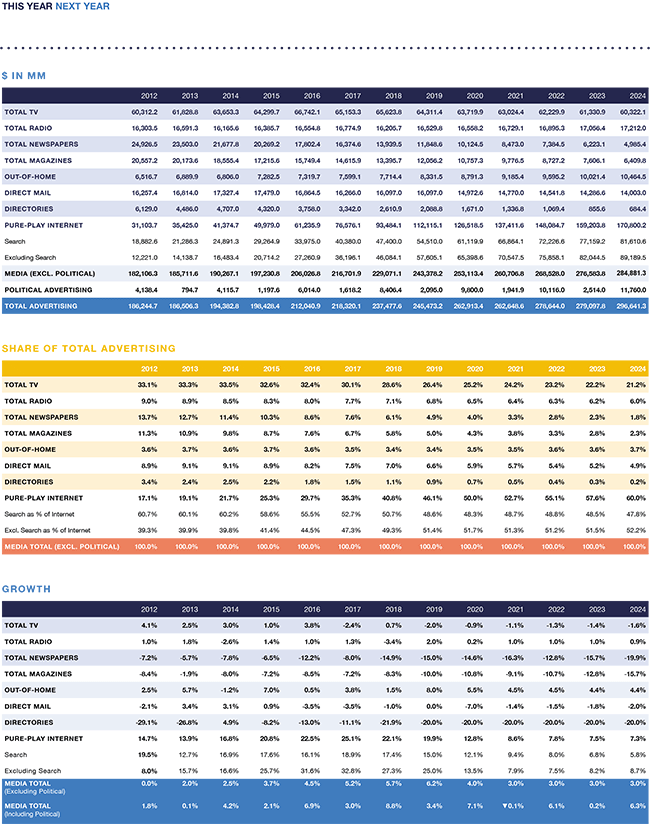
    U.S. advertising will grow +6.2% in 2019 to $244 billion. This will mark a fourth consecutive year of solid mid-single-digit growth for the industry on an underlying basis. Taking out directories and direct mail makes the health of the industry look even stronger, with a +7.6% underlying growth rate for 2019, although including political advertising in all years brings growth down a few notches to +3.8% all in. However we look at it, growth has been robust relative to the general economy, which is generally decelerating on an underlying basis.

    2020 still looks solid; we are forecasting +4.0% growth next year. We expect some softening next year as the economy reverts toward normalcy after a period of growth likely supported by factors including the 2017 domestic tax cut, an expanding federal deficit and low interest rates. As the effects of these fade, heightened trade barriers should concurrently become a drag on the overall economy. The 2020 Olympics also likely provide some marginal benefits, although we note that it can be difficult to identify the degree to which Olympic activity captures spending that would already have occurred or if it causes incremental spending to flow into the advertising market.

    In more tangible terms, the key variables driving our model are personal consumption expenditures (PCE) and industrial production (IP), which combined have a solid 0.8 R2 correlation with normalised (excluding political) advertising. PCE will likely decelerate versus 2019 levels, while IP might go slightly negative. Using these inputs without adjustment would yield a zero-growth domestic advertising market next year, although it would be hard to imagine a three to four percent nominal GDP/PCE growth economy not producing a similar rate of growth in advertising. Further, we know that a range of factors implicitly not contemplated by our model are holding up advertising growth.
     

    Digital-first marketers are likely driving much of the industry’s recent growth. We have previously written about the emergence of massively scaled digital brand owners whose businesses are endemic to the internet. We can point to Facebook, Amazon, Netflix,Alphabet, eBay, IAC, Uber and Booking.com as eight companies that are likely to spend more than $30 billion on advertising globally this year. Most of this spending will go into their home market, the U.S., adding billions of incremental spending every year into the domestic advertising economy. If we add in the next tier of digital endemics that may not have existed even a decade ago at anything like their current scale—think Wayfair, Chewy.com or any of the dozens of other digitally oriented companies spending hundreds of millions of dollars on advertising annually at this point in time—it’s not hard to imagine additional percentage points of growth emerging from these types of marketers.

    Such rapid growth from these marketers as we have seen in recent years should abate, and eventually they should normalise their growth rates. This would contribute to industry-wide ad spend deceleration. However, the U.S. is more likely to produce more of these kinds of marketers in years ahead than are most other economies, and so there is some reason for a degree of optimism around these figures. For example, we expect the new and existing streaming video services to account for multiple billions of dollars in domestic advertising spending by the time these services are all operating at scale.

    Overall, our best “feel” for the advertising market is to forecast a lower growth rate beyond 2021, and we incorporate a +3.0% expectation for subsequent years.

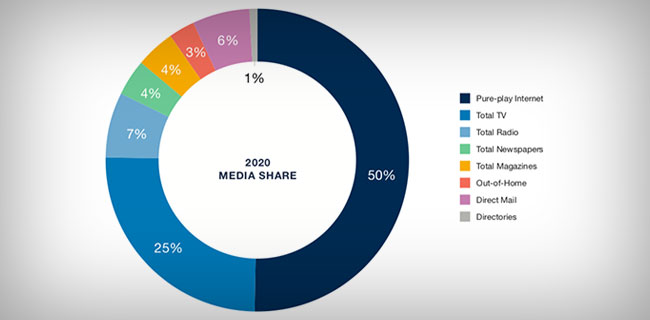
    Advertising revenue to pure-play internet-based companies should grow by double digits next year to reach $127 billion in revenue, representing a 50% share of industry revenue. We forecast digital pure-play media (i.e., excluding digital revenues associated with traditional media owners) will end 2019 with a +20% increase. Growth is still expected to be resilient next year, rising by +13% in our forecast and accounting for 50% of all media we track here. There is undoubtedly still room to grow. We can certainly point to other developed economies that currently see digital advertising accounting for higher shares of industry-wide spending, but we think the aforementioned digital endemic marketers will increasingly replace traditional companies that came before them. As those marketers necessarily skew their spending toward digital advertising, spending shares shift in the aggregate toward digital media.

    TV advertising is soft as we close 2019 and will end the year with a -7.0% decline (-2.0% excl. political), falling to $65 billion in ad revenue. Of course, many of the digital-first brands we’ve been discussing will also spend on traditional media, especially television. While defining a “digital brand” is highly subjective, those marketers are undoubtedly making up for most of the cuts in spending that other marketers appear to be making. Excluding political, underlying television advertising is trending toward a low-single-digit reduction during 2019. National TV advertising will be closer to zero, or even up very slightly, while local is down by low-single-digits. We expect this declining trend to persist, even with new forms of premium TV advertising regularly emerging. Certainly the ad-supported SVOD services will be attractive environments and their enhanced targeting capabilities will also appeal to advertisers. They will partially offset the ongoing erosion of traditional TV’s reach and frequency, but the core set of advertisers that have historically driven TV spending are likely to reduce the budgets they allocate to the medium.

    Outdoor should be the fastest growing “traditional” medium, up by +8.0% to reach $8.3 billion. Among other media, outdoor remains a standout for its capacity to sustain growth. This is supported by ongoing innovation, especially in digital out-of-home and OOH’s relatively unique capacity to generate, capture and sustain attention. These advantages are more apparent to many marketers as traditional television continues to weaken. Digital formats are increasingly important, now accounting for half of spending on OOH, with further share gains still to come especially as more automation takes root, including the emergence of performance-based targeting and data-driven trading. At a category level, digital brands and luxury marketers have provided the industry’s recent boost, and much of this has been concentrated in the largest urban markets. These factors have enabled the medium to grow by +8.0% this year, a level that is not likely to be sustained. We expect more modest +4.0 to +5.0% growth levels over each of the next five years. Notably, this represents a gradual increase in the share of spending in the overall advertising economy, which presently amounts to 3.4%.

    Radio is likely to be flat going forward. Radio appears set to hold on to its revenue base this year and is not likely to grow by much any time soon. While there is growing interest in the medium from national advertisers—especially supported by the likes of Pandora and Spotify as well as the emerging category of podcasting—the traditional base of geographically constrained advertisers that should be optimally positioned to support locally oriented media like radio has weakened over time.

    Print will continue to be weak, although it retains value as a niche medium. Unsurprisingly and despite improvements in measurement and its capacity to engage deeply with consumers, overall, the medium is still set to decline on an ongoing basis. Double-digit declines are likely to persist for newspapers and magazines, even including digital extensions. Directories will likely look worse, with -20% or greater declines going forward. By declining in only low single digits, direct mail looks somewhat more positive.

    U.S. political fundraising is approaching $16–20 billion for 2020; political advertising is expected to be $10 billion or more. So far, our forecasts have excluded politics from media spending because the scale of such activity meaningfully distorts year-over-year growth trends. Disclosures from the Federal Election Commission (FEC) covering the first half of 2019 indicate that total federal election fundraising was approximately $2 billion, up around +45% versus 2018 levels and +46% versus 2016 levels. During the prior two-year cycle, the first half-year accounted for only 15% of fundraising, and during the two-year cycle before that, the first half accounted for 16%. This indicates that fundraising through the end of 2020 will exceed $10 billion and could approach $12 billion for federal races, of which somewhere between 60–70% ($7–8 billion) would likely be disbursed during 2020. Local, nonfederal races are tracked separately and via different sources, but data from FollowTheMoney.org indicates that in 2018, there was a total of $8.7 billion in fundraising during that calendar year alone. Assuming that number rises next year, we could expect $16–20 billion in total political spending on all activities in the U.S. in 2020.

    How much of this will turn into media spending? Our understanding is that in a typical campaign, 60% of funds raised may be deployed into media spending, which would translate into $9.6–12 billion in total activity during 2020, which places our $9.8 billion estimate on the low end of this range. Consequently, we recognise that the current political cycle could lead to higher levels of spending than we currently incorporate into our forecast. As our estimates currently stand, and including political advertising in all years, we forecast 2020 advertising growth of +7.1% on a broadly defined basis (including directories and direct mail) or +8.1% on a narrowly defined basis (excluding directories and direct mail).

    Media is a means to an end; the marketer’s goal should be to optimise the mix of external and internal resources available to drive business growth. Putting all of this into some context, we are mindful that marketers can look at the data included here to gain a sense of the health of their media partners now and over the next several years. However, even a media owner in decline may still be investing in new and better ways to connect with audiences. At the same time, other media owners may be healthy in terms of revenue growth but may be neglecting to invest in everything they can to make their ad inventory more effective. As marketers continue to view media as a means to an end, investments in internal marketing infrastructure, marketing technology software and external services are among the other ways to support marketing excellence. We encourage marketers to put processes in place to optimise the balance between all of these elements. This will ultimately be more impactful than the choice to invest or stay away from any one type of media as it grows or declines in the years ahead.


  • Publicis Commerce forays into India; appoints key leadership

    By A Correspondent


    Kartik G Iyer

    Publicis Commerce has announced its expansion into India and the appointment of two new leaders in the market. Kartik G Iyer joins as Publicis Commerce Lead and Krishna Mothey joins him as Head Of Media for the Practice.


     

    In addition to India, both Iyer and Mothey will also oversee the Commerce capability within Publicis Media’s Global Distributed Delivery (GDD) offering – a centre of expertise based out of India that delivers robust capability to clients around the globe.


    Anupriya Acharya

    Said Anupriya Acharya, CEO of Publicis Media India: “As Commerce becomes mainstream for clients in India, it is the right time for us to further advance our global commerce offering here. We find there is a great demand for these services in the market both within our client sets and outside. Our strength in digital and performance marketing gives us a natural edge in scaling the global Commerce Practice. Both Kartik and Krishna come with immense brand experience and category expertise and are a tremendous boost to our capabilities.”


  • Nestlé partners with media entities to create inspiring brand narratives

    By A Correspondent


    Nestlé is partnering with India’s top media companies to produce inventive and creative brand solutions, through a first-of-its-kind initiative called Media Hive. Some of the big-league media and entertainment firms that participated in the Media Hive included Times Of India, Star, Zee, Viacom18, The Hindu, Big FM, Radio City and Arre.


    The focus was on immersive solutions that put media as the centre-piece of communications. This landmark initiative was the collaborative effort of Zenith & Nestlé.


    As many as 19 briefs came from Nestlé brands such as KitKat, Maggi, Munch, Polo, Nescafe, Milkmaid, Ceregro, Milky Bar etc to 42 media partners. Around, 354 ideas were generated in total. The Nestlé brand teams, after careful consideration shortlisted 72 ideas which were presented at the Media Hive event in New Delhi.


    Media Hive included the top leadership of Nestlé and Publicis Media. The inaugural address was by Suresh Narayanan, Chairman and Managing Director of Nestlé.


    Said Rashi Goel, Director Communications at Nestlé: “Nestlé was looking for inspiring media narratives for its brands that go far beyond the 30-seconder. Through Media Hive, we have paved the way for a new era of moving, compelling and evocative brand experiences which captivate and involve consumers. The powerful ideas generated in the Media Hive, will bring alive our brands in subtle yet, engaging ways. This is an entirely new approach to energising our brand stories and we thank Zenith for this very successful partnership.”


    Added Tanmay Mohanty, Group CEO at Zenith India & Head Of Global Partnerships at Publicis Media India: “Attention is a scarce resource today. In this context, there is a real need for enriching, long-lasting media experiences. Efforts that appeal to people’s emotional sensibilities. Media Hive brought many such striking, impactful ideas to the fore where brands can be introduced in non-intrusive ways. Though Media Hive, we are also to trying to evolve and grow the larger eco-system.”


  • Publicis Media appoints Anil Pandit as Programmatic Head

    By A Correspondent


    Publicis Media India appointed Anil Pandit as Head of its Programmatic Practice.


    Anil Pandit

    Pandit is tasked with accelerating the growth of Publicis Media’s programmatic capability across the agencies. He will oversee the central programmatic team – providing agency teams access to expert data, technology capabilities and solutions – that will deliver superior client value through greater effectiveness and media efficiency. He will also work with the global team to bring in the full Precision capabilities to India.


    Anupriya Acharya

    Said Anupriya Acharya, CEO Publicis Media India on his appointment: “We couldn’t be more thrilled to have Anil’s expertise and leadership in this crucial role as we focus on further consolidating our overall programmatic presence and bringing in PM Precision capability to India. Our group has been a pioneer in programmatic and with Anil’s leadership, we will look to fast- forward the full launch of the Precision capability in the market. Maintaining our competitive advantage on all aspects of digital and ensuring that we continue to deliver best-in-class capabilities and growth for our clients is key to our continued success.”


    Added Pandit: “Programmatic is witnessing a phenomenal rise both in India and globally. About a third of India’s ad inventory is already programmatically traded. I’m excited to get this mandate of expanding PM’s central capabilities in future platform innovation, audience strategy, data consulting and precision excellence. I would like to bring into my role, sharp client lens coupled with operational ad -tech experience and look forward to collaborating with our agencies and marketplace partners to deliver faster and more scalable impact for our clients.”


  • Publicis Media aligns Convonix & Resultrix under Performics. Tanmay Mohanty to take on additional role

    By A Correspondent


    Pallav Jain
    Sarfaraz Khimani

    Publicis Media India today announced the alignment of Convonix and Resultrix under the Performics brand. This, notes a communique, firmly establishes Performics as the largest performance marketing offering in the country by far and is in line with Publicis Media’s market-leading presence and ambitions in the areas of digital marketing, data, tech and analytics.


    Pallav Jain and Sarfaraz Khimani will serve as Co-CEOs of Performics India and will report into the Publicis Media India CEO Anupriya Acharya.


    Tanmay Mohanty

    Meanwhile, Publicis Media has also announced a new Head of Global Partnerships role for India. Tanmay Mohanty will take over this new role in addition to his current role of Zenith India Group CEO. In this role, Mohanty will bring in a “more strategic and holistic approach to global partnerships in India and ensure greater Groupe and client connectivity with partners such as Google, Facebook, Adobe and Microsoft amongst others”.


    Anupriya Acharya

    Said Anupriya Acharya, Publicis Media India CEO: “We stand at an important growth juncture and it is imperative that we put accelerated focus on next-frontier areas in marketing communications like machine learning, artificial intelligence, consulting, automation and the like.  The current changes reflect our endeavor to create a compelling offering with an effective structure that supports evolving client needs. Pallav and Sarfaraz have driven spectacular growth for Convonix from an entrepreneurial start-up to a scaled organisation, across India and in multiple market mandates including US, UK and Asia-Pacific and bring in expertise on innovative solutions around talent acquisition and talent management at scale. It makes them the ideal choice for leading Performics India. Tanmay Mohanty is a proven leader with a successful track-record of accomplishment of leading in the digital first space and then bringing that thinking to the larger integrated media space. He has brought in value and substance to every client conversation across Zenith and Resultrix. I am sure with his strong product focus and client need-gap understanding, he will shape our global partnerships in India well.”