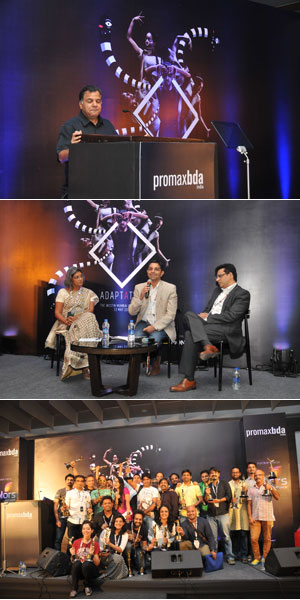
Tag: PromaxBDA

  • PromaxBDA & IRF appoint Moe’s Art as communications partner


    PromaxBDA India and India Radio Forum Awards 2018 has announced its partnership with Moe’s Art. Moe’s Art will be fulfilling its mandate as a Communication Partner for the fourth consecutive year with PromaxBDA and for the second year in a row with India Radio Forum.


    Commenting on the association, Rajika Mittra, Country Head (India, Hong Kong and Philippines) – PromaxBDA said: “We have a long-standing association with Moe’s Art for these events and it has always been a great experience working with them. We are happy to have them as our ‘Communication Partner’ for the 2018 edition as well. We are extremely happy to continue our mission of leading the global community of marketers and creatives in the media & entertainment industry and connecting the community.”


    Speaking about the association, Mayank Sen, Co-Founder, Moe’s Art said: “We are honoured to be associated with the prestigious PromaxBDA and India Radio Forum properties once again, with our continued association, we hope to up the ante in helping them create an immersive experience for the audience and media alike. With each passing edition of this event our learnings will surely help us to provide the properties with a 360 degree, holistic approach.”


    PromaxBDA India will be held on May 22 and 23 in Mumbai, while India Radio Forum will be held on May 18 in Gurugram.


  • Puja Vohra and Glenn Urquhart to speak at Masterclass session at PromaxBDA

    By A Correspondent


    PromaxBDA India has announced its first two Masterclass speakers for the 15th edition of its annual conference and awards property in India, which will take place in Mumbai on May 23, 2018. Speaking at the Masterclass are truTV’s Puja Vohra and creative mastermind Glenn Urquhart.


    Puja Vohra

    As Executive Vice-President for Marketing and Digital of truTV, Puja Vohra is responsible for creating and implementing some of the channel’s most innovative campaigns that were successful in expanding the truTV brand. Vohra has also effectively launched several shows such as The Glee project, Project Runway, Top Chef and The Real Housewives franchise, during her stint with Oxygen Media and Bravo Media.


    Glenn Urquhart

    On the other hand, Glenn Urquhart comes with experience in copywriting, direction, music production, journalism and commercials. As ex-creative director at Foxtel, he created some awarded works in Australian television promotion with launches for Grand Designs Australia and Embarrassing Bodies Down Under. He also positioned The Lifestyle Channel’s Australia multi-platform brand as the country’s first totally modular, infinite colour trend-led branding design system.


  • Rishtey Cineplex bags Gold for Best Channel On-Air Branding at Global PromaxBDA

    By A Correspondent


    Rishtey Cineplex, Viacom18’s Hindi movie channel, has been awarded a Gold at the 2017 PromaxBDA Global Excellence Promotion, Marketing and Design Awards held in Los Angeles on June 8. It bagged the Gold for the Best Channel Image On-Air Branding in the category of Total Package Channel Image – On-Air Only (Art Direction and Design).


    The design objective of Rishtey Cineplex was to create a branding that is active yet non-intrusive.


    Created in collaboration with New Zealand-based visual artist and designer David Frearson who introduced the idea of simply using a bulb and the team then translated the simplicity and beauty of this idea throughout the branding and communication. In addition to the Gold for Rishtey Cineplex, Viacom18 has bagged six other metals including two Golds and three Silvers.

  • The importance of Emotions


    It’s not enough to find a message that resonates with your customer, or tap into universal feelings and experiences to sell something. If your product isn’t good enough or competitively priced, the message will never hit home. That’s what Graeme Newell, President of 602 Communications and a customer loyalty expert who shows organisations how to build deeper, more passionate relationships with their customers, tells Anuka Roy, on the sidelines of recent PromaxBDA conference in Mumbai.


    So what exactly is emotional marketing?

    Emotional Marketing is moving beyond mere product features, and attributing those products with a deeper emotional resonance that really touches something that is in all people. Those universal emotions which all of us feel, for ourselves and each other, those are the most powerful drivers. The instinctual things that were built thousands of years ago — when we cared for each other, when we were bold and adventurous — those are the things that help a species survive. By being able to tap into those natural things that we all feel, we can give very standard products deep emotional meaning. It is also almost like turning a product in to a person.


    You are an expert on customer loyalty and your advice to organisations is deeper emotional connect with customers. But isn’t that what marketing is all about?

    It is, and it is about taking it to the next level. My company researches very specific customer groups and on the network side, we get the best loyal and new customers they hope to grab. We do not ask them how they like the network, but we ask them about how they feel about themselves, the things they worry about and hope for, and then we build the programming — the shows, the marketing, promotions and advertising around those deeply resonant things that those audiences are predisposed to feeling about themselves. If we can make that average content into something that has deep emotional resonance, people will come to our channel first. For me, when HBO comes out with a new series, because I have a deep attachment to HBO, I am totally ready to give that show a try. It is because of the experience and emotional feeling.


    How important are emotions in modern marketing, when people have no time?

    It’s a balance because you have to make sure you have good product features. In any category — whether cars, soaps or shows — if you have bad programming, no matter how emotional you are, you will not watch bad shows. I have a good product and I have to make sure that is there. And if you do not have that, then you have to work on it. It’s an idea that we call warmth and competence. You’ve got to have competence when you come in. In the television category, there are a tremendous number of competent networks. There are a million choices for dramas, comedies, sports and such. The only way I am going to give another network a try is if they, first, have proven that they have got basic competence. But aside from that, once you achieve that level, it goes to the next level, which is about affinity to that product, the idea that ‘I truly believe this network gets me’.


    Would you say that with the advent of social media and a digitally-driven society, the work of emotional marketers has become easier?

    It has. What that has enabled us to do is have a direct connection with our customers like never before, prove to them that we are listening to them, and get two-way feedback. But I think a lot of marketers misunderstand social media and are still treating it as advertising platform. It is an amazing opportunity to show what we stand for. It is a delicate mix and we have to make sure that we use social media responsibly, but it has never been easier or more powerful than it is now. Getting people, particularly loyalists, to hang with us, provides amazing opportunities for us to hyper-serve those loyalists.


    You mentioned the fact that people name-drop brands to impress others. How much of that is prevalent in a place like India where people are sensitive to prices?

    It does not matter how emotional you are if you do not have a good price point or a good product. Apple is trying hard to get into India right now, and it’s having a hard time because of its price point. What they are trying to do is to get that price point down by selling used phones and allowing people to have much better prices. It is always going to be a combination of that. Again, it is that warmth and competence idea. If you’ve got a high-priced product, I do not care how nice you are, I am not buying it. It really comes down to whether people have more time or money. In India, it is much more about time. People are willing to watch a few more commercials if they are able to save a few rupees.


    How far does emotional marketing work in the Indian context?

    You are an incredibly passionate community here. I think more than any other country in the world, the opportunity here is endless. But the concept of emotional marketing has really not been explored here. That is the next step. So much of what we have done so far has been proving basic competence. We have got good shows, line-ups, new dramas. The quality of programming is progressing rapidly here. There is an amazing, new number of networks, shows, and just introducing people to this is a pretty big job. The plot — that has to come first. Emotional marketing tends to work best on more mature products, and you have got a lot of young and a very upstart products that have a lot of explaining to do about just what they are. The first step would be to build a base around those product features. That is a solid plan where you clearly understand what the emotional derivers are for your audiences. Some networks still do not do that. My company does that as a first step. Typically, networks come in, get a programming and head out and then they figure out the emotional part of it, quite late. So, most of the time, we end up guessing what that emotion is. We do not have quality research or data that backs it up. This is what I call the ‘golden gut’ marketing. The idea that ‘I know my audience better than anybody and I know what they want’, as opposed to talking to them in a very real way. It is really about listening to your audience.


    This interview first appeared in dna of brands on May 16, 2016

     

  • Zee, MSM steal spotlight at PromaxBDA Awards 2015

    By Dyanne Coelho


    Zee and MSM walked away with 14 and 13 awards respectively at the PromaxBDA India awards held on Wednesday. Awards across 37 different categories were were presented with Star India coming in third with 10 awards and UTV Entertainment Television Limited and NGC Network won 8 awards each. While Zee bagged 9 Gold and 5 Silver Awards, MSM won 6 Gold and 7 Silver Awards. In all, 31 gold and 31 silver MUSE trophies and six gold and six silver ISIS trophies were awarded.


    Earlier, the 12th edition of PromaxBDA India kicked off at the Westin, Mumbai with an opening address by Conference Chair and Colors CEO Raj Nayak. “Short form storytelling has come of age,” he said, “The viewer today has evolved. It’s up to you to catch them head on.”


    David Shing, Digital Prophet, AOL began the morning session on an energetic note talking about the various futuristic ideas that are revolutionizing the world. “Personal experience is the new form of entertainment,” he said. Shing highlighted the word ‘Pizzled’ which is a combination of the words pissed and puzzled to describe the feeling a person gets when the person he/she is talking to is constantly busy on the phone during a conversation. “There is an information overload today and bad ads are the uninvited guests to the party.” Shing spent the most part of his talk discussing smart objects like a ring that switches on your television when you write TV in mid-air while wearing it or the same with your fan. Smart objects like the Power Suit, doesn’t require you to carry a wallet around, you merely move the tip of your coat sleeve over the billing machine and your meal is paid for, Shing explained pointing out that we would never see influential persons like President Barack Obama walking around with a wallet. “The new generation is who we should give a shit about,” Shing said, explaining that they are the ones who will be the users of these products in the future. It is all about engaging people in the calm and the chaos, he said.


    Nicole Velik of The Ideas Bodega followed, opening with a line that left everyone a little puzzled. “Creativity is everyone’s business,” she said. She went on to explain how once at her workplace, the creative team invited all the other teams; HR, Admin, finance, etc to join them in their brainstorming session, and some amazing ideas popped up. Creativity diminishes as age increases, she pointed out highlighting a few statistics, and it is most often an influential person like a teacher or a parent that kills some part of your creative self by telling you seemingly harmless things like draw within the lines, she said. “When all else fails, role-play,” she said. It helps to thoroughly understand the brand you are trying to sell. Come up with ideas that will get you fired and then pull those ideas back into reality, she advised. “It is much better to tame a wild idea, than to make a boring idea great.”


    Liz Dunning of Dunning Penney Jones shared stories of branding across the globe. America doesn’t like foreigners buying into their brands and companies, she said. Europe on the other hand is facing a major invasion by China, as a multitude of Chinese manufacturers are buying into European brands. “Indians sometimes take over a foreign brand and handle it way better than the home country ever could,” she said pointing out India’s vast growth in the industry. American brands are failing because they are not ready to spend, she pointed out. You have to spend on your product and on advertising and branding to make it a success. She cited the example of Cartoon Network and its sister channel Boomerang highlighting how each has a very different approach to branding, yet when you see the advertisements for either you will know they are connected.


    The post-lunch session of the day saw two panel discussions. The first one was titled, The Shift: Exploring new demographics, audiences and mind sets. Rajiv Bakshi, VP-Marketing, Discovery Networks, Asia Pacific, South Asia and Ajay Vidyasagar, Regional Director, APAC, Youtube Partnerships, Google were the participants of this discussion. It was moderated by Meenakshi Menon, Spatial Access. The session highlighted key aspects of the digital versus the television medium. The speakers shared relevant insights into each, including costing of content creation, consistency in programming, audience response, advertising, revenue streams and the growth of technology. “If you can bring consumers to have the conversations that you want them to have, then it is a job well done, whether on the internet space or on a TV set,” Menon said, concluding debate one.


    The next debate concentrated on the art of making a pitch to a client. ‘Pitch Therapy: A two-way conversation about the challenges of engagement’ was the topic of discussion which saw four participants; Kartik Sharma, MD, Maxus, South Asia, Paritosh Painter, Network Creative Director, Reliance Broadcast Network, Abhijit Joshi a former Ogilvy employee and Namit Sharma a former Zee employee. During the due course of this session  moderated by Tarun Katial, CEO, Reliance Broadcast Network, pointers on what to do and what not to do during a pitch were discussed. Know what your client wants, have a conviction and transfer that conviction to your client and believe in your pitch is what was unanimously agreed upon. “You have to sell your idea in the first 20 seconds,” Painter said. Pitching an idea is just like wooing your boyfriend or girlfriend, Joshi added.