Tag: Prithviraj Chavan

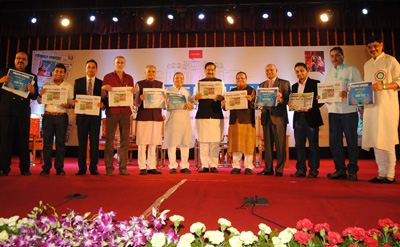
  • ‘HT for Mumbai Awards 2013’ awards changemakers

    By A Correspondent


    We should’ve carried this report Hindustan Times on Monday, the first edition after the awards happened on Friday, November 22, so our apologies to our readers. It’s one of those events which gladdened our hearts and worth the wait. It was a no-nonsense event. The chief guest, Chief Minister Prithviraj Chavan, entered the venue premises much ahead of the scheduled time of start. An emcee kicked off the proceeds, the Mumbai editor Soumya Bhattacharya spoke a bit, the speech short and sober, as the occasion demanded.


    There was just one av promo of the paper and then the six awards were given away. Very short speeches again by the winners and by the CM Prithviraj Chavan. Mr Chavan left soon after the awards and when a panel discussion on the topic ‘Giving back to Mumbai’ started.


    According to a communiqué, HT for Mumbai Awards recognized and rewarded people and organizations who share a passion for change by giving back to the city of Mumbai, and making it a better place to live in (www.htformumbaiawards.com). The inaugural edition of the awards saw an eminent jury: Dr Aroon Tikekar (distinguished historian and former editor), Chandra Iyengar, an IAS officer, Rahul Bose (actor, director, sportsman) apart from , HT’s Special Projects editor Smruti Koppikar and Mr Bhattacharya.


    The winners in the Individual Category were Kishore Bhatt, Pankaj Joshi and Sunjoy Monga, whereas the winners in the Organization category were Majlis, LEARN and Akhsara. There was a Popular Choice Award category too where the winners were selected by voting via SMS and a digital microsite. The Lifetime achievement award was awarded to the noted historian and author, the Late Sharada Dwivedi.


    Our view: excellent event. We think the ‘HT for Mumbai’ awards evening should be conducted on a bigger scale next year. It should be promoted on television like various other ‘awards’ are so that it motivates more citizens and organizations to turn changemakers. There could be an award for corporates doing great work in an effort to encourage them to take up work for the community. And while it’s a healthy sign that the event happened without seniors from Delhi (Nitin Chaudhry, Business Head – West and team were of course present), it would be seen as a huge commitment to Mumbai and the Mumbai edition if the big bosses from Delhi were also in attendance.


  • The Hindu enters Mumbai via student edition

    By A Correspondent


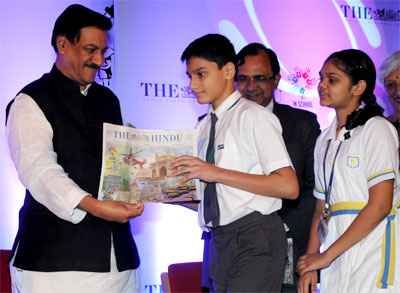
    National daily The Hindu does not have an edition from Mumbai, but its student edition made an entry with a launch by the state chief minister Prithviraj Chavan last Thursday (Aug 8).


    Speaking at the launch, Mr Chavan expressed pleasure with the entry of The Hindu in Mumbai, “even if in this small way”. “Quality of education is a big challenge that our country and this State is facing. Natural resources will not last long enough to keep us running as a major economic entity. The only way to continue as a rich and powerful country is by developing the knowledge economy and for this, quality of education is very important,” he said.


    Siddarth Varadarajan, Editor, The Hindu, said younger readers had different interests. The school edition would remain true to the idea of The Hindu, and would explain things in a language a young audience could understand. He said that the school edition would not talk down to its young audience. It would have all the important news that goes into a regular edition but conveyed in an appropriate manner.


    Educationist Nandini Sardesai, J.N. Mishra, Deputy Managing Director of State Bank of India and P.S. Venkatasubramanian, Vice-President, Circulation, The Hindu Group, were also present.


    Priced at Rs 3, The Hindu in School is published from Monday to Friday and is designed for students in Classes 8-10. According to a communique, it is distributed to over 2,500 schools across India, with a circulation of around two lakh copies. The edition will also be launched next in Kolkata by August-end. In Mumbai, complimentary copies will be available in schools for the first week. Interested schools may contact vaidyanathan.n@thehindu.co.in.


  • Lokmat Samachar’s Pune edition launched

    By A Correspondent


    Maharashtra’s Chief Minister Prithviraj Chavan launched the sixth edition of the popular Hindi daily, Lokmat Samachar in Pune. Also present on the occasion were Minister of State for Education Rajendra Darda along with media luminaries Balbir Punj (senior columnist and RS MP from Rajasthan), Prabhu Chawla (Editor-in-Chief – The New Indian Express), Tarun Tejpal (Editor-in-Chief, Tehelka.com) and Vijay Darda, Rajya Sabha MP and Chairman of Lokmat Media Pvt Ltd.


    “Lokmat Samachar will enhance the quality of life in Pune and will make it more cosmopolitan,” said Chief Minister Chavan at the launch ceremony.


    A panel discussion on “The Relationship between Media and Politicians” was organized to mark the launch. “A journalist is also a politician. Not only should the media help in shaping public opinion, it should also play a critical part in the development of the political process,” the CM observed.


    Senior journalists and editors Mr Chawla, Mr Tejpal and Mr Punj highlighted the increasing complexities of the media world, and the need to maintain a balance in giving coverage and direction.


    “Media is a fish that lives in the vast ocean of democracy,” said Mr Punj. “Hence strengthening the media will result in the strengthening of democracy.”


    Highlighting the sharp difference between the cover prices of newspapers in India and abroad, Mr Tejpal pointed out that the readers India are not willing to pay enough money to run these institutions. “This is the structural flaw due to which quality deteriorates,” he said.


    Mr Chawla decried the increasing incidences of ‘paid news’ inserted by politicians, due to which media is facing a credibility crisis. “Media has become a victim of this phenomenon,” he maintained.


    Speaking about the Pune edition of Lokmat Samachar Rishi Darda, Joint Managing Director – Lokmat Media Pvt Ltd, said: “The Hindi-speaking population of Pune, which has emerged as an education hub and IT city, was in need of a national daily. Since Hindi is our national language and therefore connects people throughout the country, Lokmat Samachar would definitely fill the gap.”


    The newspaper offering consists of the main paper of 12 pages along with a 4 pager Apna Pune that will detail the local civic issues and also leisure options for the Puneites. For You for the young, Sakhi for Women and Lokarang Sunday supplement will accompany the paper on 3 different days in a week.


    This is the sixth edition of the popular newspaper which first appeared in 1989 in Nagpur, and was thereafter launched in Aurangabad, Akola, Kolhapur and Jalgaon in that order. Lokmat Samachar has 13.56 lakh readers as per IRS 2012 Q1 AIR


    Its Pune edition has a cover price of Rs3 plus an attractive subscription scheme.


  • Counting on digital to be M&E’s trailblazer


    @FF12: Day 1: Digital attracts ‘desirable’ status
    on Day1
    @FF12: Day 2: Seamless blending with traditional mediums – a big want!
    @FF12: Day 3: Industry expects thoughts to lead to pertinent actions
    @FF12: Takeaways: Digitization rules the roost @FICCI Frames 2012

    By A Correspondent


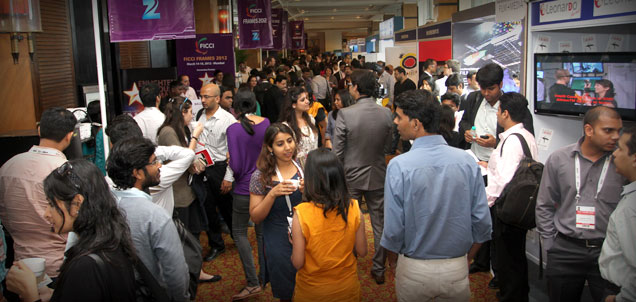
    Those familiar with the going-ons at FICCI Frames would testify how an infatuation gets displayed by delegates at the event each year so as to summarise the mood of the convention even before it broadly takes off across the three days that it is entitled to. But probably, the setting was a bit different this time around when the delegates – joined in unison by the media – were running ballroom to ballroom trying to ingest giveaways that were being thrown up abundantly across several sessions. May be, it was a year where each day had something new to offer to the delegates that kept them at tenterhooks throughout the 3-day event. And going by the loud decibels that were being emanated across every nook and corner of the venue, it was evidently clear that there was some motivating factor that was driving the gathering to go on an overdrive spree.


    The organisers of FICCI Frames 2012 have every right to take credit for coming up with a theme around a medium that attracted the attention of one and all. Having kept it on the sidelines till last year, digital was finally given its due at the convention as experts, authorities and enthusiastic youngsters came face to face to deliberate and come up with outcomes that would redefine the way the consumers consume the medium. From television to print to films and even radio, digitisation and the benefits and effects it would cast on these sectors were discussed in length at the venue. In fact Star India CEO Uday Shankar in his keynote address didn’t hesitate in thanking the FICCI committee for putting across a theme that would go on to redefine the way the industry functions in the future.


    What was apparently clear through the various sessions at the convention is that with the nearing of date for total digitisation across key metros by June 30 2012, and then across the country by 2014, broadcasters had to relook their distribution and content provision models so as to keep the consumer at the heart of every shift that will transpire in the future. Emphasising on the current digitisation scenario in the country, Mr Shankar said, “Most of the discussions that I have participated in are still around whether digitization will happen and if it indeed were to go through, how chaotic it would be. But all these are meaningless discussions triggered by a bunch of retrograde interests who are living in denial.” According to Mr Shankar, digitisation of distribution is a big reality and the 40-45 million homes that have bought DTH boxes at some point or the other are a conclusive evidence of that.


    Shooting back at critics who had doubted whether the makeover to digital would ever be a reality, Mr Shankar said, “To the critics and the cynics who are still wondering whether digitization would happen, my answer is: Look around, it is already happening and the rest of it is bound to happen because even in this country it would be difficult to undo such a momentous shift. To those who wonder how chaotic it would be, my response is that there would be some chaos, but chaos is not necessarily bad if the alternative is status quo or regression. When a transition at such a scale is happening that affects the illegitimate but strong vested interest in certain pockets, then there is an incentive to put up with chaos in the interest of the larger social objectives.”


    A broader outlook was provided by a few panellists who said that digitization will come in as a relief for broadcasters who will be benefitted from additional subscription revenue, relaxation on paying heavy carriage fees, and of course providing viewers with a superior content experience – MSOs and cable operators have to quickly respond to the digitization mandate by investing in set-top boxes – the cost that is only possible to recover after four years.


    Sounding off the challenges that digitisation would present for the broadcast sector, Tarun Katial, CEO of Reliance Broadcast Network Ltd said that, “For television, it will be a combination of content as well as marketing. The old model which was a combination of carriage and product, as it stands today, won’t work. The business plan which currently has a very high rate of carriage will obviously see the content taking precedence.” And as for content, it will be niche content that will call the shots for broadcasters as according to experts at the convention, niche isn’t niche any more as all niche channels put together command a share that is equivalent to the share of Hindi GECs and the mass channels, so to say.


    Perhaps the many advantages that digitisation will have on several mediums was rounded off by Vikram Sakhuja, CEO, South Asia, Group M who said, “The inherent power that digital brings along with it is interactivity and its ability to link multiple devices. Also the ability to enhance real-time consumption of content; linked to that is the entire thing about going mobile.” On the roadmap for the industry, Mr Sakhuja said, “I think integrated media is the best way forward. Today when people think of multimedia planning, they do a separate TV plan, print plan, radio plan, internet plan and so on. I believe that if you actually look at media agnostically and at common metrics of each cost per thousand impressions, these are the ways in which you can construct a media agnostic plan. What it does is, it suddenly gets more money into digital, and when more money can come into digital, that’s when focus is going to come in.”


    While digitisation was the mainstay of every discussion, the all-important issue of regulation too was taken up by panellists who chose to have the government respond to the many queries surrounding the topic. Uday K Varma, I&B Secretary, said that “if people at large seem to be happy with self regulation, I think the government would have no problem in legitimizing them. But I think the self regulation mechanism which has been set up by both the news broadcasters and the entertainment broadcasters, they’ll have to really prove it, not to the government but to the people at large.” He was joined in his cause by Prithviraj Chavan, Chief Minister ofMaharashtrawho said that the challenge would be to adopt the regulatory framework to new technology and ensure that over regulation doesn’t kill a good thing. The Chief Minister emphasised on the need for regulation and suggested that instead of the state regulating the media, the medium should look at regulating itself.


    The other important announcements that came up at the venue included the soon-to-be-passed Copyright Amendment Bill, the roll-out of the imminent phase 3 radio policy that would steer the growth of the medium and increased government aid for the film & entertainment sector.


    New ventures @ FICCI


    BARC takes wings

    In between the many promises and hopes that were being doled out at the sessions came the news of the Indian Broadcasting Foundation (IBF), the Indian Society of Advertisers (ISA) and Advertising Agencies Association of India (AAAI) announcing the official formation of a nationwide audience research joint body — Broadcast Audience Research Council (BARC).

    While IBF will have 60 per cent stake in BARC, ISA and AAAI will each hold 20 per cent stake. The Board of the council will have 10 members, six members from the IBF and two members each from the ISA and AAAI.


    Discovery Kids to flag off ops in April

    Another important announcement was made by President & CEO of Discovery Networks International, Mark Hollinger who announced the launch of its new network for children inIndia, ‘Discovery Kids’. Mr Hollinger said, “Launching in April, the network will initially be available in three languages – Hindi, English and Tamil. The channel will offer children a fun and entertaining way to satisfy their natural curiosity with stimulating and imaginative programming,” he said. The company plans to roll out the channel inPhilippinesandIndonesialater this year.


    Ten Golf tees off

    Taj Television India Pvt Ltd announced the launch of Ten Golf, a dedicated 24-hour golf channel. Ten Golf is the fifth channel from Taj Television India Pvt Ltd and began transmission on March 15, 2012. The dedicated golf channel will showcase a mix of live, non-live and feature programming. The channel will also broadcast live, high quality Golf action from around the world.

    Ten Golf has acquired rights for European Tour and Asian Tour till 2016, and has also entered into partnership with PGTI for three years to telecast the Indian Tour. Further, Ten Golf will be telecasting 400 hrs of golf programming in association with NBC.


  • @FF12: Adapt to the digital tide or be left out

    By A Correspondent


    In keeping with the theme, ‘Embracing the Digital World’, FICCI Frames 2012 got off to a wishful start at Hotel Renaissance, Mumbai on March 14 with a welcome address by the Co-Chair of FICCI Entertainment Committee, Karan Johar. After Mr Johar’s welcome address, Uday Shankar, CEO, Star India & Chairman, FICCI Broadcast Forum, proceeded to present his perspective on the Event and the broadcast industry in general. Making a dash for the core topic of digital, Mr Shankar began by stating, “Digitization is a big reality which will revolutionise the way content (creation and distribution) is offered.” Even though he said that digitisation will create a level playing field for the broadcasters and the cable operators, he had a word of caution to add when he said that his biggest concern was “the chaos which will be caused by the broadcast industry’s inaction”.


    Prithviraj Chavan, Chief Minister of Maharashtra was next and began by assuring how the current era was an “exciting time to be living in”. He said that the challenge would be to adopt the regulatory framework to new technology and ensure that over regulation doesn’t kill a good thing. He also said that the move towards digitization will create a huge employment opportunity but there is a need to explore how technology can empower the field of education. The Chief Minister also touched upon the need for regulation and suggested that instead of the state regulating the media, the medium should look at regulating itself.


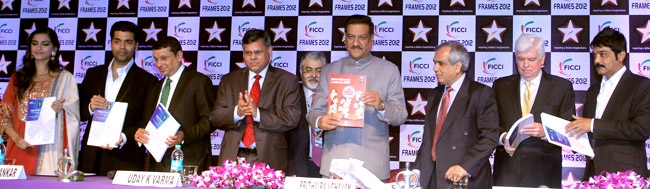
    Following the CM’s speech, the event witnessed the release of the FICCI-KPMG Indian Media and Entertainment Industry Report 2012; FICCI-Amarchand Lawbook and ‘Positivity: The impact of television on India’ by The Indian Broadcasting Foundation.


    Uday K Varma, Secretary, Ministry of I&B, opened his address next by stating that the concerns that the industry had over digitization and the Phase 3 of FM radio have been addressed by the move to allow 839 new FM stations and 500 community radio stations. He stressed that the government is committed to ensuring time bound digitization and said that come July 1, the four metros will switch over to the digital format and the plan is to ensure that the move to digitization is completed by December 31, 2014. He agreed that the challenge was mammoth – to convert 80 million analog connections to digital format, but added that it will ensure faster and deeper penetration. “This will address a plethora of issues facing the television industry, such as addressability, carriage fees, audience measurement and consumer preferences,” he said.


    Punit Goenka, CEO & MD, ZEEL too spoke about the pros and cons of digitization, how the ratings are inadequate and how self regulation was the need of the hour for the broadcast industry. Carolyn Everson, VP, Global Marketing Solutions, Facebook elaborated on how Facebook can benefit the media and entertainment industry and cited examples from music, gaming and films to drive home her point.


    Session highlights:

    Post the promises and pleasantries doled out by committee members and authorities, it was time for some serious discussion which began with a panel debate on ‘Addressable Digitization – The way forward’. Sanjay Gupta, COO – Star India, Sunil Lulla, CEO and MD Times Global Broadcasting, Sameer Manchanda, Founder – DEN Networks and Punit Goenka, MD and CEO, ZEEL comprised the panellists. The panellists agreed that digitization is the way forward and will soon be a reality. Uday K Varma, Secretary – I&B, put the ball in the industry’s court as he said that there were no political opposition to digitization and the parliament too passed the law in December 2011, therefore it is now incumbent upon the industry to make digitization a reality. Sunil Lulla pointed out that the there is greater good in digitization, but the industry has to do a lot of work over the next few years. Sameer Manchanda was of the view that digitization is a reality and that it will bring more number of channels. The session also discussed opportunities and challenges that digitization has to offer and how the industry was gearing for digitization – whether they are ready or not?


    A session on ‘Maximising the power of digital distribution’ saw industry leaders speak about the challenges that come along as the country is experiencing the much talked about shift – from analog to digital cable – the investments that goes into and many such challenges. Industry honchos such as K Jayraman of Hathway Cable and Datacom Ltd, SN Sharma of DEN, Anshuman Misra of Turner, Asia Pacific, Vikram Chandra of NDTV, Jagi Mangat Panda of Ortel, Prof Jonathan Askin, and Anita Wallgren, Government Attorney, US Department of Commerce made up for the panel.


    The panel agreed that while digitization comes in as a relief for broadcasters who will be benefitted from additional subscription revenue the relaxation on paying heavy carriage fees, and of course providing viewers with a superior content experience – MSOs and cable operators have to quickly respond to the digitization mandate by investing in set-top boxes – the cost that is only possible to recover after four years.


    Vikram Chandra talked about the difference digitization makes to the news industry. “Digitisation is important for news players. It is leading players in the news industry into areas they don’t want to be in. In the race of chasing TRPs, people are forgetting that digital has great potential that has to be tapped, a business model which needs to be looked at.” Mr Chandra also mentioned the role of tablets and high-end devices as new distribution platforms.


    Next was a session titled “Financing the Media and Entertainment Business” where the panellists comprised eminent personalities such as Prashant Jain of HDFC Mutual Fund, Mathew Cyriac of Blackstone, Soumo Ganguly of Moxie Entertainment Pvt Ltd and Daniel Dubiecki, Founder and Partner, The Allegiance Theatre, Hollywood.


    Mathew Cyriac started off the session by pointing out that majority of the investments within the media and entertainment industry were made in television and print as they represent a fairly large share  in terms of sheer numbers as against Internet and Radio. The Hindi GECs in TV is typically where a lot of money goes to, followed by regional GECs and sports channel. For print media, it was the regional publications that command a lot of attention as regional advertising is very robust and extracts a lot of profit.


    Prashant Jain pointed out that a lot of companies in India have managed to get good funding and that it is not reflective of the supposedly very, very sorry picture that was being talked about. “It’s not that all of India in the media entertainment space are not attracting funds. Companies like UTV and a few others have attracted investors.”


    In the session on ‘Protecting Copyrights, Infringements & New Trends i.e. Remake’, the panellists chose to rummage over the impediments surrounding copyright issues in the film and music industry in India. The panellists included Sai Krishna from Sai Krishna Associates, Deborah Benattar from the French Embassy, Jagdish Rajpurohit from RCL Motion Pictures, Bertrand Mouiller, former DG IFFPA and Amar Butala from UTV Motion Pictures.


    Sai Krishna provided a hopeful insight as he said, “The industry should take heart in knowing that the Copyright Amendment Bill is currently being debated in the parliament and is expected to be passed after the current Budget Session. There are provisions that can alter the way the entertainment industry functions in India.” But he cautioned that the Bill has its setbacks too, as there are no clear guidelines when it comes to copyright issues between the writer, music composer and the producer of a film.


    Mr Butala added, “We have made huge leaps in terms of legal paperwork with actors and performers where copyright issues are concerned. But it is just the start and the challenge will be to sort out legal issues and take the offenders to Court with the hope of finding a favourable outcome from the judiciary.” The panel proceeded to discuss the trend of moviemakers bagging rights for remaking movies and that there was a need for a law that would streamline procedures for the industry at large.


    Key takeaways:

    – Complete digitization makeover scheduled for December 31, 2014

    – Copyright Amendment Bill to be passed in Parliament soon

    – Digitization will encourage niche and differentiated content

    – Need for media to self-regulate self then wait for a nodal authority to do it

    – Digitization to create more employment opportunities
     

  • @FF12: Opening session weighs pros & cons of digitization


    By A Correspondent


    FICCI Frames 2012, now in its 13th year, kicked off on March 14, Wednesday at Hotel Renaissance, Mumbai. The morning session started with a welcome address from Karan Johar, Co-chair, FICCI Entertainment Committee. After Mr Johar’s welcome address, Uday Shankar, CEO, Star India & Chairman, FICCI Broadcast Forum, took the stage to address the audience.


    In keeping with the theme, ‘Embracing the Digital World’, Mr Shankar said “digitisation is a big reality which will revolutionise the way content (creation and distribution) is offered”. Even though he said that digitisation will create a level playing field for the broadcasters and the cable operators, he had a word of caution to ad when he said that his biggest concern was “the chaos which will be caused by the broadcast industry’s inaction”.


    Mr Shankar was of the opinion that instead of lamenting the loss of carriage fees, the MSOs should appreciate the opportunity of “customisation and localisation of content” being presented by digitisation.


    Though Mr Shankar admitted that there is a need for legislative enablers to remove the bottlenecks, he also said that the broadcast industry is still not ready to move to the digital format. To drive home his point he used the example of the film The Artist, where the star of the silent era films loses out when he refuses to move with times. With this word of caution, Mr Shankar ended his keynote address.


    Prithviraj Chavan, Chief Minister,Maharashtra, next took the stage to talk about the “exciting times that we are living in”. He said that the challenge is to adopt the regulatory framework to the new technology and ensure that over regulation doesn’t kill a good thing. He also said that the move towards digitisation will create a huge employment opportunity. He stressed on the need to balance technology with creativity, adding that “growth should not be lopsided but all inclusive”.


    Shri Chavan also stated that the government is taking all possible steps to ensure that content piracy is curbed but accepted that the state has not delivered on its promises to curb piracy till now.


    He also touched upon the need for regulation and said that regulation is a major challenge. Shri Chavan suggested that instead of the state regulating the media; it should look at self regulation.


    Moving on, Shri Chavan welcomed the foreign delegates and announced that his government was creating new centres for film shooting in the state. He stated that the first such centre will come up atKolhapur, where entrepreneurs would be provided with lots of financial incentives. He said that the government will “protect any creative attempt within the framework and not allow any fascists elements to disrupt it”. He also assured the film industry that its concerns over policing on film locations would be looked into.


    The Chief Minister also released the FICCI-KPMG Indian Media and Entertainment Industry Report 2012; FICCI-Amarchand Lawbook and ‘Positivity: The impact of television on India’ by The Indian Broadcasting Foundation.


    Mr Jehil Thakkar, Head, Media & Entertainment Practises, KPMG made a brief presentation about the highlights of the FICCI-KPMG Indian Media and Entertainment Industry Report 2012.


    Senator Chris Dodd, Chairman, Motion Pictures Association of America, who took the stage next, underlined the need to look into stringent regulations against content theft.  “When content is stolen, 95 per cent of the people who contribute to the vitality and success of a film are adversely affected”, he said. Quoting an Ernst & Young report, he said, movie theft contributes to a loss of US$ 1 billion annually and threatens the jobs of half a million people. He stated thatIndiais among the top 10 nations as far as online copyright infringement is concerned. He said that technology (digitisation) and content need each other and one can’t be without the other.


    Mr Uday K Varma, Secretary, Ministry of I&B, opened his address by stating that the concerns that the industry had over digitisation and the Phase 3 of FM radio have been addressed by the move to allow 839 new FM stations and 500 community radio stations.


    He stressed that the government is committed to ensure time bound digitisation and said that come July 1, the four metros will switch over to the digital format and the plan is to ensure that the move to digitalisation is completed by December 31, 2014. He agreed that the challenge was mammoth- to convert 80 million analog connections to digital format but added that the move will ensure faster and deeper penetration. “This will address a plethora of issues facing the television industry, such as addressability, carriage fees, audience measurement and consumer choice,” he said.


    Mr Varma added that in order to combat piracy, they intend to carry out an all-encompassing multi-media campaign during the 12th five year plan period involving all stakeholders from the film and music industries.


    He also outlined the ministry’s plan to celebrate 100 years of cinema inIndia. Mr Varma said that the Government of India, in cooperation with the film industry, has a line of activities between May 3, 2012 and May 3, 2013. It also proposes to present a tableaux of ‘100 years of Indian Cinema’ at the Republic Day parade next year where the plan is that the stalwarts of the industry also take part.


    Mr Varma also announced that the government is setting up a National Film Heritage Mission to safeguard India’s celluloid history by undertaking picture and sound restoration of more than 2,500 films. In Addition, theMission, with a budget of over Rs500 crore, would also look at constructing preservation vaults for archiving restored material, and for conducting workshops and training.


    The session closed after a vote of thanks given by Dr. Rajiv Kumar, Secretary General, FICCI.