By Shruti Pushkarna
| [youtube width=”350″ height=”200″]http://www.youtube.com/watch?v=2RilcOb3GrQ[/youtube] |
| [youtube width=”350″ height=”200″]http://www.youtube.com/watch?v=PdgXFlJ8g1g[/youtube] |
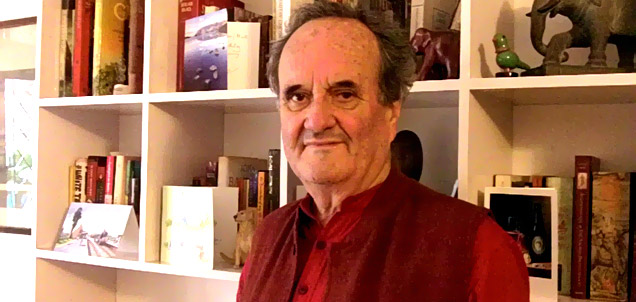
He likes to refer to himself as ‘British who is much influenced by India’. Often called an ‘expert on India’, Sir Mark Tully is famous for his extensive reportage of the changing social, political and economic trends in India as the BBC India Correspondent and as BBC Bureau Chief later. He quit the BBC in 1994 after an argument with the then BBC Director General, John Birt, where Mr Tully accused him of running the corporation by fear. But his deep-rooted familiarity with India and its culture made him stay on here even after his term ended with the BBC.
Sir Mark Tully has co-authored and authored quite a few books on India, his latest being Non Stop India which he released in the capital last week.
He is currently the regular presenter of the weekly programme, ‘Something Understood’ on BBC Radio 4.
In this interview with MxM India at his Nizammuddin residence, the veteran journalist shared his views on what he thinks of the Indian media today. Mr Tully also shared some instances from his BBC days to point out the changes that the media has seen over the years. While he seemed extremely hopeful of the print media, he felt there is a need to hold back the expansion in Indian television to see what’s going on really. “Technology,” he says, “is being badly used to overload journalists, particularly in multimedia organizations, to make journalists into radio, television and online journalists at the same time, with the net result that they have absolutely no time to find out what’s going on.”
And although he believes that India has a great future, he urges India to stop following the western model and to create its own way forward.
Q: Much has changed from the time you wrote No Full Stops in India. If you were to write that book now, what would change?
I think the big thing that would change would be that India is in a very different position economically than it was before, and India is in a very different position in what I call ‘morale terms’ as well. At the end of the ’90s, things were looking very bleak in India, we’d had twenty years or more of Neta-Babu Raj and the economy was stagnant basically because of that neta-babu raj and all the bureaucratic controls that existed, particularly controls on investment and on doing business. So that would be very different. But one thing I would say which would not be different would be the emphasis on that India must find its own way ahead and not simply ape and follow American or the western model.
Q: The Indian media has gone through an explosion in the last five to 10 years. As someone who dominated the airwaves just before that, what’s your take on the current explosion?
Well I don’t think I ever dominated the airwaves but what has happened basically is that television has taken over in a big way and sadly radio, the media which I love best and which I think is a very very important media, has not been allowed to develop properly because the government has restrained control over news and current affairs. Television has expanded and I believe that what is now needed with television is to sort of in a way call a hold to the expansion and look at what is going on on television and see whether improvements cannot now be made in that.
Q: We have had a Press Council Chairman Justice M Katju virtually damning the media and media persons. There are many who agree with him but say he’s got no right to say it. As an outsider now, do you agree with Justice Katju’s views?
I think that maybe he overstated the case, probably he did. But I don’t think we should react hysterically as journalists. I think that we should examine ourselves and see what is going wrong and there are things which are going wrong. And the first thing I would say is our failure to stand together to resist the onslaught of commercial pressures which have turned television and newspapers, and even radio into commercial rather than news organizations. Secondly, I think that we journalists, very much need to examine the way we exercise the editorial function. There isn’t, particularly in television, enough editing going on. I’ll give you one example, the Bombay attacks, if the editor in the studio had exercised tight control over reporters in the field then we wouldn’t have gotten into the mess that we did over the Bombay attacks. That’s just one example. Time and again, you see examples of shows which drift on, breaking news which drifts on without any apparent editorial control. And thirdly, what I find whenever I ask anyone in television, whether there are reviews of what has gone on the day before or a week before so that people can learn from their mistakes, so that you can criticize and benefit from that criticism, I’m always told that reviews don’t take place. When I worked in BBC World Service Radio, we used to have two meetings regularly every day; part of that meeting was looking forward to the news we would be covering that day or expected to have to cover and part of it was very much a review, and a critical review of what we’d done the day before.
Q: Your views on the long-drawn-out debates with the usual suspects as panelists on Indian television prime time news?
Well, as someone who is sometimes on these panels, frankly I am amazed that there are so many of them. There is a stage army of people really who come on to these panels and they always get politicians, and the political parties send the same people every time. And I think this is largely an excuse for doing television on the cheap. I personally believe that we should have other ways of presenting the news, discussing the news than endless panel discussions, and of course one way which you would have seen nearly often enough is through news and current affairs documentaries.
Q: And while Indian media has gone through this explosion, how would you think the British media has seen the last decade?
Well I think that the British media has changed a great deal in the last decade because of course of the media which you are in, the internet and the electronic media, that has had a very considerable effect on newspapers. Newspapers have been the main victims really and you’ve got a situation in London for instance, where a historic paper like the ‘Evening Standard’ is now given away free because it couldn’t get enough circulation to attract advertising. I think the commercial impact has been there in Britain as well. And the other thing I think change has come to over very much, which I think is a pity, is that there is far more of correspondence giving you the news in conversations with presenters rather than properly crafted news stories; and very often television just turns into bad radio. The other day I saw a comedian do a wonderful imitation of these dreadful interviews where clearly the presenter has warned the correspondent of what the question is going to be. So the presenter very earnestly asks him a question like, ‘Is the rupee going to fall further?’ And the correspondent says, ‘Yes, yes you are quite right, that is the big question.’ That sort of thing rather than the properly crafted news stories. And also like in India, because it is so much easier to broadcast from the site, there is too much broadcasting from the site now and too much repetition. I was watching the night that Gaddafi was killed, and you saw the same pictures going round and round and round.
Q: Since the time you were active and on the field in India, what do you think has been the changes that the political class has had towards the media?
I think the political classes have become more organized, they have these spokesmen now and all that. I think some of them rather like coming on the Tele, they weren’t so interested in coming on the radio. When I was with the BBC, it was a strange fluke of history really because the transistor radio had come and so radio listening was very widespread but all the listeners had was to listen to the All India Radio. So lots of them turned to the BBC as an alternative source of news and we became in effect, a domestic news broadcaster. So that meant that the politicians were much more concerned about the BBC than I think they are now, their attention is much more on the local media now.
Q: And vice versa? Journalists towards the politicians? After all they are all in the hunt for the exclusive?
I’m not sure that there has been any big change about that except one thing, I wouldn’t say they are in the business of exclusives, they are in the business of much less worthwhile, which is ‘bites’. Time and again, when I go to a book launch or something like that, quite often a young journalist would come up to me and say, ‘can you give me a bite?’ That didn’t use to happen nearly as much. And we used to have many more set-piece interviews. I must in my time have done five or six interviews with the Prime Minister, with Indira Gandhi, I interviewed Rajiv several times, I interviewed Morarji, I made a whole film about Morarji. Now you don’t see those set-piece interviews and the big leaders don’t seem to have as many set-piece press conferences as they used to have.
Q: What’s your view on the Indian print media? With the breaking news constituency now clearly dominated by news television, has Indian print been able to adapt itself to the new times?
I think that the Indian newspapers do seem to have adapted quite well, circulation figures as far as I know are doing very well. What there has been I think which is very important and very good thing really, is there has been a realization of the power and influence of the media in languages other than English. Even twenty years ago, general assumption of advertisers was why bother to advertise in a Hindi or Punjabi or Bengali media because people who read those papers, they don’t have much money, they can’t buy what we advertise. So all the stress was on the English media. Now if you look at the top ten newspapers, you will find there is only one English newspaper in that, and that was the Times of India. So I think this is a good and healthy development which has taken place.
Q: Do you think a News of the World-like scandal could ever happen in India?
Yes it could happen anywhere. I’m not saying that I have evidence that people are tapping phones here but there’s obviously a risk that journalists will fall into that. If you take the whole question of sting operations which comes fairly near that, there have been cases In India where sting operations have been mounted against the wrong person or not for proper reasons and that has caused problems and we do know perfectly well that in the local press, in remote areas, sting operations are sometimes used as a way of blackmailing people. In my view, sting operations should only be used when there is a story of very considerable importance and there is no other way of getting at it.
Q: Rupert Murdoch isn’t a bad name here in India… our values are different.
Perhaps he’s not a bad name in India because he isn’t a name here really. Yes he is involved marginally in television here but you don’t have Murdoch newspapers here and you don’t have a channel like Fox News either. And you haven’t had a phone-tapping scandal like the News of the World one. So maybe he is comparatively unknown here, although maybe he wouldn’t like to hear that.
Q: And what about our corporate sector? You have written a whole chapter celebrating the Tatas. Did the Radia tape controversy impact your views on the group? Especially Mr Ratan Tata?
Well that’s all very muddy and I mentioned in my chapter about Ratan Tata and I mentioned that his voice was heard but I didn’t come to any conclusion about it. The reason why I’ve written about Tatas in my book was something which some people haven’t quite understood. It wasn’t really to investigate them and say that are they good or are they bad, what is good about them, what is bad about them. The thing was really to bring to the attention of people, the remarkable achievements of the Tata group once they were freed from the restraints of the Neta-Babu raj and of the license permit raj. So that was the intention, to demonstrate the enormous ability that there is in India if only we can get governance right. And also to get into the book some criticism of the government and bad governance by business because I always contend that if only business will raise its voice against bad governance then we may get something done about bad governance; because if business doesn’t flourish, then the economy doesn’t grow and all the politicians seem to be interested in is the economy growing. But I would just add one thing there, I don’t believe that business should be able to dictate the policies of the government; I do believe that business needs to play a role in a balanced economy in which all sorts of other elements are also playing a balanced role.
Q: The fact is that the news media is dictated by technology these days. Is that a good thing or bad?
Well, you know, I didn’t think things in life to be wholly good or wholly bad. There are advantages in technology and disadvantages. The great disadvantage I think of technology now is that it is the ability to transmit news on the spot is being badly misused. It’s being badly misused by the endless badly edited breaking news syndrome. It’s being badly misused by this overuse of this syndrome of a presenter talking to a journalist on the spot. And it’s being badly used to overload journalists, particularly in multimedia organizations, to make journalists into radio, television and online journalists at the same time, with the net result that they have absolutely no time to find out what’s going on. So the ability to communicate in any way is of course valuable but we always forget that there can be over-communication. I think many people spend far too much time in front of screens rather than meeting people face to face. Recently I did a radio programme about the difference between talking to people on the net and talking to people face to face.
Q: India doesn’t have any news on private radio (except of course the government saying that private FM saying you can take All India Radio feeds). Do you think that once in, there could be yet another dramatic change in the way we will see news?
Yes, I think there would be a dramatic change, I think it will make a difference to FM radio. It would give FM radio many more listeners. If you take the example of Britain, the No. 1 political show of the day is not on television, it’s on radio; the one which sets the agenda is the Today programme on BBC Radio 4. If you go to Britain and you talk to a lot of people, for many people it’s almost become fashionable to say ‘I don’t watch television but I do listen to radio’. Radio is a hugely powerful medium and of course news can be prepared to broadcast on FM radio, it will make a big difference to radio and I think there will be many people who’ll turn to FM radio for their news.
Q: And one final question: Telling a story on radio versus telling a story on television?
Well I think telling a story on radio is much harder than telling a story on television. But, and I firmly believe this, the pictures on radio are better than the pictures on television. And the pictures you tell/show on radio, you describe on radio, the stories you tell on radio are much more likely to stick in people’s heads than television shows are. The art of radio broadcasting, in many forms of radio broadcasting, is to make each listener think that you’re speaking to them individually and I think you can do that in a much deeper and more meaningful way on radio than you can do on television.
 By Anil Thakraney
 By Ranjona Banerji