Tag: PricewaterhouseCoopers

  •  PwC tables 2023 Global Consumer Insights Pulse Survey

    By Our Staff


    PricewaterhouseCoopers (PwC) tabled its 2023 Global Consumer Insights Pulse Survey, which captured the views of 9,180 consumers across 25 territories.


    According to the survey, consumers globally are weighed down by concerns around cost of living and personal finances. Around 74% of Indian respondents say they are concerned about their personal finance situation, as opposed to 50% globally. 63% of Indian consumers are cutting back non-essential spending altogether, according to the 2023 PwC Global Consumer Insights Pulse Survey, which captured the views of 9,180 consumers across 25 territories. In India, the survey included 500 Indian respondents across 12 metros, tier-1 and tier-2 cities of India (Mumbai, Delhi-NCR, Bengaluru, Visakhapatnam, Chennai, Kochi, Kolkata, Nagpur, Jalandhar, Hyderabad, Meerut and Rajkot). Out of these, 57% of the respondents were male and 43% were female.


    The survey also found most Indian consumers expecting to reduce their expenditure across all surveyed categories over the next six months, a significant decline in planned spend across all categories since the previous pulse survey in June 2022. Industries, including luxury and premium products, travel, and fashion, expect to see the greatest portion of consumer spend reductions over the next six months, whereas the groceries segment is expected to decline the least.


    Sharing insights from the survey, Ravi Kapoor, Partner and Leader – Retail & Consumer, PwC India said: “PwC’s latest Global Consumer Insights Survey for India drives home the key message of ongoing financial stress in the lives of the consumers, where 75 percent of them are very concerned about their financial situation. This sentiment will have a potential restraining effect on spends in highly discretionary categories of electronics and luxury. Consumers will continue to demand world-class buying experiences in both physical and digital channels with work cut out for brands to reduce costs, enhance availability, and for ‘going local’. The silver lining here remains the unequivocal growths in adoption of digital channels and the desire to spend more on travel in the coming months.”


    Consumers, globally, are shifting their consumption habits in-store and online as the cost-of-living surges and supply chain disruptions impact product availability and delivery times. As a result, almost half (45%) say they are buying certain products when on offer/promotion, 44% are looking to retailers offering better value, 38% are using comparison sites to find cheaper alternatives, 36% are buying in bulk to save cost, and 33% are buying retailers’ personal brands for better savings.


    Supply chain disruption is shifting in-store/online consumer behaviour

    Half of the Indian consumers (50%) said rising prices remain the most frequently experienced issue when shopping in-store, supply chain issues also dominate with larger queues and busier store locations (35%), along with product availability (28%), which is also impacting consumer behaviour.


    Luxury/premium product industry to see decline in consumer spend

    Consumers are planning to reduce their spending across all surveyed retail categories over the next six months, with the greatest decrease forecast in luxury/premium products or designer products (38%), virtual online activities (32%), consumer electronics (32%) and fashion products (clothing and footwear) (31%). However, there remains an appetite for future spend, with 38% indicating they will look to treat oneself/others, whereas 54% view them as better quality. Travel (30%) and groceries (21%) had the least reported planned spend reduction.


    Vocal for local (Sustainable products are in demand from consumers)

    Despite a planned spend reduction and a challenging economic environment, consumers say they are still willing to pay more for sustainable products. Overwhelmingly, more than 88% are willing to pay higher for a product that is produced/sourced locally, or made from recycled, sustainable, or eco-friendly materials (87%), or produced by a company with a reputation for ethical practices (87%).


    Metaverse: Early-stage adoption strong, executives recognise the importance of risk management, cyber security and governance

    Adoption of the Metaverse as a shopping channel is still in its early stages, however, the medium remains under-utilised, with only one-quarter (23%) of Indian respondents familiar with the term. The largest portion of these users have primarily employed the Metaverse for virtual reality (VR), i.e., playing games or watching a movie (20%), experiencing the virtual world through the retail environment or a concert (13%), or purchasing a digital product, such as a Non-Fungible Token, or NFT (17%). Millennials (36%) are most likely to use the Metaverse, especially in countries like India (48%), Vietnam (43%), and Hong Kong (42%).


    All the while, as online shopping continues to grow in volume, consumers are increasingly weary of data privacy. 65% of respondents are extremely or very concerned when interacting with social media companies, third-party/portal travel websites (54%), healthcare (59%), and consumer companies (58%). As a result, 41% respondents do not share more personal data than they must, 37% opt-out from receiving communications from these companies, and 38% have overall reduced their interaction with these types of companies.

     

  • Key Trends in Digital and Analytics: PwC


    Although these are not specific trends for Media and Entertainment, but given the reasonably significant role of telecom and digital and analytics in the media, we bring you this trends report by PwC India (eka PricewaterhouseCoopers).


    By Sudipta Ghosh


    Key trends in 2015

    Real-time Customer engagement/interactions – There is shift from determining the proactive offers / next best offers from simple cookie based or click stream based analytics to more valued, analytical, data enriched analysis. This integrates the customer behavior patterns coming from other data sources / historical transactions. There is a wave of technology adoption for responding customers in real-time with more meaningful offers. The trend needs powerful processing platform with capability to handle high volume of data with very high velocity. Enterprises are either evaluating or adopting the big data platforms for the same. We will see more adoption of the big data platform in 2016.


    Cashless payments and related analytics – There is a great adoption of cashless payment methods (online, payment wallets, etc.) in India. The adoption will improve over time. Most of the cashless payment methods have ability for further improve the customer acquisition by extending appropriate offers. Analytics will play a great role in determining the offers that can be extended to these methods.


    Telecom transformation due to 4G – Introduction to 4G services will cause disruptive adoption of mobile internet in India. Companies like Bharati and Reliance are geared up to swipe the 4G market. The introduction of the 4G services provide a great challenge to the service providers to handle the generated huge volume of data effectively. It is estimated that there will be around 30-40 TB of data that will get generated on daily basis. Telecom service providers need to gear-up to manage and handle this data and use it for their benefits. The QoS parameters and analytics will also play a great role from regulation perspective to ensure the quality of service.


    Shift from ‘Data as a Service’ to ‘Analytics as a Service’ – The trend started with off-loading the data processing services to the private cloud or to the hosted environment and then derive the intelligence in local data center using Analytics solutions. Customers are now looking to avail the analytics as a service solutions. Niche companies or the companies with rich domain expertise are now providing analytics as a service in collaboration with IaaS vendors.


    Adoption of Big Data platforms – During past couple of years many customers evaluated the new/emerging technologies/platforms required to handle the structure and unstructured data. During second half of 2015 we observed that many customers start adopting the big data solutions/platform. The trend will continue and grow further in 2016. Many customers also have adopted the ‘Data Lake’ strategy for starting the Big Data initiatives. Customer are taking the staggered approach to build the data lakes and at the same time identifying the analytics initiatives that can be derived out of data collected in the data lake.


    IoT Devices, Human and Machine Interface – There were many enquiries and evaluation happening on adoption of data generated through IoT devices like Fitbit, Nike Fuelband, Apple Watch, Heat Sensors, etc. The blueprints are getting defined for integrating the IoT data into generic Analytics platform and derive meaningful intelligence out of it. Customers are also evaluating the scope KPO automation through Human and Machine interfacing solutions. The solutions use the technology for audio, video, images, text and other unstructured data analytics.


    Key Trends in 2015: Retail Analytics

    Retailers are increasingly using omni channel marketing to improve the customer experience as they shop across various channels like store, web and mobile platforms. There has been a huge growth in cross channel data volume and now Retailers have access to variety of data which include not only the demographic information but also past purchases, call centre interaction, social media interaction etc. Retailers are leveraging analytics tools to enhance customer loyalty by creating a personalised shopping experience that customises coupons and offers to match customers’ needs. Retailers are increasingly using segmentation based on purchase patterns, price sensitivity and customer lifestyle to identify the most relevant customers for targeting, which results in more relevant offers. Segmentation helps focus marketing on the customers who will most likely buy the products or services and avoid markets which will not be profitable. Retailers are adjusting their product mix from store to store-based on the preferences of their customers. This  help retailers improve their inventory allocations by understanding customer demand and their choice patterns resulting in increased revenues and margins


    Using analytics, retailers are able to determine the optimal pricing of products and services. The price elasticity not only help in only finding identifying the products that are most and least price sensitive but can also be used with optimisation to identify the optimal pricing. Increasingly number of companies are adopting open source analytical tools to provide descriptive, prescriptive and predictive analysis of the fast increasing volumes of data which are both structured and unstructured in nature in order to reduce the total cost of ownership


    More retailers are introducing mobile apps for integrated loyalty programs. Consumers no longer have to clutter their wallets with physical cards anymore. Instead, they can use their smartphones to track and redeem their rewards through mobile applications.


    Emerging Trends to watch out for in 2016: Retail Analytics

     Fraud detection and prevention will be an important concern for retailers  looking to build security and preserve consumer trust. Using analytics, retailers can identify unusual patterns of product and inventory movement.

     Radio-frequency identification (RFID) tags and readers will increasingly provide substantially more data on product movements and locations for retailers to analyse. Retailers will be using analytics to optimise their inventory and reduce their transportation costs.

     Workforce analytics will help organizations effectively plan their future workforce needs to increase labour efficiency and improve schedule effectiveness. Analytical tools would be used for workforce acquisition and labour scheduling based on when customers are most likely to visit a store.

    ï‚· Retailers will increasingly adopt multiple IoT technologies in the coming years to reshape the customer experience, to drive loyalty and to focus on inventory. The use cases in retail will include sensors on products, interactive consumer engagement, automated store lighting, shopper intelligence, perishable tracking, fleet operations tracking etc.

    ï‚· There will be an increase in video analytics as powerful processors are becoming available at affordable price points to video surveillance manufacturers. Video surveillance with analytical models can be used for effective in store promotions, stock out analysis and tracking customer movement inside the store.


    Rise and growth of e- commerce or digitisation of retail has been one of the key trends in the retail sector. As this digitisation continues in the new year, companies will turn to analytical solutions to both manage and make sense of the huge amount of data being churned from these transactions. Companies will require insights into the consumer behaviours to try and personalise user experience as competition will hot up between various e-commerce retailers. These companies are already investing in significant social media management to promote their services and will also turn to analytics to gain insight from that data regarding their product perception and target market. App based analytics solutions will be at the forefront of this growth as the market will shift from laptop to smart phone based solutions. New age analytics solutions like using CCTV for eyeball tracking, Planogram optimisation, single view of customer to create shopper profile and anticipate needs better, analysing supplier and employee performance and compliance (attrition analytics, workforce planning),  are all seeing an uptake in the Indian market.


    Sudipta Ghosh is Partner, Data and Analytics at PwC


  • 5 trends to watch in Telecom in 2016: PwC


    While traditional media cannot be wished away, given the growing sales of mobiles – especially smartphones and the internet – fixed or mobile, the world of advertising and marketing is getting influenced considerably by telecom.


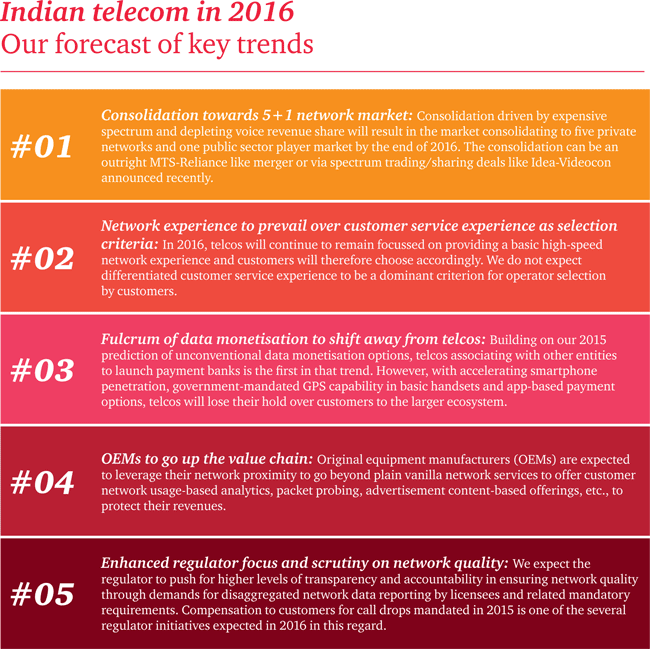
    We present a trends report (and forecast) on telecom presented by leading consulting firm PwC (eka PricewaterhouseCoopers).


    Here goes the forecast for 2016.


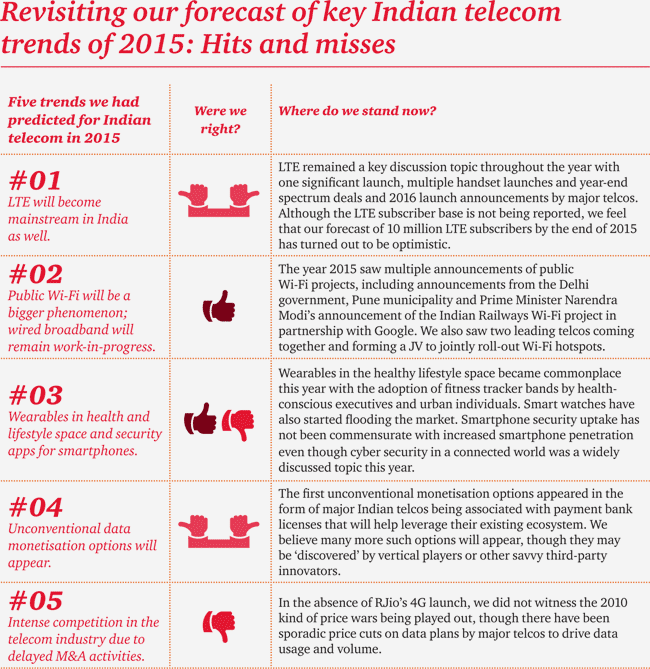
    Interestingly, PwC has also revisited its forecast for 2015 and what’s worked and what hasn’t. Here goes:


  • India@Cannes: Creativeland looks to repeat 2011 story in effectiveness

     
    By A Correspondent


    Having bagged the inaugural Creative Effectiveness Lions last year, India may find the going tough this year as it has received just a single shortlist nomination. This is good considering that India has sent only two entries this year. Last year the number was 7.


    At a total of 92, the total number of entries too have seen a sharp decline this year by 35 per cent. Last year, the number was 142. Leading the tally is USA that has sent 27 entries, Australia has sent 9 while Germany has sent 7 entries.


    With just a single shortlist, Creativeland Asia looks to recreate the magic it created last year with its entry Plan-T for Parle Agro.


    Just to recap, the awards will honour creativity which has shown a measurable and proven impact on a client’s business – creativity that affects consumer behaviour, brand equity, sales, and so on. Only entries that were either shortlisted or Lion winners, across all categories at Cannes Lions 2011 are eligible to enter into this category as these will have already been judged and established as being creatively world-class. PricewaterhouseCoopers have reviewed each entry for the Cannes Creative Effectiveness Lions and checked that claims made therein are supported by appropriate data and that entries are internally consistent and mathematically accurate. Entries will be rewarded for strategy (25 per cent), Idea (25per cent) and Results and Effectiveness (50per cent).


    The entries will be judged as one with no categories. Representing India at the jury will be Nadia Chauhan, Joint Managing Director & Chief Marketing Officer, Parle Agro. The awards will be held on Tuesday evening in the Grand Auditorium, Palais des Festivals.