Tag: Press Council

  • Press Council celebrates National Press Day

    By A Correspondent


    Col Rajyavardhan Singh Rathore, Minister of State for Information and Broadcasting, has said that the success of Indian democracy owed much to the independent and responsible press which had played a crucial role in educating and empowering the masses. Journalists have acted like soldiers utilising the weapons of pen and newspaper columns. The Minister stated this while delivering his address at a function to commemorate National Press Day organized by Press Council of India in the capital on Sunday.


    During his address, Mr Rathore reiterated the government’s commitment to protect, preserve and promote freedom of the press. The minister called upon the journalists to maintain professional integrity and ethical standards in their pursuit of truth. In the function, the minister also released a souvenir highlighting the role of Press Council of India in ensuring fair practices of journalism.


    Also speaking on the occasion, Prakash Javadekar, Minister of State (IC) for Environment, Forests and Climate Change (and former I&B minister) said that freedom of the press was sacrosanct in a democracy and that this freedom came with responsibilities. The media has to facilitate active discussions and debates on various issues of national importance, the minister added. Justice Venkatachaliah, former Chief Justice of India, who was the chief guest of the function, said that press in India had a larger role to preserve, restore and propagate democratic and humanitarian values balancing them with changes in technology and perceptions of freedom.


    The function also witnessed the conferring of National Awards in different categories on print journalists for their outstanding contributions in various fields. Justice Markandey Katju, Chairman, Press Council of India and Vibha Bhargava, Secretary, Press Council of India were also present on the occasion.


    National Press Day marked the day of establishment of Press Council of India, PCI, as a statutory agency to ensure free and responsible press. This was the day on which the PCI started functioning as a moral watchdog to safeguard the independence of press in India.


  • Jaldi karo! MIB asks TRAI & Press Council to expedite comments on foreign investment limits

    By  A Correspondent


    The Ministry of Information and Broadcasting has requested TRAI once again to expedite its comments on the reference made earlier to the body regarding foreign investment limits in the Broadcasting Sector. In its communication to TRAI, the ministry has sought comments regarding the paper prepared by the Ministry of Finance relating to revision in existing FDI caps in the broadcasting sector. The paper had been forwarded to TRAI seeking its recommendations under Section 11(1)(a)(ii) & (iv) of the TRAI Act, 1997, which pertains to the terms and conditions of license to a service provider and measures to facilitate competition and promote efficiency in the operation of telecommunication services to facilitate growth in such services.


    In a similar separate communication, the ministry has requested the Press Council of India to expedite its advice on the existing sectoral caps of FDI in the print media, under Section 13 of PCI Act, 1978. The advice has been sought in view of the communication received from the Ministry of Finance which aims to review policy of sectoral caps of FDI in the print media. Section 13 authorizes PCI to express its opinion in regard to any matter referred to it by the central government.


    The paper proposes to raise the existing FDI cap of 26% which is through FIPB route to 49% through automatic route in the news sector. In the non-news sector, the existing FDI cap is 100% through FIPB route which has been proposed to be 100% through automatic route without the requirement of FIPB’s approval.


  • The Press has lost its sheen: Kuldip Nayar


    Text and Video by Shruti Pushkarna


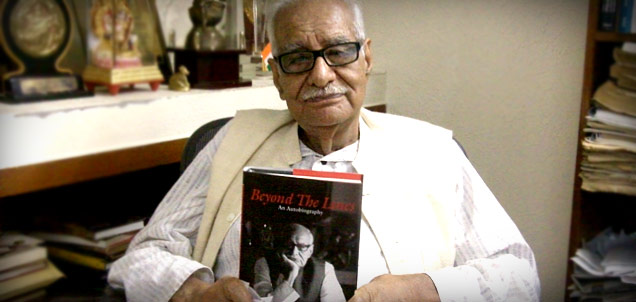
    Veteran journalist Kuldip Nayar memoirs, ‘Beyond the Lines’, are set to be released in the Capital today (July 11). He calls it a ‘political autobiography’ which recounts the political history of not just India, but Pakistan and Bangladesh as well.


    Now 89, Mr Nayar has been a close witness to a series of political events that unfolded in his journalistic career. An author and a human rights activist, Mr Nayar has also been a diplomat and Parliamentarian. He was appointed High Commissioner to Great Britain in 1990 and nominated to the Rajya Sabha in August 1997. He was media advisor to the late Prime Minister Lal Bahadur Shastri.


    He was also the former editor of the Statesman in Delhi, former Managing Editor of news agency UNI and former correspondent of the London Times. He still writes columns and op-eds for newspapers including The Daily Star, The Sunday Guardian, The News (Pakistan), Express Tribune (Pakistan), Dawn (Pakistan).


    A great believer in the power of press, Mr Nayar seems aware, and somewhere disappointed, at the emergence of the new ‘sensational’ journalism in the country. He feels that journalists today editorialize more than they report. As opposed to the ‘profession’ it used to be, Mr Nayar feels journalism today has become an ‘industry’, a ‘product’.


    In this candid one-on-one with MxMIndia, Mr Nayar shares his memories of journalism in the days gone by and the change he is witnessing today. Although he advocates self-regulation of the media, he believes that all journalists should prescribe to a strict code of ethics.


    Excerpts:


    This book is not based on columns. This is a book from my memory, 95 per cent of it is from memory, and only for about 5 per cent, I might have consulted my columns. It’s my political biography and it’s a current history of India, Pakistan and Bangladesh.You were among the first journalists to take your columns to the book form. Do you think that the book works better for a journalist?


    Have you given up on Indian media or Indian publications altogether?

    No, I have not given up entirely, because I still appear as a columnist in so many papers. Only the leading papers don’t publish my columns. I have full confidence in the press but I am disappointed that it has lost the sheen that used to be there in our times.


    Has it changed dramatically from the time when you were an active practitioner?

    Yes it has. Now it has become a product, then we were a profession, now it’s an industry. That way, independence is much less now. The influence of the owners and the corporate sector is much more than there was.


    Any other specific area where you see the change?

    Yes, the way of presenting news and the way of writing has changed. I find very few items of hard news now. In our times, we used to see what was happening in the cabinet and we even used to publish the cabinet agenda. Now it’s less inquisitive than before.


    In the Samir Jain incident you mentioned in the book, do you think the turning point in the treatment of editors by proprietors was when Girilal Jain has said to have slighted Samir Jain?

    That probably is one incident. The real watershed for journalism is the Emergency. That’s when the owners really saw that their pressmen caved in. So the owner thought that if they could cave in under pressure from government, they can also cave under my (owner’s) pressure. So the emergence of the owner started then, earlier the owner was nameless. But now we even see edits by owners and they decide who will write what.


    But there are still newspapers which are editorially driven…

    Very few.


    What’s your view of proprietors as super-editors especially in the regional, non-English media?

    That is a problem. Leading regional papers which have circulation in lakhs are owned by the same family, edited also by the same family and it’s being inherited down the generations, therefore it has become personal property. So this is a very serious issue.


    You’ve been an active votary of Indo-Pak ties, you are known to conduct candlelight marches to the Wagah border…do you think it’s correct for journalists to get ‘activist-y’?

    While I was in active journalism, I had certain views which I expressed, but did not participate in any activity. Now since I am only a columnist, I do take part in human rights violation, Indo-Pak relations and so on, because this is part of my ideology.


    You have also been quoted in the past to say that media plays a spoiler in Indo-Pak ties, that it only sensationalizes and most journalists have no sense of history…

    I think they (current media) don’t seem to have that sensitivity. I think media on both sides are still in the old age of mistrust, hatred and chauvinism. Things have changed in the region, so now we should be talking of conciliation. People on both the sides are willing to meet but media is a spoiler.


    Do you find newspapers having lost out in breaking news journalism vis-a-vis TV and the internet?

    Yes, newspapers are now breaking fewer stories, if at all they do, as compared to earlier. Television does much more. In our time, TV did not exist but now I can say that stories are broken by television network, and take the example of 2G scam, all these came from TV.  Newspapers followed up the story later.


    What’s your view on self-regulation versus government-controlled regulation of the media? You recently opposed the SC’s move to lay reporting guidelines stating that it will muzzle media. Is self-regulation the way forward?

    Yes, and why I say that is because however small regulation there may be, it will be controlled by somebody on the executive council. This question came up during Nehru’s time also, and Nehru said that he would rather have yellow press – sensational press – than controlled press. But I do want journalists to adopt a code of ethics. Editors’ Guild has formulated a code of ethics, Press Council has one, Press Commission had enunciated one. So I think we should have one code of ethics because the new type of journalism which is emerging is, at times, sensational, at times irresponsible and too much of editorializing. News is sacred, it should be conveyed as it is.


    What are your views on Paid news?

    Paid news is a recent phenomenon. This is the newspaper’s innovation and I think one of the biggest newspapers today initiated it. They are now selling space, not for advertisements, but space where the advertiser’s views will be presented as views from their correspondent. So it is really unfair to the reader who believes that news columns are sacred. You are selling the reader something motivated, some propaganda, through the credibility of your paper.


    Coming back to your book, any incident that you forgot to mention in the autobiography that you would like to share?

    Yes, there are quite a few…they were certain incidents about Mrs Gandhi’s regime which I should have included in the book. Also when I was in the Rajya Sabha, I had some exchanges with the Vajpayee government, I could have included those as well. Maybe I will do a sequel.


    Your message to a young entrant in the media…

    He or she should have commitment to certain values, commitment to the Constitution and commitment to the ethos of this country. Democracy, secularism and egalitarianism should be part of him or her while entering the profession.


    MxMIndia has partnered with Roli Books on the promotion of the book

     

  • [MJR] Katju rides to the rescue of the press!

    By Ranjona Banerji


    Thursday/Friday was one of those rare news cycles where TV and print appeared to agree with each other – at least when it came to the Supreme Court’s upholding the Right to Education Act and the reservation of 25 per cent of seats for the economically backward in non-government schools.


    Arnab Goswami of Times Now right off the bat said any opposition was elitist and demonstrated the deep rich-poor chasm in this country. This line is in keeping with his “simple living high thinking” mantra unveiled a few days ago in a debate about teenage violence. Other channels also presented the same line of thinking. This made life a little uncomfortable for those outraged that rich kiddies now had to sit next to the children of their domestics – although no one said that quite so openly, of course.


    Even as opponents of the idea went on about increase in fees and so on, no one quite bought it.


    Friday morning’s newspapers followed the same lines – with particularly vociferous arguments in favour of the RTE plan and with some tough words for those against it. For a middle class readership, it is class prejudices which are first priority and the media has certainly picked up on that without pandering to it.


    As the judgment sinks in, it can only be hoped that newspapers (TV cannot do it) delve deeper into the implementation of the act and keep track of what is actually going on. Sticky points include minority institutions and boarding schools which are currently exempt from this provision, what happens to a child after Class VIII and improvement of facilities in government schools.


    * * *


    Press Council chairman Markandey Katju has jumped on to his white horse and charged to the rescue of the freedom of the press. The Press Council is going to the Supreme Court to challenge the Allahabad High Court’s decision to stop the media from reporting on troop movement. The media, so upset has it been with the temerity of the Indian Express to carry the controversial story about fears of an army coup in some government circles, has remained largely silent on the court decision.


    This is an interesting maturity test for the media. Its compulsions to tailor material to reader demands and provide infotainment aside, there is also a larger role regarding the safeguarding of democracy and being a general watchdog. Patriotism in the media context does not mean bowing before every institution – it means quite the opposite.


    I cannot say this better than Katju himself: “…the Indian Army is not a colonial army, but the army of the Indian people who pay taxes for the entire Indian defence budget. Hence the people of India have a right to know about army affairs, except where that may compromise national security.”


    As Katju points out, the media has this freedom under Article 19 (1) (a) of the Constitution.


    Hear hear!


    * * *


    The media’s role in the Aarushi Talwar murder investigation remains questionable. It has swung from one extreme to another, drawing its own conclusions, dramatising the life and death of the young girl and encouraging the investigators’ own bizarre behaviour as a result.


    Right now, some in the media seem to have decided that the parents of the girl are innocent and being unduly targeted. Open magazine has carried a long article by historian Patrick French claiming this (he is a patient of the dentist couple).


    Unfortunately for everyone concerned, the courts will base their judgment on evidence collected and presented.