Tag: Press Council of India

  • Red Ink Awards presented to Mark Tully, Faye D’Souza, others


    By A Correspondent


    To ensure freedom for the news media, it was necessary to ensure the financial stability of journalists and job security. It is only if a journalist is financially secure that he can do his job with peace of mind, said Justice C K Prasad, Chairman of the Press Council of India (PCI).


    Giving his closing remarks as the chief guest at the ‘National Red Ink Awards for Excellence in Journalist’ on Friday, Justice Prasad said it was not fair on the part of media owners to run down the appointment of Wage Boards for media employees. Other industries such as cement and pharmaceuticals are all governed by the Minimum Wages Act, where such law does not exist for newspaper employees, he pointed out.


    “An editor returning to his office only to receive a pink slip did not augur well for the free press,” he said, adding that he had examined the balance sheet of many media groups and found the profits they were making could easily support the payment of Wage Board salaries.


    Earlier, he emphasised that the job of the Press Council of India is to ensure the freedom of the press, and “we are not here to regulate the


    Sir Mark Tully, who worked for over two decades as the Bureau Head of BBC in the subcontinent, received the RedInk Award for Lifetime Achievement’. In his acceptance speech, Tully said he grew up as radio reporter, and he would always prefer radio to television. Radio broadcasts gave a personal touch as “the listener gets the feeling that the news reader or reporter talks to him directly,” he said and recalled how at a village gathering in Uttar Pradesh, people greeted him as “a friend”.


    Tully, who was deported during the Emergency, said for journalists credibility was everything, and in today’s age they must learn to grapple with fake news. Just a small crosscheck and verification of facts would help in giving the right information to the society. He said public service broadcasting was a bolstering factor of a free press. Citing the BBC as an example, Tully said in his 40 years of working for the organisation, he could not recall a single instance where he had been asked to change or drop his news dispatch.


    Faye D’souza, Executive Editor of TV channel Mirror Now, who was given the ‘Journalist of the year’ Award, said her reporting was built on covering the issues that affected the common man. Focusing on credible news without much antics helped her channel stand out in the crowd and make a mark for itself.


    “I stick my neck out to report not what politicians are saying but what hits the man on the street, even as the entire media could be busy with irrelevant breaking news,” she


    Earlierr, a power panel consisting of Vijay Darda, Chairman, Lokmat Group, Raghav Bahl, Founder & Chairman, Quintillion Media, Anant Goenka, Executive Director, The Indian Express Group, and Samir Patil, founder and CEO of Scroll Media, debated the important and relevant issue of: Is there a business in News Media’.  Senior Journalist and Founder of IndiaSpend.Org  GovindrajEthiraj anchored the panel discussion.


    Most of the panellists agreed that news media was not a great business but there was money to be made. Bahl stressed that as the scenario shifted to digital platforms, a healthy business in niche areas was not difficult; however as the business scaled up along with the number of brands, the challenges also increased. He emphasised that the mandatory legal requirement in broadcasting for 51 per cent Indian ownership had become a bottleneck to expansion. It was not a level playing field as the law did not apply to other areas like print or digital.


    Mumbai Press Club secretary Dharmendra Jore said this year the RedInk Awards had received a record over-2,000 entries. Gurbir Singh, the convenor of the Awards Committee, said accusing the media of being anti-Establishment was foolish as by its very nature news media will always be anti-Establishment irrespective of the party in power.


    Awards were given away in 11 competitive categories and 5 special categories. As many as 32 journalists received trophies and Rs 1 lakh as cash prizes. The RedInk Award for ‘A Media Start-up that is making a difference’ was given to IndiaSpend.org, for its initiative in developing data journalism in India.


    Winners of Redink Awards 2018:

    Business & Economy

    Print : Sruthisagar Yamunan, Scroll.In | Kabir Agarwal, The Wire

    TV : Sushil Kumar Mohapatra, NDTV India


    Crime

    Print : Santosh Singh, The Indian Express

    TV : DeepuRevathy, Manorama News


    Environment

    Print : T. R. Vivek, Newslaundry.com | Aruna Chandrasekhar, The Caravan

    TV : Sushil Chandra Bahuguna, NDTV India


    Health & Wellness

    Print : Menaka Rao, Scroll.in


    Human Rights

    Print : Radhika Iyengar, Al Jazeera Media Network

    TV : Shone Satheesh, Scroll.in


    Lifestyle & Entertainment

    Print : Shamik Bag, Mint


    Politics

    Print : RikyntiMarwein, Highland Post

    TV : Jainendra Kumar, ABP News


    Science & Innovation

    Print : R Ramachandran, Frontline

    TV : Jugal R Purohit, India Today


    Sports

    Print : Shail Desai, Mint

    TV : Smitha Nair, Scroll.In


    The Big Picture

    Winner : Vinod Kumar T, The New India Express

    Runner up 1 : Indranil Mukherjee, Agence France Presse

    Runner up 2 : SibuBhuvanendran, Malayala Manorama


    Women Empowerment & Gender Equality

    Print : Leena Gita Reghunath (Surabhi Kanga), The Caravan : Shalini Nair, The Indian Express

    TV : Moumita Sen &Ruchira Sharma, India Today


    Media Start-up of the year : IndiaSpend.com


    Mumbai Star Reporter : Yadu Joshi, Lokmat & Chaitanya Marpakwar, Mumbai Mirror


    Journalist of the Year : Faye D’Souza, Mirror Now


    Lifetime Achievement Award : Sir William Mark Tully


  • Press Council celebrates National Press Day

    By A Correspondent


    Col Rajyavardhan Singh Rathore, Minister of State for Information and Broadcasting, has said that the success of Indian democracy owed much to the independent and responsible press which had played a crucial role in educating and empowering the masses. Journalists have acted like soldiers utilising the weapons of pen and newspaper columns. The Minister stated this while delivering his address at a function to commemorate National Press Day organized by Press Council of India in the capital on Sunday.


    During his address, Mr Rathore reiterated the government’s commitment to protect, preserve and promote freedom of the press. The minister called upon the journalists to maintain professional integrity and ethical standards in their pursuit of truth. In the function, the minister also released a souvenir highlighting the role of Press Council of India in ensuring fair practices of journalism.


    Also speaking on the occasion, Prakash Javadekar, Minister of State (IC) for Environment, Forests and Climate Change (and former I&B minister) said that freedom of the press was sacrosanct in a democracy and that this freedom came with responsibilities. The media has to facilitate active discussions and debates on various issues of national importance, the minister added. Justice Venkatachaliah, former Chief Justice of India, who was the chief guest of the function, said that press in India had a larger role to preserve, restore and propagate democratic and humanitarian values balancing them with changes in technology and perceptions of freedom.


    The function also witnessed the conferring of National Awards in different categories on print journalists for their outstanding contributions in various fields. Justice Markandey Katju, Chairman, Press Council of India and Vibha Bhargava, Secretary, Press Council of India were also present on the occasion.


    National Press Day marked the day of establishment of Press Council of India, PCI, as a statutory agency to ensure free and responsible press. This was the day on which the PCI started functioning as a moral watchdog to safeguard the independence of press in India.


  • MIB seeks TRAI & Press Council views on FDI cap in TV & print

    By A Correspondent


    In response to the draft consultation paper of the Ministry of Finance on FDI caps in the Print and Broadcasting Sector, the Information & Broadcasting Ministry has sought the recommendations of TRAI for issues related to the broadcasting sector and has sought the comments of the Press Council of India for matters concerning the print media.


    As the process of consultations with both TRAI and PCI would take time, the ministry has communicated to Department of Industrial Policy and Promotion (DIPP) that the existing limits of FDI caps and entry routes in the print and broadcasting sectors may continue and status quo in the interim be maintained as prescribed in the consolidated FDI Policy 2013.


    Earlier, on receipt of the draft consultation paper on FDI Caps, the ministry undertook comprehensive consultations with stakeholders in the print and broadcasting sectors to elicit their views on the issues concerned. During the consultations, divergent views emerged leading to the issues remaining inconclusive. It may be pointed out that while the Indian Newspaper Society (INS) has sought additional time to give its comments, the News Broadcasters Association (NBA) has not furnished its comments till date. In view of the given position, the Ministry has felt that the matter be referred to TRAI and PCI for seeking their comments.


    According to a communique, since TRAI is the regulator for broadcasting and cable services, as in the past, it  needs to be consulted on account of the likely impact of the proposal is expected to have on the Broadcasting Sector as a whole. In September 2012, the foreign investment limits of various segments in broadcasting sector were revised based on TRAI recommendations. TRAI had gone through the due process of consultations with the stakeholders before it made its recommendations.


  • Do journalists need to be qualified?


    By Ananya Saha and Meghna Sharma


    Press Council Chairman Justice Markandey Katju recently issued a press note that said, “Since the media has an important influence on the lives of the people, the time has now come when some qualification should be prescribed by law”. Justice Katju announced a committee mandated to “consider all aspects of the matter” and submit a report to him “suggesting the qualifications a person should have before he can be allowed to enter the profession of journalism”.


    The committee constituted by him, in addition to its mandate of recommending qualifications for journalists, will also recommend in what manner the Press Council can supervise and regulate the functioning of the institutions and departments of journalism in India so that high standards of imparting knowledge in journalism are maintained.


    MxMIndia spoke to senior journalists, academics and industry observers for their views on this (in alphabetical order of their last names).


    Prof Chandan Chatterjee, Director, Symbiosis Institute of Media & Communication

    The role of education in building a foundation for thinking as well as building an worldview is well-accepted. More so for professions that have an ability to shape the thinking and beliefs of a society


    Journalists are the scribes and opinion leaders of modern society and culture which can impact a nation’s destiny, or the adoption of a new way of doing things. Hence, journalists ought to have capabilities and skills of recording facts and events and also analyse and interpret their observations.


    The role of upgrading curriculum of post-graduate Journalism courses, to reflect the current trends and thinking becomes equally important. And, like most other professions, journalists too need to be re-skilled and upgraded in their specific areas, periodically.


    After all, every point of view has two sides. It takes a balanced and educated mind to get the breadth and depth of issues involved. Else, we will have to learn with just one point of view!


    Deepa Gahlot, Film Critic

    To be a journalist or a film critic one needs to have certain attributes – ability to write and passion for the medium. If one has aptitude for it then qualification only adds to it. Therefore, both training and education go hand-in-hand.


    Today, a lot of newspapers carry articles written by people who have nothing to do with journalism too. Having said that, I do believe that a degree will only help the person. Also, it depends on an organization, what are they looking for – someone with good skills but no degree or someone with a degree and good skills.


    I won’t say that Katju’s recommendations are harsh because even if one is passionate about law but he/she still can’t practice without a law degree, why not for journalism?


    Arati Jerath, Senior Journalist

    I think journalists need qualifications, which are not necessarily taught in journalism school. A good journalist should have the nose for news especially in a war or terrorist situation, extract right information, should be a sensitive human being when reporting on a rape case or terrorist attack. It cannot be taught in any institution. These are the values that they imbibe from their parents, schools, colleagues, mentors.


    Most media houses are very professional and hire talent based on their requirements. If the new hire does not perform, irrespective of their qualification, they are let go. A journalist needs to be a good reader, researcher but mostly, they learn on the job outside of the formalized structure.


    The Press Council’s role is of being an ombudsman and a watchdog in case media oversteps. Frankly, the council is trying to impose professional qualification on a person who wants to become a journalist.


    Chandramohan Puppala, Senior Journalist

    This is debatable. Yes, the basic qualification is necessary but not necessarily in journalism; it could be any basic qualification that would equip a person to make them capable of understanding situations or aspects. In my career, I have hired many new people as journalists who are far more knowledgeable and equipped than journalists who have spent years in journalism or have earned degrees in journalism. It is important, however, that a crime-beat reporter has orientation towards the subject. A reporter who covers economy will be more equipped if he has a degree in economics but it is not necessary that if they have a degree, they will turn out to be a good journalists!


    There are, in any case, very few specialized beats; journalists are all-rounders, and that happens over a period of time: during school, on field, the right sources, and is not dependent on a single qualification.


    Prof Dr Kiran Thakur, Journalist-turned media teacher

    Justice Markandey Katju’s plan to prescribe qualifications for journalists is absurd and Utopian. By his logic, politicians should be qualified in political science and NGO founders should be trained in social work. If he wants legal beat reporters to be law graduates, war correspondents will have to be trained in military science if not in warfare, health reporters in medicine, farm journalists in agriculture and so on.


    He will do well to realize that qualifications for reporters and sub-editors alone would not suffice. The owners of media houses, print and electronic, should also possess qualifications. The owners should be trained particularly in media ethics and their social responsibility. Justice Katju should recall the fate of the report of the Press Council committee on paid news. The representatives of owners in the Council opposed the committee and its recommendations.


    I do not understand why the PCI should be burdened with responsibilities to supervise and regulate media schools. There are bodies in the university system to look into these aspects. Let them discharge these responsibilities with efficiency. In the meantime, Justice Katju should find ways how the PCI can function effectively.


    Paranjoy Guha Thakurta, Independent Journalist and Educator

    The idea is ridiculous. It is like saying that if you want to become a politician, one must have a BA or a MA degree. The issue of lowering standards of journalism, values or journalism ethics becoming less important or declining quality is very separate. Mr Vinod Mehta himself said that he flunked his graduation exam, and look at him today. Pritish Nandy flunked his exams, and they were not even studying journalism, and look at them today. There is no dearth of examples of journalists who have succeeded without degrees much as journalists with degrees such as Dr Chandan Mitra. The ability to communicate, write or express articulately is nothing to do with a qualification in journalism.


    The Press Council should be concerned much more about its own role and duties than all of this.


  • Ranjona Banerji: The news that did not happen on TV

    By Ranjona Banerji


    All day on Monday all that happened in India was that yoga teacher Baba Ramdev and a few thousand followers continued their protest against corruption and black money in New Delhi. That is, if you watched television. As the day progressed, political leaders attended the protest and gave speeches. That was it. The rest of the news day was in Shavasana – the dead body pose.


    Not however, if you read the newspapers on Tuesday. Grains rotting in Gujarat, Haryana minister Gopal Kanda on the run after an employee’s suicide writes a letter saying that a suicide note is not admissible, the latest on the Mumbai violence, especially the provocative doctored videos on the attacks on Muslims in Myanmar, Sharad Pawar given the number 3 slot in the Cabinet behind AK Anthony, a woman researcher allegedly molested on the IIT Mumbai campus by a staff member and the end of the Olympics.


    This is just a smattering of the news that did not happen on TV. There is more, though undoubtedly a lot of it is city specific. However, it would have been interesting to know how Delhi reacted to the traffic snarls created by Ramdev’s protests, whether people suffered or not, how many were affected and so on. TV sadly did not oblige.


    ***


    Press Council of India chairman Markandey Katju has been mainly silent after his dramatic ascension to the throne. But now he’s popped up again. Strangely, it is not the media which is his focus. Rather it is West Bengal chief minister Mamata Banerjee, who he had once lauded for her honesty and determination. Now he is appalled at her authoritarian ways after a farmer was arrested after he questioned the CM at a rally. Banerjee accused the farmer of being a Maoist.


    Katju has also stated that Anna Hazare and Baba Ramdev’s anti-corruption movements are “empty gas”.


    He said: “Nothing is going to happen by Anna or Ramdev’s crusade against corruption”. The former judge said he was not justifying corruption but instead was pointing out that India was going through a “transitional period where there is no moral code”. His prophecy: corruption will continue for 15 years.


    Presumably, we will all become moral after that.


    * * *


    What does one make of anti-corruption activist Kiran Bedi’s statement that the media spends too much time on “small rapes” (she then said she meant rapes by “small” people) instead of corruption? In Bedi lies a lesson for the media. She was pumped up for being India’s first female IPL officers and qualities were attributed to her which she never had. Once she was made into a heroine in the people’s eyes, it became very difficult to dethrone her. As a result of all that hype, she is now in textbooks and has won numerous awards.


    Prolonged exposure to her during the Anna Hazare-led movement has however exposed her many short-comings. Now we know that amongst her other faults, she is also dismissive of rape. Some female role model.


  • What politicians think of big biz in news media


    By Karuna Madan


    Even as Information and Broadcasting Minister Ambika Soni recently said that the Reliance Industries Limited (RIL) did not hold any direct stake in any news media company in the country, politicians across the party lines feel that the statement does not hold water. Rather, they lament the sorry state of affairs caused due to the unholy and unnatural nexus of business and news in India .


    Vice president of the main opposition, Bharatiya Janata Party (BJP), Karuna Shukla regrets the fact that the mighty corporate and business houses are investing in news media only for the purpose of “twisting” public opinion or government policies in their favour.


    She feels that the news media must, essentially, be free and neutral at all times and circumstances: “You see, the news media is supposed to be free, neutral and free from biases. So much so that even the advertisements shown or published by the media groups defeat the very concept of neutrality. The case of 2G spectrum can be taken as a valid example. These business groups are now moving to all possible avenues of money-making. But news is sacred, it should not be touched. It cannot be sacrificed at the altar of big bucks.”


    “The people we are talking about are smart. They are not only buying stakes in media but have now started their own newspapers. Today it is ‘their money’ which is controlling news media in India . Their money decides how much truth must be revealed and how much be kept hidden. What are they trying to prove by buying stakes in existing media houses or starting their own news businesses? Investment by industrialists in media is no social service. They have no social responsibility. They invest only with the intention to influence public opinion; creating favorable opinion for them and disapproving opinion for their competitors,” Ms Shukla emphasised.


    Ambeth Rajan, Member of Parliament (Rajya Sabha), from Bahujan Samaj Party (BSP) said that the news organisations these days are not only taking money from big business houses of the country, they are also shamelessly taking directions from them and blindly following the diktats.


    “These corporates decide what news must be flashed and what not, and which news item can be used for blackmailing a certain politician or a rival business group. You see a certain kind of news flashing on a particular channel only because it has the potential to harm the interests of the rivals or support the interests of a particular segment of society or a particular political party. All this is orchestrated and staged. Is this what we know and understand as ‘sacred business of news’,” Mr Rajan averred.


    A powerful Congress leader at the Centre, who does not want to be named, told MxM India that “nobody is a saint here. Yahan doodh ka dhula koi nahin hai.”


    Meanwhile, Nilotpal Basu, Member of the Central Secretariat of the Communist Party of India (Marxist), describes it as “very disturbing trend.” “Corporate investment in news media is nothing but marketing, rather aggressive, shameless marketing. The big business houses do not really bother about what repercussions it will have on the state of affairs in the next ten years or so. These big business houses are aware of the power of media and are abusing that. The industrialists in the country exploit the news business, particularly during elections at the state and national level,” said Mr Basu.


    “The corporates are investing and owning media to influence media space and policy directions. We are opposed to unregulated investment of corporate in media. These investments undermine the concept of free media, and media as an avenue for information. This is extremely sad that this trend is going completely unchecked and the government seems just not bothered to rectify the malady,” he added.


    Likewise, Prabhodh Panda, Member of Parliament (Lok Sabha), Communist Party of India (Marxist), feels that the news media was controlled by the corporate sector even earlier by way of paid news, which came to be openly discussed only recently: “We know that the corporate sector is trying to influence public opinion by investing in news media. Even otherwise, the media is mostly publishing or telecasting paid news. It is an unethical practice by media groups, which must be curbed. It can be curbed only if the governments at the state and national level display the political will to do so. Media must maintain high stands of morality and ethics. The government, particularly at the Centre, must initiate steps to ensure that the media is not abused by the industrialists for their petty benefits, sometimes even at the cost of national security. Also the Press Council of India should come out with guidelines on the entry of corporates in the news media business and adopt a firm stand in this regard. What else the Press Council of India , or for that matter Prasar Bharti, are for,” said Mr Panda.


    Interestingly, Debabrata Biswas, General Secretary, All India Forward Bloc, stated that the motive behind corporate investments in news media is an open secret: “It is a well known fact that the multinational companies are completely controlling print and electronic media in India and even outside the country, thus trying to influence international government policies and the state of world economy. Earlier, the character of news media was altogether different. It was more of a catalyst to bring about positive change in the society. It played a major part during the freedom struggle of the country. News essentially meant positive and developmental reportage, free of all kinds of biases and prejudices. It was aptly described as the powerful fourth pillar of democracy. When one talked of media, one talked of an independent and neutral news providing machinery, not of the handmaid of industrialists. These industrialists have now completely taken over the business of news, directly and indirectly. Everyone knows that Birlas, Tatas and Ambanis are now controlling the newspapers and news channels in the country,” said Mr Biswas.


    Amarjit Kaur, National Secretary, Communist Party of India (CPI), feels that the investments by big business houses into the news media is most certainly “not innocent investment.” “The purpose of investments made by the big business barons of India into our news media is only profit, profit and more profit. Industrialists know that they can get their projects cleared within no time if they have a direct or indirect influence or say in any popular newspaper or new channel having a good subscriber base. These news outfits then act as agents of the corporates. But unfortunately, nothing much can be done about this new trend of corporate interest in media, the reason being that the government is pro-corporates and it shows. If the Information and Broadcasting Ministry is turning a blind eye to this malaise, do you think, the common man has any choice. We can only lament the situation which is turning worse by the day due to utter failure and inaction on the part of the government in this regard,” said Ms Kaur.


  • [MJR] TV journos prove Katju is right

    Ranjona Banerji

    By Ranjona Banerji


    Journalists have evidently signed a pact to prove Press Council of India chairman Markandey Katju right – 90 per cent of Indians are idiots. There seems to be no other reason for this enormous media reaction to the late night fracas between film star Shah Rukh Khan and a security guard at Wankhede stadium two nights ago.


    Of course, the shenanigans of film stars are exciting and when they behave badly it’s even more fun. But is there anything to justify front page headlines and TV debates for two days? What exactly is there to debate? Khan arrived last the stadium around the time Kolkata beat Mumbai, with a bunch of kids. The kids ran into the field. A security guard stopped them. Khan intervened. Words were exchanged and some apparently not very polite ones and then Khan left.


    For this, the world has come to an end. We are discussing politeness, propriety, banning, apologies, role models, respect for the uniform, high-handedness, diplomacy, official inefficiency, entitlement or the sense thereof, protection of children and the decibel level of whistles.


    If we went to war with China, I cannot imagine more being discussed on television. The journalists on TV cannot seem to distinguish between a security guard and a policeman. Rahul Kanwal almost burst a blood vessel when on Headlines Today veteran adman Prahlad Kakkar tore into the behaviour of security guards: “You have to respect the uniform”. I would really like to know how any of these TV guests react when faced with the officiousness of a security guard.


    Kakkad was a rare voice of sanity as was Rohan Gavaskar who said: “Banning Shah Rukh Khan from Wankhede is like banning Sachin Tendulkar from PVR”. Meaningless, in other words. Except for Arun Lal on Times Now, no one wanted to discuss whether officials of the Mumbai Cricket Association, who called for a ban on Khan entering Wankhede, were not over-reacting. Lal said it’s a question of contesting fiefdoms – with Khan as an IPL team owner against MCA officials with their hurt pride at being event managers rather than stakeholders.


    The levels of self-righteous on Times Now were staggering, with anchor Arnab Goswami, veteran columnist and author Shobhaa De and not-so-veteran columnist Simi Chandok leading the way. Goswami kept bringing up police action against Hollywood stars Nicholas Cage and Russell Crowe, again unable to distinguish between security guard and a policeman. (Hint: different uniform.)


    Former Mumbai police commissioner MN Singh tried to point out that criminal charges against Khan were not possible and this led to him being dragged over hot coals by Goswami. When the nation wants to know, let no man or woman try and douse the fire.


    Commentator Charu Sharma however poured cold water on Rahul Kanwal’s spectacular rage – mainly it seemed because uniforms were not being respected, apparently a prime concern in his life – by forecasting that an amicable resolution would be reached and the incident would soon be forgotten. The truth is that everyone knows that that is what will happen.


    As a matter of interest, after all the hot air expended over the fight which Saif Ali Khan had in a restaurant at the Taj a few months ago, can anyone remember the names of those self-righteously hurt complainants from South Africa? Hmmm.


    * * *


    On NDTV, I watched another somewhat circular debate over whether PA Sangma could become the next president of India. These speculative discussion with weak premises only illustrate our emptiness of thought. I greatly admire Divya Marathi editor Kumar Ketkar for his fortitude and level of tolerance as he sits through so many TV debates these days, trying to inject a little sanity into proceedings.


    It seems amazing to me that no TV people seem able to realise that all this political hoopla over the next president is just a diversionary tactic from all the political problems this country is facing.


    Goswami even wants a debate between Sangma and Vice-President Hamid Ansari, since he possibly believes that India has a presidential form of government. Contestant 1: I will plant 400 varieties of roses in the gardens. Contestant 2: I will conduct the tours of Rashtrapati Bhavan myself. Contestant 3: I will never build a large retirement home for myself. Contestant 4: I will never bore school children with my poems and ideas.


    Please, somebody, save us!


  • Possible for ethics & profit-making to co-exist: Paranjoy Guha Thakurta (Text & Video)


    By Shruti Pushkarna


    As he launched the second expanded edition of his book, ‘Media Ethics: Truth, Fairness and Objectivity’,  in the capital last week, MxMIndia caught up with veteran independent journalist and educator,  Paranjoy Guha Thakurta for an exclusive interaction. In this candid one-on-one, Mr Guha Thakurta spoke at length about ethics in media today, self-regulation vs. regulation; the debate on the freedom of expression on the internet and the need for media to be ethically and socially responsible.


    Mr Guha Thakurta’s experience spanning nearly 35 years, cuts across different media: print, radio, television and documentary cinema. He is a writer, speaker, anchor, interviewer, teacher and commentator in three languages, English, Bengali and Hindi. His main areas of interest are the working ofIndia’s political economy and the media, on which he has authored/co-authored books and produced documentary films. He lectures on these subjects to general audiences and also trains aspiring and working media professionals.


    Mr Guha Thakurta has served as a member of the Press Council of India nominated by the University Grants Commission between January 2008 and January 2011. In April 2010, as a member of a two-member sub-committee of the Council, he co-authored a 36,000-word report entitled ‘Paid News: How Corruption in the Indian Media Undermines Democracy’.


    Does an expanded edition mean a lot more to discuss in media ethics?

    The first edition of this book came out more than three years ago, since then a lot has happened. Moreover, after the book came out, there were a lot of people who came up with suggestions on how this book could be improved. So this book is about 40 per cent bigger and thicker than the earlier edition. There are new chapters – there is an entirely new chapter on corruption in the media based quite a bit on my experience as a member of the sub-committee of the PCI, which inquired into corruption in media and how it undermines democracy, the entire phenomenon of paid news. There’s also a new chapter on reality television and some of the existing chapters have been drastically rewritten and revamped, notably the chapter on the internet because a lot has been happening in the internet space; also the chapter on advertising, which was particularly weak in the first edition – I think it has been strengthened substantially in the new edition.


    Also a whole lot of major developments have taken place concerning the media in the recent past; these have all been incorporated in the new edition. Among these would be the News of the World and Rupert Murdoch controversy in UK, the entire Wikileaks and Julian Assange phenomenon and back home here in India, the entire Niira Radia conversations; all of these have raised significant questions pertaining to media ethics and these have been incorporated in the new edition of the book.


    How important is the ‘code of ethics’ in today’s commercialized scheme of things?

    Ethics is very important in every sphere, particularly so in the case of media, because you are dealing with information which is akin to a public good. The problem essentially arises because this information is being disseminated by privately owned corporate bodies with an important goal to maximize profit; therein lies the conflicts of interest. The problem arises because there are sections of the media that are interested in profit maximization to the exclusion of other goals.


    It’s become a bit of a cliche – once upon a time it used to be said, ‘journalism is a mission’, today journalists work only for a commission. We are seeing the corporatization and commercialization of the media having an impact on the kind of content that is being produced. The viewers of television channels, the readers of newspapers, and the listeners of radio stations are being perceived more as ‘consumers’ rather as citizens. They are ‘consumers’ of products and services which are being provided by companies which advertise.


    Can journalistic ethics and profit-making can co-exist?

    I do believe it can, it’s not easy but it is possible for ethics and profit-making to co-exist.


    What is your view on the issue of regulation v/s self-regulation? What works for you?

    In an ideal world, self-regulation is the best form of regulation. But what do you do with those who cross that proverbial ‘lakshman rekha’, what do you do with those who don’t follow the code of conduct which is supposed to be self-regulatory in nature. I’ll give you an example, in the US, when Janet Jackson had a wardrobe malfunction in the middle of a live broadcast, the channel was fined immediately by the Federal Communications Commission because the wardrobe malfunction happened during a live broadcast, it happened during primetime and the channel had to first pay the fine and then appeal against the decision in a court of law.


    What happens in India? Not very long ago, there was a series of incidents involving Bhanwari Devi Maderna episode in Rajasthan and content was put out during the day on television, which many considered to be pornographic in nature. When the Ministry of Information and Broadcasting issued show cause notices against these TV channels, all of them came to Shastri Bhawan saying, ‘we apologize and we won’t do it again’. That’s the nature of self regulation in this country.


    As far as print is concerned, we have a Press Council of India which has no powers to punish anybody, it cannot impose a fine, leave alone put a person behind bars, and its recommendations are not even binding on the government. We don’t have statutory organizations which are empowered in the manner in which say the Federal Communications Commission is, or the Office of Communications in the UK is. So it’s fine to talk about self regulation but what do you do when somebody doesn’t listen to you, do you have the wherewithal to punish them?


    Do you think we need an independent official regulatory authority for television news channels as against one set up by the channels?

    Yes, I do personally believe that it is possible and desirable to have an independent regulatory authority which is independent of the government as well as the media. Such a regulatory authority can be funded by the government, but it can nevertheless be autonomous and independent of the government, in the manner in which bodies like the Supreme Court of India, or CAG or Election Commission of India function.


    So, I do believe it is possible to have such a communications commission. The problem is that for the last decade we have been debating the need for such a commission and the joke is that every time the government proposes to form such a commission, the government collapses. There have been 10 or 12 avatars of a Bill to set up such a commission; time alone will tell when and if such a commission is established in India.


    Your view on Dirty Picture not being allowed to air during the day on Sony?

    The whole Dirty Picture episode has thrown up a number of issues pertaining to censorship, pertaining to what content is appropriate or not, and if adult content can be shown on television, if so when. I think these issues are contentious and debatable and they are going to be debated for quite some time to come.


    Would you agree with Justice Katju’s view when he says people in media are of poor intellect?

    I think Justice Katju is exaggerating. There are journalists who are dumb and there are journalists who are not dumb. I think Justice Katju is not being fair to the media fraternity but that’s his personal point of view, he also thinks 90 per cent of Indians are fools, I beg to disagree with him.


    There’s a belief that the Indian media doesn’t take too kindly to criticism. Agree?

    Who among us are willingly going to accept criticism? All of us have our egos, in that sense, I don’t think the media is unique. I think there is neither any individual nor any group who likes criticism but the point is if you do believe in democracy, if you believe in fairness, and if you are in the public eye, then you better get used to criticism otherwise you’ll end up like Ms Mamata Banerjee who could not take being lampooned online. This shows not only lack of tolerance on part of individuals, especially public figures, but I think it fails to appreciate the nature of freedom of expression.


    Isn’t it upsetting that all the journalists’ organizations like Press Club, Editors Guild are tightlipped about Paid News?

    I won’t entirely go along with you on that, I mean there was a conspiracy of silence about corruption in media and paid news, even the report of the subcommittee that was prepared by me and my colleague for the PCI, was sought to be suppressed by a powerful lobby of publishers within the PCI. Finally in October 2011, the PCI was literally forced to make that report official, place it on their website with a disclaimer saying that entire council had not approved of its content. But I won’t say all journalists’ organizations conspired to put under wraps this report. There have been sections of the media who have been reticent of highlighting corruption within the media fraternity, but I don’t think it’s true for the entire media.


    Do you think that Public Relations has adversely impacted the quality of journalism?

    No, why blame the PR person…she or he is doing his or her job. You can also say the government has bribed the media, you can say that corporate captains have bribed the media. So I don’t think we need to look for excuses, I think journalists have to look within if they have to introspect about why there is corruption in the media. You can always hold somebody or the other responsible for your sins but at the end of the day, you are yourself responsible I believe.


    Your views on the ongoing debate on the freedom of expression in the internet age

    I think this is a huge debate. The internet is not just the newest medium of mass communication, it’s also a form of personalized communication, and it’s difficult to control. Issues relating to freedom of expression on the internet have acquired many new dimensions and these are very contentious and not easy to resolve. And we’ve seen this debate been going on for a while…the ‘infamous’ Danish cartoons on the prophet Mohammed were all drawn ostensibly to generate a debate on freedom of expression. Yes, that cartoon was widely circulated on the internet, as was the gruesome video showing Daniel Pearl getting beheaded. But it’s also worth remembering and underlining the fact that the mainstream media were restrained in reprinting, publicizing either the Danish cartoon or Daniel Pearl’s beheading.


    The point is, sometimes in the name of freedom of expression, you want to generate a debate but you end up generating one huge controversy which goes out of control. It was the Danish PM who argued that the cartoon controversy was the biggest crisis that small Scandinavian country faced after the Second World War and he was particularly worried because it even had an impact on the economy of Denmark because countries of West Asia stopped buying dairy products made inDenmark.


    So very often we might want to start a debate without realising its wider ramifications. But the bigger question of what constitutes the right to offend, what is freedom of expression and the new dimensions these issues have acquired in the day and age of internet, these are very important, they are being debated and I think these debates are going to go on for quite some time.


    And given all of this, your view on the future of news media in India?

    The future of news media in India is very bright. Unlike many countries in the world, all media in India continue to expand, whether it’s print, radio, TV or internet. According to 2011 census, one out of four persons in India still cannot read or write her or his name, so as more and more people become literate I think all sections of media are going to expand. At the same time, media has to become more responsible, not just socially responsible but also more ethical if it indeed has to contribute to building democracy, to building a better country.


    If you were still a kid getting out of college, would you get into journalism given the ethical standards followed?

    That’s a difficult question…when I became a journalist 35 years ago, the Emergency had just got over. That was a unique 19 month period in the history of the country where for the first and so far the only time in politically independent India, the government of the day sought to abridge freedom of expression. For 19 months, during the Emergency, freedom of expression was sought to be curbed. I don’t think that will happen again, but the very fact that I was a student during that period did influence my decision to become a journalist. If I was born 35 years later, I don’t know if I would have preferred to become a rock star, or an airline pilot or a heart surgeon instead of a journalist.


     

  • Obdurate Katju sparks walkout by INS members in Press Council meet

    By A Correspondent

    The four publisher members representing the Indian Newspaper Society (INS) in the newly constituted Press Council – Dr R Lakshmipathy (Dinamalar), Mr V K Chopra (Filmi Duniya), Mr Sanjay Gupta (Jagran) and Mr Vijay Kumar Chopra (Punjab Kesari) – strongly protested to the Chairman of the Press Council for his remarks that “he has a poor opinion of the media” and “majority media people are of very poor intellectual level with no idea of economic theory or political science, philosophy, literature”. The publisher members were attending the first ever meeting of the newly constituted Council of the Press Council of India.

    However, Justice Markandey Katju, the PCI chairman, was firm on his stand and refused to withdraw the remarks made by him. The publisher members walked out of the meeting in protest.

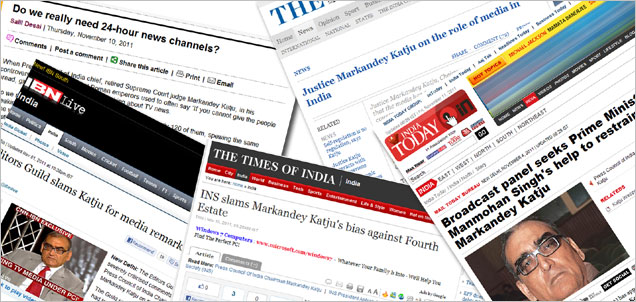
    Earlier in the day, the Executive Committee of the INS took strong objection to the remarks made by the Chairman of the Press Council of India in a television interview and in subsequent statements issued by him to the press. The Executive Committee of the INS noted with dismay that the Chairman’s remarks demonstrated a deep bias against members of the Fourth Estate and that such bias would adversely affect the functioning of the Council in its quasi-judicial role.

    The Executive Committee strongly felt that the Chairman had undermined his own position as Chairman of the Press Council of India and that of the Council, by categorizing a majority of media people as being of poor intellectual level. In a strongly worded letter addressed to the Chairman of the Press Council of India, the INS President urged him to withdraw his remarks.

  • More bite for toothless PCI?


    By Akash Raha

    Recently Chairperson of Press Council of India (PCI), Justice Markandey Katju triggered a volley of criticism and discussion after he lambasted the broadcast media, saying most of them suffer from “very poor intellectual level”. He went on to suggest that broadcast media should come under the purview of the PCI. MxM India asked some well-known media faces what they think.

    Arnab Goswami, Editor in Chief, Times Now and Vice President, Broadcast Editors’ Association (BEA) told MxMIndia: “I don’t know why Justice Katju is making these comments. There is absolutely no need to try and demolish the principle of self-regulation in TV news which ensures that electronic media is free and out of control of vested interests. Justice Katju should not make these sweeping generalizations.”

    Upset over Justice Katju’s comments on the media, former Chief Justice of India J S Verma too is reported to have recently called the PCI an “ineffective” body and said it should wrap up if it does not meet its mandate. Verma chairs the News Broadcasting Standard Authority (NBSA), which is set up by the News Broadcasters Association (NBA). In a recent statement Verma said that he is “deeply anguished” with the kind of language that Justice Katju uses which “sounds authoritarian”. NBA has requested the Prime Minister to stop the PCI from meddling with the dealings of broadcast media.

    On whether broadcast media should come under the ambit of the PCI, Rajdeep Sardesai, Editor in Chief, IBN18 Network said “I believe that the self-regulation mechanism which has been put in place by major news broadcasters must be allowed to strengthen itself. The Press Council has been unable to curb pernicious practices in the print media such as ‘paid news’, so I don’t see how mandating it to now to oversee the electronic media will serve any purpose.”

    Talking about whether he thinks electronic media should be brought under the purview of  PCI Paranjoy Guha Thakurta, an independent journalist and critic, said, “The electronic media needs to be regulated independently – this is because self-regulation is inadequate and ineffective under certain extreme circumstances. The regulator should be independent of both media interests – including the interests of the big corporate media – as well as the government. Even if the regulator is funded by the government, it can be truly autonomous and/or independent if it is Constitutionally mandated thus – such examples include the Supreme Court of India, the Election Commission of India and the Comptroller & Auditor General of India. Ideally the electronic media should have a separate regulator. Even if the ambit of the Press Council of India is widened to include the electronic medium, it has to be made truly independent and autonomous and, most importantly, empowered. The Press Council in its current form has no punitive powers and is hence akin to a toothless tiger.”

    To put things in perspective, PCI was established as a statutory print watchdog by an Act of Parliament in 1978. In recent times, PCI has come under question following chairperson Justice Markandey Katju’s recent remarks on the state of the media in India and its inability to keep a check on paid news.

    When asked if Justice Katju was trying to police the media, Mr Guha Thakurta played down the suggestion, saying, “The Press Council of India is a quasi-judicial body set up an act of Parliament. The way it is supposed to function has been clearly laid down. There is no question of Justice Katju (or for that matter, any Chairman of the Press Council) acting as either a good cop or a bad cop.”

    The question remains, should news broadcast come under the ambit of PCI? One of the reasons for opposing such a suggestion remains that since PCI has been unable to check the menace of paid news in print, there is no reason why it should make any positive change in the broadcast industry. Another argument says that the only reason why PCI has been unable to make a change is because it is still a toothless quasi-judiciary body and the government needs to empower it and give it some tooth. Either way, in this chatter and amidst much confusion is set Justice Katju and his criticism of media professionals as he sees them as naïve and stupid. Criticism which has obviously riled the veterans of the broadcast industry.

    In the wake of this controversy, several discussion forums are being organized on the PCI, the question of paid news, etc. The Foundation for Media Professionals (FMP) is organizing a panel discussion in collaboration with the Press Club of India on the topic ‘Media and Public Interest: Freedom vs Accountability’ on November 12 at Press Club of India, New Delhi. The panelists at this discussion will be Markandey Katju, Rajdeep Sardesai, Neelabh Mishra, Zoya Hasan, Pankaj Pachauri, Abheek Barman, Madabhushi Sridhar and Paranjoy Guha Thakurta with T R Ramachandran as moderator.

    Later, on November 18, MxMIndia has partnered the event ‘Paid News: Fooling People all the Time’ organised by Moneylife Foundation and Citizens Action Network with the support of industrialist Cyrus Guzder to be held in Mumbai’s Madame Cama Hall. The evening will see the screening of the documentary ‘Brokering News’ followed by a panel discussion with senior journalists and the film-maker Umesh Aggarwal. The panelists at this discussion are Umesh Aggarwal, Ayaz Memon, Paranjoy Guha Thakurta, Bhawana Somaaya, and Sucheta Dalal. This panel plans to discuss the issue of paid news, which has been a bugbear even for regulatory bodies such as the PCI.

    For more: http://www.mxmindia.com/2011/11/mxmindia-partners-%E2%80%98paid-news%E2%80%99-event/

  • Hard Knocks: Sadly, Mr Katju may have a point

    By Anil Thakraney


    The Chairman of the Press Council of India, Justice Markandey Katju, is determined to sort the Indian media out. Some days back I expressed skepticism on whether he’ll succeed in his noble endeavours. Here’s the link to that piece.

    http://www.mxmindia.com/2011/10/hard-knocks-katju%e2%80%99s-unreal-expectations/

    It appears Mr Katju read my post (hehe), and perhaps out of frustration, has lashed out at the Indian media. He’s basically questioning our skills, integrity and competency levels. Naturally, there’s collective outrage in the media frat, and an angry desi media is a dangerous beast, you don’t mess with it. I would be quite surprised if Katju remains for very long in his chair.

    Having said that, and having been sufficiently offended, we need to once again take a hard look and check if what the man says is entirely wrong. Some soul-searching would actually do us good, and perhaps we’ll hire better personnel in the media. So let’s examine Katju’s critique and his three key problems.

    He says the Indian media divides people on religious lines and is anti-people. A sweeping generalization, no doubt. But there IS a section of the media that caters to specific communities and their respective communal biases. A section is even aligned with political parties. And this ideological bias comes to the fore during riots and elections. So what Katju says isn’t entirely wrong.

    He says TV channels focus on cricket and other celebrities. And Katju doesn’t like that very much. Well, that’s true. We do pay too much attention to entertainment and celebs, and I am guilty of that too. And often hard news gets buried somewhere. Yes, we do need to worry about excessive flooze in the media, for sure. But I don’t know how this will ever get sorted out. Because the truth is: Advertisers are more interested in Katrina Kaif’s fashion mantra rather than the survival plans of the family members of that RTI activist who got killed. That’s the sad commercial reality.

    He believes journalists have not studied economics, politics, literature and philosophy. Is he entirely wrong? Switch on the news channels and you’ll notice the general knowledge skills of most anchors and reporters. Yes, it needs a lot of beefing up, we have to admit that. Most journalists are too busy chasing celebs to find time to read Shakespeare, that’s another fact of media life.

    Bottom line: It’s easy to get offended by Shri Katju’s crazy generalizations. And dismiss them as outbursts of an angsty uncle. Still, it will serve us well to pay attention. He isn’t entirely inaccurate.


    ***


    PS: Watch this show as Barkha Dutt interviews a Google chief. You’ll notice what a struggle it is for her to have a meaningful conversation with a new media specialist. It’s not her fault, really. Most of us old-world journos would find it tough going. A glaring example of the schism between the old media and the new media. Also, hope Mr Katju didn’t watch this one. Else he’ll accuse us of being zero on media, apart from literature and philosophy!


    Link: http://www.ndtv.com/video/player/news/in-the-google-of-things/215082

  • Goa journo’s sting to expose paid news. No wrongdoing, says Herald editor

    By A Correspondent

    The phenomenon of paid content masquerading as news has been around for a long time. But the issue of ‘political paid news’ came under spotlight especially during the 2009 Lok Sabha elections.

    On Tuesday, Mr Mayabhushan Nagvenkar, a journalist based in Goa, filed a complaint with the Press Council of India alleging that Herald, a leading newspaper in Goa, has been publishing “dubious ‘political’ interviews of aspiring candidates, ahead of the forthcoming assembly elections scheduled for early 2012”.

    With such instances being brought to light, a report compiled by the Press Council of India appointed sub-committee comprising Paranjoy Guha Thakurta and Kalimekolam Sreenivas Reddy “to examine the phenomenon of paid news in the Lok Sabha elections” gains more prominence.

    (The full report can be found at http://presscouncil.nic.in/reportPaidNews.htm.)

    The report states that in the area of political paid news, it is not easy to find evidence that pins responsibility for such corrupt practices on particular persons and organizations due to its illegal and clandestine nature.

    But Mr Nagvenkar has backed his claim with records of four telephonic conversations with Herald’s marketing manager Mr Tulsidas Desai, three of which were recorded on October 20 and one on October 22. The conversations, he says, indicate that the newspaper regularly indulges in such paid political news. He also alleges that the marketing manager of the paper could not have pushed a deal like this without the consent, “tacit or otherwise”, of the editorial leadership.

    The report also makes a note of Election Commission’s concern about the latest complaint  that some of the newspapers even offer packages at hefty sums, offering specific services such as projecting the image of a political party or a candidate in a positive manner or giving negative publicity to the rival party or candidate. The rates of such packages vary, depending upon the standing and circulation of the newspaper in the area covered by the constituency.

    Mr Nagvenkar gave credence to the Election Commission’s concerns recently when, posing as Bernard Costa, a fictitious person seeking to contest elections from the Velim assembly constituency in South Goa, contacted Mr Desai and asked about getting a political campaign interview published as news content.

    “Desai told me, (Bernard Costa), that I could get a political campaign interview (15 inches by eight news columns, to be exact) in the newspaper for Rs 86,400, and for an additional Rs 50,000, I could be interviewed on the Herald Cable Network (HCN), the local cable news channel operated by the same media group. None of the paid content will carry an ‘advertorial’ tag.”

    Mr Desai further explained to Mr Nagvenkar about the interview of a potential electoral candidate, Mr Raymond D’Sa, which was published in the Herald on October 20 and which had cost Mr D’Sa Rs 2 lakh.

    Asked about the repercussions he might face after publishing such an article, Mr Nagvenkar replied that he is no stranger to the media banning him. But he hopes that the Press Council will issue strictures against the newspaper as “it’s an open and shut case and the evidence is irrefutable.”

    (The full text of Mr Nagvenkar’s story can be found at www.paidnewsingoa.blogspot.com.)

    When asked to reply to Mr Nagvenkar’s allegations, Mr Sujay Gupta, Editor, Herald said: “I wish to emphatically deny that any editorial content which has appeared in the Herald, without the “advertorial” tag line has been paid for.”

    To Mr Nagvenkar’s claims of the editorial being in the know, Mr Gupta replied: “Editorial was not in the know of any such negotiations or discussions the marketing had with any candidate or anyone else. The stray remark that “editor people” would be in the know… is also incorrect”.