Tag: Preeti Reddy

  • Marketing Imperatives for Rebound & Recovering


    By A Correspondent


    More than two thirds (69%) of businesses expect to end the second half of 2020 in decline. Just under half (45%) of those expect their business to be down by 20% or less, while one in five of those leaders expects their business to be down in excess of 40% y/y. As news of positive Stage 3 clinical trials emerges, just one quarter (23%) expect their business to recover within a six-month timeframe of a vaccine being widely available, while 41% expect recovery within a year. More than one quarter (27%) expect their business to take as long as two years to fully recover from the Covid-19 crisis.


    In Global Business Compass, a study of almost 4,500 business leaders around the world, Kantar identified that almost two thirds (61%) of companies had reduced their marketing spend by an average of 36.7% in 2020. This included half of companies (50%) cutting comms and media spend by an average of 39.3%. With this widespread economic concern, and the constraints being placed upon marketing, Kantar, the world’s leading data, insights, and consulting company has identified the three core strategies marketing teams should pursue to support their business’s ‘rebound and recovery’ strategy.


    Imperative #1: Digital Transformation:

    Omnichannel and ecommerce is surging. 40% of consumers say they have increased their ecommerce spend during lockdown, rising to 48% of households with children. 45% of consumers will continue shopping with online stores they found during the pandemic. 55% of companies invested in their ecommerce capabilities during the pandemic. The change is not only about online business, new buying patterns and behaviours are emerging making brands and companies more vulnerable to competition. With digital becoming an integral part of the new normal, brands that elevate the human experience will be strongest.

    Marketing teams can drive success through reinventing channel strategies, shifting towards the best performing channels. Testing new models of growth and partnerships (social commerce and direct to consumer) should be on the agenda of every CMO, while investigating changing needs, buying power and the importance of different touchpoints in new ecommerce journeys will inform those strategies. This understanding will require a purposeful data strategy that discovers the power of owned data within the organisation and integrates it with trusted third-party data to understand the new buying signals and deliver that data to the decision makers within the marketing and media teams.


    Imperative #2:  Purpose and sustainability really will make a difference

    The pandemic has made people re-evaluate the importance of purpose and sustainability in their priorities. 85% of consumers think it is important to buy from companies that support causes in which they believe. Brands need to have an impact in people’s lives and the world they live in. Purpose is a systemic stabiliser for brands in times of global economic recession. It is paramount to revive and reinvent relationships that connect the brands to emerging consumer needs. Businesses are under pressure to play a more supporting role in giving meaning to people’s life and position themselves on issues such as diversity, local culture vs. globalism, racial justice, sustainability and community.

    Marketing teams in 2021 should reflect on what explicit or implicit needs are being met and consider the impact you can have on users’ lives, functionally or emotionally. Integrate purpose as a living element of the communication, product, brand experience and brand commitment rather than treat it as an isolated concept. Re-engage with consumers and their issues in a transparent, meaningful, connected way, and be ready to make sacrifices for the public good.


    Imperative #3: Organisation performance and innovation:

    Almost two in three leaders don’t feel they have the right operating model to be competitive. During the pandemic 20% of businesses experienced growth. There are lessons to be learned from these companies that will transform how businesses are run. 59% of companies that achieved growth during the pandemic pivoted their business model, while more than a quarter invested more in innovation. Recovery will require businesses to make drastic changes to old ways of working and significantly review and invest in organisational performance.

    Create a feedback loop with your employees and consumers to ensure your corporate narrative and long-term strategic priorities are still relevant and to accelerate your learning curve and consistently scale best practices. People’s new rituals need to be at the heart of the portfolio innovation strategy. Innovation is one of the key characteristics that enable meaningfully different brands to rebound up to nine times faster. Reinvent channel strategies – remember people crave human connection. Elevate the human experience even in digital environments. Only one in four consumers are satisfied with retailers omnichannel presence. Siloed-organisations that isolate customer experience from sales and marketing need urgent reorganisation to get a holistic view of how to reactivate demand.


    In discussing Kantar’s advice for marketing leaders Rosie Hawkins, Chief Innovation Officer at Kantar said: “Adapting to new conditions and being brave are key to fast recovery. Virtually every business we interviewed for this study agreed that consumer behaviour has changed for good. Whether it is how they shop, their product needs, their customer service needs, we need to reset what we know about customer behaviour in the future. History has taught us that businesses that are brave during these recessionary periods rebound stronger. Understand your changing customer needs, invest as much as possible in gaining share of voice (and share of market), adapt your strategy to leverage more digital shopping and service channels. Every company has an opportunity to reframe the experiences they deliver to offer purpose-driven actions and they should not be afraid of serving this important new role in society.”


    Added Preeti Reddy, CEO – South Asia, Insights Division, Kantar: “In this changing world order, it is an imperative that organisations and brands continue learning about changing consumer preferences and adapting strategies on a real time basis. This will need businesses to be agile and to develop mechanisms that capture information from multiple sources to aid decision making. This will also mean that the need to build stronger, more resilient brands will only increase further; and also to build a strong communication network to communicate brand value and intent to customers on an ongoing basis. Consequently, the role of marketing in driving future strategies of the organisation will become even more significant.”


    Kantar’s three imperatives for rebound and recovery are part of Global Business Compass. More insights can be found on Kantar.com.



  • MxM Newsmakers: Preeti Reddy, CEO – South Asia, Insights Division, Kantar on BrandZ 2020

    By A Correspondent


    Preeti Reddy
    Preeti Reddy

    On Friday, leading media services conglomerate WPP presented the BrandZ report of Top 75 Most Valuable Indian Brands.


    At 6pm today on September 18, Preeti Reddy, CEO – South Asia, Insights Division, Kantar spoke with Pradyuman Maheshwari, Founder and Editor-in-Chief, MxMIndia in an exclusive interview


    Here’s the interview:


  • HDFC stays as #1 in BrandZ ranking


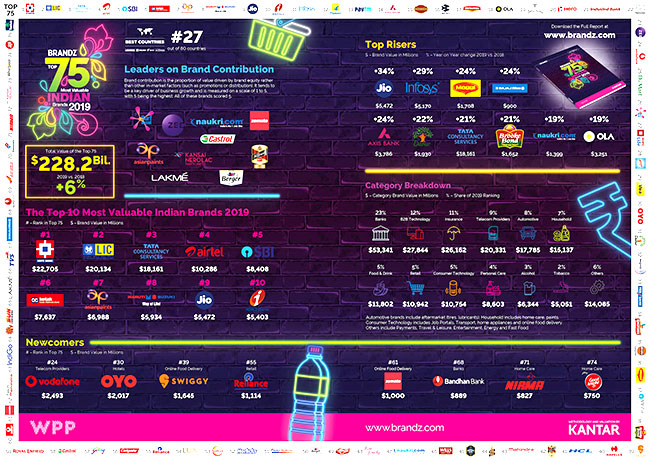
    The BrandZ study, which is the only brand valuation ranking to combine companies’ financial data with consumer insight and opinion, shows that trust is key to develop the stability required for long-term success; highly trusted brands in the Top 75 are worth 129% more than less trusted ones.


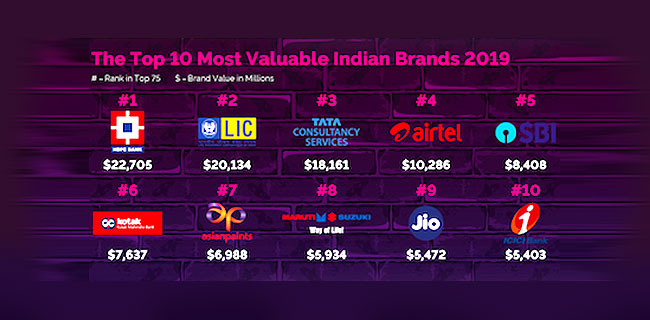
    BrandZ Top 10 Most Valuable Indian Brands 2019

    Rank 2019 Brand Category Brand Value 2019 ($M USD) Brand Value Change
    1 HDFC Bank Banks 22,705 +5%
    2 LIC Insurance 20,134 +2%
    3

    Tata Consultancy Services

    Technology 18,161 +21%
    4 Airtel Telecom providers 10,286 -10%
    5 State Bank of India Banks 8,408 +7%
    6 Kotak Mahindra Bank Banks 7,637 +15%
    7 Asian Paints Paints 6,988 +14%
    8 Maruti Suzuki Automobiles 5,934 -14%
    9 Jio Telecom providers 5,472 +34%
    10 ICICI Bank Banks 5,403 +11%


    Notable brands include ecommerce site Flipkart (No. 12), which increased its brand value 14% to $4.7 billion, while unicorn brands hotel booking site Oyo ($2.0 billion), online food ordering service Swiggy ($1.6 billion) and online restaurant marketplace Zomato ($1.0 billion) are newcomers to the ranking at No. 30, No. 39 and No. 61 respectively.


    The fastest riser in the 2019 ranking is telecom provider, Jio, which climbed one place to No. 9 with a 34% increase in brand value to $5.5 billion. Its disruptive business model has made internet access available to many Indians who were previously unable to afford it, thereby opening up access to digital platforms and services. Vodafone ($2.5 billion) meanwhile was the top-ranked newcomer at No. 24.


    Both digital and offline brands such as D-Mart (No. 25, $2.4 billion) have found success as a result of the rise of ‘middle India’; the growing number of people in the country’s second, third and fourth-tier cities and towns that are changing India’s traditional urban-rural divide.  These previously poorly-served segments increasingly have access to a variety of online services, with Swiggy and Zomato building much of their growth on this shift.


    Said David Roth, CEO of The Store WPP EMEA and Asia and Chairman of BrandZ: “As India flexes its muscles on the world stage, it faces increased macroeconomic headwinds which have combined with a rise in global trade tensions to create a challenging environment.  Successful Indian brands are adapting to these challenges and recognising that longevity requires them to do more than just disrupt the status quo; long-term brand building requires new strategies that major on stability.”


    Added Preeti Reddy, CEO South Asia, Insights Division, Kantar: “Consumer trust is a common thread among successful brands. However, it is concerning that only a few have succeeded in growing trust over the last five years. Those who done so, have done it through open and honest conversations with their customers. Brands would do well to consciously work at building consumer trust – it is the shield that gives a brand the resilience to face headwinds in uncertain times.”


    Said Vishikh Talwar, Chief Client Officer, Kantar Insights Division: “The rise of ‘middle India’ combined with rapid growth of the mobile internet is providing unprecedented opportunities for brands.  But, with an almost overwhelming choice of products and services to buy, consumers are increasingly discerning; the Indian psyche requires that brands cater for local needs with offerings that genuinely improve daily life. Today that’s as much about providing comfort and reliability as it is about generating new experiences.”


    Key trends highlighted in the BrandZ Indian Top 75 study include:

    :: Mobile internet access:Smartphone user numbers in India increased by 18% in 2018 (the fastest rate of growth in the world), mainly due to a combination of Jio’s own low tariffs and the renewed competition causing other telecom providers to reduce their rates.


    :: Buying power:Retail is the second fastest growing category, with online and offline both growing strongly. New entrant Reliance Retail (No. 55, $1.1 billion) opened  nearly 500 new stores and used Jio’s service to connect retail shops with grocery deliveries, while D-Mart ($2.4 billion) focused predominantly on offline, rising two places to No. 25.


    :: The Amazon effect: Amazon and Flipkart compete with many Indian brands across several sectors, with Amazon also opening its largest campus yet in India.  This has increased competition and driven brands to step up their operations to ensure they are meeting customers’ needs.


    :: A confident country: The success of unicorn brands such as Swiggy, Zomato and Oyo is fostering a new-found confidence in India. This is augmented with the increasingly global outlook of these new brands as they actively seek to expand their operations outside India.


  • WPP and Kantar launch their cross-industry initiative, IRG

    By A Correspondent


    WPP and Kantar announced the launch of their latest global cross-industry initiative -Institute for Real Growth (IRG) in India. IRG, notes a communique, is the first programme of its kind to help CEOs, CMOs and other senior business leaders to drive more effective growth strategies.


    The not-for-profit, independent Institute, co-founded by WPP along with Facebook, Google, Kantar, LinkedIn, the NYU School of Professional Studies (NYUSPS), Saïd Business School at the University of Oxford, Spencer Stuart and Mobile Marketing Association (MMA) aims to help organizations focus on sustained, long-term real growth by equipping leaders with best practice approaches to their strategy, structure, capability and leadership.


    The IRG was launched in India at an event titled ‘Real Growth Summit’ held recently in Gurugram and attended by numerous top leaders from major corporates.


    Said CVL Srinivas, Country Manager, India for WPP: “The study highlights that the definition of growth is very subjective in India. This reality makes it critical for businesses to identify what will drive real growth for their business. IRG has been founded for this very reason – to help organisations achieve sustained long-term growth by enabling its leaders with proven approaches which are based on knowledge, innovative thinking and peer to peer coaching and partnership.”


    Added Preeti Reddy, CEO – South Asia, Insights Division, Kantar: “Growth is hard and is becoming even harder. Companies are realising that the old formulas no longer guarantee growth and that growth itself is becoming episodic. They need to develop an architecture for ‘real growth’ and approaches that will deliver sustained all round growth. We are delighted to collaborate with the IRG program and inspire clients and our leaders to embrace these new approaches to meet the challenges of growth.”


    Said Marc de Swaan Arons, co-founder of the Institute for Real Growth: “Together with my co-founder Frank van den Driest, we have expanded on WPP’s global growth study to create an industry-wide program that is focused on helping senior leaders make better business decisions and steer their organisations on the growth journey. IRG is the only platform where growth leaders can learn from world-class Over performers and topic experts and collaborate with peers to solve their specific business growth challenges.”


  • Irvinder Kaur is India Lead, Analytics Practice at Kantar

    By A Correspondent


    Kantar has announced the elevation of Irvinder Kaur as India Lead for the Kantar Analytics Practice. Kaur will oversee the delivery of analytics offerings and drive the growth for India business.


    Said Preeti Reddy, CEO South Asia, Insights Division, Kantar:  ‘‘Irvinder’s experience across marketing, sales and analytics will help Kantar deliver better marketing ROI solutions for our clients. This is a core focus area for Kantar and we are confident Irvinder will give it the impetus it needs.”


    Added Sunder Muthuraman, CEO APAC and Global Chief Client Officer, Analytics Practice, Kantar: “Irvinder has been a co-creator of innovative data driven solutions with a focus on addressing client challenges in data analytics and ROI management. An approach that not only makes her a trusted partner for the clients, but also a strong business leader for the company.”


  • Internet usage in India > half a billion people: Kantar IMRB


    By A Correspondent


    Kantar IMRB has released its ICube 2018 report on digital adoption and usage trends in India. The annual tracking study, considered as the currency for digital adoption in the country, gauges the changing digital ecosystem in India, measuring Internet usage by demographic, activity and device segments.


    Said Preeti Reddy, CEO, Kantar South Asia:  “The Internet is transforming the way consumers and marketers interact with each other in today’s digital world. Kantar IMRB’s ICube; which has tracked the digital evolution in India for last 20 years, provides key measurement metrics necessary for planning any digital marketing or communication initiative. ICube continues to provide government, policy makers, digital businesses, marketers and communication specialists the intelligence necessary to stay on top of the developments across different facets of digital platforms and services.”


    Key findings include:

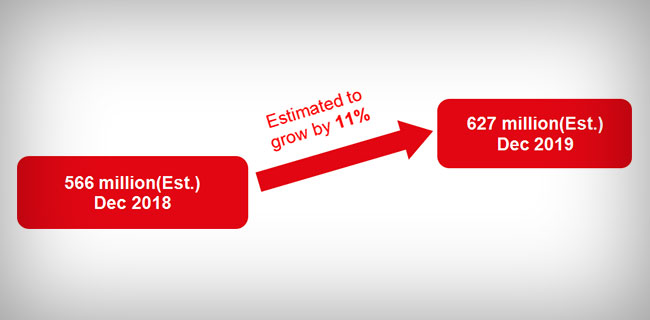
    :: The number of Internet users in India has registered an annual growth of 18% and is estimated at 566 million as of December 2018 – 40% of overall internet penetration.

    :: The report also projects double digit growth for 2019 and estimates that the number of internet users will reach 627 million by the end of this year.


    :: Of the total user base, 88 percent, or 493 million Indians, are defined as regular users, having accessed internet in last 30 days. 293 million active internet users reside in urban India, while there are 200 million active users in rural India.

    :: Unsurprisingly, the 97% of users use mobile phone as one of the devices to access Internet


    Rural India’s Digital Frenzy

    While internet users grew by 7% in urban India, reaching 315 million users in 2018, digital adoption is now being propelled by rural India – registering a 35% growth in internet users over the past year. It is now estimated that there are 251 million internet users in rural India, and this is expected to reach 290 million by the end of 2019.

    Increased availability of bandwidth, cheap data plans and increased awareness driven by government programmes seem to have rapidly bridged the digital gap between urban and rural India. Consequently, the penetration in Rural India has increased from 9% in 2015 to 25% in 2018

    :: Bihar shows the highest growth in new Internet user addition

    With one of the highest growth rates in the state GDP, it is no wonder that Bihar registered the highest growth in Internet users across both urban and rural areas; registering a growth of 35% over last year. This is closely followed by Orissa.


    Internet is now more gender balanced than ever before

    The gender digital divide is now closing. Kantar ICUBE 2018 reports that women today comprise 42% of total Internet users. Besides their sheer presence in the digital universe, women are also equally engaged and active in the digital world – spending as much time on the Internet as men.


    Added Hemant Mehta, Managing Director, Media and Digital, Kantar IMRB: “The latest edition of Kantar IMRB ICubeTM report shows that today the digital base in India is growing by over 75 million users each year – as much as the entire population of Germany! It is fascinating to note that the digital revolution is now sweeping small towns and villages perhaps driven by increased accessibility at affordable data costs. What is also particularly interesting, is the increase in the usage of digital in Rural India, where more than two-thirds of active internet users are now accessing the internet daily to meet their entertainment and communication needs. Marketers have a big opportunity today where they can use digital to reach their consumers – both in urban and rural India.”


  • Kantar​ ​& GroupM combine analytics teams to launch Kantar Analytics Practice

    By A Correspondent​


    Kantar, WPP’s data investment management division, ​has announced the launch of a new global analytics practice that unlocks deeper insights to fuel business growth.​ ​Integrating analytical capabilities from across the company, Kantar Analytics Practice will combine the ​an understanding of consumers with a​n ​analytics toolkit. In India, WPP has combined the Analytics teams from Kantar and GroupM to form one combined practice.


    Kantar Analytics Practice ​will ​offer capabilities across five areas of expertise:

    :: Brand and Media ROI: Maximising value creation from brand and media investments, by balancing short-term sales performance with long-term brand valuation and profitability.


    :: Customer Analytics: Making the right operational and strategic investment decisions in customer experience and loyalty marketing, to maximise the value of each and every customer relationship.


    :: Segmentation and Activation: Targeting your highest potential customers and prospects with personalised content, to drive profitable growth with maximum efficiency.


    :: Innovation Analytics: Optimising your customer-led innovation lifecycle for long-term growth, from spotting new trends before your competitors, to optimising the profitability of your product launches.


    :: Retail and Shopper Analytics: Maximising the commercial return from your investments in sales, retail and e-commerce via optimising decision-making in channel choice, assortment, promotions and pricing.


    Discussing the launch, Eric Salama, CEO Kantar, ​said:​ ​“Less than half (44%) of advertisers believe they have the right, actionable data. Clients feel data rich but insights poor and impact short. Kantar is unique in having the most complete view of consumers across the entire demand cycle: the way they live, feel, shop, watch and post. Combining our insights with data from across any client’s organisation can unlock deeper insights that fuel growth. “


    ​Added CVL Srinivas, Country Manager WPP India & CEO GroupM South Asia​: “The new practice addresses the clients’ ask for data driven transformation for better ROI from marketing investments in the digital era. GroupM and Kantar have been working closely together in India, co-creating services for our clients. The launch of the Kantar Analytics practice is another step in this direction and demonstrates the ability of our group to come together to provide enhanced value for clients”.


    ​Said ​Preeti Reddy, CEO Kantar South Asia​: ​The practice formalises the connected journey with GroupM in bringing data driven products to the markets like Campaign Watch (for during campaign ROI management) and consulting services on TV audience measurement data. Proprietary assets like SAAS platform ‘Athena’(built in India) will offer marketers a predictive and near real time opportunity to add up to 20% improvement in ROI from marketing investments including those in e-commerce.And, in Sunder Muthuraman, who will take over as CEO APAC & Global Chief Client Officer, we have a great leader for the practice’.


  • Kantar IMRB appoints Paru Minocha as the Head of Qualitative Business

    By A Correspondent


    Kantar IMRB announced the appointment of Paru Minocha as the Head of Qualitative Business Unit. She has taken over from Rohini Abraham. Paru joined Kantar IMRB in Sept 2015 and is based in Mumbai. She will play a key role in leading the company’s go to market services and drive the growth of the qualitative business pan India.


    Armed with over 20 years of experience in Market Research, Paru started her career as a qualitative researcher in MARG and went on to set up and head Synovate in Delhi. Having done this successfully, she moved to Mumbai to head Synovate pan India and subsequently, as Head of Innovation in IPSOS.


    Paru boasts a well-rounded experience in market research, a mix of both qualitative and quantitative research. She has expertise in several sectors including Social, FMCG, Tobacco and Automotive.


    Commenting on the appointment Preeti Reddy, CEO, Kantar Insights, South Asia said, ‘’Paru’s experience in both Qualitative and Quantitative will prove to be an asset. She brings in a deep understanding of research, complex business environments and client needs. Paru’s cross sector experience will certainly aid IMRB Qualitative to rise to greater heights under her stewardship”.


    Speaking on her appointment, Paru Minocha said, “I’m thrilled to be leading this role when the core Qualitative research is being redefined. I look forward to leveraging technology, social media data and marrying them with the primary survey data. This new approach is also reflected in how as a company we are organized and the investments that we are making in technology and digital. As Kantar IMRB, we have unique access to social data, proprietary syndicated data as well as strong partnerships with third party data owners. I strongly believe that qualitative research would form an integral part in decoding and making sense of the big data


  • More efficiency & productivity with Kantar First


    Earlier this month, WPP group’s Kantar announced a new corporate identity and management structure. This meant that operating brands not previously Kantar-branded now have a Kantar prefix and a new, common typeface.  For example: Millward Brown, IMRB, and TNS will now become Kantar Millward Brown, Kantar IMRB, and Kantar TNS. MxMIndia had a detailed chat with Preeti Reddy, CEO of Kantar South Asia- Insights, who leads Kantar’s India & South Asia operations


    Congratulations on being elevated to the position of head of Kantar’s India operation as CEO of Kantar South Asia- Insights, and this in year after taking charge of IMRB. Can you talk us through the change that has been effected?

    The change was brought about as a end result of a strategy that Kantar Worldwide put into place where the strategy is called Kantar First and the intent is to try and offer clients the best of Kantar all the time and not only on occasions. Clients have been asking us to be more responsive, more agile and more collaborative because they realise that across Kantar if you look at the work that we do, the assets that we have, the people we have. The real benefit to clients come when we give them solutions that access excellence across Kantar. So, essentially the strategy was one of bringing in more efficiency and productivity and the ability to invest in operations which is the foundation of our business and shared services so that all the Kantar brands enjoy that and you actually have scale to be able to invest in technology for efficiency and productivity and then at the client end, offer clients the benefit of getting service from various brands that Kantar has.


    So you have all three working under Kantar umbrella?

    One of the key elements of this strategy was to create a management structure under Kantar insights which has three insight companies under it. In India, the three companies are – IMRB, TNS and Millward Brown. These are very powerful brands in their own right but what we are doing now is that we are saying that they all come from the stable of Kantar so all the brands will be prefixed with Kantar to say they are from the same family yet they are different and they are strongly differentiated. The values and benefits that each one of them brings are different, so clients will have the choice of choosing from the best, choosing depending on the business situation actually choosing the solution that each one of them offers whichever they think fits their requirements best and also in some situations, the solution may be one or two or three of the companies coming together to offer the client a solution. This is really a unique model and it’s a very powerful mix because you can come together when the client needs it and you can diverge when that is the solution that the client needs.


    The WPP group of which Kantar has several agencies run separately, often each of them doing things differently. Like in the case of creative agencies. And it also has media agencies under GroupM. So would you say the new Kanar – with the three  brands- IMRB, TNS and Milward Brown- will be a conglomerate like say GroupM?

    In a sense yes, because GroupM has various companies under the umbrella of GroupM. So, yes, it is similar to that and they each retain their individual branding and their individual identity so yes it is amalgams to that model. The other thing that we have done as a part of the strategy is  we are creating one another new brand in India which is going to be called – Kantar Public which will be launched in September, under which we will sit all the government and developmental and political work that we do


    While the objective of the integration is to facilitate seamless solutions to all the clients of the operating brands, how do you ensure that each company has its independence?

    They all have their own CEOs. They all have their own products and services. We are encouraging co-locations but even when we locate together they will maintain their separate identity. Also what each company stands for and how they deliver their service is going to be quite differently positioned.


    Could you talk to us about the individual companies – IMRB, TNS, Millward Brown. Millward Brown has a new head. Also, now that you have taken on a larger role, will IMRB have a separate business head?

    I took over IMRB in September [2015] and IMRB is very large and complex. Luckily for the person who runs IMRB, it is run by very senior people highly respected in the industry and they run their own units independently. So for sometime I will be the person heading IMRB. Kantar is also encouraging senior people double-hatting in some of their roles. Millward Brown has its own CEO, TNS has and I look after IMRB as well as South Asia.


    And will they compete with each other like a Maxus competes with Mindshare?

    Absolutely, in fact in 80-85% of the cases it will be business as usual where we will compete. In the balance 10-15% of cases where the real benefit to a client is because of the collaboration and there are many clients who are asking us for that. In the sense they appreciate what Millward Brown brings to the table, what IMRB or TNS brings to the table but they often also want holistic solutions. So we will collaborate there but otherwise yes, we will compete against each other.


    Since you are going to be leading Kantar, it would be interesting to know the services and best practices that would now be adopted and offered to the clients? For instance, how will Kantar IMRB be different from IMRB?

    IMRB will also be now part of a far more global network. Earlier, Millward Brown and TNS were already global brands whereas IMRB is a regional brand but it’s a very strong brand in the region. So the difference it makes to IMRB is that it is now part of a global network and we are looking to see if India as a county can actually can play a stronger role in Kantar. One of the key elements of Kantar’s new strategy is that they have identified nine countries which are focused markets because they recognise the importance of these countries and India is one of them. So India is important because it is a growing emerging market. It is also important because the three Kantar companies together have the highest share of business in this market. It is also an important market because given capabilities that we have in India it is absolutely possible for reverse innovation to happen. Instead of new thinking, new products new services coming from the West to us, we are saying that we are emerging marketing experts, developing marketing experts and we can do fragile, agile innovation for you that you can take to the rest of the world.


    Can you share some thoughts about Kantar’s immediate plans in the region. And how is it in other parts of the region – Sri Lanka, Bangladesh…. And is Pakistan also part of the region for Kantar?

    Pakistan is a part of the Meena region for us. It is very difficult for us to do business in Pakistan from here. It’s much easier to do it from Dubai. So that’s not part of the region. Bangladesh and Sri Lanka are in a sense microcosms of India and they are at different stages of evolution. To some extent they do look to India for new thinking, new products and services but at the same time many of our clients have; like MNCs and even our large indian clients have to look at the region as a whole for them. Servicing them across the three markets and ensuring that protocols are followed and that the best of Kantar is given to them in all three markets is actually a benefit for them.


    A word on the challenges that lie ahead of the insights business?

    Everybody in the insights business realised that the industry is undergoing a transformation because consumers are changing. Consumers are far more connected and are changing in ways that makes clients themselves now look for much quicker, agile and holistic understanding of consumers. So the first demand that’s been made on us is on speed and agility. The next demand that clients are making on us is that it’s no longer about do this survey and give me the findings. Consumers themselves are generating so much data through social media, through all the opinion that they offer so its about now integrating a multiple data sources of which primary questioning of the consumers is only one data source. The most significant change that’s happened is the connected consumer and digital and it’s because of mobile phones. Recognising that and being ready for that is really the most important challenges that we face.


    There are also a few new practices that you have announced… Kantar Public and Kantar Consulting. What is the roadmap for these?

    The three Insights brands are already there and they are strong. Kantar public has already been announced and will be launched in September. We have another brand in India – Kantar World Panel which has been there for sometime now. The other brands that are present globally but are not in India is- Kantar Health, it is there in a smaller way, There is a team which does Kantar Health work here. What is not available here is Kantar Consulting which is a new brand that Kantar proposes to develop which actually is a coming together of various consulting businesses that they have – Added Value, Vermeer and the futures company. That’s not yet present in India but yes we are looking to see when the market will be ready for us to bring that in. it’s unlikely in immediate future.


    Kantar is also a 50 per cent partner in TAM.  Given that television measurement – which was the bulk of the revenue earner – is out of its purview, what is the plan for TAM?

    TAM audience measurement business has moved to BARC but now there is a joint venture which has formed between TAM and BARC which will do the data collection and provide the data to BARC. BARC will release the currency. TAM will continue to be in business of ADEX and other businesses that they had like Eikona and sports measurement, etc. So other than audience measurement business the rest of it will stay will TAM.


  • Kantar unveils new corporate identity & management structure

    By A Correspondent


    WPP-owned data, insights and consultancy network Kantar has announced the launch of a new corporate identity- for the parent brand and its 12-strong family of operating brands- designed to create a unified look-and-feel across the whole business. Operating brands not previously Kantar-branded will now take a Kantar prefix and a new, common typeface.  For example: Millward Brown, IMRB, and TNS will now become Kantar Millward Brown, Kantar IMRB, and Kantar TNS.


    Kantar’s new identity reflects and externalises an on-going change programme that started in January. The programme includes greater collaboration between operating brands and the creation of a new insights group through much closer alignment of the company’s custom brands. In addition, global operations capabilities have been brought together into a single entity and the company is moving towards more aligned shared services in HR, finance and IT. The company will shortly be adding to the portfolio of expert brands with the launch of Kantar Public, uniting its global expertise in governmental and public policy work; and Kantar Consulting, which will draw expertise from several of our brands to provide a full and broader range of marketing and sales consulting solutions and capabilities to our clients.


    Commented Kantar CEO Eric Salama: “The rebranding is a tangible, visible expression of our desire to present clients with more easily-navigable and connected solutions that bring together the best of Kantar’s expertise,” adding: “We believe our clients and partners have started to experience the benefit of this approach – in more rounded, detailed and holistic research and recommendations. And it is helpful that for the first time we really look like a single family of brands serving a common purpose.”


    Along with the rebranding, Kantar is introducing a new tagline, “Inspiration for an extraordinary world”, drawn from its new corporate purpose statement, “To inspire our clients, our people and society to create and flourish in an extraordinary world.”


    Said Preeti Reddy, CEO, South Asia – Insights, on the rebranding: “Clients have consistently asked us to be more collaborative in the way we work with them; faster and more agile at a local and global level. They want the ‘best of Kantar’ on a consistent basis, not just on occasions. Earlier this year, we put in place a whole new way of working to remove siloed thinking and barriers between the Kantar companies to collaboration for client benefits. In South Asia, we will be able to bring together the thought leadership of three powerful brands and harness the power for our clients. This combination brings with it an ability to converge thoughts when required to solve a problem as well as an ability to diverge solutions when clients need choice. That is a unique mix and in, my view, will make Kantar an even more dominant force in South Asia.


    The new identity, developed by WPP branding firm The Partners, will be rolled out across all external and internal communications channels in the coming months.

  • It’s all about the consumer for IMRB


    By Anuka Roy


    The weather was very unpredictable in Mumbai. But the interesting conference by IMRB International did not let it affect the moods of the people who attended it. K Ramakrishnan or Ramki as he is popularly known,General Manager and Country Head – Household Panel at IMRB Kantar World Panel and the host for the day, welcomed the audience to ‘Consumer Connections 2016’.


    To explain the agenda in brief and to give the audiences a head start about what to expect from the conference this year, Ramakrishnan invited on stage Preeti Reddy, ‎CEO at Kantar Consumer Insights, South Asia, Kantar and Josep Montserrat, Global CEO at Kantar Worldpanel. They explained how useful this research will be for brands to reach out to consumers in a better way. Montserrat also focused on the work they have done and the potential that India has. For making the session a little fun, the host subjected the two experts to a quick round of rapid questions, which both answered quite rapidly as well as wittily. An example, when Reddy was asked what comes to her mind when she hears about research in India? Pat came her reply, “Over worked and under paid.”


    This was followed by the presentations about consumer trends to look forward to. Rashmi Nair, Group Business Director, IMRB Kantar Worldpanel presented about ‘What lies ahead for urban India in 2016’. Her presenting was engaging from the word go and she very intelligently incorporated many popular Bollywood movie dialogues to explain her topic. She gave example of Patanjali- the brand which doubled its sales in just one year. This shows the trend of demand for local brands. She also explained how more focus is now given on the aspirations and lifestyle of the rural people.


    Next presenter Prafull Babar, Group Business Director, IMRB Kantar Worldpanel was an instant hit with the audience because he gave chocolates as a prize whoever gave a close enough answer to his questions. His topic was ‘Penetration Rules’. He explained the five key principles of buying behaviour, which were as follows:

    :: Brands grow fastest by attracting more buyers, not by getting buyers to buy more often

    :: Plenty of penetration headroom, no matter how big you are already

    :: Most of your buyers only buy you once in a year

    :: Your buyer base is in constant churn – over a third will not buy next year

    :: When buyers come, frequency will follow – no need to chase


    ‘New products Benchmarks’ was explained by VinayKhamkar, Business Director, IMRB Kantar Worldpanel. He explained that one key way to gain newer buyers is launching new products. The fact that consumers can set norms for successful launch of products was clear through his presentation. One of the key learning from this presentation was that new variants do better than new brands. He further explained about how the norms have been calculated and the research that has gone behind this study.


    Consumer Mix Model (CMM) evaluates how consumers respond to different media campaigns by analysing their impact on purchasing behaviour. This was presented by Devika Satam, Insights Director, IMRB Kantar Worldpanel. She explained that the consumer is at the heart of every marketing strategy. CMM evaluates the impact of media. It helps brands to understand the consumers’ response, optimize the media mix for better returns and calculate ROI (Return On Investment) based on actual purchase behaviour.


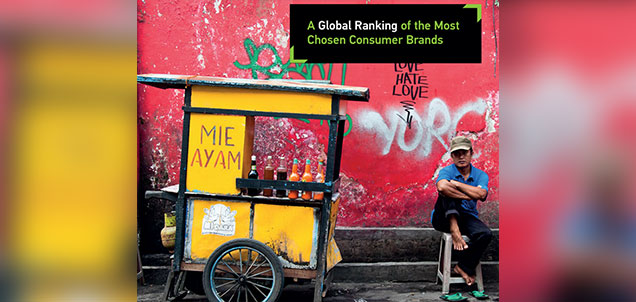
    Andy Parkinson, Global Markets Director, Kantar Worldpanel spoke about the book Brand Footprint on global ranking of the most chosen consumer brands by Kantar Worldpanel. Parkinson said Coca Cola remains the number one chosen brand of 2016 and the rise of Sunsilk has been consistent and very surprising. He also explained the entry of Indomie noodles, an Indonesian noodle brand in the global list. The reason behind local brands succeeding was the main focus of his presentation and one of the key reasons was identified as the affordability of the brand. On the other hand, Henry Swann, Global Solutions Director, Kantar Worldpanel gave an overview of the World Panel Online. It is an online data and analysis tool which gives global access to insights anytime and anywhere.


    Hemant Mehta, Senior VP, Media and Retail, IMRB concluded the conference by giving a summary of the presentations. He also gave an insight of what they are working on currently, which were Data Management Platform (DMP), data integration and behaviour based segmentation to power activation.


  • SIMC’s ‘Research Clairvoyance’ explores the world of Collaboration

    By A Correspondent


    Symbiosis Institute of Media & Communication, Pune hosted the Research Clairvoyance on January 24, 2016 as a part of the “Inspire Series” which is a series of events and lectures to commemorate 25 years of the Institute. The theme, “Transforming the world through Collaboration” stresses on the evolution of the research industry as a result of widening horizons, new technological innovations and focus on effective and time-saving methods of research through collaboration.


    Preeti Reddy

    The speakers comprised of eminent market research professionals, namely, Preeti Reddy (President & CEO at IMRB International), Shobha Prasad (Director at Drishti Strategic Research Services Pvt. Ltd) and Raj Sharma (Co-Founder and President, Majestic MRSS). These renowned gurus spoke about the need to walk the fine line with neurological measurements, which has revolutionized the way research is conducted and disseminated in the digital age, along with talent acquisition.


    The keynote speaker, Preeti Reddy kick started the event by addressing the dramatic change that the market research industry has witnessed. With the creation of new cohorts, new touch points have also emerged. She expounded that this can be attributed to the growing pervasiveness of digital technologies, which allows us to connect and synthesise data through collaboration, leading to a shift in the way research is being undertaken. She continued to explain that technology allows us to ameliorate from a sample to census, leveraging behavioral data more than ever, which leads to collaboration of disparate sources of data. Thereby, the role of research will be to bring the “Whys to the Whats” to analyse consumer behaviour patterns. Addressing the industry changes, she has identified trends such as social listening analytics, processing behavior data in motion, movement away from direct questioning to implicit understanding and data scientists becoming the new insights experts. As a result, it is inevitable for research agencies to be multi disciplinary.


    Continuing the discussion on changing trends, Shobha Prasad spoke about the blurring boundaries within qualitative research, stressing on the fact that co-creation can lead to richer insights and a more meaningful dialogue between the marketers and consumers. She further explained, “It allows us to reach them better and get real time insights to gauge their thoughts and emotions.” She opined that brands today are seeking methods to discern customers better and have an in-depth  understanding and experience with them. She espoused, “Marketing has become one on one, so you need to have a deeper human understanding of that one person.” In conclusion, she believes that brands have realised the importance of being flexible and try and engage individual consumers through storytelling.


    Raj Sharma

    Talking about ‘Revolutionizing the way research is conducted and disseminated in the digital age,’ Raj Sharma stated, “We’ve moved to implicit research.” He explained that the research methodology being employed has changed exponentially and there exists a possibility of all stakeholders becoming active participants. Further, he elucidated that platforms like mobile applications are being exploited to undertake usability research. Eye trackers, access panels and perception analysers are being put incorporated in research, along with methods like neuromarketing, sensory panels and facial decoding to gauge the most accurate feedback from the consumers.


    Shobha Prasad emphasized on the ease of training business graduates to understand consumer psychology rather than going about it the other way round. On being asked about the attributes of aspiring researchers, Preeti Reddy suggested that aspirants must be more curious about consumers and their motivations. They should be open to solving problems and seeking solutions.


    The Research Clairvoyance was insightful and gave the students a new perspective into the world of research and the changing dynamics within it. “We have experienced an introductory level of research till now, but the experts have shed light on real time industry exposure. It also gave us an overview of the various innovative tools available for carrying out processes,” said Nupur Kedia, a first year Media Management Student at SIMC.