Tag: PReamble

  • Siddhartha Mukherjee: 10 Delightful Achievements by our Indian PR & Corporate Communications Industry

    By Siddhartha Mukherjee


    Though not much has changed in terms of the ground level conditions that were actually meant to catalyse the growth and prosperity of our Indian PR and Corporate Communication Industry, I think the story lies in the fact that despite no change at the ground level, our PR Agency and Corporate Communications army has still managed to pull off a wonderful turnaround and facelift for the Industry.


    If you look back, both the Corporate Communications professionals as well as the PR Agency service providers have achieved various small and big milestones that have helped move the needle!


    Below is a list of 10 Key Achievements of our Industry:

    1. Better placed in establishing Accountability & ROI: For a function that has always struggled to establish REAL value, it has proactively come a long way in establishing its effectiveness through right measurement, research and higher dependency on data. What started as a function that was all about news management, volumes of news garnered, equivalent advertising value and negative news nipped, today, given its aura, this function literally starts and ends each day with Scientific Measurement and Research data.

    2. Attracting larger budgets: The above point is encouraging internal customers to invest more on this function.

    3. Expectation beyond Media Relations and News Management: Slowly, but steadily, the PR & Corporate Communications function has been able to establish that their skill sets is actually into Brand Management and not just News Management.

    4. Managed a seat at Strategic/Board Meetings: Given all this, the PR & Corporate Communications professional has carved a well-deserved seat for itself in Strategic or Boardroom discussions.

    5. Well acknowledged Employer Category on Job Portals: There was a time when not all job portals will separately acknowledge and highlight PR & Corporate Communications as a potential employer category. Today, it is right there!

    6. Participation in Plenty of Global and GloCAL Gratification platforms: Our Industry needs gratification. Today, there are plenty. Not only are Global Awards or Forums reaching out to our market, but also, there are interesting local Awards and Forums that are popping up.

    7. A challenging contender of Social Media management: Our Industry has done an excellent job in capturing the title of being the key custodian of Social/Online Media management. Kudos to the PR Agency and their Client Contacts for doing a fantastic proactive job!

    8. A wonderful samaritan during crisis: As a country or market that is abuzz with Crisis, management of Brand Crisis comes as second nature for our Indian PR and Corporate Communications professionals. Cost wise, effectiveness wise, understanding of stakeholder management, all these benefits come easy within our Industry!

    9. Key Tool for Reputation Management: CEO and CXOs have realized the potential of Brand Reputation and what it can do with their own career graph! No wonder, their dependency on PR & Corporate Communications to manage Brand Reputation is acute!

    10. Better Supply of Talent: On the supply side, educational institutes and academia are warming up to the idea of opening up institutes or adding special course curriculums that will ensure a supply of well-trained freshers ready to join the Industry!


  • Siddhartha Mukherjee: PR playing cupid for Sports TV Channels and Associations!

    By Siddhartha Mukherjee


    Remember FIFA 2006? Indians were swept off their feet! Our TV viewing behaviour underwent a drastic change. A predominantly cricketing nation gave the ongoing India-West Indies cricket series telecast a miss to soak into the encore of FIFA. Despite late night telecasts, TV viewership numbers of FIFA soared while that of cricket choked.


    We were reading more about international football stars than those from the world of cricket. When morning newspapers and TV channels started featuring Kaka and his girlfriend, that was the sign that PR had cracked the case and was on its way to successfully launch FIFA into the hearts of Indian men, women and children. What more could a TV Telecast partner have asked for!


    Cut to the current year, 2016. Cricket, Football, Kabaddi, Basketball, Badminton, Tennis, and many other sporting forms are all fighting to strike a chord with the Indian TV viewer. Advertisements and promotions are expensive and therefore forces limitations with PR communication frequency, spread, formats and messaging combinations. Here is where Public Relations comes to the rescue!


    Why does Public Relations score over other Communication tools:

    :: Allows a leisure spread PR exposure for Pre-During-Post event: Consumption or Footfalls into Sporting events on TV or in stadiums means giving consumers the time to decide and a reason for engagement. While creation of emotion is key, the event brand’s exposure or OTS (Opportunity to see) should be maximum or as much in advance as possible. PR allows the Sports TV Telecaster to spread the PR Plan weeks or months prior to the start of the event. A sound build up will lead into a sound foot fall starting the day of the event. Reflecting back on FIFA 2006, the pre-PR buzz (buzz created before the start of the event was 4 times more than that of the India-West Indies cricket series.


    :: Allows to experiment with various Messaging or Edit Formats: To engage with a sporting event, emotion is key. For this, one has to experiment and push out various permutations of messaging formats – through one-on-one interviews, columns, Photo captions, contributory articles, news briefs and write ups that have recency, and so on. PR allows this flexibility very well.


    :: Localised PR push will fetch Localized pull: The cost parameter restricts the penetration of Ad or Promo led communications deep into the local heartland. PR makes that easy. The localization of exposure and messaging is key that will create interest levels for local consumers – whether on TV or in stadiums.


    If you see the PR success scores in terms of what it has done to the ongoing Kabaddi tournament on TV currently, it is quite gratifying:- Increased media ink for Kabaddi as a sport with an average of 30% jump in PR scores per season

    – Number of media titles covering the sport increased by 50%

    – News on the event were not only restricted to the tournament, but also focused on the softer aspects of the Game and Players that got consumers interested to watch the telecast!


    PR has started playing cupid for the various Sports Associations and the TV Broadcaster! The ROI it brings for both the stakeholders has been very satisfying. Time will come when PR is no longer looked at as one of the IMC contributors but a pivotal one.


    Time to take a bow for all the PR Agencies and the Corporate Communication professionals who are working tirelessly to sustain the momentum of various sporting events round the year!


  • Jaideep Shergill: What makes the journalist-PR professional relationship so nebulous

    By Jaideep Shergill


    One of the most baffling relationships I have encountered in my work life is clearly the one enjoyed by the “Fourth Estate” and members of the PR/ Communications fraternity. It has always been a nebulous relationship to say the least. One hears only “whispers “in corridors and it is one of those classically closeted relationships.


    Having said this, we also know there is a level of symbiosis and mutual gain in this relationship. While the relative number of trustworthy and reliable PR pros may have dwindled in recent years, I assure you that time- and information-strapped reporters still appreciate the value offered by responsive PR folks who “get it”.


    We’ve long since entered an age when every company and every individual can be a media outlet with the capacity to create and syndicate content. At the same time, nimble media upstarts have mastered the art of headline histrionics. In so doing, they have siphoned off a growing share of the public’s ever-divided attention spans from legacy media, which today are struggling to retain the influence they historically have enjoyed.


    There are a number of reasons fueling the growing acrimony between the two professions, or at least the short fuses journalists have for many PR consultants:

    1. The ratio of PR people to journalists is skewed heavily in favour of the former group, resulting in email inbox overload and phone calls, texts and WhatsApp messages.

    2. New data-driven service providers let PR pros automate the media relations process, producing greater volumes of misguided or inane story pitches.

    3. Journalists have many other sources for story ideas, including those they follow in real-time on the social media.

    4. Journalists are asked to produce more, often in different mediums. Hence, they’re under tremendous pressure and have less tolerance for story pitches.

    5. Media relations is pushed to junior staffers at many big agencies — and inhouse communications departments — with relatively little supervision or mentoring.


    Coming specifically to India, the “state of love and trust” between the two groups leave a lot be desired from both sides.


    Here is how it plays out every day…


    PR person to journalist:

    In spite of the overwhelming number of pitches landing in your inbox, please at least reply, especially if the story idea is editorially valid.  We just seek closure, good or bad.


    Journalist to PR person:

    Take the time to learn and understand what exactly you are pitching. Be able to answer basic questions about your client’s business.


    PR person to Journalist:

    If the pitch is not in your specific coverage area, but still viable, please consider forwarding to an appropriate colleague.


    Journalist to PR person:

    Think twice about sending the same story pitch to multiple reporters, and again, know what each and every person on the receiving end covers.


    PR person to Journalist:

    Just as you have a job to do, so do we.


    And so on and so forth. I am sure you get the drift by now!


    Isn’t it time we played well especially since we are in the same sandbox whether we like it or not?


    It does seem that we are doomed to have an endless debate about the relationship between journalists and PR professionals. The fact is that we have a mutually dependent relationship. The press cannot do its job without PR and PR needs the press.


    It is time that the representatives of both the press and the PR industry has a serious discussion about the rules of engagement. It is not good for society that the critical faculties of the press are being blunted. Neither is it good that the genuine contribution of PR to the public agenda goes unrecognised. There is a mutual responsibility for a respectful distance to be kept between both professions and an equal responsibility for both to act respectfully towards the other, and that means honesty and integrity must prevail if society is to be served.


    Jaideep Shergill, Co-Founder Pitchfork Partners Strategic Consulting LLP is a PR and communication veteran and has always been contrarian about most things, drawing extraordinary amounts of irk and ire from industry peers. He can be reached on jaideep.shergill@pitchforkpartners.com. The Devil’s Advocate appears every Monday.


  • Siddhartha Mukherjee: PR Communication Management needs the Science of Pre-mortem

    By Siddhartha Mukherjee


    Pre-mortem, the opposite of Post-mortem, is an approach in which a management team imagines that a project or organisation has failed, and then works backward to determine what potentially could lead to the failure of the project or organisation.


    The Public Relations Industry, which is working hard to claim custodianship of Corporate and Product Brand Reputation, can use this approach of Pre-mortem to showcase its effectiveness to the CXOs, the actual consumers of the service.


    If you look at a typical average monthly PR Plan that the Client-Agency work on, it smacks of:

    a) Absence of any thought process of the desired end result

    b) No detailing of past trends and scenarios

    c) Prevalence of Tactics over Strategy

    d) More importantly, no detailing of how to achieve what the plan proposes


    As a double whammy, a common disease that still plagues most of the Corporates even now is the lack of clarity on “Why do we do or need PR”


    The final nail in the coffin comes at the stage of doing a post-mortem of our communications initiative through monitoring, measurement and audit. However, this becomes an absolute waste of time given that the PR planning phase has been unkempt.


    The immediate advantages that Pre-mortem will bring to the PR Communications machinery will be as follows:

    a) It will force us to set tangible and intangible desired targets or scenarios

    :: The flipside of this is that it will help us ideate on “What if we fail to achieve the desired targets”?

    :: What could be the reasons for failure one, two, three …and so on

    b) It will help us work backwards and build the various possible blocks of media plan

    c) It will help us set targets/benchmarks

    d) This will help individuals, desks and groups be accountable towards specific KRAs and KPIs

    e) This act of Pre-mortem or backward planning will ensue excitement within the CXO desk

    f) PR and Corporate Communication desk will get further boost of status internally within the Organisation


    What will ensure that Pre-mortem gets inculcated as a habit and works successfully day on day, month on month?

    a) Corporate Communications team will have to first convince its internal customers (CXOs) of the benefits Pre-mortem will accrue for the Organisation. Only then will CXOs find a reason to involve and consult Corporate Communications in their business and communications planning exercise.

    b) Corporate Communications desk will have to help their internal team members and more importantly, their agencies to transform their way of thinking from reactive to proactive. Pre-mortem is all about being proactive.

    c) The Training and Orientation facilities – both for Corporate Communications team and its Agency – will have to undergo a strategic facelift. For example, revisiting monthly and annual PR Planning will mean a sea change of approach and detailing.

    d) The KRAs, KPIs and appraisal system will need revision.


    Advertising industry, in a way, has long imbibed on the science of Pre-mortem. No wonder, looking at the size and stature of the Industry, it needs no argument to prove the effectiveness of Pre-mortem. Public Relations Industry has every reason to take it up quickly and prove its worth because of two reasons – a) effectiveness of conventional advertising in declining b) there is enough science readily available to implement the culture of Pre-mortem within team members.


  • Siddhartha Mukherjee: Media Relations is dead! Long Live The…

    By Siddhartha Mukherjee


    Till the time the corporatisation of media does not become a complete reality, which hopefully is a long way to go, media or journalist relations will continue to hold prime importance towards a brand’s perception management within the editorial news and views segment.


    However, when compared with how our generation maintained relations with journalists, what is followed by today’s generation of PR professionals is as good as dead! Barring a few genuine cases, a majority of today’s industry professionals consider journalists simply as a “means” and not a “customer”. As a result, there is no interest or willingness to know or understand this “means” beyond the elementary details such as name, publication, designation, beat and the contact details. Treating this person as a customer would have made a world of difference.


    I remember that my generation (and my seniors) always believed in executing media relations with the maximum possible personal touch – a basic example being that of meeting journalists personally. On an average day, more than 50% of our work time would get devoted to visiting/meeting the journalist personally and having a two way conversation/discussion.


    Today, however, this personal touch is missing. Emails, Whatsapp, phone calls, and more importantly, lack of personal meetings has eroded a PR professional’s ability to have a fruitful, holistic discussion about the ecosystem that the client brand survives in. Conversation is largely one way. The journalist does not have a reason or urgency to meet the PR professional.


    No wonder then, in most of the PR firms that I know of, the health of the PR firm’s relationship with journalists is managed and guided by seasoned professionals who belong to the old (our) school of thought.


    If journalists are today’s (and tomorrow’s) potential brand builders, one can’t afford to perceive them as “means”. Before we try to share or convey our story, we need to understand our customer’s (journalist) story. Here, speaking to a journalist approach needs to shift to discussing with a journalist. This needs patience, knowledge, and more importantly, a belief in the discipline of personalized media relations.


    I see no harm if, only in this case, PR firms go back in time and take a leaf or two of learnings on media relations skills and pass it on to today’s generation.


  • Siddhartha Mukherjee: PR Measurement & Monitoring are two different worlds: Which one have you chosen?

    By Siddhartha Mukherjee


    While many in the PR industry are still yet to adopt the discipline of numbers, research and analysis in their day to day course of things, as for the ones who do, there is a clear demarcation among them. On one side, are those who believe in generating and torturing quantitative and qualitative numbers for their planning, benchmarking, evaluation and audit purposes. On the other, are those who do not enjoy numbers beyond some top line, self gratifying data and charts which actually mean nothing to PR and Corp Comm’s internal customers within the organisation.


    The former represents the progressive class of our industry who believe in PR measurement, audit and serious research. The latter are those who are either aloof or do not want to acknowledge the importance of one very basic key question – Why do we do PR for a brand? This company of professionals normally and only use the nomenclature of PR Monitoring.


    The industry will evolve, grow and get acknowledged by our customers only and only if we adopt PR Measurement, Audit and Research and not confusing it with PR Monitoring. It will help if the PR industry body, captains representing the PR Agency community and influential corporate communications heads get together and drill this realisation into the various corridors. PR Measurement is strategic, PR Monitoring is tactical.


    Unfortunately, today, a majority of our Industry is majorly fixated with PR Monitoring but not the measurement bit. The reason is that clients and their PR firms are still not clear as to what the actual objective behind doing PR can or should be. Sadly, for most in the industry, the following is still felt as the reason or objective for doing PR:

    a) My competition is doing it, so should I!

    b) Feels good to see our name on paper – makes us look good in front of family members/friends

    c) To keep negative stories at bay

    d) To justify its existence through Ad Equivalent Value


    …there could be more such reasons.

    Precisely why, our Industry has largely demanded PR Monitoring and not strategic services like Measurement, Audit and Research.


    Some traits that indicate that the Brand Custodian comes from the world of PR Monitoring:

    1. Instead of working with neutral PR auditor, depends on his/her PR Agency to evaluate the quality and quality of work done by them


    2. Daily/Instant News Clips Updates (especially negative news) is one of the key expectations from the PR Monitoring service


    3. Advertising Value Equivalent (AVEs) form a key unit of measurement to evaluate success or failure of the PR machinery


    4. Share of Voice & Rankings are the full and final litmus tests for PR success


    5. Corporate Communications machinery does not set targets for itself or give one to its PR Agency


    6. Proactive PR happens largely during “product launch” month


    7. Corporate Communications desk is not directly or indirectly aligned with the Organization’s central research desk


    8. CxO expectation from Corporate Communications/PR is only media relations and to get editorial coverage on the company, important faces of management and control negative stories


    9. Fixation for increasing count of articles by getting coverage in any media title irrespective of the relevance of the title


    10. By looking at the quality and media plan of coverage, we find that there is no sync with the basic but serious question of “Why are we doing PR”.


    Siddhartha Mukherjee is a senior PR industry professional and currently Senior Vice President, Eikona – Earned Media Planning, Audit and Advisory. The views expressed here are his own.


  • Siddhartha Mukherjee: PR Measurement & Audit is for the Bravehearted

    By Siddhartha Mukherjee


    When I joined our Industry close to two decades ago, I was made to believe that the PR Agency role is about PR Planning and Execution. PR Measurement, if at all, was by Self or the Agency itself. Also, it started and ended with putting an Advertising Monetary value to it.


    While I am not very sure where the PR Agency stands on the Brand ‘Planning’ bit, we have done a great job of the PR ‘Execution’ segment. The core point, however, is on the last segment – Self Measurement or Evaluation. Has the importance of evaluation/ ROI measurement and audit grown? Have some of us misinterpreted and exchanged self-evaluation with self-gratification?


    Parallely, on the client side, with the ROI dagger dangling on the heads of CCO, CMO and other CXOs, becoming heavier and sharper, Clients have started questioning the very rationale of examiner being the same as the student and vice versa.


    Getting your PR communication initiatives measured regularly and audited by a third party is certainly for the Bravehearted. Why should it be? After all, this exercise requires guts and the ability to hear a spade being called spade. It requires the ability to get evaluated on the basis of this third party data. Not only that, sometimes, even affect your performance bonus payouts. Lastly, it requires the approach of looking at the fee being paid to the Measurement partner as an investment and not a cost.


    Having said that, its heartwarming to see a surge in such Clients who have started believing that their (monthly) PR Communications efforts ought to get measured and audited not by someone internal, not by their Agency, but by someone external & neutral – who understand the client’s business, its agency and a brand’s communication dynamics within the overall IMC mix. They have proven that they are the bravehearts!


    I fully acknowledge that adopting or initiating PR Measurement and Audit within an organisation’s communication framework requires a lot of patience, change and sacrifice. It is not at all easy! Also, I am aware that a lot of bravehearts are trying their best to initiate or start that process internally…but taking time.


    Being a braveheart need not be just about what one has been able to do or implement. It is more of a state of mind. It is more about intent and thought process – what you plan or wish to do.


    Basis my interactions with a cross-section of individuals across the industry, there can be a permutation or combination of some traits or thought processes that differentiates one as a brave heart. One, who believes in the exhaustive process of organisation’s PR Communication Management process being partnered by a third party, neutral measurement and audit service provider:


    1. Differentiates Brand Saliency from Chasing News Space: The Client believes that PR is not for Advertising value but for creating and strengthening Brand Acceptance and Tolerance.


    2. Differentiates & Respects Individual Roles & Functions: The Client believes that roles and expectations cannot be mixed or interchanged. Clients (CEO, CMO & CXOs) should focus on defining the Business & Communication Objectives. PR Agency should strengthen the Communication Objectives and execute the PR ideas. Third Party, Neutral Measurement & Audit service provider should provide the service they are meant to. One should not influence the other beyond the permissible limits.


    3. All three Custodians work together, not in Isolation: In continuation to the above, Client believes that all the above three custodians should focus and work on their given roles together, Inclusion in other words…not in isolation or Exclusion. It should be a regular, monthly phenomenon.


    4. Differentiates PR Tracking from Measurement & Audit: The Client can identify the huge and obvious difference between PR (Daily) Tracking/Monitoring Vs PR Measurement & Audit.


    5. Replaces Advertising Value with Scientific Unit of Measurement: The Client ensures that slowly and eventually, the use of EAVs/AVEs, during the course of discussion with CMOs, HeadsHesjBrand or Business Heads, or with the PR Agencies, ceases to exist.


    6. Uses Measurement & Audit as a Client-Agency relationship fortification process: The Client sees the role of PR Measurement & Audit partner as someone who will fortify the Client-PR Agency relationship and not that of Roman Agent.


    7. Encourages and Helps Agency to deep dive into Data: Client encourages its PR Agency to use as much data to research and analyze. Not only that, they use it to Plan and Deliver.


    8. Uses Measurement to Evaluate Machinery: When PR & Communications function is evaluated on the basis of data provided the neutral PR & Audit service provider.


    9. Knows he/she can benefit or lose out on Performance Incentives: Acknowledges service as The Client acknowledges that there could be times, when basis the data, his/her Performance incentives may get positively or negatively impacted.


    10. Only way of doing scientific PR for PR: The Client genuinely believes that this is the only way can do PR for his/her team’s efforts with the non-PR customers internally within the Organisation.


    Breaking the convention of playing safe, evaluation through a neutral/ third party, letting your department’s appraisal be governed by third party data, changing the rules and expectations from your PR Agency…all these and many more, requires one to be a braveheart. The change is not easy. The good news is that I am seeing more such brave hearts…keeps me going and signals at a faster and sharper Industry growth going forward.


    Siddhartha Mukherjee is a senior PR industry professional and currently Senior Vice President, Eikona – Earned Media Planning, Audit and Advisory. The views expressed here are his own. 


  • Siddhartha Mukherjee: PR = Jugaad + X + Y + Z…; X = Media Planning

    By Siddhartha Mukherjee


    It is not just Algebra. I believe this is a matter of bringing the “X Factor” into the Indian PR Industry.


    Our Public Relations Industry started and has been thriving on Jugaad. This silent army of PR professionals, certainly for the last two decades, has been quietly helping organisations and brands get “Exposure” in the news space across newspapers, magazines, TV channels, websites and social media. Their ‘Jugaad’ as relationship managers with journalists has actually helped many corporate entities enter India, settle well, understand the market and more importantly trigger the interplay of demand and supply.


    There is certainly no denying that Jugaad is a must! The economy and society that we belong to make it mandatory. However, in the last few years, this standalone art of Jugaad has been fortified with a crying need of science of planning and management of Public Relations.


    The good news is that PR is now getting equated with ROIs. ROIs are with reference to targets. Targets, in turn, have to be supported with Media Planning. In short, PR efforts are a waste if constructed without Media Planning. Whosoever’s objective it might be – the CEO’s set of ROIs, the CMO’s set of ROIs, that of HR, CFOs etc. – these can be achieved only when there is a clear plan, brief and media planning support.


    Why is Media Planning needed?

    – The cancer called EAV/AVE continues to kill and decay the industry. With more than two decades in use, this unit of measurement has not, in any way, been able to upgrade the stature of PR Agencies in the Client minds. Neither has it been able to pull funds for the service providers.

    – PR, like any other tool of Brand Communication, goes through the normal process of:

    o Input

    o Output  (ROI- 1)

    §  Exposure of your Brand and messaging in Media

    o Outcome

    §  Engagement of your Brand and messaging (ROI – 2)

    §  Conversion of your Brand within your Target Audience (ROI – 3)


    – CEO, CMOs and other Function Heads want us to speak the above language


    – Clients have started looking at us as Media Advisors and Partners. No Longer as Postmen or Liaison Officers. They want us to speak the language of Media Planning.


    Who should take charge of this?

    I have always believed that agencies are the catalysts to any change within the industry and especially, in a client’s mindset. At least that is what I have seen with the advertising industry and its agencies.


    Here, I must acknowledge that many of the PR agencies that I am in touch with, have already started this implementation. They are walking the talk! Owners, top management and their team members are, slowly though, imbibing the science of media planning.


    Are there symptoms of Change at the Ground Level?

    – PR Agency employees are moving beyond the Chakravyuh of databases like Publication List, Journalist and Editor List, Ad rate List, etc.


    – They are not only incorporating the topics of readership and circulation but also trying to understand how they are calculated.


    – They are trying to avoid the yardstick of EAV/AVEs


    – PR agencies are asking for smarter briefs stating clear and measurable expectations. PR agencies are working out even smarter deliverables in the client service contracts.


    PR agencies and our industry at large need the X factor. The definition of X factor, well, can be many. For the moment, media planning capabilities will add to or modify our industry’s existing personality.


    PR Agencies have the resource, bandwidth and very importantly, the proximity with the clients. Many have started this movement.


    The question is that when will they make it a viral, Industry wide movement?


    Siddhartha Mukherjee is a senior PR industry professional and currently Senior Vice President, Eikona – Earned Media Planning, Audit and Advisory. The views expressed here are his own.


  • PReamble by Siddhartha Mukherjee: The Shift from “BUY ME” to “WHY ME”

    By Siddhartha Mukherjee


    Talking about “Brand Reputation” and “Reputation Economy” in the Corporate world is becoming a fad. When you come to think of it, well, there’s nothing wrong about it! Compared to our (India Inc.’s and its Agency Machinery’s) state of awareness a decade back, a good start I would say. However, when you look at the reality in terms what we are actually doing towards very crucial dynamics of creating and maintaining Brand Reputation, it very clearly smacks of understanding or seriousness. Very simply put, CEOs, CMOs and all other CXOs need to understand the ground-level implications of what Reputation Economy means. The consumer, our revenue contributor, is no longer agreeing to buy our products/services just because of the Product/Brand’s recall, price promotions, packaging or convenience of place. He/She is no longer getting impressed by our communication push that focuses on “BUY ME”. The consumer has started to flip the product packaging and check who the manufacturer is. Does he/she believe him? The consumer wants to very clearly hear an honest “WHY ME”. They want to focus on the Corporate Brand!


    If one were to look at the total annual Indian advertising spends, advertisers do not spend more than 3-5% of the total on  orporate image. In other words, more than 95% is pure marcom (marketing communication) push. It is a “BUY ME” push. The “WHY ME” part has been missing. By “WHY ME”, I mean information about the maker of the product/service, its philosophy, its business ethics, its culture, its vision & mission, its approach towards the social ecosystem, its governance, quality controls, its commitment to employees, investors, government, society at large, vendors and so on and so forth.


    Corp Comm (Corporate Communications) has to emerge as the frontrunner. CEOs need to be aware that all CXOs, not just the CMOs alone, need to have a say in the brand building process. The long standing excessive weightage on Marcom has to shift and move to Corp Comm! The P/L, toplines and bottomlines simply cannot be the guiding and driving force of an organization’s business and communications planning process. For an organisation/ corporate brand, to put in place a robust reputation management machinery, and further aligning it to a singular reputation building agenda internally is paramount. While CMOs mandate is to obviously focus on BUY ME, the CEO should not do the blunder of losing sight of WHY ME? The onus is on him. In the sense that when the consumer flips the packaging/cover of the product to check on the owner or manufacturer of the product, the consumer should not take much time to recall and thereafter, convinced, place it in his/her shopping cart.


    The potential and deliveries that advertising brought to a brand custodian as a standalone communications tool has lost its firmness. Today, brand custodians need integrated help through earned media. While advertising or paid media, for its own inherent challenges is unable to deliver, earned media/ public relations can well be the custodian of both corporate and product brand reputation going forward. Earned Media/PR can well be the conveyor/spokesperson of not just the brand’s “BUY ME” bit, but more importantly, the WHY ME block.
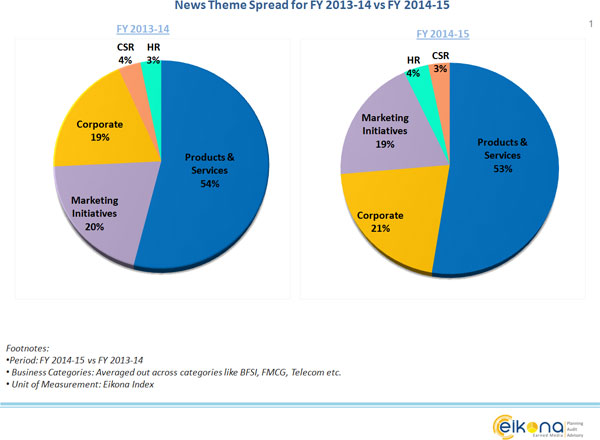


    The Eikona chart, above, gives a sense of what some of the key sectors (averaged out) like Telecom, FMCG, BFSI etc. have focused on. Have they focused on WHY ME or does it continue to be the same story of major focus largely on BUY ME? The following takeaways can be concluded upon:


    a) Things have improved, but Brand ka dil mange more: The above data sets are for the financial year 2013-14 and 2014-15. The above chart splits the total News Push or News Presence of companies across industry sectors and splits them by themes such as corporate image, human resource, marketing initiatives, product and Services etc. If you were to total up product and services and marketing initiatives-related news push, the figure is hovering around a humungous 74%. Which means that a large part of what creates and sustains a corporate brand is missing! However, a silver lining, however, is that these periods are seemingly better when compared with 2011-12 and 2012-13 (not in the chart above). They  used to smack at around 85%. Good news is that the emphasis or push on the “WHY ME” part, comprising Corporate Image, Vision and Strategy, Business Ethics, CSR, Human Resource etc., has increased/improved  as compared to 3-4 years back.


    Further, like I said before, these are averages of some key industry categories. If one were to look at individual sectors, reality in some specific sectors will be harder and much more rude. The message is clear – long-term success is all about corporate brand and not product brand alone! For this, corp Comm has to be in the driver’s seat.


    b) CXOs need to be aware of consumer’s purchase dynamics: Consumer’s purchase dynamics are no longer about Brand Track TOM scores. It is now shifting towards Disposition. It is shifting towards dynamics of strong sustained Messaging which gives away the WHY ME part loud and clear. Any product or service purchase, does’txt matter whether from B2B or B2C category, is about investigating and pivoting the purchase decision on WHY ME. Brand Track survey mechanisms will need drastic revamp. Some of the current ones are archaic and is far from taking care of BTL communication push. Also, the disposition studies will need more robustness.


    c) Why does Earned Media/PR score over Paid/Ad route?: First, the paid/ad route has long lost its credibility. Data sets like ad avoidance, falling Brand Track scores are terrific endorsers of that. Second, the Paid tool is too pricey (let me clarify – I mean money wise! Doesnot justify the ROIs). Third, Ad layout formats doesnot allow me the logistics of laying down details or even relevant snippets of WHY ME. Earned Media scores on ALL!


    d) Can it be measured?: The best part of all this is that Earned Media can be measured neutrally, holistically and continuously and be equated with Corporate and Product Brand Reputation scores.


    Call it Living Company, Loved Company, Successful Company, Lambi Race Ka Ghoda…well, it is time to change. “WHY ME” is the magic wand of long term Business Brand building. CEOs will need to take charge and make amends in the Organizational structure. Communication KRAs and KPIs will need to be recreated with & for all CXOs. Very importantly, they will need to be linked with the Business Objective!


    Siddhartha Mukherjee is a senior PR industry professional and currently Senior Vice President, Eikona – Earned Media Planning, Audit and Advisory. The views expressed here are his own.