Tag: Prasun Basu

  • So 8 out of 10 people trust advertising: ASCI-ISA report

    By A Correspondent


    Eight out of 10 people trust advertising. That’s the basic standout from a study commissioned by the Advertising Standards Council of India (ASCI) and the Indian Society of Advertisers (ISA), and conducted by Nielsen.


    The Trust in Advertising study was conducted with people across age groups in 20 centres in India, including metros, smaller towns and rural areas. The study found that eight out of 10 people trusted advertising messages across media.


    TV (94%) was the most common medium for consumption of advertising, followed by digital (82%), print (77%) and radio (29%). Viewership of TV ads is driven by non-metro markets.  Interestingly, viewership of ads on digital is the same in rural (82%) as it is in metros (83%).


    Prasun Basu
    Prasun Basu

    According to Prasun Basu, Global Head, Strategic Alliances and New Verticals Nielsen, this demonstrates the growing importance and centrality of this medium in the hinterland. ASCI spotted early that the growing consumption of digital content and advertising pointed to a permanent change in consumer behaviour and marketing. Accordingly, it set up robust monitoring mechanisms for digital platforms alongside its monitoring of print and TV advertising. It now scans more than 3,000 digital platforms for misleading messages.


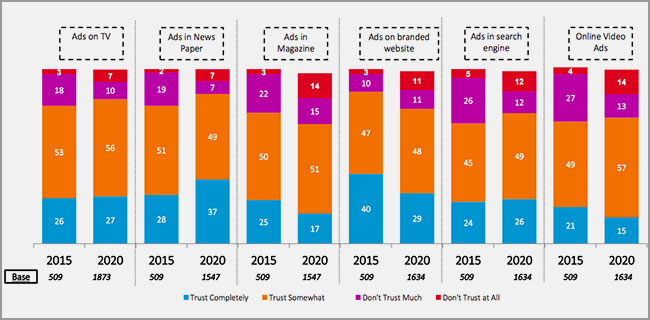
    Advertising seen on traditional media continues to enjoy high trust amongst consumers. Advertising in newspapers (86%) emerged as the most trusted, closely followed by that on TV (83%) and Radio (83%). Text/SMS ads were the least trusted at 52%.


    In terms of shifts, consumers put greater trust in advertisements consumed on TV, print, radio, social media, outdoor and search engines as compared to what they did in a similar survey conducted by Nielsen in 2015, but there is a fall in the percentage of consumers trusting text messages over this period (58% vs. 52%)


    Among sectors, audiences displayed a very high level of trust for advertisements of educational institutions at 82%. This is possibly because culturally, Indians have a strong belief in education as a means to secure their future. Ironically, ASCI finds that a significant portion of misleading ads come from the education sector. ASCI therefore has a high focus on education sector advertising.


    Manisha Kapoor
    Manisha Kapoor

    Said Manisha Kapoor, Secretary General, ASCI: “ASCI’s job of monitoring the education sector is even more crucial, given these findings. In India, the poorest of people prioritize education spends over other necessities. Most educational institutions promise job guarantees or make false claims of being the No 1 or guaranteeing 100% placement without any objective data or evidence. We are doing our best to make sure that such false advertising is removed from the market,”.


    Sunil Kataria
    Sunil Kataria

    Added Sunil Kataria, Chairman of ISA: “Brands are built on the back of long term communication with consumers and audiences. It is in the advertisers’ own self-interest to make sure that all communication is honest and truthful, so consumers can trust advertising messages, and thereby, brands. This study helps advertisers, agencies, media owners and planners understand what works well and introspect on what needs improvement”


    The detailed findings of the study can be accessesd by clicking here


  • Nielsen India predicts the scope of e-commerce sector in India

    By A Correspondent


    Nielsen India expects the fast-moving consumer goods (FMCG) sales coming from the e-commerce channel to grow to $4 billion by 2022. The channel contributes 2 per cent to the current FMCG market. These are insights from Nielsen’s recently launched E-Trak Index – a measurement solution that tracks the FMCG E-Comm industry.


    Metros lead the e-omm FMCG race with a 6 per cent contribution from the channel to total FMCG sales. Amongst these, Foods is the biggest contributor with 44 per cent; then it is personal care (40 per cent) and household care (13 per cent).


    India’s first such solution is created using aggregated ePOS (electronic point of sale) data from cooperating E-commerce players and data science backed estimation for non-cooperating E-commerce players in India. The index adds a crucial element to the Retail Measurement Services that Nielsen provides by adding a view of the FMCG E-Comm space for All India Metros currently – with monthly read for Total FMCG, Super-categories, Category level for about 20 categories and for 11 categories at a top manufacturer level. Manufacturers and marketers get data, information and insights that can be further used to hone their E-Comm channel sales strategy to help shape a smarter market.


    Announcing the launch of E-Trak, Prasun Basu, South Asia Zone President, Nielsen Global Connect, said: “Measurement is necessary. Measurement is difficult. Best possible measurement.” Explaining this further he added “Data and insights from Nielsen’s Retail Measurement Services continue to provide an essential foundation for manufacturers and marketers to understand their market. In this rapidly evolving world of commerce, India’s FMCG industry is now making its presence felt in the E-Comm channel – appealing to consumers’ need for convenience, and in sync with increasing smartphone and internet penetration. To give a truly complete picture of the changing marketplace, we are happy to announce that Nielsen India has launched a specific E-Trak index that will now measure FMCG consumer offtake in the E-Comm space – marrying this with trends seen in modern and traditional trade to get a read on omnichannel in the country.”


    Added Sharang Pant, Head-Retail Measurement Services and Retailer Vertical, South Asia, Nielsen Global Connect: “While the foundation is taking shape, E-comm’s dynamic nature has made it a disruptor in the marketplace. E-Comm has seen a transformative journey and is now a $1.2Bn Industry growing from 0.5 per cent contribution in 2016 to a 2 per cent contribution in 2019, and slated to be 5 per cent in 2022 – this is in half the time that brick and mortar retail took to evolve. That said, these channels are not cannibalizing each other, and all continue to grow with E-Comm outpacing modern trade and traditional trade. The view that Nielsen presents on understanding channel, category and consumer trends will directly help players understand the right strategy in terms of assortment, pricing and positioning to win with the evolving consumer”


    Said Nitya Bhalla, Head- Data Science, South Asia, Nielsen Global Connect: “Given the significance of the channel from both a current as well as future perspective, Nielsen has built a unique state of the art hybrid model for estimating this dynamic and growing channel. The methodology involves leveraging data from key collaborating E-tailers in the FMCG space. We then use crowd sourced data coupled with machine learning techniques from a panel of 200K+ consumers to estimate the Ecommerce sales for FMCG products.”


  • MMA’s Cognition Research Study tells marketers to get a ‘First Second Strategy’

    By A Correspondent


    The Mobile Marketing Association (MMA), launched its Neuroscience Cognition Research study which establishes that the human brain needs 400 milliseconds to engage with mobile advertising and trigger an imprint, positive or negative. This research has been done to test and assess the duration at which advertising on mobile platforms can be recognized and processed cognitively.


    Speaking at the launch of the research in Mumbai, Rohit Dadwal, Managing Director, MMA – Asia Pacific, said: “The challenge of attention in advertising is not new. MMA has now brought in neuroscience to understand the human brain’s reaction to advertising because it pushes the boundaries of what eye tracking studies allowed. MMA is committed to walking the path of science in marketing for brands. This report will demonstrate to marketers that the need of the hour is to focus on developing the right creative content given that human attention is a scarce commodity.”


    Added Moneka Khurana, Country Manager – MMA India:”Up until now, there were no conclusive answers or meaningful guidance for marketers in terms of how to better plan for the dynamic mobile environment. MMA’s Cognition Research establishes the relationship between exposure time of ads and consumer attention, with a focus on optimizing their creative for the needs of this new environment. This and similar such outcomes from the Report will help the marketers to better invest their marketing dollars to achieve maximum impact.”


    Said Prasun Basu, President – Nielsen, South Asia: “While advertisers have always known that there is a linear relationship of time with attention and impact of an ad, to discover that according to science, that length of time is less than half a second, is surely going to present a challenge to the creative and media teams. It is now time for marketers to come up with the First Second Strategy for mobile marketing.  It will be very interesting to see how they tackle the findings of this study and use the key takeaways to as the basis of their revised strategies.”


    MMA conducted the Cognition Neuroscience Research project in collaboration with The Advertising Research Foundation (The ARF), the trade group focused on research on advertising, media and marketing, and Neurons Inc., an applied neuroscience research company, set out to understand how consumers process information in a mobile environment.


  • Prasun Basu appointed President, South Asia for Nielsen

    By A Correspondent


    Market research industry veteran Prasun Basu has taken charge as President, South Asia of Nielsen India. In this role, he’ll be responsible for leading Nielsen’s business operations in India, Bangladesh, Nepal and Sri Lanka.  Basu has been heading operations of Millward Brown as MD-South Asia from April 2013 till this announcement. According to information received, Piyush Mathur who led Nielsen operations in India from 2010 has now moved as Senior VP at Westport, Connecticut.


    Basu has previously held senior roles within research and consulting organizations covering both developed and emerging markets such as the US, Latin America, Middle East, Africa, Southeast Asia and South Asia. Basu is returning to Nielsen, having previously led the BASES and Consumer Research businesses in South Asia, as well as heading up the BASES business in India, Africa and Middle East.


  • HDFC, other finance brands dominate WPP’s BrandZ

    By A Correspondent


    Finance brands are highest risers in the BrandZ India Top 50 with HDFC Bank being the most valuable brand for second year. The total value of India’s strongest brands has risen by a third (33%) over the last year, according to the second annual BrandZ Top 50 Most Valuable Indian Brands ranking announced on Wednesday by WPP and Millward Brown. This is the highest rate of growth achieved by any BrandZ ranking in the 10 years since valuations began, exceeding that of the Global Top 100 as well as the rankings forChina, Latin America and Indonesia.   India’s Top 50 brands are now worth $92.2bn (up from just under $70bn in 2014). The record-setting value increase has been driven by brands’ successful response to the rising sense of empowermentamong Indian consumers, and the government’s efforts to create a more conducive business environment.


    Brands in the financial sector (+49% growth) made the largest contribution to the overall increase in value, but significant lifts were also seen across most other sectors, indicating the broad strength of India’s economy and Indian brands. Home and personal care brands achieved a combined increase of 32%, followed by the auto aftermarket sector (28%), automobile brands(27%) and telecom providers (21%).


    Private companies, state-owned enterprises (SOEs) and brands owned by multinational corporations that are publicly traded in Indiaall experienced growth, illustrating how receptive the market is to brands of all kinds. 52% of the brands in the Top 50 are privately-owned, evidence of India’s entrepreneurial energy. 30%of the brands are owned by multinationals, which have successfullyadapted to the needs of Indian consumers, becoming so embedded in their lives that they are perceived as ‘local’.


    The BrandZ™ Top 50 Most Valuable Indian Brands 2015

    Rank 2015

    Brand

    Category

    Brand value 2015 ($m)

    Brand value change

    Rank 2014

    1

    HDFC Bank Banks

    12,577

    33% 1

    2

    Airtel Telecoms

    11,039

    34% 2

    3

    State Bank of India Banks

    9,374

    37% 3

    4

    ICICI Bank Banks

    5,122

    45% 4

    5

    Asian Paints Paints

    3,867

    38% 6

    6

    Bajaj Auto Automobiles

    3,345

    10% 5

    7

    Hero Automobiles

    2,907

    34% 7

    8

    Axis Bank Banks

    2,494

     New New

    9

    Kotak Mahindra Bank Banks

    2,394

    39% 9

    10

    Maruti Suzuki Automobiles

    2,318

    54% 11

    11

    Idea Telecoms

    1,981

    5% 8

    12

    Castrol Lubricants

    1,773

    40% 15

    13

    IndusInd Bank Banks

    1,542

    46% 19

    14

    McDowell’s Alcohol

    1,516

    9% 13

    15

    Nestlé Food/dairy

    1,498

    22% 16

    Key highlights of the 2015 BrandZ Top 50 Most Valuable Indian Brands study include:

    • Financial brands continue to dominate.With 13 brands in the Top 50, accounting for 41% of its value ($38.1bn), the financial sector has built brand strength by making a consistent effort to serve consumers better. Biggest risers: Union Bank of India (no.46, +72%), Punjab National Bank (no.22, +61%) and IndusInd Bank (no.13, +46%).
    • Home and personal care brands grew 32%, driven byincreased disposable income and spending on premium products, and investment by marketers across traditional and new media. These 12 brandshold 15% ($13.4bn) of the ranking’s total brand value. Fastest risers: Lakme (no.44, +69%), Lifebuoy (no.31, +49%) and Colgate (no.26, +44%).
    • Purpose is power. Indian consumers expect brands to actively participate in building a better society, and those that do have a higher brand value. Lifebuoy (no.31) has a social mission to change consumers’ hygiene behaviour, while Asian Paints (no.5) aspires to rejuvenate people’s living spaces and bring joy to their lives.
    • Indian consumers trust brands.In stark contrast with other markets, trust in brands is growing steadily. Consumers in Indiaappreciate brands, and 33% say they trust them. Among the most trusted are jeweller Tanishq (no.21), part of the respected Tata conglomerate, and Colgate, which is part of Indian folklore, and has been instrumental in organising dental check-up camps to raise dental hygiene awareness.
    • All four new entrants are of Indian origin – Axis Bank, Canara Bank, MRF (tyres) and Royal Enfield. Three are privately owned, and one is an SOE.
    • Disruption is on the horizon – from e-commerce and mobile brands that are building scale and connecting with consumers at a frenetic pace. These are not yet eligible to be ranked in theTop 50because they are not publicly traded.

    David Roth, CEO of WPP’s The Store commented: “The 2015 study shows that India is a market of great opportunities where consumers are feelingempowered, and this is increasingly reflected in their brand choices. The new Modi government is committed to creating an environment in which brands can flourish. India is distinct in many ways from other fast-growing markets, however, so simply applying strategies that have proved successful elsewhere will not work in India. Any brand intending to compete in India must gain deep insights into its nuances – such as the need to modernise while respecting the past, and the desire to remain fundamentally Indian.”


    Added Prasun Basu, Millward Brown’s Managing Director, South Asia:“India’s top brands are strong, and getting stronger – but there is no room for complacence. The top four had to grow their value by 37% on average to hold on to the same positions as last year, and close to 10% of the brands that made the Top 50 in 2014 have dropped out. To benefit from the continuing rise in consumer confidence and optimism brands need to understand the changing consumer, respond with innovative products and breakthrough communication, and experiment and invest in new media that reflect the spirit of the country today.”


    Said Ranjan Kapur, Country Manager, WPP India: “Building a successful brand in India also means helping to build India itself. Consumers are trustful of brands, but trust can crumbleovernight. Brands must work hard to sustain trust by connecting with thecountry’s communal sense of responsibility. Brands need to find ways to support the national agenda, and help to develop a more modern, prosperous and equitable society.”


    The BrandZ Top 50 Most Valuable Indian Brands 2015 report, charts and photography, can be downloaded from www.brandz.com.

  • Millward Brown unveils Media & Digital predictions report for 2015

    By A Correspondent


    Millward Brown has released its Annual Digital & Media Predictions for the year ahead. For the seventh year running, the company is providing marketers with a clear guide to the challenges and opportunities of the next 12 months.


    Authored by Millward Brown experts from around the world, the 2015 report identifies the need for marketers to empower programmatic media buying systems to do more than simply access cheaper and more targeted impressions.


    To make this transition, marketers will need to build creative that can be customized and seamlessly delivered by media buying algorithms. Millward Brown says brands that achieve this will be able to create a new form of dynamic and relevant storytelling.


    At the same time,marketers will need to ensure the advantages that come from programmatic targeting are not delivered at the expense of other key campaign objectives such as communicating brand messages and building long-term desire. Successful programmatic providers will increasingly differentiate themselves based on their ability to deliver campaigns that not only drive behaviors but also improve brand metrics.


    “To date, the debate around programmatic media has been firmly centered on the ‘how’ of operations and behavioral metrics such as cost per click,” said Mark Henning, AMAP Head for Media &Digital at Millward Brown. “In 2015 we expect marketers to be equally focused on the benefits programmatic may be able to bring to building meaningful brands and the opportunities to leverage it more creatively.”


    Prasun Basu, Managing Director, South Asia Region at Millward Brown said,” Millward Brown’s Annual Digital & Media Predictions provide a guide to how marketing is likely to change in the next 12 months. A series of media conclaves in Mumbai, Delhi and Bengaluru will provide marketers and media professionals a platform to discuss these trends and exchange ideas that will impact the way brands reach out to consumers.”


    Millward Brown also anticipates other important changes in the media landscape around the world and describes in the 2015 predictions how marketers can “get media right”.  These include:

    :: As native advertising becomes an established medium, advertisers should partner with best-in-class publishers who strike the right balance between advertising and editorial.

    :: New and exciting paid marketing opportunities will emerge on micro-video platforms, but only brands who know, learn and love those platforms will succeed.

    :: Location-based marketing opportunities will become powerful when brands focus on consumers’ interests rather than on their own.


  • HDFC Bank is India’s Most Valuable Brand


    By A Correspondent


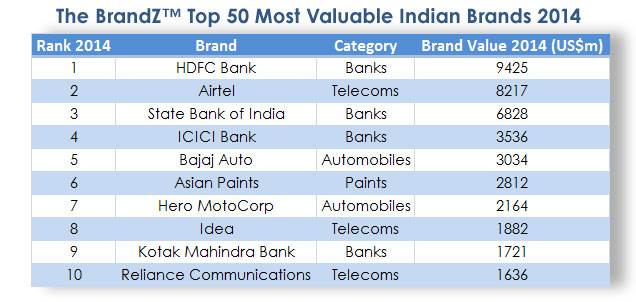
    The combined Brand Value of all the brands in the inaugural BrandZ Top 50 Most Valuable Indian Brands ranking is almost $70bn BrandZ. HDFC Bank is India’s most valuable brand with a value of $9.4bn. Carried out by marketing and brand consultancy Millward Brown in conjunction with WPP, the valuation is the only one in India that takes into account consumers’ opinion of brands to calculate the contribution that product brands make to business success.


    The BrandZâ„¢ India study shows that India’s unrestricted ‘right to play’ for businesses has nurtured great diversity amongst brands in the ranking. The Top 50 come from 13 different categories. Seventeen are multinational corporations (MNCs), 26 are private Indian brands and seven are state-owned brands. This indicates that India is an open, fertile market for building valuable brands, irrespective of age, origin, structure, category, ownership or even price range.


    HDFC Bank, the No 1 brand, has a network in more than 2,100 cities. It is popular with its 28 million customers for launching mobile apps designed to make banking easier, and running literacy, education and skills training programmes in rural areas. The No 2 brand, Airtel, is the fourth largest mobile operator in the world with nearly 300 million customers, while India’s largest commercial bank, State Bank of India, is at No 3 in the ranking.


    Services businesses (Banking, Telecoms and Insurance), which are the nerve centre of today’s Indian economy, are prominent in the ranking. Seven of the Top 10 brands, and 30% of the Top 50 brands, come from the service sector. Financial services stand out, with the 12 banks and insurers in the ranking holding the largest proportion (37%) of total Brand Value. Analysis shows these brands have built value by successfully achieving scale – both in geographical reach and the diversity of their offerings. Telecoms, Personal Care, and the Food and Dairy sectors also feature strongly in the Top 50. The data shows that these brands – along with the other FMCG brands in the ranking – excel at connecting with Indian consumers.


    The average Brand Contribution (a measure of the impact brand alone has on value) of the Top 5 brands is far higher than the overall average of the Top 50, illustrating the positive impact that building a strong brand has on the financial valuation of the brand. These brands create powerful connections by being meaningful to consumers, and differentiating themselves from others.


    Key findings highlighted in the BrandZ Top 50 Most Valuable Indian Brands include:

    :: Being meaningful and different builds value – India’s most valuable brands are highly relevant to consumers and differentiate themselves through service, new offerings and brand experiences. One such example is personal care brand Colgate (No 28) – even after 70 years in India the brand has successfully remained relevant and continues to differentiate itself from the competition.


    :: India has evolved into a brand powerhouse – India’s Top 50 most valuable brands have as much Brand Power (consumers’ predisposition to choose that brand over another) as the global Top 50, and are ahead of the other emerging economies.


    :: Private sector players and multinational corporations dominate – together these contribute around 85% of total brand value. They have succeeded by nurturing a strong relationship with Indian consumers.


    :: Megabrands lead the game – like other fast growing economies, India is dominated by a handful of big brands or companies that own stables of brands: the Top 5 account for 45% of the ranking’s total value. Their tremendous scale and ability to cater to a wide spectrum of the population has translated into financial gains.


    :: ‘Balanced brands’ is the mantra – brands that are able to build both strong connections with consumers and business scale that leads to the creation of financial value are contenders for entering or rising up the BrandZ ranking. Three out of the Top 5 Indian brands demonstrate this balance.


    :: Consumer technology is ‘the category waiting to happen’ – there are currently no homegrown consumer technology brands in the Top 50, but this category is on the verge of emergence. The presence of Indians working in the sector globally is high, and consumer-facing technology brands founded by young entrepreneurs have already started to gain ground.


    :: ‘Indianizing’ products and services is important – the many successful international brands in the ranking have taken the time to understand Indian needs and tastes and adapt to them. Noodles, food seasoning, soup and sauce brand Maggi (No.18), personal care brand Colgate (No.28) and beverage brand Horlicks (No.20) are masters at this – and are thought of as Indian brands by most consumers as a result.


    :: Old and new sit side by side – living with one foot in the ancient world and one in the modern makes consumers equally receptive to heritage brands (Bajaj Auto, No.5, established 1945) and new brands (Airtel, No. 2, established 1995). More than a quarter of the Top 50 brands were created after the economic liberalization in 1991 while Dabur, No.22, was established 130 years ago.


    Said Prasun Basu, Millward Brown’s Managing Director – South Asia: The stronger the relationship a brand can build with consumers in its category, and the more it can leverage that to build scale, the more sustainable and profitable it becomes. All of the Top 50 brands are reputable, successful engines of growth for the future of India. Any global manufacturer that makes the effort to understand the diversity of the Indian consumer’s needs, tastes and aspirations, and which can build a proposition that is both meaningful and appropriately differentiated, will succeed in building a strong brand.”


    Added David Roth, CEO of The Store, WPP: “With the second highest number of social networking users in the world, and the third highest number of users of mobile devices, developing an e-commerce strategy that focuses on social and mobile platforms is essential for brands in this region.”


    Said CVL Srinivas, CEO GroupM – South Asia, “We are already seeing the impact of the purchasing power of the internet and mobile users in India, with the exponential growth of e-commerce companies in the space of travel, e-tailing, ticketing and many main line brands increasing their brand building budgets to digital media in multiples.”


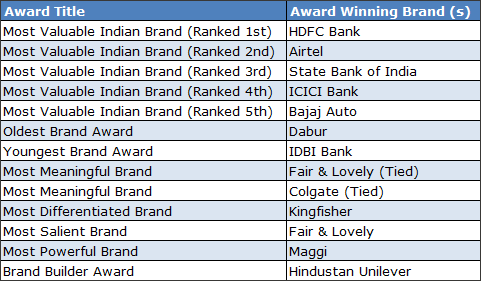
    In addition to the rankings, special awards were also presented to brands among the Top 50 under the following categories.


    Millward Brown BrandZ India Awards 2014
    A copy of the BrandZ™ Top 50 Most Valuable Indian Brands 2014 report can be downloaded at www.brandz.com