Tag: Prashant Singh

  • Zee Mindspace Awards to be hosted at #ZeeMelt 2016

    By A Correspondent


    Leading content company, Zee Entertainment Enterprises Limited (ZEEL) announced the launch of the first edition of ‘ZEE Mindspace Awards’, a property which aims at recognizing brands, which have captured maximum mind-space. The awards ceremony will be held on 27th August 2016, at #ZEEMelt 2016 - India’s biggest festival for creativity and innovation in marketing and communications.


    Commenting on ZEE Mindspace Awards 2016, Sunil Buch, Chief Business Officer, ZEEL said, “Achieving ‘consumer mindspace’ is every marketer’s ultimate goal. The thought of extending our 3-year old brand intellectual property ‘ZEE Mindspace’ also as an awards property, was based on this very essence. The marketing fraternity is an integral part of our overall business value chain and in today’s digital era it is indeed a challenge for the marketers to arrive at the right marketing mix. The proof of the pudding is being present in the ‘Mindspace’, which is the foundation of ZEE Mindspace Awards.”


    The winning brands will be awarded at the ZEE Mindspace Awards 2016 in the presence of 500+ CMOs and stalwarts from the marketing and advertising industry. Going forward, ZEE Mindspace Awards aims to serve as an additional independent barometer for marketers. While there are numerous awards targeted towards rewarding the creative campaigns undertaken by brands, ‘ZEE Mindspace Awards’ is the only property which recognizes the overall marketing mix implemented by the brand owners to carve a ‘Mindspace’ within the consumers.


    Prashant Singh

    Prashant Singh, Managing Director, South Asia, Nielsen said, “Nielsen’s research methodology is a brand assessment among consumers who have adopted new age media in addition to traditional media and provides brand owners’ insights into how brands are adapting to this fast-evolving space. More than 12000 online surveys were conducted to evaluate 288 brands across 36 categories. The research was broken into multiple phases – from initial screening of brands to final rounds focusing on understanding what makes a brand resonate in the consumer’s mind. The winners were identified after undertaking a rigorous process, based on top-of-mind recall, popularity, the kind of advocacy the brand commands, the desire to own the brand and finally the buzz it generates. Above all, it’s the brand’s ability to pop-up in mind at the first instance that holds maximum weightage.”


    #ZEEMelt 2016 will also witness the 4th edition of ZEEL’s brand intellectual property – ‘ZEE Mindspace Conference’, which aims at bringing the marketing fraternity together to connect, discuss and explore new possibilities. The sessions under ZEE Mindspace Conference comprise of two main themes, Previewing Tomorrow – where we get insights into the future of several areas in the industry and Open Possibilities – introducing us to the many advantages that data, content, consumer analysis and branding offer in transforming businesses.


  • Consumers in a Connected World


    By Dyanne Coelho


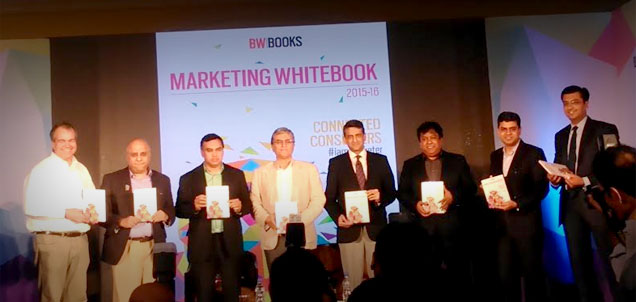
    Businessworld in association with Nielsen launched the 11th edition of the Businessworld Marketing Whitebook 2015-2016 with much ado including an impressive lineup of speakers. Key trends in the marketing space were touched upon through the sessions.


    John Burbank, President Strategic Initiatives, Nielsen set the tone for the release of the Marketing Whitebook with his insightful discussion on ‘Gearing up for a Consumer-First World.’ “I think the world is data-rich and analytics poor,” he said. The basic questions are the ones marketers need to be asking, he said. These include ‘How many are actually seeing my advertisement?’ and ‘How effective is my advertisement in delivering ROI?’ among others. Do not let the complexity of the amount of big data change these fundamental questions, he advised.


    ‘A Year of Cautious Optimism: What Lies Ahead for Business Leaders’ was the first topic of discussion. The panel included Devendra Chawla, Group President, Foods, Future Group, Rakshit Hargave, Managing Director, Nivea India and it was moderated by Gurbir Singh, Executive Editor, Businessworld. “A category comprising skincare and personal care is growing in single digits, the consumers are not opening their pockets,” Hargave pointed out, while Chawla said that food and FMCG products are not hit as badly as sectors like real estate and automobiles. High value purchases have been hit harder, he said.“Inflation, especially food inflation has eaten into the money supply of the family. The consumer is holding back,” Hargave mentioned. Chawla however highlighted that the beauty industry is actually growing 70-80 percent. To this Hargave, added that the pattern is no different for him. Beauty products in the men’s category are growing faster than those in the women’s category, he said.“Marketers ought to work on deriving more basic information, get more innovative, study different needs and tastes of consumers, etc in order to keep up with changing times,” Hargave said.


    Salil Kapoor, COO, Dish TV moderated the next session which dwelled on the topic of the ‘Emergence of New Media for an Impactful Connect with Consumer’. “By 2020, 50 billion devices around you are going to get connected, you have to be smart about who to reach out to,” Avinash Jhangiani, Managing Director, Digital and Mobility, Omnicom Media Group said. Shripad Kulkarni, CEO, Vizeum India opined that this newness is here to stay. “We see a very bright trend emerging of experimentation which leads to all kinds of advertising. It is moving towards a new metric of performance. This is a good thing,” he said. The topic of big data was discussed in the regard. Tarun Jha, Head of Marketing, Skoda India spoke that the automobile industry is highly dependent on big data. “We run lean ships, spend money wisely, have a very focused objective for every campaign and ensure that every penny is accounted for,” he said.


    Social listening has become a serious business, the panelists discussed in the session titled, ‘#iammarketer: The Realities of a Changing Consumer World’. “Socialisation allows us to build communities of like-minded people, build engagement, etc. This is where one gets insights from across categories and consumer behaviour,” Veetika Deoras, Head of Brand Marketing, Digital and Corporate Communications, Tata Capital said. While many marketers have evolved into digital, some are still experimenting, Ashutosh Gupta, Director Marketing Solutions, LinkedIn India said. “It’s not about social or digital, it’s more about the consumer journey,” he said. Sudeep Ghosh, VP Marketing at VIP Industries is of the belief that one should not follow the template. “Do digital if it works for you,” he said. Digital works differently for different brands and hence each needs to adapt depending on its needs, he added.


    Prashant Singh, MD, Nielsen India lead the discussion entitled, ‘The Rise of the Connected Consumer’. The panelists included Kamal Basu, Marketing and PR Head, Volkswagen India, Prashant Peres, Director Marketing – Chocolate, Mondelez India, Sameer Satpathy, CMO, Marico Ltd and Tarun Arora, COO and Director, Zydus Wellness Limited. The session revolved around how the need of the hour is not about focusing on advertising or broadcasting, but on using an integrated approach to have a full conversation and up brand value for consumers. “Legacy marketers are often apprehensive about the impact they can make through new media, there is a fear,” Peres said. Arora on the other hand argued that the line between online and offline is blurring as both need to use each other to build the brand. “Multi-channel purchase is going to happen and FMCG cannot sit back,” he said. From an automobile industry perspective, digital is the lifeline, Basu pointed out as most buyers do primary research online before they walk into a store. Satpathy however believes that it all depends on the task for the brand.


    CVL Srinivas, CEO, GroupM South Asia played moderator to an interesting discussion on ‘Decoding Diversity in India’ followed with presentations by Sachin Jain, President, Forevermark India and Samir Jain, MD, Bunge Ltd wherein each pointed out the growth of their brands and how they adapted their marketing strategy to different segments of India in order to target different sets of consumers.


    Earlier, Annurag Batra, Chairman and Editor in Chief, BW Businessworld (also Chairman and Editor-in-Chief of the Exchange4media group) delivered the opening address, gearing up the delegates for the rest of the event.


  • Ad:tech 2013 focuses on integrated digital marketing

    By A Correspondent


    The third India edition of digital marketing event, ad:tech New Delhi 2013 saw panellists deliberate on topics such as integrated mobile marketing, video integration, location-based relevancy, social media ROI, search and content. Alyssa Altman, Vice President, SapientNitro, in her keynote on the second day of Ad:tech New Delhi 2013 shared findings of their survey in which 88 percent of respondents said that today’s global marketing world has become challenging than ever before. She cited a Gartner study which predicts that by 2017, CMOs will purchase more technology than CIOs.


    While the first day of the conference focused on marketers’ perspectives on the digital consumer; the second day hailed ‘gamification’ as the latest trend for this year and speakers predicted that it will become a major global experience by 2016. Globally, there are more than 500 million people playing games at least for one hour every day. Avinash Jhangiani, Vice President – Digital, Omnicom Media Group, explained about their game changing live collaboration platform for global media planning, ‘Source’, which can even create powerpoint decks automatically. He also shared examples of brands like Visa, Mahindra and Movie Munchies that have successfully gamified their campaigns.


    Citing the example of Mario Bros, Rahul Avasthy, Director Strategy for Zapak Digital Entertainment, said that the same game mechanics can be applied to non-game real-life experiences to help solve the challenges of bounce rate and converting latent leads (CPL). He noted that successful campaigns require not just good content but also intent, citing the example of Arby’s Burger which leveraged gamification generated over 41,000 organic entrants and 3,00,000 actions.


    Mohd. Imthiaz of Hoppr said that there are only 20 million smart phone users in India which is why marketers need to plan campaigns that can run on every type of phone. He said that location-based services can help make the typical lean hours into peak hours. He mentioned that for a consumer, the real benefit a marketer can provide is the joy of watching and sharing content.


    Praveen Sharma, Head of Media Sales, Google India, insisted that with proliferation of multi-screens, apart from the opportunity, it also poses challenge for content creators since viewers filter out the mediocrity on screens other than the TV. T Gangadhar, MD, MEC India said, “As a media agency, we are moving away from media planning to audience planning. We consider YouTube as channel. Plans are increasingly becoming video plans.”


    Prashant Singh, MD – Media, Nielsen India said, “It is important for a digital campaign to be based on three parameters: reach, resonance and reaction. Getting these three basics right would help measure the ROI.” Pratik Mazumder, Head Marketing and Strategic Relations, Yatra.com highlighted the fact that while brands are insistent on ROI from digital media, many brands do not move beyond ‘Likes’ on social media to engage with the consumer.


    The event concluded with power-packed presentations from Sunita Rajan, Senior Vice President, BBC Advertising who spoke on ‘Revenue at the speed of User Adoption’ and Bettina Sherick, SVP Digital Strategic marketing, 20th century Fox International on ‘Marketing the cinema experience in a digital world’. She cited the example of global marketing initiatives for Life of Pi and how Fox leveraged the proliferation of digital platforms for marketing purposes, and also created innovations for consumers to disconnect and experience films on the big screen.


  • IRS will see a technology leap: Prashant Singh, MD-Media, Nielsen India


    By Johnson Napier


    Nine months since RSCI began the process for shortlisting the most bankable partner, it was jubilation time for the team at The Nielsen Company in India, having won the coveted contract of research work for the Indian Readership Survey. The victory is sweeter following as it does the controversies of the past few weeks.

    While the industry is still taking in the news of the appointment, for Nielsen India it is a chance to prove its authority in the print measurement space. And what better metric than IRS. The company plans to centre its focus on newer mediums – with increased dependence on technology – that will help ease data collection and analysis and more importantly bring about consistency in the readership numbers.


    MxMIndia interacted with Prashant Singh, Managing Director – Media, Nielsen India to gather his views on being appointed the new partner by RSCI for IRS. Though it is still early days, Mr Singh dwells on what the future will look like for readership studies in India and how they are geared for the big challenge that’s being watched closely by all concerned. He even had some words of comfort regarding the controversy that it is currently embroiled in thanks to its joint ownership of TAM Media but he assures that it won’t have any impact on how they continue to do business going forward. Excerpts:


    Q: This isn’t the first time the Nielsen Company has done a readership survey in India, though it is after a gap. How have things changed since then (other than the size of the population and hence sample size)?

    Things have changed within the market research industry itself. With the advent of technology there is so much that is available to us to tap into. Today, the scenario is such that any market research can be elevated to a level where one can get a much better read of the market without going through the peeves that are associated with it. For example, Nielsen is actively deploying Computer Aided Personal Interviews (CAPI) instead of the regular pen-and-paper format that was practised for market research. What that does is that while there is an interviewer who goes and interviews the person instead of using pen and paper, the person uses a computer/tablet/palm-device to capture responses. As I said, the entire market research industry has gone through a significant change in the past 5-6 years. With MRUC, we hope to bring significant technological upgrade even on the IRS.


    Q: What is it that you think won you the bid (we know it didn’t go to the lowest quote, because yours was higher)?

    I have no idea. This is something that you should ask MRUC. We are just happy that we bagged this prestigious project.


    Q: Do tell us what you are going to be doing from now to when your part of the study will start? When does work start for you?

    The MRUC and Nielsen teams will sit down and discuss what the plan will look like going forward. The first step for us is to sign the contract and start with those proceedings. Probably MRUC is the right body to talk about future plans, which we will do sometime in the near future.


    Q: For the benefit of the industry, what are a few of the salient differences between the IRS we see now and the IRS that we will see when you’ll be there?

    Multiple innovations in technology features are being brought in. Some of them would be visible to the users while some will be visible to MRUC. But at this point it is not fair for me to talk about the specifics of the proposals. There will be more clarity on what are the things that are coming to the fore in the near future.


    Q: Do you see any challenges cropping up with Nielsen planning to lay increased emphasis on technology?

    Where market research is concerned, with technology we’ve been fairly confident that there are benefits and not challenges. In fact there are challenges in doing market research in India whether it is about how you show inputs to respondents or about how you make sure that the right interviews are happening at the right time and place…and technology actually enables us to do a better job at it. In the last 3-4 years, we have taken multiple steps to embrace technology wherever we can right from data collection to data reporting, etc. So we see technology as an enabler and not a challenge.


    Q: One of the problems that any such vendor contract arrangement is about what do you do when the contract is not renewed? For instance, even after 8 years of working on, Hansa (and Ipsos) lost the contract to Nielsen?

    We do a good job and keep our clients happy; there is no reason that the contract will not be renewed. It is about how you deliver to the promises made. If one doesn’t deliver then obviously the contract could go away from you.


    Q: Will you hire some of the talent from Hansa if rendered redundant due to the loss of contract, later in the year?

    I cannot comment on this.


    Q: Media measurement is a tricky business these days and most often a thankless job. Your take on this?

    Not just media measurement but market research anyway is challenging. In India there are multiple challenges including sociological, geographical… and every market research agency has to understand these challenges and figure out ways to deal with them. Sometimes you can deal with them nicely and sometimes not so nicely. If we are open with our clients and talk to them about the challenges that there are then I think we should be fine.


    Q: One of the frequent peeves we’ve heard from the magazine sector is that IRSes don’t measure niche readership very effectively. How will you correct that?

    Again I cannot comment on that but it is part of the proposal and the RFP and you will hear more about that from us and MRUC together.


    Q: There have been some charges that while Nielsen is a specialist in television measurement, it isn’t with print readership?

    Globally, Nielsen is a specialist in television (measurement)…that’s what I can say. I cannot comment on what  others speculate. Yes, we do specialize in television measurement which does not mean that we do not do other things. People will speculate what we can and what we cannot but I cannot say much on that.


    To give you a higher perspective, Nielsen as a company globally looks at business in two key parts: we measure what people buy and we measure what people watch. Both the businesses are very significant in terms of revenue. So it’s not that Nielsen is just a ‘watch’ business we have a huge portfolio within the ‘buy’ side of the business too. It would suffice to say that we do a lot more than television.


    Q: One last question, and we know the matter is sub-judice: but we heard murmurs that Nielsen shouldn’t bag the contract because its name is stained in the TAM controversy. Also, a hitch with the retail audit earlier this month. Your comments.

    We are happy that the MRUC and RSCI have given due importance to the proposal that we submitted and have awarded the contract to us. We are working towards making sure that we do a great job in delivering IRS. As for the controversy, we have a policy of not commenting on issues that are under litigation and will stick with that. But I can say that it is business as usual for us amidst all that is happening around.

     

  • Nielsen bags research contract for IRS

    By A Correspondent


    It’s now official. The Nielsen Company has been awarded the coveted contract for the research work for the Indian Readership Survey. On a recommendation of  the Readership Studies Council of India (RSCI), the Media Research Users’ Council has decided in principle to award the contract for the IRS to Nielsen. The formal award of contract will follow a process of legal due diligence.


    The decision was arrived at after a comprehensive nine month process that began in November 2011, with the formation of the RSCI by its sponsors, the MRUC (Media Research Users’ Council), and ABC (Audit Bureau of Circulation). The RSCI was mandated by the industry to oversee the conduct of a unified Indian Readership Study (IRS), billed as the world’s largest continuous readership study.


    The process involved the active participation of 20 senior representatives of advertisers, agencies and publishers who served on the RSCI Managing Committee,  as well some of the sub committees formed to vet every aspect of the submissions – from technical superiority to fieldwork integrity, research cost, organization strength and stability. Another 24 senior industry professionals contributed to the technical deliberations, under the chairmanship of the Technical Committee, Paritosh Joshi.


    “Proposals were received from the most hallowed names in the Media Measurement universe and the quality of submissions was uniformly high. The knowledge and skill on display drew upon the very finest professional capability available globally,” said Mr Joshi. “Developing an RFP award recommendation was an unusually challenging task. The Nielsen Company proposal, that has won the approval of the Council, was exceptional in its methodological rigour, comprehensiveness and future readiness. The design recommendation and resources committed to the project should enable the Indian Readership Survey to reassert its position of preeminence in Indian media measurement,”


    “Our objective through the process was two fold – One, to achieve the construct of a study that would be the gold standard all over the world in readership measurement. And two, to involve all industry stakeholders in the decision making process with a spirit of collaboration and teamwork,” said Lynn de Souza, Chairman of the RSCI.  The months and years ahead will present several challenges as we introduce a first ever data capture system – the Dual Screen CAPI (Computer Aided Personal Interview) – a system that will reduce interview time, respondent fatigue and confusion, and interviewer bias of any kind.


    “The MRUC’s belief in the  innovative techniques and technology proposed for the forthcoming Indian Readership Survey will certainly transform market research in India, improving quality and the effectiveness of gathering and applying consumer insights for businesses and marketers. Nielsen is honoured to have been chosen as its partner in this landmark study that will no doubt shape all future research across India.” said Prashant Singh, MD – Media, Nielsen India.


    Ms de Souza commended the work put in by industry seniors in the selection process. “I am overwhelmed by the seriousness and commitment of the many industry seniors who gave freely of their time on weekends, and holidays as well, to help the RSCI arrive at a decision. Thank you would not be enough. Ravi Kiran, our marketing Chairman, was also very helpful in enabling us to identify new revenue sources given that the new IRS will be captured, stored, disseminated and analysed digitally.”