Tag: Pranab Mukherjee

  • Prez, PM celebrate Essel Group’s 90 years with Subhash Chandra & family

    By A Correspondent


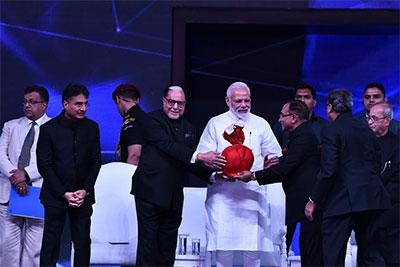
    Essel Group, the leading entertainment-led business group, is celebrating 90 years of existence and to celebrate the occasion, Chairman Dr Subhash Chandra announced the launch of the DSC Foundation by contributing Rs 5000 crore from his family wealth, the ‘Sarthi’ initiative and its English global news network, WION – World Is One News, in the presence of President Pranab Mukherjee and Prime Minister Narendra Modi in New Delhi on Sunday. The Group also honoured the winners of the first edition of the Zee Media Family Business Legacy Awards – Dabur India Ltd., Wagh Bakri Tea Group and Wockhardt Ltd.


    Said Dr Chandra: “This journey of 90 years has been filled with remarkable successes as well as challenges and obstacles. It has been a journey of creating history, venturing into unknown territories, only to emerge as leaders, capitalising on our pioneering vision and sheer entrepreneurial spirit. As we look to the future, I am confident that we will carry forward the legacy of the Group with complete passion, dedication and above all, the spirit of #YoungAt90! On this occasion, we are launching our new initiatives – Sarthi, DSC Foundation and WION, that will empower the lives of the people. Sarthi will provide a platform to help people with their problems by connecting them to the right persons and then taking it to the logical conclusion. With WION, we want to provide a medium which will give people news from around the world and how it affects India. This initiative is not for profit, but a medium for society and the nation to benefit. Through the DSC Foundation, we will be building capacity in the society to take on problems and tackle them. We are pledging Rs. 5000 crore out of our profits towards this Foundation.”


    Meanwhile, the Essel Group also announced the winners of the first-edition of Zee Media Family Business Legacy Awards which aim to honour and recognise India’s oldest family-run businesses which have expanded their empires over successive generations. To select the winners, entries from business groups which spanned a tleast four generations and had a turnover of over Rs 1000 crore, were invited and then verified by Ernst & Young, the internal process partner, using rigorous criteria to arrive at the final winners.


    The winners of the first-edition of the Zee Media Family Business Legacy Awards are Dabur India Ltd., Wagh Bakri Tea Group and Wockhardt Ltd.


  • State funeral for Laxman. Prez, VP, Prime Minister condole passing

    President Pranab Mukherjee has condoled the passing away of eminent cartoonist RK Laxman.


    In his message, the President has said, “I am extremely saddened to learn about the passing away of Shri R.K. Laxman.


    I feel personal loss because I was both an avid follower and subject of his cartoons. India will miss the genius who made the common man into a national icon. He conveyed important social messages using humour as a tool and reminded the public that people in authority are fallible and human.


    Honoured by the government with a Padma Vibhushan, Shri Laxman was a conscience keeper to the nation through his cartoons. His death leaves a void in the world of creativity and social commentary which will be difficult to fill”.


    The Vice President of India M. Hamid Ansari has also condoled the death. In his condolence message, he has said that Laxman, best known as the creator of the “common man” touched the lives of millions of our countrymen by his incisive humour  and  socially relevant messages expressed through his immensely popular cartoons. He has conveyed his heartfelt condolences to the bereaved family.


    “I am deeply saddened at the passing away of Shri R. K. Laxman, the most eminent cartoonist of our country in recent times. Laxman, best known as the creator of the “common man” touched the lives of millions of our countrymen by his incisive humour  and  socially relevant messages expressed through his immensely popular cartoons. I convey my heartfelt condolences to the bereaved family. I pray to the Almighty to give them strength and fortitude to bear with their loss.”


    Prime Minister Narendra Modi has condoled the demise of Eminent Cartoonist RK Laxman.


    “India will miss you RK Laxman. We are grateful to you for adding the much needed humour in our lives and always bringing smiles on our faces.


    My condolences to the family and countless well-wishers of a legend whose demise leaves a major void in our lives. RIP RK Laxman”, the Prime Minister said.


    Meanwhile, the Maharashtra government has announced a state funeral for Mr Laxman.


  • Ranjona Banerji: TV news viewing can be injurious to the lower jaw

    By Ranjona Banerji


    Since president-elect Pranab Mukherjee spoke to almost everyone on Tuesday, it was hard to see why news channels rushed to qualify their interviews as “first” or “better” or whatever. Exclusive, in TV parlance, is apparently when you do the same thing as everyone else, except five minutes before.


    Anyway, Mukherjee did not say very much about anything he was going to do as President although he talked about his childhood and his early political career. The silliest question I reckon came from Sagorika Ghose of CNN-IBN who asked whether Mukherjee’s ascension to Rashtrapati Bhavan was a “return of Bengal to the mainstream”. At this point my jaw dropped so low that it fell off and I was so busy retrieving it that I couldn’t pay attention to the rest of the interview.


    The best I could get from Arnab Goswami’s interview with Mukherjee on Times Now was that first Mukherjee walked round his garden 40 times, then 33 times and now 30 times and he did not know how many times he was going to walk around the Mughal Gardens. He said he heard the gardens were very large. Anyway, as President he will have ample time to work out stuff like that. Or if he asks someone they might tell him how big the Mughal Gardens are.


    * * *


    Sunday was all about the presidential election as well as everyone gave us live coverage. Of course, after some time they ran out of things to say because there was very little to say about a presidential election in India, at least not enough that can last a whole day even given TV’s marvellous propensity for waffling on about nothing. The highlight of the day was losing candidate PA Sangma’s losing speech. He started by congratulating Mukherjee and then went into a whine about how the Congress had used bribery, extortion and threats to ensure Mukherjee’s victory and how the North East and betrayed not just him but all tribals and themselves as well. (They didn’t vote for him.) Sangma’s entire campaign was based on pettiness, so nothing surprising here. What was surprising was Navika Kumar of Times Now stating emphatically that this was the best, most gracious and most sportsmanlike speech she has ever heard from a loser. Her guests Krishna Prasad of Outlook and commentator NN Satchidanand tried to point out otherwise, but she would have none of it. Jaw-retrieval is a common affliction for those who watch too much TV news, as I should know by now.


    * * *


    Rupert Murdoch has stepped down from several boards which control News Corp’s titles in the US, UK and India. The pressure to do so apparently came from investors, after the phone-hacking scandal led to the closing of The News of the World and all the arrests of News Corp staff, current and former. Murdoch’s rise saw a lot of bile but in his fall are some abject lessons for media bosses and for those journalists who decide that principles are nothing when faced with corporate pressure to perform in a particular manner or to do anything to get results. The Nuremberg trials ought to be required reading for young aspiring journalists: the fact that you got an order is not defence enough.


    * * *


    I was appalled yesterday and continue to be appalled today about Monday’s front page anchor in The Times of India about a group of Indian athletes that went to the 1936 Berlin Games under a saffron flag singing Vande Mataram and impressed Adolf Hitler enough to give the group a medal. The story behaved as if getting a medal from the 20th century’s most frightening dictator was a great honour. There was not a squeak in the story about Nazism and what the organiser of the group thought of that. The glorification of Nazism in India is restricted to those influenced by the religious nationalism that comes of out of Nagpur. The story, therefore, should have mentioned or questioned the RSS connections of the group. Saffron flags and Vande Mataram were clear giveaways but why not come out openly and say so? And for a journalist – and a newspaper – to ignore the Nazi angle to such a story is criminal.


    * * *


    Vikram Doctor’s article in The Economic Times on food and the Olympics was extremely readable and well-researched. Try it: http://blogs.economictimes.indiatimes.com/onmyplate/entry/thanks-to-french-humour-here-s-best-of-british-food


  • Ranjona Banerji: NCP ties itself for Whiner of the Week award

    By Ranjona Banerji


    The winner of the presidential election maybe Pranab Mukherjee but the award for Noosemaker/Whiner/Tantrum Thrower of the week is divided between PA Sangma and Sharad Pawar. One is former NCP, the other current NCP and both founders of the NCP.


    Pawar suddenly decided that he was very upset with the sort of musical chairs being played at Cabinet meetings. I quite sympathise because I never liked musical chairs as a kid at birthday parties. Today’s children will not understand, but in the olden days birthday parties were an elaborate form of torture for children, who were forced to compete with each other and make fools of themselves in order to get a slice of cake and a few chips. Sounds a bit like today’s political parties actually.


    Anyway, Pawar felt that every time the music stopped, he was forced to sit in another chair. Sometimes it was the second chair (first being the prime minister) and sometimes it was chair 3 or 4. This was clearly insulting. He might have only nine MPs but why should that other chap from a much smaller state holding a job that Pawar once did get the second chair?


    Later we were told he was not so petty to be worried about chairs. All he wanted was a coordination committee. Whatever.


    PA Sangma, former Lok Sabha speaker and the country’s best known Tribal and Christian – according to him – wanted to become President of India. This is a legitimate goal, but Sangma, one might say, went about it the wrong way. He approached, of all people, Naveen Patnaik and J Jayalalitha for help. However powerful they may be in their own states, they did not have the numbers to make Sangma President.


    Since Sangma was part of the UPA, he could have at least spoken to someone within the coalition. Instead he chose to go out of it. After much reluctance, the BJP decided to support him. The UPA and two NDA allies supported Pranab Mukherjee. Everyone except Sangma saw Mukherjee’s victory as a foregone conclusion. Not because Mukherjee is much loved or the greatest person ever but because the UPA had the numbers. Then Sangma and the BJP said he wanted to be the loser with the highest number of votes (this is a strange award category known only to Indian politicians).


    Then Sangma said that he had to win for India’s Tribals and Christians. Most Tribals and Christians were silent. (As it turned out, not all of their representatives voted for Sangma.) Then Sangma said that Mukherjee had used a comma where it was not needed in his nomination form and had not used the right kind of nib in his pen. Also, he did not stand on the right side of the table when submitting the form (unlike Sangma who seems to be heading quite firmly to the right). Since Sangma was by now advised by the world’s biggest litigator Subramaniam Swamy, the plan was to go straight to the Supreme Court with 1,000 public interest litigations. The Election Commission blocked that route.


    So now that Sangma has not become president, he is nibbling away at sour grapes. He should not, because he is now eligible for the Best Sore Loser and Most Ungracious Defeat speech awards, with a good chance of winning both. The Congress used bribery, extortion and threats to get Mukherjee to win and the North East states (which elected Mukherjee by the biggest margins) betrayed him.


    Boo hoo hoo.


  • The Anchor: Asif Syed on 5 Things that are getting hotter in New Delhi

    By Asif Syed


    1. Manmohan Singh – Will the sardar become asardar?

    For a while now, many observers of the Delhi durbar have felt that the real Prime Minister wasn’t Manmohan Singh, (no, not Sonia Gandhi, she’s the super PM) but Pranab Mukherjee. Whether it was with government work, party work, troubleshooting for the UPA sarkar or heading 13 Groups of Ministers that deliberate on government policy, Pranab was the man. The joke is that the PM (Manmohan) spoke so little is because the real PM (Pranab) didn’t let him.


    Now with Pranab on his way to becoming President of our republic, many ministers in the Union Cabinet have found some additional breathing space, but none so much as Manmohan Singh. So much so that the very day he took over the Finance Ministry, the sardar ordered the government to go looking its lost “animal spirits!”


    So will the sardar become asardar or will the real number 2 – P Chidambaram, who was second only to Pranab in the GoM count with 12 in his kitty – muscle in and fill in the vacuum.


    2. The Summer of 2012

    The venerable Times of India has reported that Delhi has had the hottest summer in the past 33 years with the average temperature frizzing the mercury to an average of 41.25 degrees. Interestingly, and what is probably a sign of the times, the data for this investigative story was sourced not from the Metrological Department of India but from the website of the National Climatic Data Centre (NCDC) in the United States.


    Unlike Bombay and (ahem) some other parts of the developed world that have uninterrupted power supply, Delhi seems to have introduced the new concept of uninterrupted power cuts. Add to this the severe water shortage – basically no water at all from the MCD – and one gets situation where residents who are out on the streets to protest the lack of bijli get into a scuffle with each other over tankers delivering water.


    Of course, Lutyens Delhi, home to national level politicians, bureaucrats and businessmen has no bijli or paani problems. The air conditioners in the MPs homes are humming and sprinklers keep their lawns achingly green.


    There is fervent hope that the monsoon rains will bring some respite but they too seem to be avoiding Delhi and are stalled somewhere over central India. Maybe the ToI can talk to the NCDC about what to do…


    3. The most modern thing in Delhi

    Not all is bad in Delhi and the Delhi Metro Rail Corporation is the best thing going on the ground, below the ground and above the ground. It has changed the face of Delhi for the better like nothing else and with every phase of expansion it is bringing the spread out city of Delhi and the other parts of the National Capital Region closer to each other. It is the one thing that works in the city of a thousand hindrances and works very well.


    With two phases completed and almost 200 km of track laid and services running, the DMRC has commenced Phase III which it aims to complete by 2015 and Phase IV by 2021. By then the Metro will have more than 400 km of track and will reach every corner of the megapolis. It is already one of the most advanced metros in the world and soon will also be one of the largest. (check out this map – http://en.wikipedia.org/wiki/File:Masterplan_of_Delhi_Metro.png)


    Like Vicky the eponymous sperm philanthropist of the move Vicky Donor says to his nani, “Dill mein sirf do cheezein modern hain, ek hai metro aur ek tu.” I can’t vouch for the old lady, but he is bang on with the metro.


    4. News Capital

    For a city where the large majority of the people have at best only a passing acquaintance with the English language (or as they say in Delhi – bus sirf hi/hello hai), it is home to more English language newspapers, magazines and television news channels than any city in India.


    At last count there are more than 15 mainstream general and business daily newspapers being published from the city in English. The Millennium Post was the latest of the blocks and a couple more are reportedly in the pipeline. At this rate we run the risk of soon having more English newspapers than readers who read English.


    Throw in Hindi and other language publications and Delhi is probably host to the largest print news industry, with more print journalists than any city in the world. And in no other city can one find such a large number of journalists that speak, report and write in such a range of Indian languages.


    Sucking in all the content produced everyday and spitting it out in a physical form is a robust contract printing industry that is centred largely in neighbouring Noida. The printing industry there probably has the distinction of having not just the largest number of printing presses of all shapes and sizes of any city but of also printing newspapers not just in English in Hindi but also a number of other languages. For example, Vibha Printers (in NOIDA obviously) print newspapers in six languages.


    Never mind the lack of revenue, let alone profits, the news business inIndiais growing faster than ever before.


    5. Rahul Gandhi – naram but still garam

    As ever, Rahul Gandhi remains the hottest politician in India and with talks of an impending Cabinet reshuffle he is hotter property than ever.


    There is now talk about him finally finding a seat in the Cabinet as the Deputy Prime Minister, no less. The logic goes that this will be a suitable post for him to make his entry into the government as it won’t be decried as nepotism at its most obvious and it will still be a prominent enough to position him as the next leader of the party and the government. Party pundits feel the results of the next general election in 2014 will be determined by the ‘Youth Vote’ and who is better to capitalise on this demographic dividend than the youthful Rahul Gandhi.


    His middle-of-the-road pragmatism and firm resolve to stay away from the politics of caste and religion give him a universal appeal. And that, the thinking goes, will lead to a windfall of young urban and rural votes for the Congress and its allies.


    Though it would be wise to recall the ‘Rahul Effect’ in recent elections. Beginning with Bihar and followed by Pondicherry and most recently Uttar Pradesh, the last three assembly elections where he has played a significant role, it has become clear that Rahul’s presence alone does not bring in electoral results for the Congress party.


    However, the party, and specially dye-in-the-wool Congressmen, can’t stop gushing about him like schoolgirls with a crush on Ranbir Kapoor.


    Asif Syed is Editor and Publisher of Current and www.CurrentNews.in. He toggles between New Delhi, Mumbai and Buenos Aires
     

  • Ranjona Banerji: Will Pranab Mukherjee be our next President?

    Ranjona Banerji

    By Ranjona Banerji


    Do we have a President of India at last in Pranab Mukherjee? The Union finance minister, perhaps inspired by incumbent Pratibha Patil’s wonderful lifestyle, wanted a similar retirement plan for himself. Lovely house and gardens, lots of fuss and protocol and nothing to do – perfect!


    This is hardly surprising since Mukherjee is the most hard-working man in the Universe. Not only is he the finance minister, a bad enough job, he is also the go-to man for both the government and the party. If the prime minister’s not there, Mukherjee’s in charge. If some ally is misbehaving, off goes Mukherjee to sort it out. If anything in the government is going wrong, Mukherjee to the rescue. If Parliament needs to be taught a lesson, up pops Mukherjee. Since he is 900 years old and has been part of every Parliament as long as anyone can remember, no one can contradict him. Earlier, in the 1970s, no one could contradict him because he always had a pipe in his mouth, so no one could understand him. Now he has got rid off the pipe but comprehension is still a prerequisite to contradiction. He also has a look in Parliament and if he gives you one, you quail and sit down quietly. This puts an end to the Opposition usually.


    In addition to this, he is head of some 8,000 Groups of Ministers and another 8,000 Empowered Groups of Ministers. (I really don’t know what these are but they sound important.) Effectively, this means the government will come to a standstill once Mukherjee moves to Rashtrapati Bhavan. Since we in a form of paralysis anyway, the government is hoping no one will notice.


    The main thorn in Mukherjee side is his “sister” Mamata Banerjee, also known as “I am a simple man”. The “simple man” does not want Mukherjee in the top chair. Bengali parochialism has still not recovered. This is akin to Bengalis supporting Kolkata Knight Riders instead of Pune Warriors. Oh, right, they’ve done that anyway. The TV channels are wondering how the man who everyone (except them) knew would get the job, eventually got it in spite of all their best efforts. India demands an answer here.


    The two comedy acts running on the sideline are PA Sangma and Arvind Kejriwal. The BJP is wondering whether or not to join this laughter challenge.


    The only person laughing all the way to the Mughal Gardens is Pranab Mukherjee!


  • Aaj Tak Care Awards to be announced tomorrow

    From the MxM Infodesk


    Leading Hindi news channel Aaj Tak will host the Aaj Tak Care Awards on June 6 at Hotel Taj Palace, New Delhi. Finance Minister Pranab Mukherjee will be chief guest at the awards which will honour leading companies in the corporate sector who have contributed towards inclusive and sustainable development keeping in mind the society as the focal point


    Aaj Tak Care Awards will be given in five different categories: Education, Empowerment, Environment, Health & Livelihood. IMRB and FICCI partnered the event.


    Commenting on the awards Joy Chakraborthy, CEO, TV Today Network said, “It is a matter of great pride for all of us to honour the real champions of corporate India who have positively impacted the society. We looked at companies who have gone beyond their corporate objectives of growth & profitability and have put a society centered approach at the centre of everything they do.”


  • [MJR] Who will guard the Republic?

    By Ranjona Banerji


    The last week has been singularly dull as far as the news is concerned. No one jumped up and dominated the headlines as normal life (disaster, death, chaos, catastrophe, cricket, celebrities) continued on its normal course. But one question has been burning up the cyber waves and some print and hot air space: who will be the next President of India?


    Since many who live in neo-India believe that we already have and definitely should have an American-style presidential system (this justifying the large quantities of hamburgers and cupcakes which their progeny consume), the person who will assume this titular post is very important. The biggest problem for the President of India, as far as I can see, is whether they can stand for hours, saluting, during the Republic Day parade.


    But for neo-India, it is somebody who can represent India abroad and presumably, likes hamburgers and cupcakes. Even veggie hamburgers will do.


    The current incumbent, Pratibha Patil, has upset everyone in the ongoing battle of the Patils. The fact that she is building a house on army land has deeply upset a retired Lt Col, Suresh Patil. The fact that some rules were tweaked to build a very large house has got our hot air experts, our cyber warriors and large brigades of the generally self-righteous exceedingly upset. Anyway, she goes away in July.


    So then what?


    Some want the schoolchild-obsessed APJ Abdul Kalam to come back since he was popular though why we need a popular president beats me. Others think it is time Union Finance Minister Pranab Mukherjee was helped up the stairs to a ceremonious post. Still others think it should be Prime Minister Manmohan Singh who gets the privilege. Lok Sabha Speaker Meira Kumar’s name is up there in the mix. Former Lok Sabha Speaker PA Sangma (he was a popular speaker, now!) was suggested but party boss Sharad Pawar has shot that one down.


    The most unimpeachable candidate seems to be the venerable Dr Karan Singh, but he may well be too erudite and well-spoken for neo-India to appreciate.

    The twitterati, as puerile as they are pliable, think that porn star Sunny Leone is a good choice.

    I leave you to chew over these choices, none of which we will make.

    You have until July.


  • Freaking News: Tendulkar upstages the budget extravaganza

    By Ranjona Banerji


    Pranab Mukherjee owes a big debt to Sachin Tendulkar. By the time Saturday morning dawned, the newspapers it seemed were far more excited about the century of centuries than they were about fisccons, indirect taxation and how do you solve a problem like Mamata.


    The Times of India, Uttarakhand, had “Sachin, Thanks a Ton” as its lead headline and story. The budget was tucked below the fold. The Hindu went with convention and the budget, “Dr Pranab’s bitter medicine” but there was Sachin’s “century of centuries just below the fold. The Hindustan Times (Delhi) put Sachin as a banner on top of the budget – “God of All Things” and then said, “Reforms on Rewind”.


    The Times of India’s Mumbai edition put Sachin at the top and the bottom. There was the banner “Tondulkar goes where no one ever has or ever will”, then a graphicked-up finance minister with the headline, “Face it. Life’s got a lot more taxing” and then “Thanks a ton, Sachin” at the bottom. DNA, Mumbai went with “Budget bores, Sachin scores” which about put the matter in perspective.


    As far as headlines go, I would say Hindustan Times has won, DNA has come second, Times has tried too hard and Hindu not at all.


    Interestingly, Hindustan Times, Mumbai’s Sachin banner read “Man of the Century” which perhaps proves that HT thinks that either no one in Mumbai will get the Arundhati Roy reference in the “God of All Things” or that people in Mumbai can’t do maths (man of 100 centuries, surely?) or that the Mumbai edition just felt it had to be different from Delhi. Now that’s a legitimate desire, surely?


    Even The Economic Times could not ignore Sachin and tied the two together into one headline, “On Budget Day, Sachin scores”. The Vodafone tax case also got a cricket reference “Vodafone may have to face Pranab’s Doosra”.


    Thus the nation’s fascination with cricket and Tendulkar managed to upstage the annual extravaganza that newspapers go through every year.


    * * *


    In fact, Saturday must have been a news editor’s nightmare, trying to decide which story was bigger. After all, we’ve spent almost a year going on and on about Tendulkar’s 100th century and couldn’t give it second place even if it arrived on budget day.


    As for what the newspapers said about the budget, it was more of the same – some people liked it and some didn’t. More than likely: all will be forgotten as Mamata Banerjee plays out some new drama and Akhilesh Yadav loses some of his sheen. Pranab Mukherjee will probably have the last laugh.


  • Budget shows the finger to digitization


    By A Correspondent


    In the end, one hopes that the angel is in the details. On Day 3 of the annual Frames jamboree put up by industry body FICCI, one hoped that Finance Minister Pranab Mukherjee will announce sops for digitization. The broad proposals didn’t. And for once, one hopes that rather than find the devil, there’s an angel hidden out there.


    Okay, there are some nice things in there. Like sops early stage funding from Venture Capital companies to media companies. But the IBF director-finance Naresh Chahal’s outrage was understandable. The government – and infobroad secretary Uday Varma re-iterated it – is firm on the June 30 deadline for the four metros. “If India has to grow, digitization will be a vital ingredient for its growth and thus it is important that we be technologically updated. Digitization is here to stay and we need to embrace this change.” While set-top boxes may not have found favour, LED and LCD television panels and parts of mobile phone memory cards have been looked at favourably by Mr Mukherjee.


    So while the FM hasn’t made life tough by adding taxes, the fact that he didn’t cut or even totally drop duties on set-top boxes was a huge dampner. Doubtless, the economically weaker sections in the four metros of Kolkata, Chennai, Mumbai and New Delhi will be forced to cough up monies if they want to catch non-terrestrial entertainment.


    Meanwhile, Mr Rakesh Jariwala, Partner & Tax Expert, Media and Entertainment at leading consulting firm Ernst & Young said:  “The key takeaway from the Union Budget 2012 for the Media and Entertainment Sector (‘M&E’) is the exemption to be provided from service tax on Copyrights in Cinematographic films with the introduction of the negative list concept under the service tax legislation.”


    The non-inclusion of advertising in television and print in the negative list for service tax is also a dampner given that the levy has been increase from 10 to 12 per cent. This means that there will be a tighter squeeze on adspend budgets. While advertising on big ticket shows will not suffer, the small monies spent on digital, outdoor, radio and other experimental/BTL activities may take a hit given the 2 per cent additional squeeze.


    And then there’s an increase in excise duty too which will increase the burden on M&E professionals and corporates and with the easing of Income Tax slabs not quite balancing the increase in expenses elsewhere.


    However, the film industry and entertainment event organisers may find some benefit with the recommendations.”The proposed negative list legislation seeks to specifically exclude admission to entertainment events and access to amusement facilities, thereby granting a much needed relief to the entertainment industry,” Mr Jariwalla added. “For film industry, it is proposed that service tax will not apply on transactions between producer to distributor, distributor to exhibitor (by exempting copyrights in cinematographic films) and between exhibitor to cinema goer (by including admission to entertainment events in negative list),” he said.


    For entrepreneurs just getting into media and entertainment who were cold-shouldered by venture cap companies given the restrictions, the easing up of restrictions on funding should be a welcome move.


    Please refer to Microsite on Budget 2012 for the following stories which were uploaded on Saturday, March 17:

    Budget 2012: Ernst & Young Analysis of Direct & Indirect Tax proposals in M&E

    Budget 2012: What it means for India Inc

    Budget 2012: Reactions from Stakeholders

    Budget 2012: Video reactions from trade

    Budget 2012: Entrepreneurs may find fund-raising easy with removal of restrictions for VCs

    Budget 2012: Ranjona Banerji on how TV Channels fared with their Budget specials

    Budget 2012 Anchor: 5 M&E ways in which the govt can make monies on the Budget


  • IndiaToday Conclave 2012: Securing the global promise

    By A Correspondent


    The India Today Conclave, India’s largest thought festival for the finest minds from across the country and the world, is scheduled to take place in the capital on March 16-17. The theme this year is The Asian Century: Securing the Global Promise. The focus, as usual, is on contemporary concerns as well as on innovations. But the Conclave will have a wider reach this year. Because India Today firmly believes that the more ideas are shared the bigger they become.


    The India Today Conclave goes free with ThinkTent, a brand new innovation this year, to increase the reach of the Conclave and to engage theIndiaof tomorrow-young executives and management students. Conceived as an outdoor event in a massive and comfortable tent, ThinkTent will beam proceedings live, via giant screens, concurrently with the Conclave.


    Not just that, the audience will get the opportunity to interact with Conclave speakers, who will also be available for photo ops and autograph sessions. One can register for ThinkTent at the Conclave website and, if selected, can be a part of ThinkTent for free.


    The Conclave is also proud to present a debriefing session from the Union Finance Minister, Pranab Mukherjee, a day after he presents the Budget to the nation. March 17 will open with the Finance Minister’s keynote address, explaining his budget. Delegates will get the rare opportunity of interacting with him over a Q&A session.


    On March 17, Akhilesh Yadav, the young Samajwadi Party leader, who has pedaled his party to sweeping electoral success, will address the Conclave. But he will not be the only one. There will be the opportunity to listen to a range of new heirs of political dynasties from acrossIndiaand its neighbours-from Namal Rajapaksa, MP,Sri Lanka, to Sajeeb Wazed, Special Adviser toAwami League,Bangladesh, Omar Abdullah, the Chief Minister of Jammu & Kashmir and Shehrbano Taseer, Journalist,Pakistan.


    With India Today’s culture of being in step with news, this year there will be a concurrent session, The Business Today Budget Studio@India Today Conclave, on March 16. The live budget coverage will be accompanied by senior editors from Business Today, India’s premier-most business magazine, and experts from the world of finance explaining the implications of the budget and answering queries.


    As usual, the Conclave promises to be a star-studded affair. Beginning with an inaugural keynote address by social activist Anna Hazare on ‘Yeh Dil Maange No More Corruption’, the two-day conference will reflect the full range of contemporary interests, passions and concerns: India’s favourite cricketers Virender Sehwag and Harbhajan Singh on the zigzagging fortunes of Indian cricket; superstar Kareena Kapoor on the rise of the New Heroine in Bollywood; His Excellency Anwar Bin Ibrahim, Leader of Opposition and Former Deputy Prime Minister of Malaysia, on arguments for democracy and a keynote address by Henry Kissinger, Former Secretary of State of the United States of America and Nobel Laureate.


    The conclave will close with  Imran Khan,  Pakistan’s legendary cricket captain and chairman of the political outfit, Tehreek-e-Insaf, delivering the Dinner Keynote address. The event will be followed by a gala dinner, specially created by British gourmet chef, Rob Rees.


    With some of the finest minds from around the world assembling inNew Delhi, The India Today Conclave will once again provide the perfect platform for a free and frank exchange of ideas.


  • Need to relook at aid

    By Ranjona Banerji


    In a total break from television, let’s look at today’s newspapers and some thought-provoking opinion pieces. On The Times of India’s edit page, Ramesh Thakur looks at the conundrum of foreign aid which helps the donor more than the recipient. The issue has popped up again with the British media replaying Union finance minister Pranab Mukherjee’s year-old comment that the aid which India gets from Britain is “peanuts”.


    Thakur discusses how aid can often be crippling to a country trying to pick itself out of a crisis and what is most required is not handouts but forcing governments to perform. The Africa experience with aid has been much discussed and certainly no continent has suffered as much. Pakistan is also paying the price of too much and not even home-grown development.


    When India tried to stop aid from Britain, it was the British agencies which asked for the aid to continue. The call in Britain is to use that money internally, needed in times of cutbacks. It would make good sense perhaps for the governments of India and Britain to relook at aid to India. If we don’t need it and they do, why should we still take it?


    **


    In the Business Standard late last week, Mihir Sharma argued that contrary to popular belief, Indian governments give too many handouts to the rich and middle classes (“Handouts for the well-heeled”). It’s a well-argued piece, bolstered by facts, which should prove a shocker to middle class thinkers and people who usually see the poor as some undeserving, greedy, grasping lot who are a burden to the exchequer.


    **


    Sundeep Sengupta on the Hindu’s edit page puts into perspective how far India has strayed from its earlier stand on climate change and the consequences of conceding so much ground in Durban. Climate change no longer seems to be a hot ticket as far as the Indian media is concerned but that doesn’t make it any less important!
    Another subject which hasn’t perhaps been adequately discussed is the situation in Syria, especially from the Indian point of view. Krishnan Srinivasan, former Indian foreign secretary, has a look at the war-like situation in Syria and examines the role of UN sanctions.


    **


    Since it is Valentine’s Day, the Deccan Chronicle has looked at it seriously. Novelist Charu Nivedita questions whether India can know real love, hampered as it is by convention!


    On which note…