
Tag: Prakash Javadekar

  • Will the New I&B Minister fulfil M&E Industry’s Expectations?

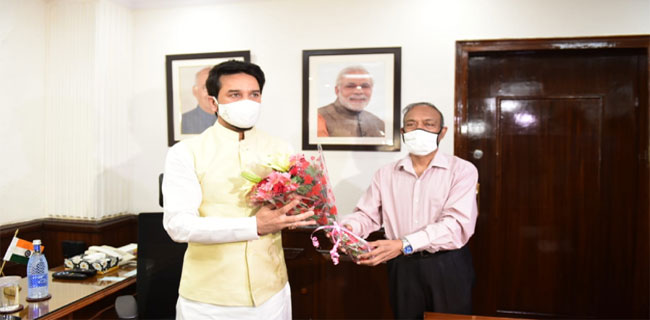
    The Minister taking charge (PIB photograph)


    By Indrani Sen


    Indrani SenLast week, in the reshuffling of the cabinet of ministers of the Central Government, Anurag Singh Thakur took over a double-barrelled charge of Sports & Youth Affairs Ministry from Kiren Rijiju and Information & Broadcast Ministry from Prakash Javadekar. He was elevated to full cabinet minister rank from minister of state rank in which capacity he has been working in the Finance and Corporate Affairs Ministry since 2019.


    Two years back, I first read about Anurag Thakur when he was appointed as a Minister of State “…’You elect Anurag with a record margin, I will make him a big leader,’ Shah had urged the voters at an election rally in Bilaspur, Hamirpur, on May 12. They did. And Shah kept his word, with Thakur being sworn in as a Union minister last Thursday.


    (https://economictimes.indiatimes.com/news/elections/lok-sabha/india/from-bcci-to-union-cabinet-anurag-thakur-enters-big league/articleshow/69585917.cms?from=mdr). Thakur first got elected to Lok Sabha from Hamirpur through a bypoll in 2008 and then won the same seat three times in 2009, 2014 and 2019.


    Amit Shah has continued to honour his promise as in two years Thakur has not only got elevated to the rank of a full cabinet minister, but has also been entrusted with the charges of two key ministries considering the importance of young voters in India and the dynamically changing media scenario in the digital age. It is expected that Thakur will be able to resolve the issues faced by both the M&E Industry and the sports industry given his record as a parliamentarian from 2008, former Chairman of the IT Committee and President, BCCI.


    Last week, various leaders from M&E industry welcomed Thakur as the newly appointed I&B minister and expressed their hopes that he would be looking into various concerns and demands of the various sectors and would provide a level-playing field for TV broadcasters, publishers on print & digital platforms, radio operators, cinema producers, etc. The various issues which are on the cards currently can be divided into two categories, one related to the content of the media and the other related to all non-content issues. Let us first look at the issues in the first category related to the content of media.


    Starting June 18, the Centre has sought public comments on the draft bill of the proposed Cinematograph Amendment Bill (2021) which includes fine and a jail term for film piracy, introduces certification on the basis of age and empower the Central government to order recertification of an already certified film following receipt of complaints. Centre had sought public comments on the draft bill starting June 18, 2021. Six film trade associations have already sent a joint representation to I&B Ministry objecting to the revisionary power sought to be provided to the Centre. Well-known filmmaker Shyam Benegal has also opposed this bill, saying that the government has no role in film certification and recertification. As this proposed amendment enhancing the role of the Central Government in deciding on the content of the films seems to be part of a bigger gameplan of the Central Government to choke the voice of Indian media, it is doubtful if Thakur in his new role will be prepared to listen to the voice of the industry.


    The timely adoption of the new IT rules by OTT and digital news channels also belongs to the content category and the bigger game plan mentioned above. Under this rule digital media publishers, publishers of digital news linked to traditional media, and over-the-top (OTT) media service platforms to furnish basic information about themselves and their self-regulatory mechanisms creating a role for a government appointed regulator for overruling the decisions of self-regulatory bodies. As I wrote earlier on this topic (https://www.mxmindia.com/2021/06/will-indian-netizens-lose-their-digital-rights/), so will not elaborate on it again. Subsequently, many publications moved court against the IT rules 2021. The Supreme Court has turned down a transfer petition filed by the Centre seeking transfer of all cases related to IT Rules to the apex court. Thakur will be expected to handle the legal cases and resolve the issue to the satisfaction of the Central Government.


    About two weeks back, the Central government introduced a three-tier grievance redressal mechanism as an amendment to the Cable Television Network (Regulation) Act with the intention of making the content related grievance redressal system for TV Broadcasters at per with the OTT and digital news platforms. The TV industry requires more clarity on this issue and its implementation.


    Among the pending issues pending for some time in the non-content category, the following require immediate attention from the new I&B minister:

    :: Certain long-standing demands of broadcasting sector related to their demand for an infrastructure status, liberalised licensing regime and a stable regulatory climate. The proposal of IBF seeking stimulus package based on economic relief and flexibility in the regulatory system.


    :: Addressing broadcasters’ concern about 5G system disrupting their transmission. Almost all C-Band satellites use spectrums between 3.7 GHz and 4.2 GHz for their downlinks and band of frequencies between 3.7 GHz and 4.9 GHz are used by most television channels for their operations which are adjacent to the band of frequencies identified for 5G usages in the country in the range of 3.00 GHz to 3.6 GHz.


    :: To come up with a solution for audience measurement of TV channels by either introducing reforms in the current system of BARC or by setting up an alternative TV measurement system. In November, 2020 I&B Ministry formed a committee headed by Prasar Bharati CEO Shashi Shekhar Vampati to examine the matter and to give a recommendation. The Vampati Committee submitted its report to the I&B Ministry in January, 2021, but the content of the report was not shared with public at large. The recommendations may also provide some guidelines for resuming the ratings of the news channels which have been suspended by BARC.


    The M&E industry at large and the TV broadcasters in particular are hoping that Thakur will address their immediate concerns impartially and will take positive steps towards making constructive changes in the media ecosystem. Industry watchers like me are keeping our fingers crossed as only time will prove the efficiency and effectivity of our new I&B Minister.


  • Self-Regulation by news portals and platforms key: Prakash Javadekar

    By A Correspondent


    Addressing the delegates at the 16th Marketing Conclave organised by the Internet and Mobile Association of India (IAMAI), Chief Guest Prakash Javadekar, Minister of Information & Broadcasting, Environment, Forest and Climate Change and Heavy Industries & Public Enterprises, Government of India today said that fake news is a deadly virus, and the way forward to tackle the menace is self-regulation by the digital platforms.


    Seeking greater accountability from social media platforms, he said misinformation weakens the functioning of a democracy and there should be a calibrated approach to thwart the spread of lies and disinformation. With all villages in India set to be connected, thanks to Bharatnet, there is a greater need to educate the masses about the detection of fake news.


    Speaking about the importance of the digital medium, the minister said that digital advertising is the future. “We must understand that with the speed it is growing and with the number of smart phones users increasing, digital content and digital advertising has become very important because of its reach and speed. Acknowledging the importance of the medium, he said that even the government has started to leverage the medium and are advertising through the medium.”


    The lead speakers from media and platforms at the conference include Anant Goenka, Executive Director, The Indian Express, Harsh Mariwala, Founder and Chairman, Marico, Satyan Gajwani, Vice-chairman, Times Internet, Girish Agarwal, Director, Dainik Bhaskar Group, Mark Read, CEO, WPP and Nitin Paranjpe, Chief Operating Officer, Unilever.


  • The Silent Coup by Prasar Bharati


    By Indrani Sen


    In February 2019, post TRAI’s NTO, big broadcasters had pulled out their Hindi mass entertainment channels from DD Free Dish which subsequently led to loss of viewership, weekly GRPs and ad revenue for those channels. The four big broadcasters, who submitted fresh bid invitation for vacant MPEG-2 slots by Prasar Bharati and won the e-auction held on June 2, 2020, must be sighing in relief now after getting five channels back on DD Free Dish. With effect from June 10, 2020, DD Dish TV subscribers would be able to view Star Utsav, Sony Pal, Zee Anmol, Colors Rishtey and Zee Anmol Cinema. It is definitely a win-win proposition for viewers as well as the channel owners in the post Covid-19 scenario.


    Considering that these channels were earlier earning on an average 100 times more that the average carriage fee of Rs 6 to 8 crore paid per annum to DD Free Dish and most of them lost 50% + of their ad revenue after pulling out from DD Free Dish, it is no wonder that they have all boarded back the DD Free Dish Band wagon at the first available opportunity. The five channels are in dire need of restoring their ad revenues in the post-Lockdown stage and cannot do without the viewership numbers which DD’s free-to-air platform promises to add. It is a silent coup by Prasar Bharati for making DD Free Dish an essential part for the survival and growth of these private channels.


    In most of the statistical analyses of subscribers of DTH providers, DD Free Dish is not included which makes the advertising and media Industry forget about its existence. While Doordarshan does not have the built in mechanism to measure the growth of DD Free Dish connections, estimates available from government sources as well as private consultancy firms unanimously agree that DD Free Dish is the leading DTH service provider in India.


    On June 23, 2019 at a programme to launch distribution of DD Free Dish TV set top boxes in Kashmir, Union Minister for Information and Broadcasting Prakash Javadekar claimed that (https://www.indiantelevision.com/dth/dth-operator/dd-free-dish-has-35-crore-subscribers-prakash-javadekar-190623) Doordarshan was the biggest DTH service provider in India with 3.5 crore (35 million) subscribers of DD Free Dish.  He further claimed that there are total 5.5 crore (55 million) DTH connections in India. The 2019 FICCI-EY report estimated 30 million subscribers for DD Free Dish and predicted that it would cross the 50 million mark in near future.


    It is evident from the activity related to DD Free Dish on various private e-commerce sites that their business is doing well. From the sale of DD Free Dish set-top boxes on Amazon (https://www.amazon.in/STC-DD-free-Dish-Set-Top/dp/B07FNKDGGC ) to installation of DD Free antenna on Indiamart (https://www.indiamart.com/proddetail/d-d-free-dish-antenna-installation-5874029873.html) to sale of remote  on Flipkart (https://www.flipkart.com/mase-remote-dd-free-dish-controller/p/itmfdcbspgtjqmgg) , e-commerce sites are doing brisk business due to the popularity of the DD Free Dish.


    DD Free Dish is available in Ku-Band on GSAT-15 (at 93.5°E). It has been upgraded from time to time. The number of channels available increased from 80 to 104 in 2019, of which 26 channels are reserved for Doordarshan. Currently 104 SDTV channels along with 40 radio channels of AIR are available to the subscribers. DD Free Dish has been the greatest contribution which Prasar Bharati has made to broadcasting in India since the satellite TV’s invasion from the sky and privatisation of TV channels. If the set top box for DD Free Dish can be made technically enabled to receive WiFi signals then a new vista of media consumption will open to the vast audiences belonging to  “Bharat”.


  • NBA requests GOI for stimulus package

    By A Correspondent


    On Monday (April 27), Rajat Sharma, veteran journalist and President, News Broadcasters Association (NBA), addressed a letter to Prakash Javadekar, Hon’ble Minister for Information and Broadcasting, regarding stimulus package for the news broadcasters relating to Bureau of Outreach & Communication (BOC)/DAVP advertisements and outstanding dues of the member news broadcasters of NBA.


    Here’s the text of the letter:

    “As you are aware the unprecedented crisis due to the COVID19 has put the finances of the news broadcasters under severe stress.

    The news broadcasters to ensure social distancing from spread of the virus and for ensuring the safety of the editorial personnel/staff has had to take various steps/make alternate arrangements within and outside the premises for news gathering/ reporting/office purposes. This has resulted in the operating costs of news broadcasters during the current pandemic/lockdown having gone up exponentially.

    Advertisements which is an integral and essential part of the business and the main source of revenue for the news broadcasters has come under severe pressure during this pandemic/lock down. Advertising agencies are putting huge pressure to defer the payments to broadcasters and to allow more time over and above the 60 days credit period; the recovery of bills is going to be hugely challenging, while facing an even bigger task of almost zero or negligible income in the coming several months. While the news broadcasters are coping with the financial problems of recovery of dues, we are also faced with serious problems of advertising inventory/ release orders being cancelled and inventory/ bookings being less than 50 percent for even the top-rated news channels. Poor recovery and lack of future income would mean that the news broadcasters would have to weather the storm for two /three quarters and hope for a partial recovery towards the end of the financial year.

    To overcome the financial crisis, we are suggesting that the MOI&B announce a stimulus package for the broadcast media by (1) increase the rates of BOC/DAVP advertisements by 50 per cent and (2) substantial increase in budgetary allocations of all Ministries/ Departments and organizations of the Govt. of India for dissemination of information/communication relating to COVIND 19 pandemic by BOAC/DAVP through private satellite TV channels for its widest reach to all sections of the society.

    Further, we have been representing to the MoI&B for several years, the issue of outstanding dues of BOC/DAVP of our member broadcasters, which is pending since 2010, and there has been no resolution till date.

    We have collated the current outstanding dues reported by our member broadcasters with regard to various Ministries/Departments released by BOC/ DAVP up to 31.3.2020. The total outstanding dues reported by members of NBA is approximately Rs.64,49,87,733/-, a substantial amount, which has remained unpaid over the years. Against the said outstanding, it may kindly be noted that that the outstanding dues of the Ministry of Information and Broadcasting (MoI&B) reported by the members is approximately Rs.8,62,25,333/-.

    We are attaching three statements. Annexure 1, gives the breakup of outstanding Ministry-wise, Annexure 2 gives the breakup of the outstanding dues member-wise. Annexure 3 gives the individual member details of the said outstanding.

    We request you to kindly instruct the BOC/ DAVP to clear all the outstanding dues of various ministries and in particular the dues of the Ministry of Information and Broadcasting (MoI&B)of approximately Rs.8,62,25,333/-. Payment of these outstanding dues of BOC/ DAVP will give some relief to the broadcasters who are under severe financial stress. If the payments have not been made to the broadcasters due to non-receipt of payment we request the MoI&B, to kindly take up the matter with the concerned client Ministries /Departments and organizations of the Govt. of India, to release the long overdue payment expeditiously to BOC/ DAVP.

    NBA Board members will be happy to be on a Zoom call with you and your officials to explain further the imperative need for the suggested stimulus package for the sustenance and survival of the news broadcasters. It would also give us an opportunity to discuss other issues which we have represented to the MoI&B.


  • IBF seeks relief package for the broadcast sector

    By A Correspondent


    The Indian Broadcasting Foundation (IBF), has sought the government’s support to deal with the economic crises in the television broadcast sector as a fallout of the Covid-19 outbreak in the country.


    In its letter to Prakash Javadekar, Minister for Information and Broadcasting, IBF has made the following requests:


    1. Regulatory moratorium for the sector for at least next 18 months.

    2. Phased resumption of production activities.

    3. Extension of moratorium period for GST payment.

    4. Mandating digital payments of subscription and advertising dues to broadcasters.

    5. Advisory to DPOs in respect of release of payment of subscription fees for the period up to February 29, 2020

    6. Waiver of processing fee and temporary live up-linking fee for live sporting events for a period of one year from the resumption of normal business activities.

    7. Increase in time period of one to two years for operationalisation of new channels which have been granted permission.

    8. Suspension of requirement of Performance Bank Guarantees in respect of channels sought to be launched for a period of one year.

    9. Waiver of carriage fee due to Prasar Bharati for three months (April, May and June) for FTA channels on Prasar Bharati’s Free Dish Platform.

    10. Deferment of payment due to Prasar Bharati for Free Dish carriage by 31 March 2020 be deferred until July 2020.

    11. All pending refunds even exceeding Rs. 5 Lacs should be urgently processed.

    12. The first instalment of advance tax (due on 15 June 2020) should be done away with and taxpayers be allowed to pay the 2nd instalment (due on 15 September 2020) directly without any interest liability

    13. The due date for deposit of TDS for the months of March and April 2020 should be extended to 31 May 2020 without any interest liability.

    14. Extension /waiver of permission for FX payments for foreign satellite transponder hiring.

    15. Lower rate of TDS from 10 to 2 per cent on subscription revenues

    16. Payment of stamp duty on agreements should be deferred upto expiry of ninety (90) days’ from the date of lifting of nationwide lockdown.

    17. Allow discharge of GST reverse charge obligation through GST input credit rather than paying in cash.

    18. Extend all existing stay of income tax demand for next 6 months without any new hearing.


    Said N P Singh, President, IBF: “The outbreak of the pandemic and the subsequent lockdown have posed several challenges for the television broadcast sector.  With complete cessation of  production  of  television  shows,  cancellations  of  live  sporting  events  and  scheduled advertisements, advertisement  bookings  nosediving  by ~50 per cent;  delays  in  payments  by advertising agencies/advertisers and distribution platform operators, the Broadcast sector is facing the brunt of the slowdown,” adding: “Moreover,  while  we  welcome  the  compliance  and  statutory  relaxations  granted  by  the Government in its latest notification of Apri 15l, the broadcast sector is seeking a stimulus package from the Government in the form of economic relief and regulatory flexibility so that all Broadcasters especially the smaller businesses can be helped to get back on track. IBF has also requested the Government for reduction in GST rate on Digital services (B2C), automatic  refund  of  input  credit  and  immediate  processing  and  issuance  of  lower withholding order (LTDS)”.


  • FM players reach out to govt for bailout

    By A Correspondent


    The Association of Radio Operators (AROI), the apex body of radio broadcasters in the countyr, has reached out to the Government of India seeking a bailout package in view of the severe impact of the Coronavirus outbreak on the industry.


    All private FM radio players have written to the Union minister of Information and Broadcasting, Prakash Javadekar about industry going through a tough phase with advertising revenues shrinking over the past year, coupled with a steep fall in government ads, and hoped the government will consider its requests for certain concessions it had sought in December 2019. The impact had worsened with the sudden outbreak of pandemic Covid-19 globally leading to services sectors and brands cutting back on advertising spends.


    The industry has collectively asked for a three-pronged bailout package till the economy stabilises. This included a one-year moratorium on all licence fees and charges by the government and Prasar Bharti, and restoration of government advertising on radio, besides clearing the long-pending payments from the Directorate of Advertising and Visual Publicity.


  • A Wishlist for the New I&B Mantri


    By A Correspondent


    We know that Information and Broadcasting is not only the ministry Union Minister Prakash Javadekar is going to be overseeing. The all-important, future-critical environment ministry is also something that the Pune politician is going to be concentrating on. And given the challenges that prevail on the environmental front as India races towards an infrastructure upgrade, clearly I&B will be Javadekar would do well to ensure the ministry runs on an auto-pilot.


    The minister is affable, even as he conscientiously follows the party line on all issues. He is friendly with the media, but that’s about it… we know how much the media – especially the part dealing with news – is truly independent.


    But there are many things we expect the new minister to do (and not do):

    1. Ensure minimum government intervention: The MIB should have minimal role in the functioning of MIB. It must monitor the role of the TRAI in broadcast and digital. Empower industry associations to take decisions, and if necessary have a body like TRAI to ensure these things happen. Just that. The TRAI shouldn’t be issuing diktats to the industry.


    2. Ensure self-regulation proliferates: And in order to be able to do that the government must ensure that all those who wish to take advantage of its largesse (DAVP ads), must be active participants in the self-regulation process


    3. Stay away from measurement: The MIB and the TRAI are actively engaged in television viewership measurement. Thankfully, for all players, not in print, radio, digital and outdoor measurement. The government must have no role in BARC, MRUC, RAM etc etc. These are funded by industry, and the forces within each trade will ensure that the measurement agency (and currency) performs.


    4. Allow news on FM Radio: This is an old demand that we have tried to impress upon every I&B minister. Insisting that private FM players can only air All India Radio news is pointless. If the government really wants Radio to grow, it must allow news on FM Radio. Let self-regulation and industry associations ensure that quality is ensured and national security isn’t compromised. If it’s okay to have news on TV, print and digital, why not Radio?


    5. Minimal controls on OTT: puhleez. OTT is set to grow exponentially and we hear that the government is planning to set rules on the content that will play on the platforms. If that happens, it would be unfortunate, and meaningless because there are enough and more ways to access content. Adequate viewing advisories should be enough, we think.


    6. Level and Just Taxes: The industry has been pushing for some relaxations on the GST front. This applies to advertising and the various media and entertainment entities. Minister Javadekar would do well to ensure a level and just playing field for everyone.


    7. Continuity: Can we have one single I&B Minister for the next five years, or at lease 2.5 years. Wishful thinking?


  • Welcome, Prakash Javadekar. But has Modi missed a trick by not combining I&B with telecom?

    By Your Editor

    The suspense over portfolio allocation ended earlier today with the announcement via a Rashtrapati Bhawan communique. While one needs to figure why some people were chosen (or not chosen) for a few key ministries, there is a new master for the media sector – the information and broadcasting ministry: Prakash Javadekar. The other important ministry for the media – telecom – sees Ravi Shankar Prasad continuing in office.

    Although it requires some lateral thinking, one would’ve thought that given the mandate the new government has won and the Prime Minister’s penchant for going out-of-the-box, we would’ve had a single minister for telecom, and information and broadcasting. There’s a lot more to IT than the internet and social media, and it could well be looked at by another minister, if at all.


    However, that’s not been done. And we are back to one minister for I&B and another for communications, IT and electronics. Sad, given that telecom is driving media in a big way, and in order that the digital economy grows, it’s important that there is integrated attention.


    Be that as it may, let’s welcome back Prakash Javdekar to the I&B Ministry. He’s affable and has had some experience in I&B (May-November 2014) and a few years as a member of the Press Council of India. Javadekar is liked by most people and can be a consensus-builder.


    There is loads happening in the media – especially on the digital front – and the minister would be required to step in and take a progressive approach to tackling things.


    Will he? Won’t he? We’ll know for sure soon enough.

  • Press Council celebrates National Press Day

    By A Correspondent


    Col Rajyavardhan Singh Rathore, Minister of State for Information and Broadcasting, has said that the success of Indian democracy owed much to the independent and responsible press which had played a crucial role in educating and empowering the masses. Journalists have acted like soldiers utilising the weapons of pen and newspaper columns. The Minister stated this while delivering his address at a function to commemorate National Press Day organized by Press Council of India in the capital on Sunday.


    During his address, Mr Rathore reiterated the government’s commitment to protect, preserve and promote freedom of the press. The minister called upon the journalists to maintain professional integrity and ethical standards in their pursuit of truth. In the function, the minister also released a souvenir highlighting the role of Press Council of India in ensuring fair practices of journalism.


    Also speaking on the occasion, Prakash Javadekar, Minister of State (IC) for Environment, Forests and Climate Change (and former I&B minister) said that freedom of the press was sacrosanct in a democracy and that this freedom came with responsibilities. The media has to facilitate active discussions and debates on various issues of national importance, the minister added. Justice Venkatachaliah, former Chief Justice of India, who was the chief guest of the function, said that press in India had a larger role to preserve, restore and propagate democratic and humanitarian values balancing them with changes in technology and perceptions of freedom.


    The function also witnessed the conferring of National Awards in different categories on print journalists for their outstanding contributions in various fields. Justice Markandey Katju, Chairman, Press Council of India and Vibha Bhargava, Secretary, Press Council of India were also present on the occasion.


    National Press Day marked the day of establishment of Press Council of India, PCI, as a statutory agency to ensure free and responsible press. This was the day on which the PCI started functioning as a moral watchdog to safeguard the independence of press in India.


  • M&E CEOspeak: Towards Shreshth Bharat ka Shreshth Entertainment


    Media & Entertainment captains met with new information and broadcasting minister Prakash Javadekar in New Delhi on Thursday, June 18 convened by the CII. Sudhanshu Vats, Group CEO – Viacom18 Media and Chairman and CII National M&E Committee for 2014-15 made his opening remarks. Excerpts from his speech:


    A warm welcome to colleagues in the media and entertainment fraternity to this round table conference

    I thought individual leaders will talk about the sub-sectors within the media and entertainment sub-sectors so I would very briefly underline the philosophy. We think media and entertainment could be built and taken forward. And also use this opportunity to take this industry from a USD 20-odd bn to100 bn USD by the end of the decade, which roughly translates to about five times over the next six years and almost doubling every three years.


    Reflecting upon this matter, one of the things that comes to surface is that it is a very dynamic industry. It is an industry which has so many sub-sections and there are so many things which are happening all the time. At the same time, when we reflect upon the election campaign which your party, under the able leadership of Shri Narendra Modi had undertaken. And it reminded me of how each element of media – whether it was social media, outreach to rural areas through mobile vans, 3D holograms, Twitter posts – everything which was being used has been so well understood. I was at times thinking, may be we’ll learn a lesson or two. Having said that, what I wanted to lay down was four areas in which I think the industry would benefit as we go forward.


    Purpose

    The first part, we set out with, is the PURPOSE with which we are going to drive this industry.The purpose, again to derive a phrase from Shri Narendra Modiji, is ‘Shreshth Bharat ka Shreshth Entertainment’. I think, that, if you ask me, is the underlying principle. It has to be about the consumers of this country, and through them, may be, all the global citizens and everyone else.


    Transparency

    It then involves transparency. It involves understanding of the models and allowing the free market free speech to prevail.


    Accountability

    The second piece is accountability. What can we do to actually drive it and let the market forces play?

    I think one is single-window clearance, which is needed across the board in our industry, whether we are talking of films, events, licenses…

    The second thing which is important is time-bound answers because one of the things that has plagued us at least in the last couple of years, more so, is the inordinate delay in trying to get anything done. To requisition a new channel for an established network, an organization must undergo the rigmarole of thousands of permissions/ clearances.


    Clarity

    The third thing which we seek is clarity. When it comes to clarity, making the policies clear and consistent over a period of time is of essence. And I think this will be very useful for the sector, especially when I talk on behalf of my distribution colleagues. If we have clarity in that sector, our ability to get investments in the industry will go up considerably.


    Foresight

    And the final piece is foresight. As an industry, we may be valued at approximately 22 bn, but I think we have two very important things: the multiplier effect in GDP growth of M&E industry is very well known. In the top G20 countries this multiplier effect is in the range of as high as 5% to 20% of the growth. And it sometimes gets hidden because the size (of the industry) at this time appears small.


    Our new esteemed prime minister recognized tourism as one of the most important things. Therefore the role which we can play as an industry to grow tourism in India -is by allowing shooting in the country, or whether by showcasing various parts of the country, there are several such things. It is the foresight which we bring in through


    1. That we have a huge GDP growth multiplier effect

    2. We have a huge impact on tourism as an industry
    3. And finally when it comes to foresight, as the world moves forward, as India moves forward, convergence of media, telecom and technology will be the key thing as far as consumers are concerned. The implication therefore on manufacturing in technology and manufacturing in other sectors.


    So with these four things, which are: very clear purpose, clarity of what we want to achieve, accountability, and finally foresight, that this industry has a big role to play, ability to generate direct employment of over 6 million and multiple more hired if you look at all the others concerned, I’d like you to address us and then all my esteemed colleagues to talk about specific issues.


    Minister of Information & Broadcasting Prakash Javadekar noted the address from various CEOs from the TV, Films, Radio, Print, DTH fraternity. Mr Vats commented on Mr Javadekar’s response to the various issues brought to surface:

    “The Hon. Minister of Information & Broadcasting, Mr Javadekar was extremely candid and open to discussion. He was receptive, and spoke from his heart with great conviction. He heard all of us CEOs across media domains and responded to each issue individually. It gives me hope, that if we work together, we shall achieve a 100-bn USD industry, that employs millions of Indians and createshundreds of IPs and products, and build the Shreshth Bharat.”