Tag: Pradeep Gupta

  • Axis My India publishes India Consumer Sentiment Index

    By Our Staff


    Axis My India, a leading consumer data intelligence company though better known for its Exit Poll results, has published the India Consumer Sentiment Index (CSI), a trend analysis that will track real-time shifts in consumer sentiment nationally. The sentiment analysis delved into five relevant sub-indices – Overall household spending, spending on essential and non-essential items, spending on healthcare, media consumption habits and mobility trends.


    Commenting on the launch of the report, Pradeep Gupta, CMD, Axis My India, said: “The India Consumer Sentiment Index is our endeavour to capture the shifts in the pulse of the demographic as we navigate a radically altered post-pandemic world. We have selected relevant categories like inflation in household spends and expenditure on healthcare to account for everyday challenges affecting a significant percentage of the population. While the second wave negatively impacted economic sentiment around employment and business prospects, the index will aspire to demonstrate the accurate picture based on the remodelling of the vaccine distribution strategy, which has shown encouraging results. By plugging into economically and culturally significant data-points, the CSI will try to gauge, interpret, and predict the impact of macro factors on the lives of the average India across demography and geographies. Our mission is to bring out the most authentic voices via the rigour of data and analytics.”


  • Axis My India features in Harvard curriculum

    By Our Staff


    Axis My India, the consumer data intelligence firm that made waves with its exit poll forecast last year, is now part of the Harvard Business School curriculum. The B-school has built a case study based on its election forecasting model.

    Said Pradeep Gupta, Chairman & Managing Director, Axis My India: “We are delighted that a globally renowned institution like Harvard Business School has built a case around our work at Axis My India. We are pioneers in the methodology for election surveys and have predicted most accurately the outcomes of 43 out of 47 elections so far which demonstrates our expertise in providing insight solutions through field surveys across the length and breadth of our country. Our ingenious use of technological solutions, robust processes, quality control, and completely in-house infrastructure and resources have played a significant role in our success. We will strive to constantly delight our clients with accurate insights that demonstrate our hold over the nation’s pulse, particularly rural communities.”

    Added Professor Ananth Raman, UPS Foundation Professor of Business Logistics Chair, OPM, HBS: “This case study illustrates numerous operational details, including those associated with training surveyors and moving them across different locations based on their linguistic and socio-economic identities to get a feel of the electorate’s pulse. Predicting elections accurately in an extremely complex country like India is difficult. AMI’s track record is a testament to the company’s project management and process excellence capabilities. I am certain that, through the case, Mr Gupta and Axis My India will inspire several business students at Harvard Business School to create their own entrepreneurial journey.”


  • Axis My India scores again with India Today exit poll

    By A Correspondent


    In May this year, after the Lok Sabha results came in, ace pollster Pradeep Gupta cried. Yesterday, he was visibly moved, his eyes having welled up in the presence of Rajdeep Sardesai and Rahul Kanwal and the studio guests.


    The Axis My India Chairman and Managing Director and his team had predicted it right yet again with the Maharashtra and Haryana polls. While other media outlets may have got it wrong, the India Today-Axis My India exit poll delivered the most accurate picture of around 11 crore voters in the two states.


    Said Kalli Purie, Vice Chairperson, India Today Group: “I think getting the exit poll right again, especially against popular belief, separates news channels from propaganda channels. It’s our approach on ground reporting and non-alignment that we were able to read data with a level of understanding. And doing it in Haryana elections, where the margin on so many seats was so slim, is a validation of the scientific and thorough approach of Axis.”


    Added Gupta, crediting the accuracy to team work and scientific monitoring of voter behaviour. “We follow international best practices. Our methodology is highly refined that helps us eliminate margins of error. Our sampling is the most demographically representative in any given election. We closely, and continuously, monitor voter mood and intent.” On air, Gupta thanked the India Today group for standing by his predictions.


  • Axis My India partners with TAM India to launch new consumer insight platform

    By A Correspondent


    Axis My India is partnering with TAM India to launch a one-stop consumer insights research platform, with one million+ respondents covering 670+ districts of India over a 12-month period that will answer the most preferred consumer brand(s) and most used consumed brand(s) across 40 product categories. It will also enable data users to micro-target segments of consumers geographically for effective localised marketing plan implementation, thus deriving higher ROI.


    Speaking on the occasion, Pradeep Gupta, Founder of Axis My India, said: “We have leveraged our inherent and historic strength of successfully executing electoral research across length and breadth of the country for building this new service. The extent to which culture, opinion, perception changes every 100 miles in our country has made me promise to myself to create a two way communication platform for marketers soon. Gradually, we endeavour to reach out to all the 250 million homes in India. Our past success in capturing the true voice of citizens about their preference and perceptions on governance parameters gives us great confidence in extending this expertise to provide similar insights to the brand owners in this country.”


    Commenting on Axis My India’s partnership with TAM, Gupta added, “Partnership with TAM is a significant milestone for us. TAM’s contribution towards the growth of Indian advertising andbroadcast industry since 1998 is well known and a documented fact not only in India but also globally. This partnership with TAM gives us access to advertising details of thousands of brands across media in India. These very brands are keen on making their presence felt in the minds & hearts of a diverse Indian market place.”


    Commenting on TAM India’s partnership with Axis My India, LV Krishnan, CEO, said, “It is equally exciting for us as data from Axis My India survey of onemillion+ respondents will be a single window for brand owners for addressing their quest to enable micro level marketing. This is making it a first of its kind research platform not only in India but across the globe. This will positively create a new set of expectations from Advertisers, Broadcasters & OTT players. Our in-house teams, S-Group & TAM Edge will work with Axis My India & Client teams closely to provide data insights for driving implementation of their marketing strategies at a granular level.”


    In November 2017, Axis My India is planning to come out with Phase I of the survey where the most preferred brand will be announced across 40 categories through its initiative of Trust Index.


  • PG awarded Best Entrepreneur Mentor by skill min

    By A Correspondent


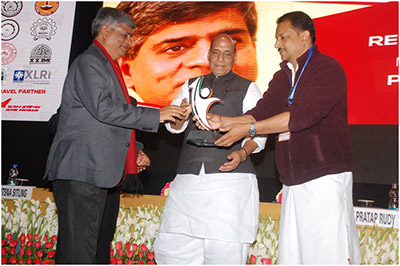
    Pradeep Gupta, CMD, Cyber Media India Ltd, has been recognised and awarded the Best Mentor (Private) for his role and contribution to mentoring entrepreneurs in the private sector at the National Entrepreneurship Awards 2016, instituted by the Ministry of Skill Development and Entrepreneurship (MSDE).


    The award was handed over by Rajiv Pratap Rudy, Minister for Skill Development and Entrepreneurship in the presence of Home Minister Rajnath Singh. During the ceremony, an overview of MSDE’s entrepreneurship initiatives were outlined by Minister Rudy. Home Minister Rajnath Singh in his speech highlighted the role of entrepreneurship in making India a leading economy globally. He also congratulated the winners and praised them for their exceptional achievements.


    PG, as Pradeep Gupta is also known in media circles, is a first-generation entrepreneur pioneered technology publishing in India when he launched CyberMedia in 1982 at age 28. A BTech from IIT Delhi and PGDBM from IIM Calcutta, PG has also set up an incubation and acceleration centre for electronics start-ups. PG is one of India’s earliest angel investors and chairs the Alumni Trust, sponsors of IvyCap Ventures with corpus of $140mn for Series A and is on the board of OOM Calcutta Innovation Park.


  • Digital is changing the publishing game: IMC panel

    By A Correspondent


    There is a revolution happening in India, and publications have to ride the wave. This has been the dominant theme ever since the digital eruption began, and the urgency has only grown. The message was echoed at the panel discussion on ‘The State of Digital Publishing – Challenges and Opportunities’ on the second day of the Indian Magazine Congress.


    Kirthiga Reddy, Director, Online Operations, and India Head, Facebook, said that according to the Indian Readership Survey, digital media has been growing faster and bigger than print media, and its drivers are technology and changing consumer behaviour.


    On the technology side, India has the highest growth rate in internet adoption. “We are in the midst of a smartphone, tablet, featurephone revolution,” she said. “On the consumer side, consumers want to find exactly what they want, when they want it, as the pressure of time is intensifying, and this is changing how people are doing things.”


    There are three big opportunities in social media, Ms Reddy said. One is reach, the second is two-way interaction, and third is using that interaction for unprecedented personalization. “On the Facebook platform for example, you can reach one billion people globally. Marketers need to think about platforms including the lowest end feature phones, as well as using the range of regional languages.”


    People do not just want to consume information, they want to interact and share it, she said. This desire to share is higher in India than the global average. Some best practices are to have a content strategy that leverages the power of each platform, it’s not about one content strategy for all. The most effective use of social media is when the company thinks of social media as part of everything that they do; it is not something separate.


    Moving on to personalization, Ms Reddy said that in five years from now, it will be unthinkable that an individual goes to a website and sees the same thing as other individuals. Consumers are going to demand personalization. No one is going to have the time to flip through pages and pages of matter which is irrelevant to them. One challenge to highlight at this time, she said, is education to help people navigate the new world of new and social media.


    Umang Bedi, Managing Director, South Asia, Adobe, said the global trend is to put digital first, and India has to keep in step. The way the world looks at content strategy is about taking content into a digital format first, giving the flexibility of creating content any time anywhere, and rendering that content and distributing it. Then it is about optimizing, personalizing and monetizing the content, breaking down the traditional silos. Adobe, he said, is very close to a solution for meeting the consumer need of personalized customization.


    “Mobile traffic has exploded in India, and everyone wants to put content in digital format. And every time someone goes online and interacts, they leave a digital set of signals. Brands need to listen to these signals, assimilate data and make decisions based on these observations which are tailored to each individual. Conversions grow by 4x or 5x when brands are able to differentiate themselves in this way,” Mr Bedi said.


    Punitha Arumugam, Director, Agency Business, Google India said that thinking about digital has to go beyond desktop and mobile, but the context is likely to become one comprehensive device – the Google Glasses – as early as by the end of the year. Adapting publishing to existing digital devices has to include developments of the future such as this, she said, which will change the way consumers interact.


    The advent of technology has ended up making consumers increasingly lazy, she said, and this also influences the way brands reach them. She cited the example of pizza company Red Tomato, which has a fridge-magnet application that can be used to order pizza instantly based on previously ordered choices. However, when reading a magazine online, consumers behave the same way as they do with magazines in hard copy, she said. Which is, they stop at pages, stop at ads, etc, in contrast with other online behaviour which is search-oriented.


    In the publishing space, magazines need to be frenemies rather than enemies, Ms Arumugam said, highlighting that collaboration can help the industry as a whole, and thereby benefit individual brands as well. She also added that measurement needs to include online readership as well as the traditional offline numbers, and the next IRS, in collaboration with Google, would be tuned to reflect this.


    The discussion was moderated by Pradeep Gupta, Chairman and Managing Director of Cybermedia.


  • Could Indian mags go the Newsweek way?


    By Ananya Saha


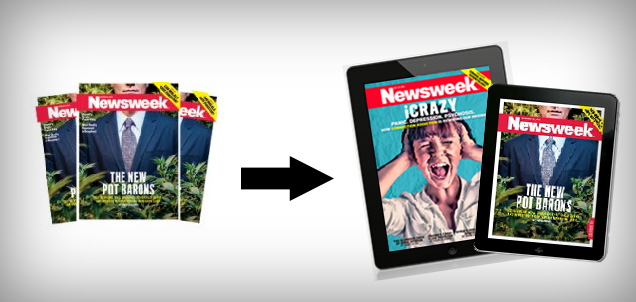
    Newsweek, founded nearly eight decades ago, is moving to a digital-only product from 2013. According to editor-in-chief Tina Brown, it cost $42 million a year to manufacture, print, distribute, and manage the circulation of Newsweek.


    Newsweek is in the best position to go completely digital due to their strong online presence through Daily Beast. But the news has sounded an alarm bell for print magazines all around the world. As news becomes a 24/7 affair and people prefer online access, the readership of news magazines is on decline the world over. It is no wonder then that magazines are reaffirming their presence in the online space too. With Kindle usage on the rise, e-magazines are creating waves.

     

    Tarun Rai

    Even as Indian print industry continues to see new launches, the readership is on the decline (though a minor slide), as recorded by recent IRS figures. “I am not very surprised at the decision. I believe the issue for Newsweek is the nature of the magazine it is. As a result, the relevance of a weekly ‘news digest’ has diminished. It is not a question of print or digital – it is a question of the nature of some magazines that may not be as relevant today. The same cannot be said for lifestyle and special interest magazines,” opined Tarun Rai, President of the Association of Indian Magazines and CEO, Worldwide Media.


    Suggesting that print media still has a bright future, Paresh Nath, Editor and Publisher, Delhi Press said, “It is more of a failure of a publisher than the sunset of an industry. Printed books and material will continue to be relevant as they were in the last several hundred years.” Agreeing that the digital market for Newsweek may have matured earlier than the publishers expected, Pradeep Gupta, chairman and managing director of CyberMedia, said, “In the market they are operating in, digital is growing very rapidly and therefore Newsweek has moved in that direction.”


    The predicament of the dawn of the digital era has been repeated often in the Indian context.


    “I am happy to say that magazines are already re-inventing themselves for the digital world. Abroad as well as in India. All our magazines are available in their digital versions. We are also aggressively developing various magazines’ apps and will be launching them soon. We see an opportunity in reaching a new younger audience through our digital initiatives,” said Mr Rai.


    Even while most magazines have moved towards digital and print versions simultaneously, the print version remains important for reaching the wider audience of readers and advertisers. Time magazine also has responded with their online version adaptable to any platform and any size, particularly for mobile reading. Varghese Chandy, Chief General Manager, Marketing Advertising Sales at Malayala Manorama said, “Reinventing needs to be done not only for news magazines, but every single product for its survival.”


    According to Anilkumar Sathiraju, AVP & Head, DDB MudraMax – Media, South, revenue will still come from print version since revenues from digital in India are still at a nascent stage, even though digital penetration is increasing rapidly. Going forward, he predicted that revenues will still be higher from offline magazines.


    Magazine have the most engaging format with the deepest touch points according to various international surveys. The growing numbers of tablets reassert the fact that this is the platform that gives the closest magazine-reading experience. Mr Chandy said, “However, monetizing the digital platform will be a greater challenge even for Newsweek.”


    While the industry believes that magazines should be ready for the digital era, Mr Nath holds an interesting view: “Magazines do not need to reinvent themselves due to the digital onslaught. Digital delivery of content is like delivering content in Times Square by shouting when hundreds of voices are simultaneously trying to convey the same or similar things. When crowds assembled in Tahrir Square, Cairo, it was thought that the digital media is a powerful weapon, as sentiments were whipped up not by newspapers but by digital media. What is the end result? Muslim Brotherhood that conveys thoughts through printed material ultimately got into power. Very little original content is created on digital media. It only copies and pastes and does so millions of times over. Magazines or print versions of newspapers do not know how to overcome the shouting match where noise and not seriousness is the basic currency. When the time of reckoning comes, people will have to go to the print version, and magazines and newspapers will remain relevant. Magazines have to find out how to outgrow the noise.”


    Delivery is still an issue – from readers visiting libraries in the past for content consumption, to wanting the content delivered to them. “Print brands have given up the will to fight and are trying to join the digital crowd that has weapons stolen from print itself. Yes, the world of delivery has changed, not consumption of content,” said Mr Nath.


    But with readers wanting immediate access to content, 24×7, digital is only going to grow. It is time that that magazines move faster towards the digital era, according to Mr. Sathiraju.


    The way forward

    “In India, spend on magazines continues to grow because of an increase in literacy, increase in disposal income and lower internet penetration. Therefore, Indian publishers are embracing digital formats. Print advertising is currently 10 times the digital advertising in India. Over the next five years, the penetration of digital will increase. And that is why CyberMedia has reoriented its strategy around creating of a media mesh,” predicted Mr Gupta.


    Mr Nath said that the question of digital versus print comes from the English-educated class in India. He said, “Long ago in India, content used to be created and consumed under the banyan tree. Now it is in front of a screen but the quality of this content is poor, one-way, where hundreds speak and no one listens. In India among the English educated there is a problem as this class cannot enjoy English content (is there any English Indian serials or English Indian movies or English Indian music?) whether in print or on digital media. This class keeps shouting that print is dying as it does not know how to ‘read’ in any language.”


    The view might hold true but the increased consumption of magazines on digital platforms cannot be ignored.


    “It’s anybody’s guess as to when the digital versions of magazines will become bigger than the printed ones. I firmly believe that the lifestyle and special-interest magazines space will continue to grow in both. It is the sunrise sector of Indian media. And both the print as well as the digital versions will grow, allowing our content to reach an even wider audience,” said Mr Rai.


    As Mr Chandy concluded, “The Indian print industry needs to be ready for the future. Currently online penetration is single-digit. This is likely to change in the near future, especially in the metros.” Thus, publishers need to be platform-agnostic and essentially become content managers. Their primary task will be to reach the audience through whichever platform is relevant.
     

  • Hoshie Ghaswalla takes charge as CEO, Cybermedia

    By Archita Wagle


    The winds of change are blowing at premier technology publishing company Cybermedia India. Senior mediaperson and old company hand Hoshiediar Ghaswalla has been appointed Chief Executive Officer. When MxMIndia spoke to Mr Pradeep Gupta, chairman and managing director of Cybermedia, about the reorganisation, he said: “Earlier only the information and communication technology (ICT) and speciality media group had been reorganised. But now our entire media business has been reorganised and Mr Hoshie Ghaswalla is now CEO of Cybermedia.”


    Earlier this year, Cybermedia had reorganised its information and communication technology (ICT) and specialty media group (SMG) in four units Mr Ghaswalla’s charge. The move was for better functioning, faster decision-making and better customer interaction and the new organisational changes were to come in effect from April 1.

    Said Mr Ghaswalla on his appointment, he said: “CEO is just a title, but I am certainly glad to be given this opportunity to head the entire  media business. These are challenging but extremely exciting times for the media industry”.


    On his plans, Mr Ghaswalla said: “We had hired a leading consulting firm last year  that worked with  various internal and external stakeholders to come up with a plan  for the future which  I will now focus on executing.  For the immediate future we are going Digital first – we will provide content to our audiences where they want it, when they want it and in the format they want it. For advertisers and sponsors, we will be moving a lot more towards the solutions approach. As a group we have always innovated and are therefore looking at some game changers which will give us tremendous scale in the mid-term.”