Tag: Population First

  • Population First invites entries for Laadli Awards

    By A Correspondent


    Mumbai-based social impact organisation Population First, which works for women empowerment and gender equality, has announced its ‘Call for Entries’ for the 10th Laadli Media and Advertising Awards for Gender Sensitivity (LMAAGS) 2020. The date for receiving entries is 30th June 2020.


    Said Dr A L  Sharada, Director, Population First: “From mere 100 entries in 2007 to more than 1500 entries in 2017, Laadli Media Awards have come a long way in acknowledging the media’s contribution in women empowerment and gender issues. The increasing volume of discussion in public domain on gender issues is an indication that we are witnessing the beginnings of change. These awards facilitate engagement of journalists with gender issues and we are happy to note that our various interventions have resulted in more coverage from gender perspective over the years across media.”


    Over 800 awards across 14 languages in print, electronic, radio and web categories have been presented to media and advertising professionals from across the country since 2007.


    Added Dr Sharada: “Considering the popularity of OTT streaming sites & applications, an award for a Web Series is also introduced this year.  Also, two new and popular awards are being introduced in the General Entertainment segment for the Most Inspiring Woman Protagonist and Best Episode with a positive message on a gender issue”, she informed. A special award for Best Reporting on Covid-19 from a gender perspective is also being introduced in this edition.


    For detailed guidelines and entry form, visit www.populationfirst.org or email at laadlimediaawards2020@gmail.com.


  • Population First partners KC College for study on media coverage on gender issues

    By A Correspondent


    Population First, the communication and advocacy initiative working towards gender sensitivity, has conducted a study on ‘Media: How Gender Sensitive, How Inclusive’ in collaboration with the Gender Issues Cell of KC College, Mumbai. The report of this research will be released in the presence of several dignitaries and students on Friday July 28 at the KC College auditorium in Mumbai at 3:30 pm.


    The findings of the study will be shared in a panel discussion with leading mediapersons Kalpana Sharma (Former deputy Editor, The Hindu), K V Sridhar (Founder, Hyper Collective), and Devleena Majumdar (President HR, Culture Machine).


    Said Dr A L Sharada, Director, Population First: “The study was conducted with funding support from UNFPA.  The project was restricted to media organizations within Mumbai Metropolitan Region and covered a total of 87 respondents drawn from 36 media organisations across languages. The conclusions, thus, are derived from the rich data gathered from interviews with media personnel and from review of previous research studies and existing literature on the subject. Data on gender distribution at different levels within media houses have clearly reflected gender disparity.  Board members, Founder members, CEO etc are predominantly men.  Women are found in large numbers as HR personnel across print and advertising but are less in number in broadcast. The presence of women camerapersons, photographers in technical sections is dismal across all media. The study also throws light on beats being highly gendered, awareness of Prevention of Sexual Harassment of Women at Workplace, demands of work and family life came out as a major hindrance for women professionals in media and more.”


  • Colors joins hands with Laadli as Cause Partner

    By A Correspondent


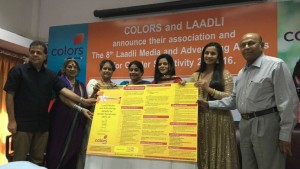
    Laadli, the flagship campaign by Population First for gender sensitivity, has announced various initiatives including the popular awards for communicating gender sensitive and women empowerment issues. to raise awareness and work together on various initiatives relating to uplifting and empowerment of women. It has inked an MoU with general entertainment channel Colors for the same. The Laadli Media and Advertising Awards for Gender Sensitivity (LMAAGS), for instance, recognisees and celebrate the efforts of the media and advertising community to promote gender sensitivity in India.


    Speaking at the launch, S V Sista, veteran adperson and founder and Executive Trustee, Population First said, “Over the last few years LMAAGS has set a benchmark for the media in the space of gender sensitive reporting of women. We thank the media for their continuous support towards this cause. The LMAAGS was instituted to salute this spirit in the space of gender sensitivity, thus celebrating the power of media. Our partnership with Colors this year will further augment the cause that we all stand for.”


    Speaking at the launch, Raj Nayak, CEO – Hindi Mass Entertainment, Viacom 18 said, “Gender equality and women empowerment are tangible issues faced by our country today. Associating with Population First for Laadli Media Awards is a step towards this direction. As we steadily move towards increasing and improving the rights and security of women, it’s heartening to know that there is a section of the media and advertising industry that is working diligently towards rehabilitation of the affected strata of our society.”


    According to Dr A L Sharada, Director, Population First, “From a mere 100 entries in 2007 to more than 1500 entries in 2015, Laadli Media Awards have come a long way in acknowledging the media’s contribution in women empowerment and gender issues. The increasing volume of discussion in public domain on gender issues is an indication that we are witnessing the beginnings of change. This year, too, we hope to see a quantum leap in the number of entries of Laadli Media Awards.”


    The last date for receiving entries is December 15, 2016, and the awards will be announced soon thereafter.


  • So which ads are most gender-sensitive?


    The image of the women in Indian advertising, is changing. From wife/mother/homemaker earlier, she is now career person/influencer/decision maker as well, which is a more accurate reflection of society. But it is still only a handful of ads that have gone a step further to bend gender stereotypes and show men taking on the roles traditionally played by women in a household. Gender sensitivity in advertising is still some way off, but the new, empowered woman in today’s creatives, shows it isn’t that far down the road either. Meenakshi Menon, Founder, Spatial Access, and AL Sharada, Director of Population First speak about how today’s ads have come a long way and pick their favourite TVCs…


    Do you think advertising is more gender-sensitive today than ever before

    Meenakshi Menon: I think the biggest problem with advertising today is that it lives in cuckoo land. You see the people in ads that you would never come across in the street. And the way advertising portrays women has also historically been a problem. But I think recently, one has seen a positive change.


    AL Sharada: There has been a visible change in the last two or three years, perhaps as a reaction from younger women and men against gender stereotyping and gender violence. Also, more women today are influencing and being actively involved in purchase decisions. There is more participation of women in the workforce, so obviously advertising can no longer ignore them. I don’t think it is being done because of social or altruistic reasons but it [has become] an important issue for [marketers]. Particularly with digital media, they are able to explore these issues in a more elaborate way.


    Menon: Now that you mention digital media, I think a lot of advertisers today are concerned about the gender issue not because they are genuinely concerned, but because digital and social media will immediately pounce on somebody if they are seen to step out of line. So thank god for social media.


    And would you say that gender-sensitive ads can really change social beliefs and improve the lot of women in the country?

    Menon: It’s a popular myth that advertising reflects the reality of life. So if wives are being beaten up in the privacy of their homes, should they then also be beaten up in the public arena of television? This is such a stupid argument. But as practitioners of advertising, if we believe that because of our creative work people go out and buy one brand rather than another, then it is our responsibility to not just reflect society, but actually guide society as well.


    At Population First, you’ve been doing a lot of activities to educate advertising people. Do you think you have been successful?

    Sharada: It really had a lot of impact in the sense that the [feedback] we received from the senior-most leaders in the industry was amazing. And that makes me very optimistic and hopeful that we will be able to take this agenda forward. Particularly, if you look at the fact that an ad is instituted for gender sensitivity this year means a lot because the industry is recognising gender-sensitivity as an intrinsic value for good communication.


    So let’s talk about the ads that you find worthwhile, sensitive and ‘right’…

    Menon : I’ve been very impressed with Ariel’s Share the Load ad. Everytime I see it, I want all the men that I know, to see it too. Today it is becoming increasingly fashionable for men to cook, but it’s not fashionable to do laundry. Everywhere across the developed world, laundry is seen as a chore for the individual — men and women do their own laundry. What I really like about it is that it’s the father saying, with regret, that he did not help his wife, or [pay heed] when his daughter was playing house while his son was playing cricket.


    Sharada: I totally agree, because in all our campaigns, we see that if you don’t change the family, you can’t change society. The balance between the father and mother is [shown as] unequal and this gets perpetuated through generations. This ad actually talks about the whole gendering process that happens in the family, where the girl is given a tea set to play with, while a boy is given a cricket ball, and how that builds up all the associated roles and responsibilities, which are not equal.


    What other ads would you list among the Top 3 or 5 on gender sensitivity

    Sharada: I think the Titan Raga ad is good because it talks about the right of the woman to have a career, and also subtly and effectively shows the attitude of a man when he wonders how he can be without a job…


    Menon: Another ad I thought interesting was the Biba arranged marriages one, where a hackneyed, traditional situation – of a boy’s family coming to see the girl – is [turned on its head] when the boy says, ‘Give me 10 days, and I will learn to cook something for you’. I thought that was really amazing.


    Sharada: There are two or three ads that challenge the gender stereotypes of a man. One of them is the Samsung Galaxy Note 4, where they show the man spending time with his daughter, taking her for her performance, taking her out for a meal and then, because he has to get back to work, he takes her to his office. The work-life balance we see in this ad, is usually associated with women, but here a man is seen striking that work-home balance. Another ad I like, which is similar, is the Raymonds one where a man opts to stay home to look after the child while the woman goes to work. We really need to question the ‘macho’ image of men, and bring in new and more socially-acceptable images of them. I also like the Myntra ad where a woman decides to leave the job [because her boss has promoted someone else over her because she is pregnant]. It addresses a very important issue of gender discrimination in the workplace and it was significant that they had a woman boss in the ad…


    Any message for marketers and the creative fraternity on producing gender-sensitive advertising?

    Menon: One way to distinguish advertising that is gender sensitive from advertising that is gender offensive, is for [a male] creative director to ask himself if he would be okay with an ad that portrayed his wife or mother in a similar way. If he uses that as a filter, then you might find more people saying this is ok, and that is not. We need to educate people on how they can tell whether something is gender sensitive or not.


    Sharada: There are four or five points which you should keep in mind when you are creating an advertisement. You should give equal space and an equal role to both men and women. I find many youth brands doing that, having an equal number of young men and women in the ads. Second, the way they are addressed and spoken to in the ad, is also very important. Third is to keep this in mind: Are you promoting certain stereotypes because they are comfortable and accepted, and will not cause hassles, or are you reflecting the reality? If you keep these things in mind, I think you can avoid being gender insensitive in your communication.


    Menon: Frankly, I think that we have seen a lot of gender-sensitive advertising today because more and more marketers are concerned about consumer backlash. Because of social media, it is very easy to point out something that is offensive. And yes, this trend is not limited to the urban areas alone.


    A part of this discussion appeared in BrandStand on Zee Business on March 5 and 6. Catch it on YouTube at http://bit.ly/BStand05Mar16. This story first appeared in dna of brands on March 7, 2016.
     

  • How India can see more gender sensitive ads


    Last week, Population First hosted a day-long workshop titled ‘Men are from Venus, Women are from Mars’. The event, supported by the United Nations Population Fund (UNFPA) and with Social Access as knowledge partner, saw key issues of gender sensitization being discussed.


    Although it was planned some months back, in the light of the Tarun Tejpal episode, there was much attention on the issues discussed.


    A key component of the workshop was a report analyzing decisions taken by the Adevertising Standards Council of India (ASCI) on indecent representation of women. The report was undertaken by Feroza Sanjana under the guidance of the UNFPA and Population First.


    We present here the recommendations made in the report and the conclusion.


    Towards greater participation: Three major means to motivate greater participation to strengthen ASCI’s complaints mechanism include a need for increased awareness of ASCI, increased gender sensitivity and strengthening compliance.


    (a) Greater awareness of the ASCI: With regard to awareness initiatives, despite starting a TVC campaign there still remains a low awareness of ASCI, according to Mr. Collaco and Mr. Narayan. There is a strong need to inform people of the existence of the complaints mechanism and the easy accessibility on the ASCI website. This could be done through strengthening the ASCI National ad campaign in print and TV to motivate consumers to complain to ASCI in case they find an ad misleading, offending or harmful. In order to further promote this, ASCI conducted a contest at Goa Fest to promote responsible creativity under the theme Creativity with a conscience, open to advertising, marketing and media professionals, which revolved around creating short films using a mobile phone, in which more than 120 teams participated.


    (b) Motivating the public and ASCI members to participate: Create widespread public demand for gender-sensitive advertising through the propagation of gender equality. Improve the participation from CSOs, NGOs and women’s groups in this initiative to advocate the correct depiction of women in advertising. Sensitise ASCI members to gender equality to increase suo moto complaints by conducting training workshops. The NAMS initiative of the ASCI when complete will also empower ASCI members with a database of gender-sensitive advertising.


    (c) Strengthening the compliance code: A major factor influencing the desire to complain is the rate of compliance of offending clients and advertisers with complaints upheld by the CCC. The compliance rate of total complaints upheld has increased from 75.4 per cent in 2007-08 to 86.4 per cent in 2011-12. For gender issues, the compliance levels to complaints upheld by the CCC are 100 per cent. However, the number of complaints upheld is very low to begin with. The compliance code needs to be more specific in case of gender-sensitive advertising. NAMS is a welcome initiative by the ASCI. Also decisions by the CCC need to be taken fast so action against offensive ads are taken as soon as they are aired and not after they are off air.


    The power of ASCI has considerably increased due to compliance with the ASCI Code being mandated in the Cable TV Network Act Amendment, 2006. However, outdoor and print ads are excluded from its purview. UNFPA and Population First with ASCI can take up the issue with the GOI to make ASCI a more comprehensive regulatory body.


    2. Create safe spaces for discussion: A major number of offensive ads come from product categories such as deodorants and cosmetics, including fairness creams. In the case of the former, there is a need for campaigns which reposition their product in a gender-sensitive manner. In case of the latter, a discussion and open debate should be started on whether advertising for fairness creams is problematic, or whether the product itself is a problem. If so, then a similar regulation as in the case of ads for alcohol and cigarettes should be applicable. UNFPA and Population First need to advocate discussions in various fora about these issues with a longterm view in mind.


    3. Highlight positives: There are examples of ads being made today which can serve as good examples of gender sensitivity and which deal with sex in a gender-neutral tone.


    (a) Build more evidence: There are still gaps in knowledge regarding the impact of the depiction of greater gender sensitivity in advertisements on sales. There is a strong need for further research in this field, as the findings of such a study will provide evidence-based advocacy with clients as well as advertisers.


    (b) Make it interactive: There is no formal mechanism to measure the impact of self-regulation in changing attitudes towards gender issues within the advertising industry. There needs to be a feedback mechanism to gauge the level of gender sensitivity in the industry as a whole. Reliable information can lead to a formulation of a good strategy towards gender sensitisation efforts.


    4. Specify and strengthen the ASCI Code: The rationales provided by the CCC are broad-based and at times underspecified. A detailed guideline on representation of women and gender sensitivity in advertising is needed to provide a uniform rationale which reduces subjectivity in decision making. In addition, a more specific code and quick implementation of NAMS will serve as an incentive to the general public to complain.


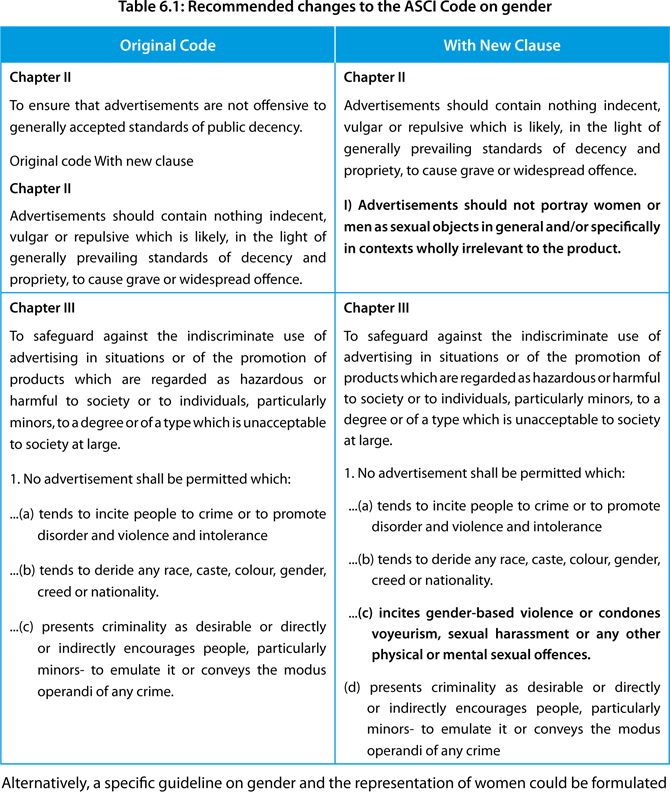
    Following this, it is suggested that the following clauses be included in the ASCI Code (See Table).


    Conclusion

    Between 2007 and 2012, ASCI has significantly strengthened its ability to self-regulate and has on average achieved a high level of compliance, which is now also mandated in law. To further build on this, we hope that the above findings provide concrete direction for future engagements between Population First, UNFPA and ASCI. Finally, we hope that better organisation, improved record keeping and a less restrictive anti-disclosure policy in the management of ASCI would help researchers in the future.


  • Laadli day for women with media campaign


    By Meghna Sharma


    Celebrating Women’s Day is no small matter. From special programmes to activities, from status updates to tweets, everyone will do their bit to make the day special for the woman/women in their lives.


    But with too much negativity around us, it is possible to celebrate oneself? ‘I am Laadli’, a social media campaign by Population First in collaboration with Leo Burnett, plans to do just that by making women celebrate themselves.


    A L Sharada

    “We know we are not going to change the world through this campaign, and that is not our objective too. We just want women to celebrate the day by celebrating themselves. It’s a day when we want to celebrate the positive,” says Dr A L Sharada, Programme Director, Population First.


    The agenda

    Started in 2005, the Laadli campaign addresses the issue of sex selection through community initiatives, college based youth initiatives, media sensitization on gender issues and interventions with medical professionals and BMC medical department.


    Over the years, the campaign has seen many ups and downs, but wants the positively to triumph over the negativity. Last few months have shown the gruesome face of humanity in the country where women have to fight for their safety even in the 21st century.


    So is to be blamed for it? At the very root of the violence against women is the mindset that undervalues women, rationalizes violence and discrimination against them and perpetrates denial and abridgement of their rights.


    “Through this campaign call upon every woman who has succeeded in claiming her rights, overcoming discrimination and one who has made a place for herself in whichever way in this society to proudly claim her right to ‘be’ and reaffirm her commitment to ensure that every girl becomes a Laadli of not just her family and friends but of the nation,” hopes Dr Sharada.


    KV Sridhar

    “This year the plan was to keep it simple yet powerful,” says KV Sridhar, NCD, Leo Burnett which got associated with the campaign six years back. “One doesn’t and shouldn’t need others to celebrate themselves. Hence, we wanted this year’s to be different and thought ‘why can’t we just do so by telling women to add ‘I am Laadli’ as a prefix to their names.”


    It is just the beginning but already a lot of women especially celebrities have joined the venture to help other women. Renuka Sahane is one of them.


    Renuka Sahane

    “I was contacted by the initiative last year and since then I have been associated with them. One doesn’t need a reason for doing so. I’m sure every woman would want to be a part of a campaign which celebrates its very existence,” feels the actor, who is proud of the fact that her family didn’t distinguish between her and her brother and both were given equal opportunities as well as encouraged to follow their dreams.


    More than just tokenism

    Every year, the day sees numerous activities celebrating women, but do they really make a difference or are nothing but just a token?


    “One must not forget that an ocean is made of many drops. So, if through these small efforts one tries to make a change, it is much more than just tokenism. It goes a long way in some way or the other,” feels Mr Sridhar.


    “We don’t want others to become reformers or activists. We just want them to be positive and helps others be it in any way. For instance, funding a child’s education, volunteering at any NGO, spreading awareness are just some of the many ways one can try to make a difference. And appreciating that shouldn’t be seen as tokenism because it will take time to change mindsets,” adds Dr Sharada.


    Responsibility of media

    “Unfortunate as it was, the Delhi gangrape incident did bring about a change in our society. People who never took a stand, took one and came out to support not just the victim but all the women who are ill-treated in some way or the other,” points out Dr Sharada when asked what role the media plays in bringing about societal change.


    After the incident, many blamed the media – advertisements and films, especially item numbers, as the reason for such incidents. “Television is a very strong medium and influences many but it would be wrong to blame it. All depends on how one watches it. For instance, if one watches a lot of crime shows, does he become a criminal?” asks Dr Sharada.


    However, Ms Shahane believes that the content of the television too needs a little improvement. “If, day in and day out, women are shown as an object or treated like doormats in the shows, then it is not helping society in any way. It just goes to prove how patriarchal our society is.”


    As for social media, which sees youngsters and others alike contributing and sharing their thoughts across sections, the initiative hopes to change attitudes and mindsets of people through their campaign on the medium. “We want everyone to be a Laadli. So by the simple act of adding Laadli to the name on social networking sites or signatures on their mails, official or otherwise, one is only going to spread the message and help others too to be proud of themselves,” says Mr Sridhar.


  • Laadli awards for gender sensitivity presented

    By A Correspondent


    The  fourth edition of “The Laadli National Media Awards for Gender Sensitivity 2011-12” for honoring Media and Advertising professionals was organized by the NGO Population First on Tuesday, February 5 at the NCPA, Mumbai.


    The Laadli Media Awards were instituted in 2007, as part of the media advocacy efforts under the Laadli girl-child campaign. The objective of the awards was to felicitate, acknowledge, recognize and encourage media, journalists and advertising professionals to keep working on gender issues and to draw the attention of the public to their positive efforts in the media with regard to gender sensitive reportage.


    The Oscar-winning and Indian cinema’s most well-regarded costume designer - Bhanu Athaiya – received the Laadli Lifetime Achievement Award at the event. The awards also had renowned ad-film director, Gauri Shinde receiving an award for Best Mainline Film for her directorial debut, ‘English Vinglish’. Other noted personalities like singer Sunita Rao, noted film director Ashutosh Gowariker and famous Indian film director and screenwriter Sudhir Mishra, Director, R. Balki, Bollywood actress, television talk show host Pooja Bedi, Prof. Nandini Sardesai, Rajashree Birla were also present while the event was hosted by television journalist and columnist Ms. Barkha.


    The leading author and columnist Ranjit Lal was awarded a Special Award for Best Book-Fiction on the issue of female infanticide for ‘Faces in the Water’. Sylvester da Cunha received a Special Award for Laadli moppet the Amul baby girl.


    The Laadli National Media Awards was graced by the presence of the well-known classical singer Shubha Mudgal, who rendered few songs on women empowerment. There were short performances by children trained by India’s famous choreographer, Shiamak Davar, the Saxophone Sisters, and children from a village in Shahapur.


    The book “Sense And Sensitivity” was launched during the award ceremony. This book is a compilation of the award winning entries of last three editions of the Laadli Media Awards for Gender Sensitivity. It showcases the real stories from all over India and brings to limelight investigative reports, editorials, features and human interest stories on gender inequality and violence.


    A panel of distinguished jury members, comprising eminent media and social sector personalities namely Vishwanath Sachdev, Sathya Saran, Mahesh Bhatt, Vimla Patil, Pradeep Guha, Deepa Gahlot, Ramesh Narayan, Pradyuman Maheshwani, Prakash Bal Joshi, Aanand Mahendroo, Neeru Nanda, Sameera Khan, Goutam Rakshit, Juhi Chaturvedi and Mrinmayee Ranade selected the awardees.


    Eighteen awards were presented which were selected by eminent jury members. In the four regional awards organized over the year, around 80 awards were given across all the States and Union Territories of the country covering 12 languages. The Laadli National Media Awards comprise the best of the season in addition to the special awards.


    List of Awardees

    WINNERS OF NATIONAL LMAGS 2011-12

    Category/ Language Name of the Awardees Channel/ Publication Title of the Entry Sub- Category
    Electronic – Malayalam P.P. Sandhya Asianet News Shisuva Vivaham (Child Marriage) Best Issue Based Programme
    Print – English Sharmista Choudhury The Week Tribal Warrior Best Human Interest Story
    Print – Marathi Amita Bade Prahaar Mahila – Kacharavechak Nave…Swachata Vyavasthapak (Waste Managers, Not Garbage Pickers) Best Column
    Print – Hindi Priyanka Dubey Tehelka MadhyaYugeen Pradesh Best Investigative Report
    Electronic – Malayalam Shiny Benjamin Jaihind TV Ottayaal Best Documentary
    Print – English Neha Bhatt Outlook What A Girl Wants Best Feature
    Print – Odiya Susama Misra Margadarshi Sustha Samaj Gathanare Nari (Women in the Creation of a Healthy Society) Best Article
    Web – English Deepa Ranganathan The Alternative Boys Don’t Cry Best Feature
    Electronic -  Marathi Prajakta Dhulap IBN – Lokmat Reportage – Kolhapurchya Leki (Daughters of Kolhapur) Best Feature
    Advertising-  Hindi DDB Mudra creative team DDB Mudra  Age of Marriage (NRHM) Best Public Service Advertisement
    Advertising – Hindi Sumanto Chattopadhyay Ogilvy & Mather Tejaswini (Tata Steel) Best Advertisement
    Special Award
    Book – English Ranjit Lal Penguin Books India Faces in the Water Best Book – Fiction
    Gita Aravamudan Penguin Books India Disappearing Daughters: The Tragedy of Female Foeticide Best Book – Non-Fiction
    Film – Hindi Gauri Shinde Eros International English Vinglish Best Mainline Film
    Film – Beary K V Suveeran Thanneer Films Byari Best Feature Film
    Drama – English/Hindi Purva Naresh Ok Tata Bye Bye Best Drama
    Special Award  Sylvester da Cunha  Amul Moppet
    Bhanu Athaiya The Laadli Lifetime Achievement Award


    Laadli the Girl Child campaign was launched in June 2005 by NGO Population First with the purpose of creating a positive image of the girl child. In Hindi the word ‘laadli’ means the ‘beloved girl-child’. The programme works to stop the practice of pre-natal sex selection by addressing the core issue of son preferences and discrimination against the girl child. Since then, it has been working actively on various campaigns, activities with various groups like college youth, NGOs and other communities and has received an overwhelming response from various segments of Mumbai.


    Population First is a communications and advocacy initiative for a balanced, planned and stable population. Its main focus is on reducing gender imbalances in the population and work towards gender sensitive and social development oriented health and population programmes.  (For more information: log on to www.populationfirst.org, www.creative-excellence.org )


    For more information, please contact:

    Crisscross Communication: Stacy Fernandes | stacy@crisscross.in  | 9819829870 || Anshu Ahuja | anshu@crisscross.in | 9987423546


  • Jaldi 5 with Gopi Kukde: No gender bias in advertising

    Veteran adperson Gopi Kukde was one of the mentors invited by Population First for the creative thinking workshops engaging mass media students on gender issues. Although the International Day of the Girl Child was celebrated last week, Mr Kukde has been travelling and he completed this interview via email over the last week.


    01. It was good to see the first ever International Day of the Girl Child being celebrated last week. How do we prevent it from being mere tokenism (as in, what are the steps that need to be taken to avoid it being just another ‘day’)?

    It always happens that a ‘top-of-mind’ event is spoken about and celebrated for a few days. Unless we feel for the cause from bottom of our hearts it is difficult, rather impossible to convert it into a revolution. Nevertheless one must keep on trying!


    02. In your experience with interacting with marketers and advertising agency professionals, do you think they are sincere in their attempts to appreciate the responsibility towards the ‘girl child’ in a society like ours?

    Yes and no. While most of them look at it as an opportunity to win an award, which is why you see most shallow attempts time and again, there are some professionals in this award-crazy world who do it as a social responsibility.


    Though I feel that a lot of professionalism and science needs to be added to our attempts for, the task is a mammoth one. It is an issue that is spread across the country for centuries, in different levels, sometimes absolutely contradicting each other.


    Do you think self-regulation bodies like ASCI and Advertising Club and AAAI should also take it upon themselves to promote the cause?


    Although I believe that advertising is a smaller part of the pie in such a movement, the larger part depends on the government, the media and the social leaders. In this situation, the more the merrier, without making it a case of too many cooks complicating matters. For this we need a systematic approach and a strong belief in the cause. The more systematic we are better the results would be.


    03. Your views on gender biases in today’s advertising?

    For the last 35 years I have not come across any instance like this, which is why I am proud of advertising as a profession!


    04. One view of marketers is that they need to sell to consumers given the prevailing behavioural patterns and they can’t be correcting those. How do change this view? (Marketers often feel that they need to sell according to prevailing Indian consumer attitudes and mentality and that there is little they can do to change that. How do you think this can be tackled?)

    I don’t think so. Advertising has changed many perceptions. Yes, it might take time, but constant efforts will definitely show results.


    05. Television serials, television and print media content also further aggravate this image of women. What is your view on this?

    You are right, our television serials and some other media do portray a woman the way she shouldn’t be. The ultimate goal they look for is TRP and sales. This would automatically reduce once this small effort becomes a movement.


    (Interviewed by Fatema Rajkotwala)


  • Arise, awake… and care for the girl child!


    By Fatema Rajkotwala


    Jaldi 5 with Dr A L Sharada: More ads must say: Yes, she can
     

    Population First has been at the forefront of the initiative on the way the girl child has been projected in the media. Dr A L Sharada, Director, Population First, spoke to MxMIndia on the girl child and the media and how we can prevent the celebration of the International Day of the Girl Child from being mere tokenism.


    01.  It’s good to see that the first ever International Day of the Girl Child is being celebrated. How do we prevent it from being mere tokenism?

    I welcome the UN, as a global body declaring October11, as the International Day of the Girl Child. This gives us an opportunity to take stock of the work that we have done so far, look further into what needs to be done and how we could take the issue at hand, forward. However the fear that it may turn out to be yet another gesture of tokenism is a valid one. The only way we can stop it from becoming yet another international day celebrated as a formality every year, is through concerted efforts to work on some of the major issues regarding the girl child.


    There are many issues concerning girls such as child marriages, low enrolment in schools and neglect of their health and nutrition needs. We need to advocate and lobby for more focused policies and programmes to improve the status of the girl child. We need to use the opportunity provided by the International Day of the Girl Child, every year to reflect upon achievements, fine tune our policies and redesign our programme, if required.


    Do you see that Population First’s efforts have had an impact on the media?


    I see lot of positivity and openness from the media towards these issues and a willingness to approach them differently. In the current media scenario, many of these issues are being addressed but more need attention. We, at Population First believe that we have to start a dialogue with all stakeholders, media being a primary stakeholder. We, as a nation have internalised, and have deeply ingrained patriarchal values to an extent that unless someone points it out, at times we are unaware of a possible patriarchal tone in our public communications. We need to initiate dialogues with all groups of society, so that together we can build a more gender-sensitive society.


    02, In your experience interacting with marketers and advertising agency professionals, do you think they are sincere in their attempts to appreciate the responsibility towards the girl child in a society like ours?

    Our experience with the advertising professionals has been very positive. We found them to be open-minded, willing to look at our standpoints and revise their current approach. From the time we began interacting with professionals in the advertising industry in 2008 up to today, we find a much greater presence of girls in advertising and many advertisements that are now projecting positive and non-stereotypical images of girls.


    03.  Do you think self-regulation bodies like ASCI, Advertising Club and AAAI should also take it upon themselves to promote the cause?

    Yes, definitely. It is important that activists working on gender issues and the regulatory bodies of media and advertising work together to ensure that the media does not project demeaning and negative images of girls. It is also imperative that  media does not consciously or otherwise, support or promote negative social attitudes and practices such as eve-teasing, commodification, objectification of women and violence.


    04.  What are your views on gender biases in today’s advertising?

    In 2008, during our analysis of advertisements showing girl children, we found that girls had a lesser presence and were often presented in a stereotypical fashion, for example mostly endorsing products that have been promoted by their mothers too. It was also observed that an ideal family is always shown as mother-father with one daughter and one son, or two sons. Rarely did we find ads showing two daughters. While a lot has changed in the last few years, in terms of projection of girls in advertisements, it is still rare to find an advertisement where two daughters are shown in a family setting. This, I believe, promotes the perception that a son is a must in the family. In a context where the country’s sex ratio is declining, this is a very disturbing trend.


    Television serials, television and print media content also further aggravate this image of women. What are your views here?


    Yes, it is true that the portrayal of women in print and electronic media is regressive and voyeuristic in flavour and we have to work on changing this. This is why we have instituted Laadli Media Awards for Gender Sensitivity. We have received 1500 entries this year and the quality of the content is improving. There is a lot of potential for change. The most pertinent example here is that of the popular show, Satyamev Jayate, which has suddenly got numerous issues into our drawing rooms. It shows the effect of one strong programme with a potent combination of Aamir Khan, an industry giant like Reliance and a media tool like Star TV. This shows that there is potential to bring social change. New media and its various options are also democratizing the way news now reaches out and has gained momentum with youth across the country as tools for creating public opinion. It is an exciting time to be, in terms of working with media on social issues


    05.  One view of marketers is that they need to sell to consumers, given the prevailing behavioural patterns, and that they are not in a position to correct these attitudes. How do we bring about a change in this view?

    I would like to highlight two ads here. For instance, an HDFC investment plan ad shows a father investing for his daughter’s education instead of a more common notion, such as saving for her marriage. This is a positive and refreshing approach to the product and in no way undermines the value of the product. The other ad I would like to mention is the Tata Nano ad where a small girl hugs the car, and the father gives her the car keys. This shows that the father is proud of his daughter. Giving visibility to girls in ads, is by itself crucial. We need to see more such instances where girls have to be shown in a capable light and in diverse concepts while selling a product. After all, communication is all about conveying the message effectively, is it not?

    (Interviewed by Fatema Rajkotwala)


    Last December, the United Nations declared that it would annually observe the International Day of the Girl Child, starting from October 11, 2012. Supported by the United Nations Population Fund (UNFPA), in partnership with Whisper, leading non-government social welfare organization Population First will celebrate the first International Day of the Girl Child today (October 11) at Mumbai’s Y B Chavan Centre (*see disclosure below).


    The first ever International Day of the Girl Child is marked to help prioritize girls’ rights as the salient issue in the coming decades. ‘Laadli‘ is Population First’s Girl Child campaign against sex selection and falling sex ratio. It focuses on creating a positive image of the Girl Child in society.


    Veteran adperson Bobby Sista is Executive Trustee, of Population First. Mr Sista spoke to MxMIndia about the positive response from the advertising world towards the issue, “The response from the advertising world has been encouraging. We, at Population First are absolutely delighted that at last a global body has recognised that the girl child is a special category that needs special, global attention. One of our primary focuses is to eradicate the horrible practice of pre-birth sex selection. I have been highlighting and propagating the economic value of the woman as a homemaker in our society and her contribution to the country’s GDP. A woman is at least four times better at being a manager, or doing any job today. Why always talk about the girl child in a suppressed context? What is it that a woman cannot do today, that a man can do?”


    Dr A L Sharada, Director, Population First spoke about the need for activists and media bodies to work together to bring about social change, “It is important that activists working on gender issues and the regulatory bodies of media and advertising work together to ensure that the media does not project demeaning and negative images of girls. There is a lot of potential for change. New media and its various options are also democratizing the way news now reaches out and has gained momentum with youth across the country as tools for creating public opinion. It is an exciting time to be, in terms of working with media on social issues.”


    Part of the multi-stage campaign, ‘Question Everything’ was a two-day workshop on Creative Thinking, Communication and Gender. Organized by ‘Laadli’ Changemakers Club of Population First, the workshop engaged students from Mass Media colleges across Mumbai, with an aim to involve the youth in a dialogue on gender issues, with a focus on enhancing the image of the girl child. Highly experienced advertising and media professionals such as Gautam Rakshit, Gopi Kukde, K V Sridhar (eka Pops), Dolly Thakore and Zoya Akhtar shared their expertise and guidance with students. The event will see the launch of 1MM, one-minute movies made by college students questioning gender inequality and injustice.


    Says Mr Sridhar, National Creative Director, Leo Burnett , “We have realised that at times, lack of knowledge and sensitivity tend to be the reason for negative content. But when you’re creating something, you have a white paper in front of you, you can create anything. We need to influence content creators first, then clients, then people themselves to come out of years of reinforced images of family planning. When you sensitise teens and youngsters, power to impact is higher. The new mantra for communication in the digital era is- Play, Buy and then Share. Young minds involved in making a one minute movie raise issues without fear to express and once you get involved, you think about it, play it with experience, then you buy into the philosophy, then you share it. Youth sharing via mass media tool such as Facebook or Twitter have a far reaching impact. This is a process that has been initiated. That is how social revolutions were made, religions and value were spread.”


    Part of the event’s agenda is to recognise young women achievers such as the female fire-fighters of the Mumbai Fire Brigade. The event will also felicitate celebrity parents and daughters who have made a mark for themselves in media, corporate and political circles.


    Population First has also introduced the Laadli Media Awards for Gender Sensitivity to encourage and recognise media content that has positive social messages for the girl child.


    Disclosure: MxMIndia has published for Population First a special volume on the First International Day of the Girl Child that will be released at an event in Mumbai this evening (October 11). Also, we strongly believe in the cause and feel that media and entertainment can play a key role in changing gender perceptions. – Ed.


  • Jaldi 5 with Dr A L Sharada: More ads must say: Yes, she can

    Population First has been at the forefront of the initiative on the way the girl child has been projected in the media. Dr A L Sharada, Director, Population First, spoke to MxMIndia on the girl child and the media and how we can prevent the celebration of the International Day of the Girl Child from being mere tokenism.

    01.  It’s good to see that the first ever International Day of the Girl Child is being celebrated. How do we prevent it from being mere tokenism?


    I welcome the UN, as a global body declaring October11, as the International Day of the Girl Child. This gives us an opportunity to take stock of the work that we have done so far, look further into what needs to be done and how we could take the issue at hand, forward. However the fear that it may turn out to be yet another gesture of tokenism is a valid one. The only way we can stop it from becoming yet another international day celebrated as a formality every year, is through concerted efforts to work on some of the major issues regarding the girl child.


    There are many issues concerning girls such as child marriages, low enrolment in schools and neglect of their health and nutrition needs. We need to advocate and lobby for more focused policies and programmes to improve the status of the girl child. We need to use the opportunity provided by the International Day of the Girl Child, every year to reflect upon achievements, fine tune our policies and redesign our programme, if required.


    Do you see that Population First’s efforts have had an impact on the media?


    I see lot of positivity and openness from the media towards these issues and a willingness to approach them differently. In the current media scenario, many of these issues are being addressed but more need attention. We, at Population First believe that we have to start a dialogue with all stakeholders, media being a primary stakeholder. We, as a nation have internalised, and have deeply ingrained patriarchal values to an extent that unless someone points it out, at times we are unaware of a possible patriarchal tone in our public communications. We need to initiate dialogues with all groups of society, so that together we can build a more gender-sensitive society.


    02, In your experience interacting with marketers and advertising agency professionals, do you think they are sincere in their attempts to appreciate the responsibility towards the girl child in a society like ours?


    Our experience with the advertising professionals has been very positive. We found them to be open-minded, willing to look at our standpoints and revise their current approach. From the time we began interacting with professionals in the advertising industry in 2008 up to today, we find a much greater presence of girls in advertising and many advertisements that are now projecting positive and non-stereotypical images of girls.

    03.  Do you think self-regulation bodies like ASCI, Advertising Club and AAAI should also take it upon themselves to promote the cause?


    Yes, definitely. It is important that activists working on gender issues and the regulatory bodies of media and advertising work together to ensure that the media does not project demeaning and negative images of girls. It is also imperative that  media does not consciously or otherwise, support or promote negative social attitudes and practices such as eve-teasing, commodification, objectification of women and violence.

    04.  What are your views on gender biases in today’s advertising?


    In 2008, during our analysis of advertisements showing girl children, we found that girls had a lesser presence and were often presented in a stereotypical fashion, for example mostly endorsing products that have been promoted by their mothers too. It was also observed that an ideal family is always shown as mother-father with one daughter and one son, or two sons. Rarely did we find ads showing two daughters. While a lot has changed in the last few years, in terms of projection of girls in advertisements, it is still rare to find an advertisement where two daughters are shown in a family setting. This, I believe, promotes the perception that a son is a must in the family. In a context where the country’s sex ratio is declining, this is a very disturbing trend.


    Television serials, television and print media content also further aggravate this image of women. What are your views here?


    Yes, it is true that the portrayal of women in print and electronic media is regressive and voyeuristic in flavour and we have to work on changing this. This is why we have instituted Laadli Media Awards for Gender Sensitivity. We have received 1500 entries this year and the quality of the content is improving. There is a lot of potential for change. The most pertinent example here is that of the popular show, Satyamev Jayate, which has suddenly got numerous issues into our drawing rooms. It shows the effect of one strong programme with a potent combination of Aamir Khan, an industry giant like Reliance and a media tool like Star TV. This shows that there is potential to bring social change. New media and its various options are also democratizing the way news now reaches out and has gained momentum with youth across the country as tools for creating public opinion. It is an exciting time to be, in terms of working with media on social issues

    05.  One view of marketers is that they need to sell to consumers, given the prevailing behavioural patterns, and that they are not in a position to correct these attitudes. How do we bring about a change in this view?

    I would like to highlight two ads here. For instance, an HDFC investment plan ad shows a father investing for his daughter’s education instead of a more common notion, such as saving for her marriage. This is a positive and refreshing approach to the product and in no way undermines the value of the product. The other ad I would like to mention is the Tata Nano ad where a small girl hugs the car, and the father gives her the car keys. This shows that the father is proud of his daughter. Giving visibility to girls in ads, is by itself crucial. We need to see more such instances where girls have to be shown in a capable light and in diverse concepts while selling a product. After all, communication is all about conveying the message effectively, is it not?

    (Interviewed by Fatema Rajkotwala)