Tag: PoliTech

  • Vijay Mukhi: My Klout score is 0

    By Vijay Mukhi


    I have been writing for over 30 years and my editors taught me one big lesson about writing, get your headline correct and the war is half won.


    This time I wanted to write about companies like Klout or PeerIndex or Kred that decide whether you will get your job or your next promotion or worse still, decide who would marry you. I was reading this article on Wired that started off talking about this bright guy whose interview got shortened because his Klout score was in the 30s and the job finally went to someone whose Klout score was in the 70s. I then chanced to discuss this with old friend Harish Mehta who told me that he knew of lots of people in the technology world who hold C level posts in large reputed companies and wake up in the morning by checking their Klout score first, which then decides their mood for the rest of day. I am waiting for Shaadi.com to display Klout scores on their websites. (when I use Klout, I am also referring to  Kred and PeerIndex and the rest of the gang, as Klout is the most well-known of all social media scores).


    I knew that my Klout score would be approaching 0 because my social media footprint does not exist at all. This is what I do on the social web. I hate Twitter because being a writer, saying something in just 140 characters is alien to my existence, anything less than 600 words ( the size of this column) is just not enough. The only tweets in my name are that of my computer program that posts one tweet every day on my behalf. I love (check for a stronger word to use) Facebook, spend at least 30 minutes every day without fail but do not post. Facebook should get a Nobel prize for making the world a happier place to be in because all that I do is read inspirational/ motivational/ funny/ etc/ posts/ videos/ pictures. This brightens up my life and that of lots of people I know. On LinkedIn I just accept whatever requests I get for people who want to connect with me. I do not have the creativity to create You Tube videos or take pictures. This sums up my conversation on the social web , which is silence and more silence.


    I created a Klout account and then came back after 48 hours to see my Klout score and I was expecting a number approaching 0. To my utter surprise and horror it was actually 39. I am not joking, that is my Klout score while I am writing this column. My first reaction was that for marketing purposes Klout gives everyone a minimum score of 39, as a score of 0 would be too insulting. After doing some serious research (ironically using the social web), I realised that people actually had scores in their teens. I then thought that maybe Klout needed to be fixed. After all who am I, a nobody on the social web, to dare question the social media rankings that these companies give out. So I will not say that Klout is broken and needs to be fixed, all that I would do is ask three simple questions.


    Question 1

    This is the million dollar question, how does Klout arrive at my score?

    The answer I got was very simple, if Klout tells you all about the secret sauce they use to determine your score, then you would be able to artificially inflate your score and thus beat the system. For example if we give a high ranking to say Followers on Facebook over Followers on Twitter, then you would focus on getting more Facebook followers over Twitter. It’s not very expensive to buy followers on the social web and if anyone can determine a fake follower, he/she would have more money than Bill Gates and Warren Buffet put together. This becomes a Catch 22 situation, do and you are dammed, don’t do and you are damned too!


    Google faced a similar problem in the last century. If they told us how they ranked websites when you did a query, then it would be very easy to make sure that your website come in the Top 10 list. Even today there is a more than a cottage industry of people who claim that they can give you a higher ranking on a Google search. This only means that if Klout tells us how they calculate my score, I would be able to decide what my score would be. If they do not, which is the case at present, I have no idea how they compute a score and therefore I now have a right to criticise Klout till the cows come home. The day my score goes through the roof, then Klout is the best thing since sliced bread.


    Question 2

    The Social Web or the Internet is as different as chalk is from cheese.

    The first question can go either way, This one can never have a easy answer. Twitter is text, Facebook is pictures, YouTube is moving pictures, LinkedIn is resumes. Fortunately for us there is no monopoly on the web and I can list at least 25 entities that I would use to rate someone. The bigger players in the social media in, say, China do not mirror the important social media players, say, in Europe. How can any one decide which of these social media players should get what weightage in computing my score. Here we are on a slippery slope because we now have to take a call on who is more important, do we give more marks to Twitter or Facebook or even worse do moving pictures score over static images? Even within pictures, does Instagram score over Facebook. I do not think anyone would even dare answer the question without starting a virtual riot, one reason why the likes of Klout do not tell us how they compute a score. The bigger problem is that within Twitter, for instance, how do you rate a person. Do you give a higher score to the followers count, the number of retweets or the number of times a person is mentioned in a tweet. Do the number of tweets made count. Even within retweets , a retweet by someone with a zillion followers has to have more weight than someone who has only 6 followers like I do. If you give a weightage to the number of times I am mentioned on Twitter, should we not give a positive mention more weight than a negative mention or do we believe that all publicity is good publicity? This is where manipulation comes in. If I know that Klout puts a greater emphasis on positive mentions, then I hire bots that write positive things about me on Twitter and get a Klout score of 100.1.


    Question 3

    The Internet is not created equal when it comes to sharing data.

    With volumes on the social web going through the roof, the entire process of calculating a score would be done by a computer program, no humans would be part of that process. Thus 500 million tweets or 1 billion Facebook users is par for the course, we do not treat these volumes as big data anyone as we have the technology to deal with these vast volumes of data. The problem is that different parts of the Internet follow different policies when it comes to allowing you (better still, your computer program) to access this data. Twitter is most open about this, you have access to nearly all of Twitter’s database, the only restriction is the amount of data you can access per minute. Facebook on the other hand is very stingy with its data access policies. For example, you can figure out the number and names of followers that Mr Bachchan and Mr Salman Khan have in common on Twitter but not on Facebook. Surprisingly Facebook protects my privacy more than most of the social web. Google is at the other extreme, it hates sharing even 1% of its massive database. LinkedIn’s philosophy of life is to charge you for sending ads to its users. I cannot imagine how Klout can use Facebook to determine my score if I do not give Klout access to my Facebook data. A lot of this data created by the social web is free, a lot has to be paid for. After all all social media companies are after all big data companies, they make money by selling your data. Look at the cost of just storing all the tweets we make everyday, forget about processing them. The business model of these ranking or influence companies does not cut any ice with me. How would Klout cover every blog that is out these is a mystery to all of us. Some bloggers may be very influential in their space but will be invisible in all the junk floating around.


    To sum up, the social web is just too complex to be bought down to a simple number. We will never know how this number is generated. All of us should take these numbers with loads of salt and treat them like fairness cream, at one level they must be banned or carry a injurious to health label.


    Klout should at least reduce my score to under 5 if they have to regain any credibility with me.


    Vijay Mukhi is one of India’s best known infotech gurus. His books on technology (especially the one on C) written in the mid-1990s have been considered must-reads for all those learning C. He has been writing on business and social issues concerning IT since the early 1980s. PoliTech, his fortnightly column for MxMIndia, is now more broadbased and will appear every other Thursday.

     

  • Vijay Mukhi: Why can’t we use tech to increasing voting percentages?

    By Vijay Mukhi


    This is the time of the year where TV channel after TV channel, newspaper after newspaper, celebrity after celebrity would ask you to go out there and vote. And guess as it happens all the time, a large population of Indians simply does not vote. And who is to blame for this, not the people who do not vote, but all of us for not using technology to make it easier for us to vote.


    Why can I not vote in the 2014 general elections either sitting on my computer at home or in the office and vote or voting from anywhere in the world using my mobile, not necessarily my smartphone. We allow Indians to use the phone for online banking, to buy stuff, but would not allow an Indian to use his or her phone for casting a vote. But wait, I am as always running too fast, let me rewind a little.


    Most of you would not know of a Mr Chand Goel, IAS who was Additional Chief Secretary, State Election Commission (SEC) , till he retired some months ago. A year before the last BMC elections took place, he created a committee under the SEC to look into the feasibility  of allowing us to vote for the BMC elections using a computer or a mobile phone. I was a member of this committee. We met a zillion times and were also about to award a pilot project when things went awry. What I am placing before you is my journey in the use of technology in the political process. For the uninitiated, the SEC is a state body that conducts all elections other than the Lok Sabha and the Assembly elections which are conducted by the Centre.


    Let’s start at the end and not the beginning. We all complain about people not voting, but not asking ourselves why do we make it so difficult for them to vote. I have not missed voting at an election to date but I have not enjoyed the process. The first problem is checking whether I am yet a voter, then finding out where the venue for polling is, the venue is a moving target at Parel at least. Then finding the actual polling booth is very easy, that booth that has the smallest line is where I vote because the rich and famous in my area do not come out and vote. The largest queue is where the poor reside, it’s a very stark contrast at Parel. Its great castigating the rich and famous for not voting, deriding them on TV, the fact is that they do not vote and if we need to give them one less reason for not voting, they will vote.


    Let me start by making it very clear that I am not saying  anywhere that we only have people voting by phone or computer, we allow anyone to vote either by a phone/computer or by the old way using a EVM, which by the way is state-of-the-art technology. Once you chose one method, you would have to stand on your head to use the other method. This means we have two voting lists, one for the EVM or physical vote, one using technology, the safer cyber way.


    My gameplan at the SEC committee was as follows. The computer/laptop was dead and the mobile phone rules. If we had to allow only one device to be used to cast a vote, my vote would go to the phone. I have yet to see an Indian who does not carry a phone at least in a city, in villages the rules would change but we are fooling ourselves if we believe that rural India does not use technology. We are also fortunate that Android and oOS take up a bulk of the phone market, the other two yet in the fray are Windows and Blackberry. Thus to cover nearly 99% of the phones, the Election Commissioner has to create just four Apps. We have Apps that do everything the human mind has not thought off and it would cost under Rs 10 lakh to create such an App. For using a laptop or a computer you can use a website instead of an App or download programs and install them on your computer.


    I, as a person who would want to vote using a technology solution, would simply have to go once to a voting centre and get myself removed from the physical voters list and get myself electronically registered. If we had a technology savvy state, this process could have been undertaken at the same time I applied for an Aadhaar card. My biggest problem with the Aadhaar card is that it does not use technology, I would want it to use a chip, it instead uses a piece of paper and hence it really needs to be renamed to an Aadhaar paper than a card. The state already has my eye scan and my fingerprints, you need no more biometrics. At the voting centre all that they do is take my fingerprints and eye scan and Computerji will identify me as Vijay Mukhi, remove my name from the physical voters’ list and add my name to the electronic voters’ list along with my current constituency. All this should take less than a second if the voters list was computerised. I forget to mention that before I went to the centre, I had already downloaded the App on my mobile and now to activate it, I simply use my Aadhaar card number or another number the system gives me or my biometrics. This is simply a question of detail. For using a laptop, I would visit a website, download a program for my OS, the rest would be the same.


    Come voting day, when I activate my App, it simply goes to the master server owned by the EC, finds out my constituency and then displays the candidates, I use touch to select the candidate and my vote is cast. No finding voting booths, no standing in short or long queues, no summer heat or winter cold, no finding time to vote, etc, etc. Now if I refuse to cast my vote, the state can put me behind bars for life and throw away the key. There would be teething troubles like me losing my phone, the App would not start, if it does start, no network connectivity etc. Lots of such problems would arise, all of them solvable. The physical voting list would be smaller in size and hence boothcapturing would also come down as a large percentage of the population would not use the present form of voting.


    I spoke to a large number of people from all walks of life. The political class had lots of issues. The main one was that a large mass of people who did not vote would now vote. The uncertainty there was who would they vote for. Because of this not a single political party came out and supported what we were planning to do. The second issue was of secrecy of your vote. In the present system, no one knows or can ever know who you voted for. In the new system, a political party can insist that unless you vote for me in front of my eyes, I will not pay you for your vote. If I want to sell my vote, no law can stop me. By using technology, you can only vote once. The political class should be happy with this as voters cannot commit their vote to more than one political party. The biggest unknown for politicians was that some political party would hijack the entire process by using a virus and hence win the elections. My only answer was that if this was possible, then the banking system would have already crumbled. Why use a virus to win a vote in a country, I would use technology to rob the entire banking system. This way I would not have to govern nations, I could buy them all.


    Another area that needs reforms is the creation of election rolls. I keep seeing ads asking me to check physically whether I am on the rolls or not. It is only recently that I could check the voters rolls online. Once I am on the rolls, why should my name ever be removed. The day I die, my family registers my death and automatically my name gets removed. If I move from one place to another, I should fill up an online form, get authenticated and my name moves from one roll to another. Every political party I spoke to was worried that as the election rolls have not been updated the right way, election malpractice is very common. We can use the Aadhaar card as starting point for cleaning up the voting lists.  After all maintaining a database of a billion people is a very easy job to do in the world of big data.


    We all need to vote otherwise democracy does not survive. At the same time we need to make sure that we must use technology to make it easier to get people to vote. There was a huge hue and cry when we shifted to the EVM from paper ballots, there will be a high hue and cry when we take the next step and allow people to vote from the device they choose. Take the case of the old and infirm, how do we get them to vote. We are also being very elitist because I can take a week off to vote, the daily wage earner cannot take time off to vote, he/she needs technology more than the rich. If we do not make voting easier, then people will not vote and society would lose. We trust technology with our lives – robotic surgery, to drive our cars, our money, everything important that we do. Then why do we not use technology to help us cast our vote. It great seeing our idols, coming out and asking us to vote, time has proved that we turn a deaf ear to what they say to us.


    Ideally, the Election Commission of India should be everywhere asking people to remove their names from the physical voters list. After all we are a country that runs technology for the advanced world. Knowing our EC, and I am not being a cynic and I am not yet a senior citizen, but it is highly improbable that I would ever cast my vote using my mobile phone.


    Instead of banning exit polls, opinion polls, etc, our EC must use more technology and not less technology in our entire election process.


  • Vijay Mukhi: There are no fake accounts on Twitter and Facebook

    By Vijay Mukhi


    If you believe the title of this column, you will believe anything, including the medicinal properties of snake oil. Let’s take a hard look at a real Twitter user, vijaymukhi712 by typing in any browser http://twitter.com/vijaymukhi712. The reason why this user cannot be a fake under any circumstance is because he/she has tweeted over 150 times and also has an unrespectable 16 followers. He/she is also a confirmed romantic as most of the tweets sent talk about love. There is no way a person who tweets once a day for months can be a fake. However, if you look at the tweets for a certain day of the month, say, August 22, July 22 etc, they are all the same. One probable explanation could be that this user tweets the same tweet every day of the month, you can accuse him/her of running short of love tweets.


    The more probable explanation is that the author of this column is extremely lazy. All that he did was collect 30 love quotes from a site on the internet and placed it in a database. He then wrote a 5-line program that picks up the current day of the month, goes to the above database and picks up the corresponding love quote and tweets it. This explains why the quotes are being repeated every month. If I had the patience to collect 366 love quotes, then there would be no way you could figure that Twitter user vijaymukhi712 was not a human. I used to do the same for my Facebook account, but I stopped because too many people (friends) started liking and commenting on my quotes, hence I stooped embarrassing people. This program that tweets automatically is so simple to write that I doubt that I can get anyone to purchase the code from me, even though I am willing to accept payment in 10s of paisas.


    My basic tenet is that there is no way to distinguish whether a Twitter/Facebook/Social Media account is being operated by a human being or a machine. There is an arms race going on in the social media space where everyone wants to showcase the number of users they have, not at all talking about the quality of the users. Thus it’s in the best interests of the social web to go overboard in making it child’s play for you to create users real or fake. The social web believes that there is a direct correlation between the number of registered users it has and its stock price, the higher the number of users, the more money the social web makes through various means like selling advertisements.


    I have seen no attempt at all made by the social web to clamp down even slightly on fake users on its properties. I always thought that my name was unique, in the solar system, but on Twitter there is a vijaymukhi, vijaymukhia, vijaymuhiy, vijaymukhi712 and so on. Is there no way for Twitter and Facebook to crosscheck why are there so many Vijay Mukhis on Earth. All that I would do if I was the person in charge of the social web, I would insist  for a phone number while registration to which I would then send an sms to verify the user’s identity.


    I would make sure that you cannot use the same mobile phone number twice bearing in mind that every user may not afford a mobile phone. This is one sure and simple way to eliminate fake accounts, but is anyone out there listening?


    The social web has made sure that you can access it by using any device, be it a computer, phone, tablet and now a watch. The only way they can achieve this is by allowing you to use programs to handle the entire process. The social web was smart enough to realise that a CEO would be on the social web only if he/she could outsource their social media presence to an outside agency. After all, few CEOs would actually have the time to tweet or post. Thus the company entrusted to manage the CEO’s account would only make money if they could automate the entire process. This is what I did and I have a Twitter account that is now very active. Unless you automate a social media presence, you cannot scale and make money hand over fist.


    The second problem that the social web faced was that no CEO would like The Times of India to talk about how he/she has only say a mere 1000 followers, very bad for reputation. To resolve this issue I believe the social web made creating fake followers very easy. Today, it has become a lucrative  business for people to start companies that guarantee millions of followers and likes on Twitter and Facebook for sums of money. The bits of the social web is now replaced by $s. If our government was serious about reducing CAD, encouraging activities like this would go a long way in making the Rupee stronger.


    What I now spending sleepless nights thinking about is a simple fallout of fake followers. I now have around 10,000 sleeper Twitter accounts which can be activated by the simple act of running a program. I also have a database of over 50,000 negative and other generic statements like You do not know what you are talking about, You are an idiot, You have the brains of a donkey, I disagree with you Sir etc etc. Very easy for someone who understands some English and a one-time activity for creating a database of known English comments. I wait for Mr Modi to make an innocuous tweet. I then turn my social media cyber army on and within minutes I have 10,000s of tweets against Mr Modi’s tweet. Another cyber army of mine only specialises in retweeting these tweets. Within minutes, Mr Modi is now trending, in a very negative sense.


    The media picks it up as how 10,000s of people on Twitter/Facebook have risen against Mr Modi and eating him for lunch. Makes for Breaking News, Modi is losing the war in cyberspace, a cyber revolt against Modi, etc. This simply shows how unpopular Mr Modi is in cyberspace. Nobody realises that it’s not even a storm in a teacup as none of these tweets are by real people.


    Do this for a month and the press convinces the rest of us on how Mr Modi has lost his edge in cyberspace and therefore his chances of being anything. How much would the entire exercise cost, if you paid over Rs 10 lakh for this exercise, you would have overpaid. You can also substitute Mr Modi by Mr Tharoor and nothing would change.


    My worry is that because it is so cheap and there are no safeguards built into the social web, reputations could be damaged with seconds. I would like the Election Commission in India to make an Act like this into a serious electoral and criminal offence which can get a candidate/party debarred for life. The only hitch is that if I pay someone in Bangladesh a lakh of rupees in Indian currency in cash to increase Mr Tharoor’s followers by a large number. When this happens I complain to the EC that Mr Tharoor has indulged in an electoral malpractice. How would the EC prove it either way, only God knows. The only way out is that the EC in India codifies strong Do’s and Dont’s on what is fair and decent campaigning in cyberspace. We haven’t seen such a document yet.


    Finally, a word of advice to the print and TV news media. Can we please stop reporting social media numbers until the dust settles down? Comparing the number of Mr Modi’s followers with Mr Tharoor’s makes no sense as there is no way of ever figuring out whose followers are fake or not? We must stop believing in social media statistics until we have independent verification of the numbers we use. The social media ecosystem needs to make sure we have a credible way of looking at numbers, if they do not, they will go by the moniker, snake oil salesman. I am saying this with a lot of responsibility as that is what the social web ecosystem is known by today.


    Next time we will talk about actual numbers that people charge all over the world to make you more popular that Mr Bachchan or Mr Salman Khan on the social web. You do not have to sell your house to be more well known than Bollywood stars on Twitter and Facebook. See how much respect you get from everyone, you could be a social media icon!


  • Vijay Mukhi: Why the BJP is wrong in wanting to be aggressive on the Social Web


    PoliTech / By Vijay Mukhi


    Last week, the BJP had a major briefing of its media cells from all over the country which was addressed by the party top brass. The advice they were wrongly given was told to ‘swamp the social web’ and also be ‘aggressive’ . A extremely bad idea in my view. For some vague reason we believe in the myth that to spread your message on the social web, you have to be aggressive and like Rambo, go out all guns blazing. The social web is not like primetime TV where you are encouraged to shout and scream and interrupt others. Nothing could be further than the truth. The social web respects good behaviour and we normally highlight only a very small part of the social web which does not reflect on the majority behaviour. Let’s look at some real numbersto substantiate why the meek shall inherit the social web. Let’s start with Twitter and then move to Facebook.


    The only way to judge the popularity of a tweet and not that of its owner is to see how many people retweet it. There is no other objective way of determining the popularity of a tweet. An indirect metric about the popularity of your tweets would be that if people like your tweets they would follow you or tweet about you and may not always retweet your tweets. Let’s look at what types of tweets get retweeted from India and created by Indians only. We are not looking at tweets that you retweet, that is. those that start with RT @, which are obviously tweets written by others that you like.


    The No 1 and 2 position on this list is taken up by our silent cricket captain M S Dhoni with around 9900 retweets followed by Shah Rukh Khan at the next three places. The first politician on this list is Narendra Modi at No 9 with around 3000 retweets. Mr Modi bags a total of only six places in our list and the only other politician he has for company is Subramanian Swamy, that also only once. To be on the top 100 list, all that we need is our tweet to be retweeted 1278 times, not very difficult to get 1300 followers to retweet your tweet. But even that our politicians’ followers cannot manage. Bad showing for the political community on Twitter!


    The other big Twitter politician Shashi Tharoor simply does not figure on this list unlike the big film stars who make too much of an impression and dominate our list. Shah Rukh Khan is the real badshah of Twitter retweets. Thus we can be sure that being mentioned on Twitter a lot or having zillions  of followers do not get your tweets retweeted at all which means that not enough people are getting access to your tweets. The bigger story is what types of tweets get retweeted.


    First, none of these tweets contain any aggression in any form whatsoever. All these tweets said nothing controversial, used no sexual overtones, used the queen’s English and were something you could share with your family. If you were a [olitician who wanted his/her tweet to be retweeted, what is the first lesson you would have learned. Please do not cross the line of decency on Twitter, it is not a line drawn in sand but in concrete. The Twitter world would not like to be associated with heat, noise and thunder, so stay away from all forms of aggressiveness if you want your tweet to go viral. If you want to promote Mr Modi, please do so, but do not use any aggressive behaviour of any form, the tweet will not go viral it will only create a backlash against Mr Modi.


    Only if the Social Media cell of the BJP looked at the list of the top 100 retweets out of India, they would have not given their media cells advice that they gave.


    It is a big mistake on the part of the larger media that says that if you shout on Twitter and be loud, you will be heard and retweeted and you will go viral. An analysis of the retweets out of India  shows that decency and dignity go a long way on Twitter.


    What should bother the politician most about Twitter is that the tweets that get retweeted have very little political content. Those tweets of Mr Modi that do get retweeted and are political in nature simply have not fired the imagination of his supporters. The idea of a Politician to be on Twitter is to get the message out and the only way is to make your tweets go viral. A Modi tweet that gets retweeted 4000 times does not spread the message at all. It’s cold consolation that Mr Tharoor also does not fare any better. My belief is that Mr Modi and the others of his ilk may get someone else to write his speech, but he says it on stage. On Twitter I believe someone else writes his tweets and he does not know or seem to care why his political tweets do not get retweeted.


    The media in India has a fascination for Twitter but does not seem to realise that Facebook is by larger and dwarfs Twitter in size and influence. Facebook is a more visual image and words do not sell on Facebook but images do. For proof of this let’s look at the Top 100 hundred likes for Facebook posts out of India. A like is the most important concept in Facebook and is used a lot, you like a Facebook post, you like a Facebook page etc.


    We do three things on a Facebook status update, we add a picture a video or plain words. And guess what?! 99% of status updates that were liked were pictures and Videos and only 1% used words. This makes it very clear that Facebook is a visual medium for likes and all the writers have fled to Twitter. Pictures sell on Facebook not words. We do not use Facebook to have long discussions, as Facebook is simply not structured for engaging people in a debate on any issue. Politicians do not figure in the list of likes at all.


    On the other hand, if you want people to share with others what you have posted, then you do not have to change tack a lot. Here once again text does not rule but pictures do. Only 3% of the Top 100 in the category of sharing goes to text updates. Unfortunately, the only politician on this list is Mr Modi, he comes in at a lowly 49 and appears 3 times. The big question that needs to be asked is that if for Twitter, politician were sort of around, they are totally missing in action on Facebook.


    With text you can be aggressive, with pictures what sells are stuff that looks pleasing to eye, that appeal to the senses and this is why film stars win on Facebook. Salman Khan with 2 dogs is what people like but at the same time people like more than they share on Facebook. See the pictures that made the list and tell me one that you found aggressive or offensive. None of them were there to garner attention of make a point, low key also wins on Facebook.


    The world learnt just one big thing from the Obama e-cmapaign. The best way to win the social web elections is by getting people to share your message to others. On TV, all content is created so that I do not use my remote, TV content tries to make my remote disappear. On the other hand, on the social web, there is no remote, a mouse or a finger is always within reach. The core idea on the social web is can I get the user to share my email, my tweet, my post. If I can, then I have a winner. This means that please do not send me an email every month with your picture 10 times telling me what you do, content like this puts me off and I will never click on Forward. I will not participate in spreading your message out. Give me content that I can share with  my friends, my followers, my -mail contacts, etc and you have a viral effect.


    As a columnist, I love reading comments, tells me that someone is reading. What I do not understand is people calling me names without any reasoning. What the BJP should have told its media heads last week was to weed out these aggressive followers of theirs on the social web who do get loud, aggressive, abusive , etc , etc. Even expel them if need be. If the BJP wants to win the social web elections, these people must go or else the Congress comes out on top.


  • Vijay Mukhi: Why politicians are a failure on Twitter

    By Vijay Mukhi


    For all of us, the image of a politician in our minds is someone who with a simple wink and nod can bring a mighty city like Mumbai to a grinding halt. Someone who can also get a million people on the ground running at a moment’s notice. Politicians are men (or women) of the masses, their claim to power is because they have a connect with the people that no one else has, they represent the voice of the teeming millions. Journalists, and not columnists like yours truly, also think that they know the pulse of people.


    On Twitter, the Indian political class as whole  get an F- on Twitter because they have failed to connect with the cyber citizen using a tweet. So for now at least, no political party from India can ever think of organising a massive e-morcha on Twitter because they simply lack an understanding of what makes the Twitter tick. I expected them to have the same connect with the cyber world as they have in the physical world, but I am really disappointed as they have miles and miles to go.


    Before I get the wrong end of the stick of their followers (the editor thinks I am making a habit of this), let me as always use real numbers to substantiate what I have just said. There is no rule on Twitter that says that you have to follow someone to read his/her tweets, but Twitter makes it easier for you to see all the tweets of your followers on one page. Following someone on Twitter does not mean that you like or hate them. All that it means is that you would want to read that person’s tweet. I am sure a large number of Mr Modi’s followers are from the Congress camp and vice-versa. Finally, following someone needs a maximum of three mouse clicks and you can unfollow anyone you want with equal ease.


    Then, pray, can someone explain to me why would Mr Modi be Number 20 on my list of people I follow with only 2 million followers and Mr Tharoor a close Number 21 with 1.8 million? The Number 1 on my list is the Dalai Lama with 7.3 million followers followed by Amitabh Bachchan with 5.8 million and Shah Rukh Khan at 4.55 million very closely followed by his new long lost friend Salman Khan at 4.22 million. If you compare politicians from the US then President Barrack Obama has over 34 million followers and Justin Bieber 42 million. This means that if we compare like with like, then even Mr Bachchan is a pygmy on Twitter when it comes to Justin Bieber.


    If you look at the larger context of Internet penetration, India has about 120+ million internet-enabled netizens and the US has around 180 million. Some day I would like to write a column on how these numbers have no scientific basis, that column would indeed raise a lot of debate. Not everyone in India with an internet connection would use English as their first language and the social web is largely English even though regional languages are a viable option.


    The only valid conclusions that we can draw is that Twitter users are a very small minority of our Internet population, not even 10 percent of our netizens use Twitter. The day Messrs Modi or Tharoor cross 10 million followers, then we would crown them kings of Twitter but not of the social web which is a very different animal. The only reason why Twitter is seen to be a gamechanger for politicians is that each and every print or television journalist professional follows them on Twitter (more than any other social media property including the mighty Facebook). The day Twitter stops being followed  by the media, its influence on politicians would also drop. These Twitter cyber wars are more the creation of the media than a fact. Conclusion: Mr Bachchan, the three Khans and His Holiness should should be giving lectures to the politicians on how to increase their followers count on Twitter and not people like me who have not crossed 300 followers yet. You learn from people who have been there and done that.


    It’s important to understand that unless you have followers, Twitter makes it very difficult for people to read your tweet.


    The second metric we use is the number of times you are mentioned in Tweets. This is a metric that has more potholes than you could find on Mumbai roads. Take the case of Mr Modi. Do we count tweets that have his Twitter handle? But most times people would not use his Twitter handle, but use Modi or Narendra and the context says it all. The surname Modi is very common in India and do we search for tweets that also use his other nick NaMo. Finally, he is also know by some as the hashtag Feku. This is why getting an accurate count of the number of tweets that mention Mr Modi can always be argued till the cows come home. I have taken a decision, which you will disagree, I only count tweets that mention Mr Modi by his Twitter handle.


    With that explanation under our belt, in July Mr Modi comes 3rd with 78,000 mentions, Digvijay Singh  8th with 42,000 and Mr Tharoor 9th with 41,000. Not bad, three politicians in the Top 10 and three more in the Top 20. Would we not reconsider that may be we were wrong in failing the politicians? The only problem with mentions is that there is no way of figuring out whether the tweets were positive or negative.


    As Mr Bachchan once said English is a funny language and Twitter is even funnier. The reason being that we have 140 characters max to write out our tweet and of these we use stop words like ‘a’, and ‘etc’ that do not add any meaning to the tweet, we also take up valuable space by using Twitter handle names, urls etc in our Tweet making any sentiment analysis of a tweet extremely difficult from a machine’s point of view.


    Guess we need to have another column on why it is difficult to figure out whether a tweet is positive or negative is because the English we speak is not the same as that the US or UK speaks. However, if you believe in the maxim that all news is good news, and a nasty tweet is also a good thing, then your numbers would be different from mine.


    Let’s look at the third metric, which to my view is the most important of your popularity on Twitter on an ongoing basis. That is how many tweets of yours get retweeted. The best way to show that you like a tweet akin to a thumbs up is to retweet a tweet so that your followers also get access to a tweet. Thus the more your tweets get retweeted, the more you are getting your message across. In July, Mr Modi comes in at Number 7 with 78,000 retweets and he has Subramanian Swamy’s company at Number 15 and Kiran Bedi’s at Number 17. This you would agree is a bad showing compared to Mr SRK who is Number 1 at 170,000 retweets and Rahul Bose and Mahesh Bhupathi who just cross the 100,000 mark. This only means that the SRK fan base actually took the trouble of retweeting his tweets, whereas for whatever reason the politicians’ followers do not like to retweet their tweets. One reason could be that politicians’ followers do not know that they must retweet a tweet to show appreciation or that the tweets themselves do not convey something that enthuses these followers to retweet. Some day we would write another column on what tweets are popular in India and how should politicians tweet so that their tweets get retweeted. Conclusion: When it comes to creating tweets that can be retweeted, politicians have a lot to learn from our film stars.


    The last metric is simple output, how many times you tweet. This is not a very accurate counter as quality should always take preference over quantity. If politicians tweet a lot, all that it means is that they or the team that they have hired to tweet for them (this is a very big majority of politicians who would fall in this category) are active. Here Barkha Dutt takes pole position at about 40+ tweets per day and Mr Swamy comes in as the most active politician tweeter at a lowly 20 tweets a day at Number 12,  very closely followed by Ms Bedi at Number 13. We all know that politicians love speaking but it appears they or their teams do not enjoy tweeting very much.


    How do we explain this dismal showing of our politicians on Twitter? I conducted a small experiment. I send out 10 direct tweets to the political class, giving them the good news about their tryst with Twitter. The unwritten law is that you normally respond to a direct message on Twitter with a direct message, especially if it is good news. I do not know Barkha Dutt from Adams, but when I sent her a message on the same lines, she responded within 30 minutes. That’s one more person the politicians can learn from. Clearly, barring a few exceptions, politicians do not tweet themselves and do not spend time understanding the dynamics of Twitter. I have rarely seen a politician use a laptop forget about using a tablet or smartphone. Thus they are people who take what their ‘masters’ say in the physical world and simply tweet it. This model cannot work.


    My conclusion is that we will only see our political class take the top 5 positions out of 10, the day they start spending time on Twitter themselves and thus internalize the medium and platform.


    Next time we will rank the Indian Politician on Facebook because what works on Facebook does not work on Twitter which will not work on YouTube which will not work on e-mail and so on. The social web is not one homogenous mass where the same rules apply.


    A lots of people commented on what I wrote in my last column. Please understand that I am not a soothsayer. I am only interested in starting a discussion and debate how technology can help change the way our elections will be won and lost. All the data that I have used is available at www.vijaymukhis.com. I know no one who has the answer and I am looking into a mirror while I write this. I am happy to clarify doubts or any of the points I make. And, yes, I represent or have leanings towards no political party or movement.


  • Vijay Mukhi: Are Narendra Modi’s Twitter followers fake? And what about Shashi Tharoor’s?

    By Vijay Mukhi


    The best job on the planet is being a columnist on Politics and Technology, because no one in this space  talks sense or hard facts and numbers. Breaking news everyday is about Narendra Modi’s Twitter followers being fake, but no one is offering any credible evidence on either side of the debate, fake or real. So, before I throw my hat in the ring and get egg all over me (which is all in days work for me) let me tell you that I believe in the maxim Trust but Verify so before you cast the first stone, please download all the data that I have gathered from Twitter from my website www.vijaymukhis.com. We are also comparing only Narendra Modi and Shashi Tharoor as the other politicians are pygmies on Twitter compared to these two giants.


    Modi, today,  has 19,34,170 followers on Twitter compared to Tharoor who has  18,42,046,  a lead of just under a lakh. Modi and Tharoor share  447,920 followers in common which is around 25% of their followers , Modi and Kiran Bedi share 408,401 followers and Modi also shares 2,98,005 followers with Arvind Kejriwal. Thus, we can safely conclude that there are about 4 lakh people on Twitter who just like following politicians from India — why, we have no answer. This leaves Modi with a maximum of 15 lakh fake followers as fake followers would not share politicians from different groupings.


    How do we define a fake follower? Simple answer, someone who does not tweet. Modi has 6,77,296 followers who have never ever tweeted. Now imagine, why would someone join Twitter and not tweet at all! This is very extremely damning and conclusive evidence, we need no judge or jury to convict that these have to be fake followers. Thus if 35% of Modi followers have to be fake, what more evidence do you need! But, do not open the bubbly to celebrate, Tharoor has only 5,23,843 followers who also have never ever tweeted , which make up 28% of his followers. Can we thus draw a line in sand that says that if up to 28% of your followers have never ever tweeted then it is okay but any percentage above that makes these followers a fake? A more charitable explanation is that there is a silent (in terms on not liking the sound of a keyboard) majority out there on Twitter who do not tweet at all, but simply read tweets. If you take a step further, 12% of Modi and Tharoor’s followers tweeted only once and 7% only tweeted twice. A simply addition tells us that over 46% of Tharoor’s followers and 54% of Modi’s followers do not like to tweet or cannot tweet for various reasons. We need to accept that not everyone likes putting pen to paper even though we have to write less than 140 characters.


    The best evidence of popularity or influence on Twitter is how many people follow you. About 4,85,077 or 25% or a quarter of Mod’s followers have 0 people following them. Aha, this nails Modi finally and this is enough  proof that these followers are fake! The obvious answer is that if you do not tweet then obviously no one will follow you and for Tharoor the number is 2,61,883 or 14%. The percentage of the number of followers who have only 1 or 2 followers following their tweets, sort of remains the same. Thus like sending tweets , we have a whole community of users on Twitter who are so important that nobody follows what they do. Twitter Orphans can well be a new addition to the English language, what say?
    The obvious conclusion is that about half your followers would be inert or inactive or to use the TV analogy, coach potatoes who would surf from politician to politician.

    One sureshot way of finding out whether your followers are fake is to look at how many followers did you add every day of the year. During the month of July 2013, Modi added on a average around 5000 followers per month and Dr Tharoor about a 1000. For May and June, these numbers were also similar. The only conclusion we can draw here is that Modi’s team is very smart, had they added 50,000 followers on one day, they could be caught in the deserts of Rajasthan. But what if I paid an agency (millions on the web that do this for a small fee) to increase Modi’s followers count by a lakh on a certain day, the media would go ballistic and say that Modi was caught with his hand in the desert sand.


    I agree we are getting nowhere. So let’s look at another metric. When did  your Twitter followers create their account on Twitter or an ageing analysis. A whopping 1,02,385 of Modi followers were born on Twitter in April 2013, 94,874 in June 2013 or better still 502, 918 of his followers are under 180 days old on Twitter or created in the year 2103. For Tharoor, this number for 2013 is only 171,459. For 2012, the equivalent numbers are 595,656 for Modi and for Tharoor 360,540. A non-convincing explanation is that India is the youngest country in the world population wise and therefore all of your followers must represent this trend of being young. More than half of Modi’s followers have joined Twitter nearly a million , in the last 18 months only ,maybe just for him. This is why Twitter should give Modi an award for bringing so many people to Twitter!


    Where Tharoor leaves Modi biting the dust is when it when to the quality of followers, and that also by a factor of 2. We simply added up all the followers of people who follow Tharoor and the number was an astonishing 27,89,94,347 and for Modi it was half that at 10,87,44,125. We have not removed duplicate followers from this list. So theoretically when Tharoor tweets and if all his followers retweet his tweet around 27 crore people would see that tweet. Tharoor followers have tweeted over  52,26,34,885 times but Modi’s followers being newer and weaker are half that at 27,57,99,883. On a average, a Tharoor follower has 150 followers who tweets 282 times and a Modi follower would have only 56 followers and tweets much less at 143. Thus an average Tharoor follower would beat a Modi follower in a virtual fist fight as Tharoor has a long and khandhani history on Twitter.  Maybe and we have no evidence for saying this, but a Modi follower may have more pets (aka puppies) than a Tharoor follower. It a foregone conclusion that Tharoor’s followers are twice as strong as Modi’s followers and no guesses who would win a twitter slugfest, in spite of what conventional wisdom says that Modi’s followers are winning on Twitter.


    OMG, read over 5000 characters ie 35 tweets (my editor decides column length in tweets and not characters)  and yet no conclusion on whether Modi has fake followers or not! So, let’s muddy the waters even more. Go to the Twitter page of a user vijaymukhi712 by typing www.twitter.com/vijaymukhi712. This user bears my name and I have actually tweeted 86 times, a pretty active user one would have to admit, to a fake user under any yardstick. Every day my internet avatar ( not sure of the sex as you will soon see) quotes a love tweet so has his heart in the right place. But if you check further, say the 19th of every month, you will see the same love quote. This user is a creation of a computer program (which is why I cannot determine the sex)  which wakes up at 7 in the morning GMT and depending of the day of the month sends out a tweet. I did not have the time to create a database with 365 tweets. Is this a fake user or a non-human user, a word that will enter the human lexicon very soon. Twitter makes it very easy to create a user that needs no verification and we all tweet using some computer a program written by a programmer. Will there be a way to distinguish between a fake user from a machine-created one? May be and a big may be in my next life!


    Finally, all fake things must come to an end and so we come to our real conclusion.


    It is in the best (commercial ) interests of the social web to make it very easy to create fake followers as greater the number of Twitter users, the more money Twitter and the rest of its ilk charges for ads. It’s also is in the best interests of the social web that we have no way of determine a fake from a real user. It helps politicians as it make them more important in cyberspace than they really are. I seriously stopped getting women to date me when they realised that my Twitter followers was around 300. We must realise that a large majority of Twitter users will not tweet, they are readers nor writers. If politicians hired the right technology hackers, they will never ever get caught while massing millions of fake followers. Our Internet population will triple from 120 million today to at least 400 million in the next 1000 days thanks to 4G and this problem of fake followers or fake identities or fake tweets or fake anything will never ever be resolved. This emboldens all of us to say what we want about anyone or anything on Twitter and the social web as verification of any type is a miracle and we all know when the last miracle too place.


    My last two bits: Modi’s followers are as genuine or as fake as Tharoor’s followers are. Take your pick by doing the obvious, by tweeting.


  • Introducing PoliTech: a new fortnightly column by Vijay Mukhi


    There is much excitement about the exchanges by politicians on Twitter and Facebook. But will these have any impact on the forthcoming general elections? Internet Guru, infotech evangelist, data security specialist, trainer, author and former columnist Vijay Mukhi will answer this question and track trends in a new fortnightly column for MxMIndia


    By Vijay Mukhi


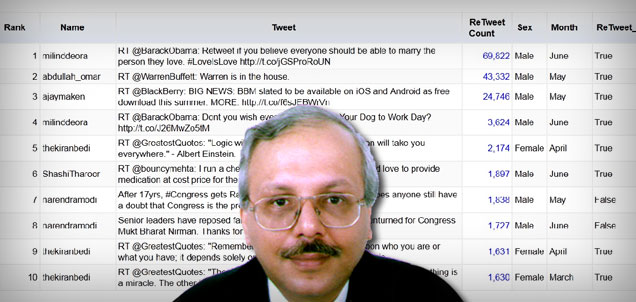
    Our politicians don’t understand social media. They need to take lessons from the likes of an Amitabh Bachchan, Shah Rukh Khan or even the Dalai Lama. Their tweets don’t get retweeted, and the ones that do like those of Milind Deora or Ajay Maken or Omar Abdullah aren’t political in nature.


    For instance, Ajay Maken’s tweet was as follows: RT @BlackBerry: BIG NEWS: BBM slated to be available on iOS and Android as free download this summer. MORE: http://t.co/f6sJEBWrVn . Note it didn’t concern anything remotely concerned with politics. And Omar? Here’s his tweet that got retweeted 43,332 times at the time of writing: RT @WarrenBuffett: Warren is in the house.


    The US internet population is around 170-180 million and that in India is 120-130 million.  There may not be too much of a gap here, but the problem is that in the US of A, 70-80% of the population is internet-enabled whereas in India it’s only 10-20%.


    Also, of the 15% of population that’s internet-enabled, at least 5% will be kids who don’t vote and another 5% from the affluent who have never voted, and possibly never will.


    What we have in balance is a 5% of the internet-enabled janata and I don’t think a swing here or there really matters. Bottomline: Mr Modi and his team may embrace Twitter and Facebook, write blogs, go to YouTube, but all of this will not help him win the 2014 general elections.


    But in 2019, we should have four to five hundred million people on the internet, and only then we could say there will be action on the social media front. Elections 2014 will be the semi-final and it’s important to get our act together for 2019.


    I have been a fair number of videos of the US elections over YouTube. One of them had a mindboggling 43 million views. With that kind of a number, the videos in question can impact a result, and create a stir with the masses. That’s why elections in the US can be fought over Facebook and Twitter.


    There are many issues that the new social order raises and which must be debated. The Election Commission sends people with video cameras to monitor the speeches at political rallies. How are they planning to monitor Facebook and Twitter? If I stand for elections from the Mumbai South constituency, and if you are in the US and you pay Facebook a million dollars for my promotion, how’s the EC  going to monitor that spending?


    Also, a contestant is not allowed to campaign within 48 hours before polling. So can Narendra Modi send a tweet out in that time period? And what if a well-wisher from England sends a hundred thousand tweets hours before voting?


    While one can’t be critical or character-assassinate an opponent, what’s stopping an unnamed supporter from doing that on Twitter, create blogs and go berserk? Suppose I create a million fake BJP Twitter followers and if they start retweeting nasty things about the Congress, wouldn’t it amount to be an election malpractice.


    It’s issues like these that we must discuss, debate and ponder over. The Election Commission must seize itself of these issues and figure what it should do. And if that doesn’t happen, expect mayhem in 2019.


    Battlewatch: BJP wins Facebook, Congress up on Twitter

    If the general elections were to be held today and the voting population comprised Facebook and Twitter users, the BJP would win the elections.


    What works on Twitter however does not necessarily work with Facebook and vice versa. Facebook is more BJP whereas Twitter is leans slightly towards the Congress.


    The million dollar question that no one has been able to answer is how do you rank politicians on Twitter or Facebook in terms of influence which then reflect in how people actually vote. Because there can never be just one answer, we look at how we can slice and dice the data to answer our conclusions.


    In our view the most important parameter on Twitter is not the number of followers you have but the number of Retweets. This is because you can follow someone only once but you can Retweet tweets multiple times. Retweeting is an ongoing process. When you Retweet, you are generally in agreement with that tweet and it is the only way of giving a thumbs up for that Tweet on Twitter. Please visit Vijaymukhis.com and see politicians fare on ReTweets. We update our data at least once a day and everything is interactive (www.vijaymukhis.com).


    Next fortnight: How many of Narendra Modi’s followers are real? And those of Shashi Tharoor?