Tag: Pogo

  • TV for Children: Growing, and how!

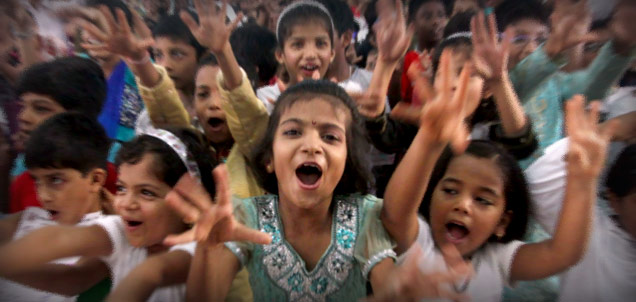
    Representational photograph (Kids participating in laughter therapy session in in Mumbai… Photograph by Fotocorp)


    By Ananya Saha


    There was a time, not so long ago in the 1990’s, when the Sunday slot of Mahabharata and animated series meant family viewing or kids genre. Kids were allowed to watch TV with parental permission. And today, kids genre in television media is the third largest after Hindi GECs at 27.6 per cent and Hindi movies at 11.9 per cent according to the FICCI-KPMG 2012 report.

     

    Anita Nayyar

    Acoording to Anita Nayyar, CEO, Havas Media, India & South Asia, the advent of Discovery Channel in 1999 saw a segment of kids watch it for education or interest. “Star World in 2004 had programmes like ‘Full House’ starring kids, but it was really post-2006 when kids became dominant. Their growing viewing needs and dedicated channels for them were addressed by various slots on various channels and some dedicated channels like Cartoon Network, Pogo, Disney Channel, Nickelodeon, Hungama, etc,” she points out. However, there is no denying the fact that there is not enough programming and print magazines for the young adult making them an underserved audience.


    Nina Elavia Jaipuria, EVP and Business Head, Sonic and Nickelodeon India concurs, adding, “In terms of getting their daily dose of entertainment, this TG needs to flirt with options available across multiple platforms – be it TV, online or print.”

     

    Sashwati Banerjee

    Apart from television content, on the print content, Sashwati Banerjee, Managing Director, Sesame Workshop Initiatives India PLC added, “Books / print is another matter. This is not a generation that is growing up with print awareness and it is reflected by the recent ASeR report which showcases that children in Grade 5 are reading at Grade 2 level. There is a serious crisis in education, and reading, comprehending and fluency are critical indicators to children’s lifelong learning. There is a large number of publishers in India, but very few publish children’s books and a still smaller number specialize in publishing children’s books. Recent reports have indicated that ebooks have a higher growth potential. However, wider access is still an issue as these books require high end mobile devices (cell phones and tablets) to access and use.”

     

    Nina Elavia Jaipuria

    Catering to infants to kids upto eight-years, Galli Galli Sim Sim has evolved in multiple ways since it’s inception in 2006. It evolved the format from the classicSesame Streetmagazine style to a more narrative ‘block style’ based on research that children in India are more used to stories or narration. Considering that access to television is limited, Galli Galli Sim Sim produced a radio programme, that is being aired by 10 community radio stations to reach populations with critical messages around health, hygiene, literacy and girl child education.


    Talking about Nicklodean and Sonic, Ms Jaipuria, said that Nickelodeon reaches out to 11 million kids pan India. “With media spends on kids channels approximately in the range of Rs 270cr, It is slated to grow further due to a slew of new channel launches in FY 13, she asserted. She also said that with the launch of Sonic in 2011, the investments in the kids genre has grown.


    According to a recent E&Y study the children’s genre has emerged as the largest viewership segment after India’s general entertainment channel (GEC) sector. The segment comprised 18.3 per cent of the viewership among 4-14 year olds in 2011, as compared to 16.9 per cent in 2010. The study also states that advertising revenue generated by the children’s genre totalled Rs 2.4 billion in 2011, up from Rs 2 billion in 2010. This is attributed to the growth in the viewership in the children’s genre from 43 million in 2010 to 48 million in 2011. This segment focuses on its target audience through a total of 14 channels in the age groups of 2-4 years and 4-14 years, comprising the majority of the market, as well as 14-18 years.


    The market for kids programming is huge, and the audience in this segment is growing. No wonder then that this November Zee launched ZeeQ, a 24×7 edutainment channel for kids aged 4-to-14-years. There are talks and suggestions of a DD Kids given Doordarshan’s reach. Kids seem to be pampered in the true sense and it is positive pampering.


    Even as the category sees more entrants trying to woo the young audience, in terms of advertising pie, this genre ranks after general entertainment and sports. “We’ve seen a range of products and services making the kid the hero – from financial like insurance say an ICICI Smart Kids with the kid at the dinosaur museum or Bank of India with the kid putting his piggy bank in the locker to a flipkart.com with kid avatars of the elders contemplating a buy; simply because they are either targets or influencers and their starring role has the potential for breaking clutter. We’d estimate the kids ad-market between Rs.200crores to Rs.260crores. The pioneer in using kids to demonstrate pester power was Maruti Suzuki’s Esteem report card commercial,” elaborated Ms Nayyar.


    With evolving societal structure as well as keenness on kid’s development for the future, Ms Nayyar predicts that “edutainment” will be the biggest driver in the category growth. Kids today are also more exposed .They are more amenable to instruction through entertainment. According to her, the vehicles that will drive the growth will be television, print and online, with online gaining lead.


    “Word-of-mouth in this category has really been underestimated but here is a core audience for this marketing phenomenon,” said Ms Nayyar.


    Challenges

    Content creators and television channels for kids are increasingly experimenting with applications for cellphones and low-cost tablets and migrating content from a traditional linear medium such as TV to non-linear mediums to expand access to populations that need it the most as well as to enhance and enrich learning experiences for children. Notwithstanding the fact that the advent of digitization in India will be a key driver to the growth of the genre in the near future, mobile devices rather than the television set will be the primary driver to engage children in the future. “We’re seeing this change in theUSas well,” said Banerjee.


    But the genre is facing very many challenges even as it looks at growth. As Ms Jaipuria points out:

    – The kid’s category is still hugely under-indexed despite the category contributing 8% to viewership on an All India Level at 4+ age group. TV adsales are under 2% for this genre. Hence investments in the business are under pressure.

    – The fragmentation in the kid’s category is increasing by the day with over a dozen players existing currently. This makes it possible for the broadcasters to offer differentiated content across genres and platforms.

    – Kids as an audience are a tough bunch to target. They do not consume print and outdoor as primary consumers. A large chunk of the marketing investment is on BTL activities such as School Contact Programmes, Retail activation, direct consumer contact using multiple on-round vehicles which have an extremely high cost per contact.

    – Distribution and carriage remains a challenge for this category.


    Also, as Ms Banerjee explains, children today are “exposed to all kinds of programming especially in single TV homes. There is also extremely low awareness amongst parents on what children should view and what they should not. There is an imperative need to provide rating guidelines as well as awareness on how media affects children.”


    While the experts believe that the greatest challenge is the creation of original content, or even good adaptation, quality is a major issue. There needs to be a very clear understanding  of the sub-slice segment categories to contain the spill to international programmes, CDs and the online world as also increase the share of viewership of the media vehicle.


    Says Ms Nayyar: “A lot of content and marketing is done and created for the Sec A and B but we miss a whole other India which invests heavily to educate its kids to give them another destiny. Here, affordable print with in-school promotions with reach beyond the creamy layer would create a whole new bottomline. Also, regional is a huge emerging market; again content with localization and language are opportunities and challenges. Content as always will be both the game player and game changer!”


    The growth might also come from other content and entertainment avenues such as gaming. The only challenge is to tap into the potential with the right content.


  • The not-so-chhota success of Chhota Bheem


    By Tuhina Anand


    Chhota Bheem, the nine-year old boy and his small group of friends – Raju, Chutki and Jaggu (the talking monkey), have been having a dream run on Pogo. Launched in 2008 on the channel, the character of Chhota Bheem has gone on to become immensely popular and we have seen the character move to the bigger screen with Chhota Bheem movie and there is no dearth of merchandise based on his character, including comic book, tee-shirt, fun puzzles, bags, bean bag, toys and more.


    Krishna Desai

    Talking about the popularity of the show, Krishna Desai, Director Content, Turner International India Pvt. Ltd, said: “Since its launch in 2008 on Pogo, Chhota Bheem became an overnight success. Today, Chhota Bheem holds several titles to its credit including being ‘Kids’ Favourite TV Character’ (Ormax Media 2011 Report). In addition to other popular shows like Mr Bean and Kumbh Karan, Chhota Bheem has helped Pogo sustain its No 1 since 2011. In fact, this year, the premieres of ‘Chhota Bheem: Dholakpur to Kathmandu’ movie in March and ‘Chhota Bheem aur Hanuman’ movie in May, were the number 1 programs across all channels.” (Source: TAM, All India , 4-14 yrs, 12:00-13:30, March 25 and May 1, 2012)


    However, TAM data for the period of April 15-May 12 (CS 4-14 yrs, all India market, excluding feature films shown on kiddie channels) shows that for the channel share, one sees a fluctuation between Pogo and Disney for the top slot where in week 18, Pogo has a share of 25.5 as opposed to 20.4 of Disney. In week 19, Pogo is at 21.2 while Disney has jumped to 24.6.


    Giving his take on the popularity of Chhota Bheem and Doraemon, Karthik Lakshminarayan, COO, Crest (Madison Media), said: “Be it Chhota Bheem or Doraemon, both are exceedingly popular in the kids genre. Even for the top slot there is a tussle between both the shows. The popularity works well for the advertisers as well as the channel. However, if one were to look at superior production quality then Chhota Bheem scores over Doraemon as the latter seems dated.”


    While Doraemon might seem dated, there is no lacking in its popularity. The show runs on Disney as well as Hungama almost round the clock. Same is the case with Pogo, where Chhota Bheem and its repeats are shown numerous times during the day. Mr Desai, talking about this strategy said: “Normally, most shows face the issue of fatigue over a period of time. But in the cases of popular shows like Chhota Bheem, this factor is not applicable. When any show is launched there is a novelty factor which draws in new audiences. Thereafter, the true test of success begins. If kids like the show, they will tune in to watch their favourite episode over and over again. Over a period of time, kids tune-in to pre-empt the dialogues or even sing along with the theme song, making them feel like a part of the toon world. Also, the non-sequential flow of episodes helps to steer clear of boredom.”


    “Being a pioneer in the kids’ genre, we have done in-depth studies analysing the viewing patterns of kids between the ages of 4-14 years so as to effectively target our core TG. Basis these studies we decide the schedule for our channels. The second factor taken into consideration is to ensure that the scheduling of both our channels (Cartoon Network and Pogo) complement each other and don’t eat into each others share. We also consider the competition and other TV genres scheduling while lining up our shows,” he added.


    Some of the other popular shows on Kids channel include Kumbh Karan on Pogo, Roll No 21 on Cartoon Network, the Suite Life of Karan and Kabir on Disney, Art Attack again on Disney, Ninja Hattori on Nick, Oggy and the Cockroaches on Nick, Mr Bean the Animated Series on Pogo and Tom and Jerry Show on Cartoon Network.


    However, the success of Bheem lies in the fact that it’s an indigenous animated series created by Green Gold Animation Pvt. Ltd, based in Hyderabad. As Mr Desai of Pogo pointed that what stands out about the series is the strong story and characters. Although it is based in the mythical and timeless village of ‘Dholakpur’, the characters are very relevant to the mannerisms of kids today. Thus, kids relate to the characters and aspire to be like them be it a superhero or a best friend. “Yes, we did anticipate the show to do well but we all have been happily surprised at how phenomenally well it is doing,” said Mr Desai.


    With the success of Chhota Bheem, came its movies that Pogo co-produced, the recent one being Chhota Bheem and the curse of Damyaan which was released last Friday.


    Source: TAM Media Research, TG: CS 4-14 yrs, Market: All India, Period: Week 16 to 19 (Apr 15 to May 12), 2012 *Note : The analysis excludes Feature films aired on Kids channels


    Some of these movies were aired in 2011 on Pogo and the channel has a more aggressive strategy for them in 2012, wherein they will showcase one new movie every alternate month. In March, Pogo aired ‘Chhota Bheem: Dholakpur to Kathmandu’ and in May premiered ‘Chhota Bheem aur Hanuman’.


    Also seeing the popularity of other supporting characters in the show, like Bheem’s best friend Raju, Pogo  create a successful spin-off movie on him called ‘Mighty Raju’ in 2011. Sequels to Mighty Raju will also be seen in 2012. Its online success can be gauged from the fact that on www.pogo.tv, there are 700+ games on the site out of which Chhota Bheem enjoys a majority.


  • This is a carefully considered business decision: Siddharth Jain

    It wasn’t an easy day at office for Siddharth Jain, Managing Director- South Asia at Turner International India Private Limited. Mr Jain, who had assumed his current role in November last year, took time off to respond to MxMIndia’s questions in an emailed interaction.


    What exactly happened… there were promos running for forthcoming shows and then this announcement of pulling down curtains?

    This is a carefully considered business decision based on performance of the channel. We invested substantially and put all possible resources behind Imagine TV throughout. As in any other business, the investments were directly linked to reaching a certain performance benchmark. However, in the two years, Imagine did not grow or perform as per expectations and as a result, Turner made the carefully-considered decision to cease operations of the channel.


    Did you consider selling the channel (a la 9X)?

    We worked incredibly hard to exhaust all options to avoid cessation of business operations.


    This is the second GEC from the Turner stable that has failed. But your other channels are doing well, with Pogo hitting an all-time high recently. Will Turner try its hand at another GEC or is it quits for now?

    Absolutely. Turner remains fully committed to future investments and long-term participation in India. Having been pioneers in the Indian M&E space in international news and kids’ entertainment, Turner currently operates some of the strongest media brands in India. POGO is indeed doing very well, being the Number one channel in the kids’ TV genre for the last six months (as per TAM). Turner will continue to be leaders in the media and entertainment industry and to explore expansion opportunities in this key priority market for Turner.


    What happens to the team and staff of Imagine? Anyone being retained or moved to other businesses?

    Turner will retain some employees for a transition period and some others are being offered permanent roles within other Turner channels to fill current vacancies.


    For the other Imagine employees getting impacted, Turner has set up an HR outplacement service which will provide advice on how to write a better CV, interviewing techniques and other job hunting skills. We will also introduce the employees to recruitment consultants, HR professionals from other media organizations and facilitate their new job search. Our focus is to ensure the closure is executed in a fair and appropriate manner for all of them and in full compliance with all legal requirements, employment terms and company policies. We will use our best endeavours to make this as smooth a transition as possible for them.


    The integration exercise that Turner carried out in May 2011 didn’t seem go down well with a few key personnel exiting the company eventually. In hindsight, was that what triggered the channel’s downfall?

    The two are not related in any way. Integration really helped in getting better operational efficiencies between Imagine and our other networks. While exits happened in the last one year, if you look across the industry it is in the normal course of any GEC. There is not one person or one department that was responsible but a number of factors that led to the channel not delivering consistent ratings that were required to sustain the business and continued investment.


    Why wasn’t there a suitable replacement to Sameer Nair post his exit?

    We are not in a position to comment on Mr Nair.


    Are there any plans for your library of programming? And what happens to the programmes signed up?

    As of today, we cease all business operations of Imagine TV. The closure is a complicated process as we are ensuring fulfillment of all our business commitments to advertisers, distributors, production houses and other partners.


    As you look back, do you think it was an unwise decision to buy Imagine from NDTV? And would it have been better for you to have launched an all-new channel so that it doesn’t come with the baggage of an unsuccessful channel?

    The acquisition of Imagine was a wholly appropriate, strategic and extensively-considered decision.


  • Pogo achieves highest GRP in kids genre

    By A Correspondent


    After holding the number 1 title in kids’ genre over the past 6 months (*Source: Tam, All India, Kids 4-14, Weekly GRP), Pogo has achieved the highest GRP of 174 in almost the last 6 years in the kids’ genre (Cartoon Network earned 181 GRP’s in week 21 of 2006).


    Also, the premier of the movie Chhota Bheem: Dholakpur to Kathmandu delivered a TVR of 2.4, the highest of any movie or show in 2012. This combination of GRP and TVR has led to POGO dominating the viewership pie with 25.6per cent relative share.


    Monica Tata, General Manager, Entertainment Networks, South Asia, Turner International India Pvt. Ltd. said: “We are elated with Pogo’s increasingly better performance, and the irrefutable contribution of Chhota Bheem in making the channel reach such a milestone. The response received from our viewers is nothing but an encouragement to continue to provide quality and engaging content so as to surpass these accomplishments.”


    Pogo, a multi-genre channel created exclusively for kids in India, was launched successfully by Turner on January 1, 2004 and is distributed by Media Pro Enterprise India Pvt. Ltd. POGO is available in over 24 million cable & satellite homes.


  • Brands focus on toon channels as viewership changes

    By Ameya Chumbhale


    If you thought Cartoon Network, Pogo, Disney, and Hungama TV were kids’ channels, look who’s watching them – nearly a fifth of those watching these channels are between 25 and 44 years. And nearly four out of ten viewers of these channels are more than 14 years.


    Most children, on the other hand, either prefer or are forced to watch what adults are watching on general entertainment channels – soppy serials or reality shows. According to TV viewership data shared by TAM Media Research, only 15 per cent of all children viewing TV, watch kids’ channels. The rest – 85 per cent — watch general entertainment channels (GEC).


    Needless to say, this has become a big opportunity for advertisers, especially those who try and reach out to parents through their children. “Parents are increasingly looking at children as representatives of the new world and latest technology. Consequently, children between 10-14 have a considerable say while buying a car or a gadget,” said Santosh Desai, chief executive officer at Futurebrands.


    In fact, for Turner International India, which runs Cartoon Network and Pogo, nearly 35-40 per cent of their advertisers last year came from what would seem like “non-traditional categories such as auto, consumer electronics, finance and telecom,” said Monica Tata, general manager for entertainment networks at Turner in India.


    Chairman and chief creative officer at ad agency BBDO India Josy Paul, while explaining the rationale behind these channels attracting non-traditonal categories of ads, says that brands don’t want to miss out on any opportunity of talking to the mother who is the anchor of the house. Traditionally, one would expect kids’ channels to air ads by ice creams, chocolates, F&B, and toy companies.


    Insurance major Aviva India is a case in point. Aviva spent 5 per cent of its advertising budget on kids genre in 2011 and had run the ‘Aviva Young Scholar Hunt’ contest between July and October 2011 on Pogo. The impact was telling. “Of all the insurance plans sold by Aviva, the share of child plans went up from 2-3 per cent in 2010 to 11-12 per cent in 2011,” said Gaurav Rajput, director of marketing at Aviva India.


    Sony tablet computers and Hewlett-Packard printers too are advertising across all kids channels these days. In fact HP, which launched its printer campaign across kids channels two weeks ago, is something they have done after several years.


    “My target group for the campaign is parents of school-going children, so the kids channels were a natural fit,” said Ayesha Durante, country manager for marketing HP India. For Anuradha Aggrawal, senior VP for consumer insights at Vodafone India, whose team spends a lot of time researching the dual viewership (kids and adults), says it helps in choosing their icons — the pug and the ZooZoos, which connect with children, actually help to build an early brand association with these young consumers.


    Mr Desai cautions that this could be a long-term strategy which only sectors like telecom can afford as they have “cash to burn”. He further added that in a one-TV system, everybody has his/her time slot to watch TV. Therefore, if a child is watching a kids channel, the parent has no option but to watch it.


    For the genre, this means big business. The Disney channel has more than doubled its ad revenues last year while Hungama TV’s revenues rose by 35 per cent, said Vijay Subramaniam, business head at Disney Kids Network India which runs the Disney channel, Disney XD and Hungama TV in India. Disney enjoying highest share of viewership at 22 per cent among kids aged between 4-14, according to TAM.


    Subramaniam says that the return on investment is not proportional to the viewership as kids genre corners just over 1.6 per cent of total revenue of the television industry against the over 6 per cent share of viewership.


    According to the 2011 FICCI-KPMG report, the TV industry is projected to grow to 33,700 crore by 2015 from the current 14,400 crore (2010) at a CAGR of 17 per cent. And the kids genre gets the maximum in terms of viewership after GECs and movie channels, which lead currently.


    Source: The Economic Times

    Copyright © 2012, Bennett, Coleman & Co. Ltd. All Rights Reserved