
Tag: PMAR

  • A Tale of Two Reports


    By Indrani Sen


    Indrani SenIt is time to celebrate as the TYNY (This Year Next Year) 2023 report released by GroupM last week declared that the total value of Indian AdEx in 2022 has crossed the 100K crore mark touching INR 1,09,636 crore and in 2023 is estimated to grow at a healthy rate of 15.5% over 2022 towards another milestone of 150K crore (predicted as INR 146450 crore in 2023). Digital AdEx with an estimated 30% growth rate is expected to power the overall growth. India continues to be the fastest growing advertising market and as per the TYNY report has moved up from 9th position to the 8th position among the Top 10 countries with a share of 2% of the global adspend.
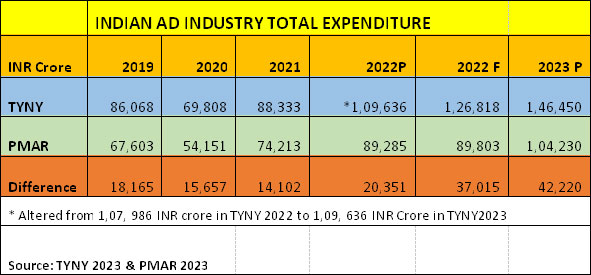


    As per the tradition set up over the last few years, the PMAR (Pitch Madison Advertising Report) 2023 was also released last week with a prediction that Indian AdEx will cross 100k crore mark in 2023 (predicted as INR 104230 crore) with a growth rate of 16% over 2022. Digital AdEX with an estimated 25% growth rate provide momentum to the growth.


    Both the TYNY and PMAR have been predicting in the same line over last few years with the gap between their estimates of the size of Indian AD Industry becoming wider year on year. By 2023 the size of the gap in the two estimates will be 40% of the total Indian ADEX size estimated by PMAR and by 2025 the size of the gap may become 50% of the Indian ADEX estimated by PMAR!! Globally is quite common to have difference in the estimates of the AD Industry size / AdEX estimated by different organisations, but if the difference becomes huge then it causes serious concern.


    Six years back, I wrote here an article comparing the estimates of TYNY 2017 and PMA 2017 https://www.mxmindia.com/2017/02/what-is-the-real-size-of-indian-ad-industry/. In that year, the estimates for Digital AdEx by the two agencies were almost the same, INR 7000+ crore in 2016 and INR 9000+ crore in 2017. However, the TV AdEx estimated by TYNY was considerably higher than the TV AdEx estimated by PMAO and hence the total Ad Industry expenditure estimated by TYNY was around INR 6000 crores higher than the that of PMAO.


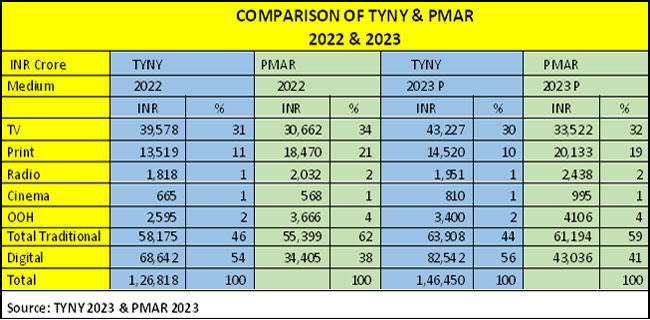
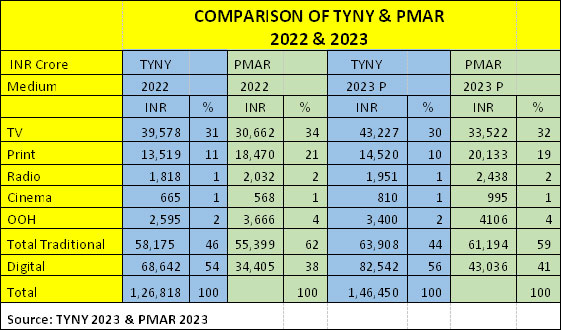
    It is interesting to note that over the last six years, Digital AdEx has increased at a much higher rate in the TYNY reports than in the PMAR reports. In 2022, the Digital AdEx INR 68,642 crore reported by TYNY was double the estimate INR 34,405 crore shown by PMAR.  AS per the TYNY report, Digital ADEX now has more than 50% share of the total AdEx, while in the PMAR report total traditional media is still enjoying around 60% share of the total AdEx as shown in the table below.


    The various industry websites including www.mxmindia.com and financial/ business publications have already reported on the findings of the two reports. Digital did not suffer during the three waves of Covid-19,  among the traditional media TV was the first to recover its pre pandemic revenue, outdoor recovered in 2022, print, radio and cinema are expected to recover in 2023. On the whole. 2022 was a good year for Indian Advertising and the immediate future looks bright.


    In spite of the widening rift between the TYNY and PMAR estimates, their leaders agree on the future directions. Prasanth Kumar, South Asia CEO, GroupM has said “As technology redefines interactions between consumers, brands and businesses the ad industry must navigate thru this changing environment.” Sam Balsara, Chairman and Managing Director, Madison World has advised the advertisers “to take advantage of the evolved digital infrastructure for distribution and advertising to prepare for the future growth and to invest in building their own D2C channels.” Only if the two agencies could stop the widening rift between the two reports, we would be in a happier situation.


    Indrani Sen is a veteran industryperson and educator. This is a new season of her Monday column on MxMIndia. Her views here are personal.
     

  • Indian ad industry nears 100k cr milestone


    By Indrani Sen


    Indrani SenLast week, both GroupM’s This Year Next Year (TYNY) and Madisons Media’s Pitch Madison Advertising Report (PMAR) got released and their basic findings have already been reported by all business and trade media. The general mood in the advertising industry is exuberant as both the reports have confirmed that AdEX zoomed in 2021, by 37% as per PMAR and by 26.5% as per TYNY in spite of the third wave of the pandemic. In 2021, India was the fastest growing market in the top 10 countries, ranking 9 globally and ranking 5 on incremental ad spend predicted for 2022.


    The current year also promises to be a good year for Indian ad industry with PMAR predicting 20% growth and TYNY predicting 22% growth in adspend in 2022 over 2021. However, this year the two reports raises a paradox, will the ad industry cross INR 100,000 crore milestone in 2022 as predicted by TYNY or touch 90,000 crore as predicted by PMAR? It seems that we will be celebrating the milestone of achieving INR 100,000 crore ad expenditure twice, once in 2022 by GroupM, its constituent agencies and clients and once again in 2023 by another large part of the industry who prefers to use PMAR.


    It is acceptable that two or more research studies done by different agencies may yield different estimates of adspends by media and as long as the trends are the same, all such estimates can be used by the industry. Indian media, advertisers and agencies have learned to live with different estimates for the industry size, growth rates as well as predictions from different sources including TYNY and PMAR. However, as the difference of almost INR 21,000 crore between the estimates for 2022 in the two reports is huge, it may be prudent to analyse the macro level statistics of PMAR and TYNY to find out the source of such huge difference.


    As digital, TV and print account for a total share of 94% to 96% of the total ad expenditure in both the reports, a review of the adspend across these three media will suffice for finding out the sources of the difference in estimates.


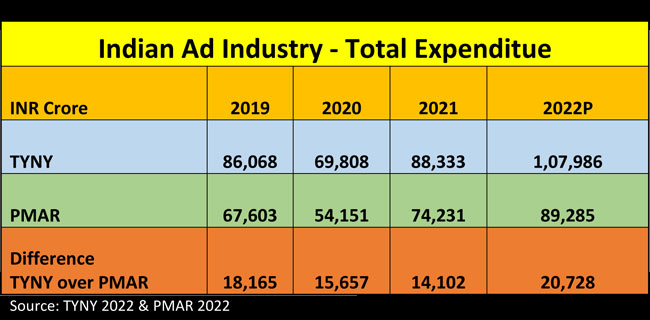
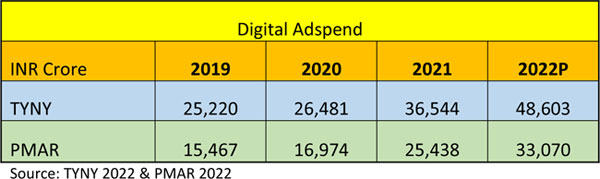
    Both GroupM and Madison Media have reported digital as the fastest growing media in 2021 and a continuity in the momentum of growth in 2022. In TYNY, digital adspends has equalled the TV adspends in 2021, where as in PMAR the digital adspends will equal or cross TV adspend in 2022.  Over the last three years, TYNY has been consistently reporting about INR 10,000 crore more in digital media ad spend than PMAR. In 2022 the ad spend in digital media is estimated to be INR 15,533 crore higher in TYNY than in PMAR.


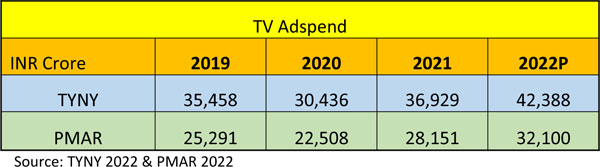
    Similarly, in case of TV adspend, the estimate by TYNY was higher than TYNY by INR 10,000 crore in 2019, which reduced to INR 8000 crore in 2020 and 2021. However, in the estimate for 2022, the same has again become higher by INR 10,000 crore. So, the estimates for digital and TV taken together account for a difference of INR 25000 crore between TYNY and PMAR in their predictions of 2022.


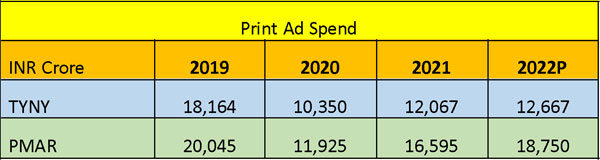
    When it comes to print adspend, the table is turned as PMAR has been consistently estimating higher spends in print than TYNY. In 2022, PMAR’s prediction for print ad spend is INR 6000 crore higher than that of TYNY. So, by combining print with digital and TV and other traditional media, the difference of INR 25000 crore gets reduced to INR 21000 crore.


    Source: TYNY 2022 & PMAR 2022


    It seems a bit unfair that TYNY has condemned print adspends in India to almost zero growth in 2022. As TYNY is done as a global report, has this estimate for Indian print ad spend been influenced by the global scenario where in most countries print ad spends have been steadily declining for years?


    I have written about the difference in the findings of TYNY and PMAR earlier in www.mxmindia.com. I know that we will never really get to know the reasons for such huge differences between the estimates of TYNY and PMAR, but it is becoming increasingly difficult to explain the reasons for the same to students of media management in a classroom as there is a danger that they may get confused and lose faith in media research.


    Read past commentary by Indrani Sen at:


    https://www.mxmindia.com/2021/02/so-how-do-the-groupm-madison-forecasts-compare/

    https://www.mxmindia.com/2020/02/a-roller-coaster-ride-of-adspends/

    https://www.mxmindia.com/2020/02/well-pitched-delivery/

    https://www.mxmindia.com/2019/02/indian-ad-industry-are-happy-times-really-here-again/

    https://www.mxmindia.com/2018/02/indrani-sen-mind-the-tv-adex-gap/

    https://www.mxmindia.com/2017/02/what-is-the-real-size-of-indian-ad-industry/

    https://www.mxmindia.com/2016/02/indrani-sen-boomtime-for-media-a-review-of-the-pitch-madison-advertising-report-2016/


  • What is the real size of Indian Ad Industry?


    By Indrani Sen

    Last week was exciting for the advertising and media industry as the two major reports on industry Adex were released on two consecutive days. GroupM released its ‘This Year Next Year’(TYNY) 2017 report on February 14 followed by the release of ‘Pitch Madison Advertising Report’(PMAR) 2017 by Madison on February 15. In the last few days, both the reports have been published and analysed in the business newspapers and websites, leaving hardly any scope for adding any comment on the same.

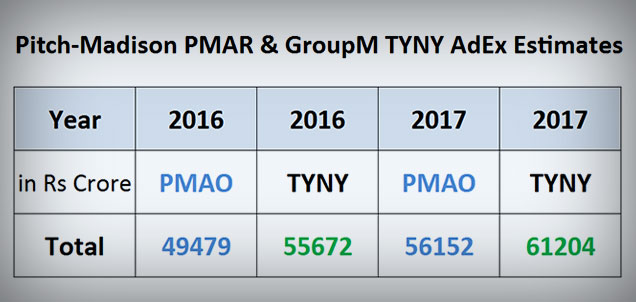
    As usual there is a difference between the two projections, this time it is of around Rs 5000 crore. The biannual report on advertising expenditure TYNY 2017 has forecast India’s advertising investment to reach an estimated Rs 61,204 crore in 2017 based on a growth rate of 10% over 2016. On the other hand, PMAR 2017 has projected a growth of 13.5% in 2017 over 2016 and has estimated the size of the industry to reach Rs 56,152 crore.

    According to Sam Balsara, AdEx dropped by Rs 1650 crore in the last two months of 2016 after demonetisation and as a result, the industry adspends narrowly missed the mark of crossing Rs 50,000 crore. On the other hand, the GroupM report, Indian advertising industry clocked Rs 49,758 crore in 2015 and crossed the Rs 50,000 crore mark comfortably in 2016 by scoring Rs 55,671 crores. Madison estimated Indian adspends as Rs 43,991 crores in 2015, Rs 49,480 in 2016 and has projected Rs 56,152 crore in 2017. The difference, between the two sets of estimates, has been hovering between Rs 5000 to Rs 6000 crore, which is not a small amount.

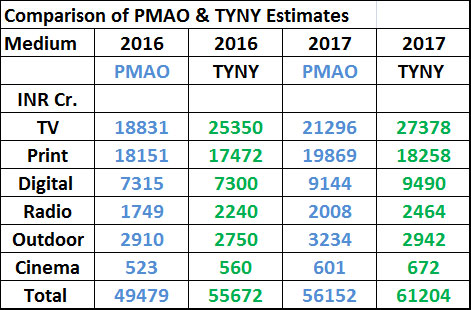
    If we compare the two sets of estimates by medium, we find that the major difference lies in the estimates of TV advertising expenditure, which is bit surprising as TV AdEx is very well-documented. Is there a difference in the way the two estimates are drawn up which leads to a gap of almost Rs 6000 crores between the estimated TV advertising expenditures?


    PMAR has shown more favourable estimates for Print and Outdoor than TYNY, while TYNY estimates for Radio and Cinema are higher than the estimates of PMAO. It is interesting to note that for Digital medium, the two estimates ran neck-and-neck for 2016 and are quite close for 2017.

    GroupM Report mentions that Media Adex reported do not include:

    • TV – special inventory like astons, L-bands, tickers, etc
    • Print – tender notices, appointments, classifieds/ matrimonial
    • Radio – activation spends
    • Digital – ad spends by SME segment
    • Outdoor – wall painting

    The above leads us to conclude that the numbers shown in the TYNY for the above five media would be actually higher than their estimations, particularly for Radio, where activation/ events tied up with digital has become a major source of earning for the FM radio stations.

    The Pitch Madison Advertising Report does not mention about the ad expenditures which are not covered in the report, but we can assume that Madison also has not covered the above expenditures which are not included in Media AdEx in their report.

    So, what is the real size of the Indian Ad Industry? Are we yet to cross the Rs 50,000 crore mark or did we cross it last year?


    Indrani Sen is a media services veteran, having worked with JWT, later Mindshare and then with Emami. In recent years, she is an independent consultant and academic. She is Adjunct Professor incharge of the Media Management programme at the Symbiosis Institute of Media & Communication, Pune. The views expressed here are her own.