
Tag: plagiarism

  • Don’t dodge the Plagiarism & Pitch bullet!


    By Sanjeev Kotnala

    Plagiarism and creative coincidence have survived far too long in the Industry. Sometimes pitches have been blamed and many times inability to act has been the favourite excuse. Many times they have been termed as inspired and adapted versions.

    The recent high profile case created a few conversations. Trade portals, social media and business newspapers recorded and reflected many points of views. And then, the calm settled in. The conversation moved to a new subject.

    I am here trying to keep the conversation going. May be it will someway help to generate some momentum and discussion on the subject.

    We once again are dodging the bullet. 

    We believe it won’t happen to me, or at least I am not the one doing it. In the worst-case scenario, I can’t do anything about it. We won’t act. However, we will expect colleagues and the Industry to support us when it happens.

    None of us has the answer. Even the solution I shared a few weeks back is a non-starter. I searched for inspiration, and I found it in work ‘Don’t Dodge The Bullet’ by a young Canadian agency called ZULU ALPHA KILO.

    Only collective action can rein Plagiarism.

    It will keep raising its ugly head again and again unless we the industry collectively decides to bite the bullet. There is no escape till the time pitches are speculative, till they are not based on processes and demonstrated capabilities. Or till the time agencies keep making speculative ideas pitches in the name of new business development. And consulting firms keep winning the pitches. Sound familiar watch this data – data approach.


    Maybe it’s time to ditch spec creative! Don’t think it is going to happen. I have myself been part of this circus, and it is tough for individual agencies to break the cycle. However, I am happy that some of the agencies are in reality, refusing to do speculative pitches and pitch without a fee.

    The problem of Plagiarism can only be addressed collectively through industry-approved process and guidelines. And when the leading agencies and clients set an example for others to follow.

    SAY NO TO SPEC!

    Yes, I am borrowing from Zulu Alpha Kilo. I love this Agency and its way of raising industry issue while self-promoting itself.

    So, I blatantly pick this gem from their site, “Architects don’t give away their blueprints. Diners don’t fork out free meals. Personal Trainers don’t sign over their intellectual property on spec’. It is part of the brilliant video poking fun at the speculative pitches and the process.

    May be it is time for us to look at Zulu Alpha Kilo to share the insights at Goafest. The Agency has rallied  against creating spec work for potential clients. Watch the video and this time think a bit more than smiling and laughing.


    Pitches are essential, but the process needs tweaking.


    Suggest the clients and agencies visit http://www.SmarterPitch.com. It is a website by who else but Zulu Alpha Kilo. Here, you will find ways for the client and the Agency to improve the pitch process.

    We are, in fact, tired of listening to the same Sh*t. Just like politicians, everyone mouths the same emotions; we are looking for a relationship. In truth, they land-up evaluating the transaction. The result, the client is dazzled by the pitch creative and has orgasm discussing how it will win awards and they also work for the brand. The partnership is all but buried at this stage.

    In some cases, the deal (yes, I said deal) does not go through. The client, because of no possible backlash, presents the creative as a brief to the Agency. They give enough directional ideas and successfully nudge the Agency to create a version similar to the one that gave them orgasm during the pitch process. Being a co-created process, the lines are blurred, and everyone ( except the two parties who know the truth) believes it is original work. Anyway, no one questions the similarity. And if someone does talk, the conversation dies in no time.

    The Agencies Must Collectively Decide.

    In HTA, young joiners’ were asked, if they wanted to be a doctor or a tailor. You don’t question a doctor, like Mohammed Khan, Piyush Pandey, or Ivan Arthur. Or be a tailor, where you tell him, how long the trousers should be, what kind of pockets it must have to the extent od how many belt loops should be there. We know where the Industry has moved.

    Now, the question is different. And I love the way it is expressed simply in the website. https://www.smarterpitch.com.

    But agencies aren’t cattle. When a client invites everyone and their kitchen sink to a pitch, it’s a clear signal to us that they have no idea what they want from a potential partner”. Or maybe they are

    It is clear that when a client calls more than 3-4 agencies for a pitch, it is a clear reflection that the client has not done the homework. They don’t know what type of Agency they want and need.

    Maybe There Is A Way Out.

    Maybe the clients should engage a consultant to understand their needs and culture and narrow down the field for them to evaluate. They could share the process and criteria of evaluation. Restrict the pitch to a maximum of 3 agencies.

    The pitch should be for the process and demonstrated capabilities, not speculative ideas. If ideas are presented, the agencies must get a date-stamped and presentation signed by both the Agency and the client. These should be upped on a cloud-based archive managed by an Industry body.

    Till this is done, the physical presentation docket could be signed and archived.

    We will at least be able to fix one of the co-ordinates. It will be clear, who presented the idea to whom and on which date. The question of similarity, creative coincidence, idea shopping and possible penalties should then be discussed.

    ZULU ALPHA KILO

    Zulu Alpha Kilo is the young Agency that won Ad Age’s 2017 International Small Agency of the Year and 2016 Small Agency of the Year (the first time the overall honours has gone to a non-U.S. shop). The Agency keep doing work as self-promotion that makes a statement about real life in the Industry. Here watch Zulu Alpha Kilo created most terrifying (and humorous) recruiting video, called Scared Straight: Out of Advertising. It was made for Strategy magazine’s Agency of the Year event. Geared towards wide-eyed ad students entering the workforce. It was before the famed “Say No to Spec” spot.

    And here are the four rules Zulu Alpha Kilo thinks may work.

    https://youtu.be/sMcXuEkgijw


    ZULU ALPHA KILO pitching for Trump and Clinton business in a humorous note but in an insightful way.



  • Is it right to damn the Copycats?

    By Johnson Napier and Ananya Saha


    Intellectual theft in the advertising industry is not a new phenomenon. The Creative Abby this year brought back focus on the topic, but plagiarism had never gone away. However, it has become easier to identify a stolen creative now, than it was earlier. We spoke to a cross-section creative people for a perspective.


    Abhijit Awasthi, National Creative Director, Ogilvy & Mather

    The way we look at plagiarism is that if there is an awards show and if there is a contentious piece of work that is brought to light by somebody, then I wouldn’t want to award that work. But I wouldn’t go as far as to say that so and so ad has been plagiarized or copied – I wouldn’t make that allegation, as I would like to give the benefit of the doubt to whoever has created it. We are in the business because we like coming up with and creating ideas. We live in an age where we are exposed to most ideas especially on the internet, so sometimes something that you like subconsciously in the back of your mind just comes out without you realizing it. So I would treat it as an unfortunate incident and carry on with my work. A lot of such allegations come to the fore when you see print or outdoor advertising where it is the question of some visual or wordplay or illustration technique, which is not really worth mentioning. Like I keep giving examples of chemical processes which are 8- or 10-stage in process, and when it comes to filing a patent one realises that it has already happened before. So you come to terms with it as being unfortunate and you move on.

    The thing is that there are thousands of different creative ideas that are churned out in different parts of the world and it’s impossible to keep track. Also one cannot keep a repository of every ad that is created and keep tabs on it. So there are discussions that are held on the similarity of ideas and also on an idea which has been seen before but which has been polished and presented in a better form. They end being given the benefit of the doubt and appreciated by the jury.


    Bodhisatwa Dasgupta, Associate Creative Director, Grey Group India

    It’s a tricky thing, this plagiarism business. Especially when it comes to something creative. Because here’s the thing – say you make a hundred kids sit in a room and arm them with crayons and paper. Then, you tell them to draw (let’s say) a picnic. Or love. You’ll find out of 100 people, at least 30 of them have drawn a similar picture. Is that plagiarism?


    Bring it closer home to advertising. The web is filled with instances where something that has won big time this year was done some three years ago. Different agency, same execution. Of course, you could say that the present agency just poured over annuals and blindly copied each ad, and executed it slightly differently. Or, you could say (and incidentally this is what I think) that creative people think alike. They take similar leaps, think of similar insights, draw and write similar things. So most of the time, while the pictures may be the same, it’s the crayons that are different.

    As a mentor to an army of bright kids, I’ve vehemently discouraged them from poring over award annuals. Because here’s what happens – they think of an idea, then they flip through the annuals, only to see their idea in the flesh, beautifully executed. It’s a demoralizing thing. So my advice to them is, forget what’s been done. Think, think and think some more. Scribble out your ideas. It doesn’t matter if it’s been done before. What’s important is that you thought of something that was worthy enough, a few years previously, to win a Pencil. And that’s bloody good, for an intern/ trainee.

    Having said that, I know of people who’ve blindly copied another’s folio to get a job. That’s quite shitty. Of course, the thing with shit is that sooner or later, it’s sniffed out and dealt with.”


    Ashish Khazanchi, NCD, Publicis Ambience

    We keep hearing of instances of plagiarism in advertising now and then. In the current scenario it has gone to the extent of being a witch-hunt where people are seeing things that don’t exist. What happens is that there are thousands of creative people from around the world who work on a similar kind of brief and it is possible that the out of the hundred different ads, expressions from a few ads will have some similarities. But there are some ads that are too apparent and imitations of earlier produced works.


    In most ads today, the visual referencing could be similar – like television ads could be inspired from some big film, but more often than not people are not so stupid that they will enter an ad in an award which has been copied from elsewhere. There could be some odd cases where ads could be termed as plagiarized ads and the only way they could be booted out is if the jury is selected with a lot of caution. After all jurymen are people who have travelled a lot and have been around to ad festivals and they know a lot of stuff that is happening in the industry. So, the tighter the jury, the better it is for the industry. You have to get people who know the category that they are going to be judging.

    I do not agree that plagiarism does not happen in the West or even South East Asia. It happens there too but the big thing is that the western world is moving more towards the digital world. Which means the work they are treading on is all known. For them, the way a Press or TV ad was done is not as relevant any more. They are looking at integrated communications across mediums, which means more accountability for the work that’s been done. So there is not much scope for plagiarism in new-age mediums.”


    Philip Thomas, CEO of Cannes Lions Festivals

    “We have clear and unambiguous rules against scam work across all our festivals and it is a matter of record that we can and will remove awards from agencies who have won using scam work.


  • Anil Thakraney: Why plagiarism is unstoppable

    By Anil Thakraney


    The root cause of scam ads and idea thievery in advertising is the mad lust for awards. As long as national creative directors continue to reward/hire people based on their ability to bag these (meaningless) trophies, creative people will continue to fraud and cheat. So that’s a given.


    But the moot question is this: How come the frequency of creating scam ads and looting ideas is higher in India than in the western world? Surely agency heads in those nations too value personnel who win awards. I think part of the answer to that question lies in the great Indian culture. We are a nation of a million scamsters and cheaters (look around you, it’s happening everywhere), so there’s no reason why the desi ad guys won’t join in the party. This nation scores very poorly on ethics, and it’s a reality we have to quietly accept and live with.


    The other answer is creative sloth, and to an extent, lack of talent. Not getting hit by a bright idea? Why not quickly scan the Black Book to see if an ‘inspiration’ strikes. Or trawl the internet to suss out what the firangi creatives are up to. Easy, no? Who will notice the lift? Award juries can’t keep an eye on millions of ads being created around the world. Also, if I do get caught, I can always claim it’s ‘divine coincidence’. In any case, by the time the chori is discovered, I would have got that massive pay hike.


    I’ll give you another insight: Notice that most plagiarism and scams ads happen for the static media. Press ads, posters, hoardings, stickers, etc. It’s not often that we catch people lifting TV commercials. And that’s because of two reasons: Senior creative directors in India are entirely focused on the TVC, and pay very little attention to the other stuff, which is delegated down the line. With no one to keep an eye on them, some junior/middle level creatives resort to cheating. There’s another thing: Art directors/Visualisers in India (this is not the case in the west) usually get left out of TVC script writing and production. This is because many are considered to be ‘the down market, vernie, JJ school types’. Which means their only chance of recognition is an award for a press ad/poster. And this leads to the frantic Black Book/D&AD annual scan.


    So now you know why scams and copying of ads won’t stop anytime soon.


    ***


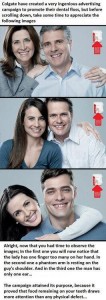
    PS: Excellent press ad by Colgate. Am getting to see a truly brilliant print effort after a long time. Are you experiencing that ‘Why didn’t I think of it’ moment? Tempted to copy? Go ahead, lift this idea for your brand. I won’t tell anyone. Promise!

    Click to large


  • Anil Thakraney: The credibility letdown

    By Anil Thakraney


    Must say I am quite surprised to hear that the suspension imposed on Mr Cut Paste by his bosses at Time mag and CNN has been lifted quite swiftly. I was of the opinion that Fareed Zakaria would have to pay a heavy price. Clearly, I was wrong.


    This is the exact statement issued by Time, as per media reports: “We have completed a thorough review of each of Fareed Zakaria’s columns for Time and we are entirely satisfied that the language in question in his recent column was an unintentional error and an isolated incident for which he has apologized. We look forward to having Fareed’s thoughtful and important voice back in the magazine with his next column in the issue that comes out on September 7.”


    Now, while one wants to applaud Time and CNN for being large-hearted, I am a bit worried about the ramifications of the quick forgiveness. Younger columnists and journalists will get the wrong idea. Because, the message is this: ‘Okay, you made one mistake, but otherwise you have been good at your job. So we’ll let you get away with this dishonest act.’ As a writer, my reading is that it’s okay to do the odd chori. In that sense, I believe Zakaria’s example sets a bad precedent. He directly (or indirectly) lifted passages from another journalist, that is a fact, and he has admitted to it. And Zakaria ought to have been made to face the music for this misdemeanour. Especially because he’s a veteran in the profession.


    There’s another thing: Zakaria’s credibility has taken a body blow following this incident. Why would I trust his writing ever again? How can I be sure he hasn’t played another mischief? Given that, there had to be a cooling-off period ordered on Zakaria for at least one year, if not more. So his readers are assured that, one, the man has been adequately punished. And two, he has had sufficient time to introspect on his misdeed.


    All I can say is, Fareed Zakaria is one helluva lucky guy.


    ***


    PS: I have always wondered why the placards that protesters carry during various andolans are so dull. Well, here’s a link that tells you it need not be the case, that placards can be fun. Hope to see some wit and humour during desi protests. Perhaps ad agencies can pitch in with some thoughts. If we must watch the likes of Anna and Ramdev fasting, may as well have some entertainment going on the sidelines. 🙂


    Link: http://www.thepoke.co.uk/2010/11/01/the-best-protest-march-ever/gallery/image/


  • Demystifying plagiarism, the legal way


    By Nandita Saikia


    Can one be jailed and fined if convicted?
     

    All you wanted to know about plagiarism but didn’t know who to ask. We posed a few questions to Nandita Saikia and requested her for a response sans the legalese

    1. Is plagiarism a crime? As in, does copying of substantial portion of a published work written by someone without attribution and without permission become a punishable offence? What exactly is the punishment?

    Plagiarism alone involves copying another person’s ideas without attributing them, and is not a crime by itself although it is considered unethical.


    If plagiarism involves copying not only ideas but also a substantial portion of a copyrighted work without attribution and without permission, it would amount to both copyright infringement and the violation of the ‘special right’ of the author to be credited.


    Copyright infringement and the violation of an author’s right to be credited are both civil wrongs and criminal offences. A civil suit may be instituted, and criminal charges may also be filed.


    In a civil suit, the remedies which may be obtained are: injunctions to restrain further infringement, damages, the rendition of accounts of profit, and the delivery up of both infringing copies of the work and the plates used to make them. If required, certain administrative orders may also be obtained to assess the extent of infringement.


    If criminal charges are filed, a convicted infringer is liable to be imprisoned for between six months and three years and to be fined between Rs 50,000 and Rs 2 lakh, for the first offence. This punishment is enhanced for subsequent convictions.


    2.Does attribution without permission for text or photographs or graphics (for instance: Photograph courtesy xyz) amount to an infringement of copyright? And if it is an offence, what is the punishment?

    Assuming the work is protected by copyright, in most cases:  It is infringement to publish a work without permission.  It is both infringement and a violation of moral rights to publish a work without permission and without attribution. It is a violation of moral rights to publish a work with permission and without attribution — (possibly) unless the author has agreed not to be attributed. The remedies available to those authors whose right to claim authorship has been violated are similar to those available in cases of copyright infringement as described in response to question 1.


    3.Assuming an article is written and has taken some vital research data or information from another article (and this information is not easily available or is not publicly accessible), but the information is presented in a different language and different from the one already published. Will this be considered plagiarism and is it infringement of intellectual property?

    It would amount to plagiarism if the ideas of another author were used without credit. It is also likely that it would amount to plagiarism if the research of another author was used without credit.


    However, if the language used in the later article was completely different from that used in the original article, it is unlikely that the subsequent article would infringe the copyright in the original article.


    Depending on the circumstances, the later article may violate the moral right of the author of the original article to be credited for his work.


    4.In a typical writer-publication relationship, who owns the copyright in the absence of any written contract on it… the publication or the writer/photographer/artist? What if the writer/photographer/artist are freelance? And what if he/she is an employee?

    The employer generally owns copyright in the employee’s work for the purpose of dissemination through the employer’s publication and similar publications. For all other purposes, the employee owns the copyright.


    However, a freelance journalist would ordinarily be the first owner of copyright in his work unless he signs an agreement to the contrary. Ownership may vary depending on whether or not the work is commissioned.


    The commissioner generally owns the copyright in a commissioned photograph.


    To a large extent, the ownership of copyright in a work is determined by contract. This area of the law contains a number of caveats and exceptions, and it is extremely difficult to make generalisations.


    5.What about ideas and concepts? And page designs and headlines?

    Ideas and concepts are not protected unless expressed and ‘fixed’. Original page designs may be protectable as artistic works if they are distinctive. Headlines are unlikely to be protectable, although it may be possible to argue that especially distinctive, original headlines are protectable.


    6. And lastly, what is the legal standpoint on plagiarised advertising… visuals and copy? Also, television and films?

    In broad strokes, the general principles relating to infringement apply across the board regardless of the nature of the work. If a work is protected by copyright, the permission of the copyright owner is usually required to do things like reproduce or adapt the work. Also, authors have the right to be claim authorship of their work.


    Nandita Saikia

    The terms ‘plagiarism’ and ‘infringement’ are often used interchangeably although they are different.  Plagiarism itself is primarily an ethical issue, which involves using the work of another author without crediting them. The right not to be plagiarised is not recognised by statute, except to the extent mentioned in Section 57 of the Copyright Act (which gives authors the right to claim authorship of their works, among other things).


    Plagiarism may occur independently of copyright infringement. This is because any use of a work without crediting its author would be plagiarism. However, copyright infringement can only occur if the earlier work copied from is protected by copyright. So, for example, copying from a very old work whose copyright has expired would be plagiarism but not infringement.


    Also, plagiarism may involve merely copying the ideas which another person has expressed in their work either without crediting them or using their words. If plagiarism occurs without copying or adapting the actual words of the author of the earlier work, it is unlikely that the plagiarism would also amount to copyright infringement.


    Further, it is worth bearing in mind that it works both ways. If the earlier work was protected by copyright, copying or adapting any substantial part of it without permission would infringe the copyright subsisting it even if its author was credited. In other words, the unauthorised, substantial reproduction or adaptation of a copyrighted work is copyright infringement even if its author is credited.


    As such, copyright infringement and plagiarism generally occur simultaneously only if the words of an earlier work are copied or adapted without permission and without attribution, and the earlier work is protected by copyright.


    Copyright itself subsists in certain works such as books, films and music. As a general rule, the initial owner of the copyright in a work is its author (although this is subject to several exceptions).


    Copyright owners have the exclusive right to do things like reproduce, adapt, translate and publish their works, or to allow others to do so. These exclusive rights are collectively called copyright, and vary in their specifics depending on the kind of work.


    In most cases, doing anything which is the exclusive right of the copyright owner without his or her permission amounts to copyright infringement, which is both a civil wrong and criminal offence. As such, a civil suit may be instituted (usually seeking to obtain damages and an injunction to restrain further infringement).


    In addition to this, Section 63 of the Copyright Act states that convicted infringers are liable to be imprisoned for between six months and three years and to be fined between fifty thousand and two lakh rupees, while Section 63A stipulates an enhanced penalty for second and subsequent convictions.


    Apart from copyright, the Copyright Act also recognises the right of an author to be credited for his work via Section 57 of the Copyright Act which, among other things, grants authors the ‘Special Right’ to claim authorship. If this right is violated, remedies similar to those obtainable for copyright infringement may be sought.


    Widely referred to as a moral right, the Section 57 right to claim authorship is perpetual, is independent of copyright, and remains unaffected by transfers of copyright ownership. Thus, it could be considered to be similar to the right not to be plagiarised, although it is not identical to it.


    Nandita Saikia is a media and technology lawyer practising in New Delhi


    Plagiarism: No good word, this
     

    While the reasons to plagiarise can be debated, and argued, what remains essential is editorial integrity to see it as a bad practice

    By Ananya Saha


    Fareed Zakaria has opened a Pandora box after being accused of plagiarism. Editorial sanctity is being now being questioned when it comes to using plagiarized content. With internet becoming a major source of stories filed by journalists, it has actually become difficult to keep a tab on plagiarized material. Indian media has been, time and again, put under scanner for plagiarism.


    The business daily, Mint has addressed the issue of ‘plagiarism and fabrication’ in its ‘MintCode’ clearly: ‘We don’t copy the work of others. And we don’t make things up. We do not plagiarize, meaning that we do not take the work of others and pass it off as our own.’ In fact, Mint does not transmit news releases in their original form. “A story that appears in our paper and has plagiarized work from a press release is a serious violation of our Code of Conduct.” If any of its own journalists’ or columnists’ work is plagiarized, Mint asks them to notify the editor, deputy editor, and immediate editor. According to the code, any Mint reporter and writer have to use original content, language and phrasing.


    While the ‘MintCode’ is clearly charted out on its website and The Economic Times too has a code of ethics on its website, not many newspapers have such a clear ‘code’ charted out.


    What is also important to understand is that such code of ethics is also bypassed by journalists who succumb to pressures of deadline.


    Deccan Chronicle uses software that alerts the desk when more than eight words are plagiarized. A T Jayanti, chief editor of Deccan Chronicle, said: “You do not need a policy on something so blatantly wrong! Our team is aware that they can be suspended, and can even lose their jobs.”


    Chandan Mitra, editor and managing director of The Pioneer, has come across few columnists who have plagiarized content while writing for his paper: “The columnists were found guilty, and we stopped their columns as soon as we got to know. We take a hard line against such practice. If there is a complaint, we prefer to run our checks and if found guilty, we do not have to think twice before stopping their columns.”


    Mr Mitra insisted that Fareed Zakaria’s case is an alarm bell, and the Indian newspaper industry needs to be more cautious, especially “when the laws of the land are not as stringent.” He also feels that because of the internet, it is easier to track down if the article or any written piece has been extracted as is from its original source.


    While the reasons to plagiarize can be debated, and argued, what remains essential is editorial integrity to see it as a bad practice.


    Vikas Mishra, Editor, Lokmat Samachar said: “Nobody in our newspaper is authorized to copy-paste from any article. Never in the history of Lokmat has anyone plagiarized. If there is an article worth mentioning, we always mention the source or attribute the quote in our write-ups.”


    When asked if plagiarism is more rampant in the regional and vernacular newspapers, Mr Hari Mohan Mishra, news editor, Dainik Bhaskar said that it is actually the English newspapers that see more of plagiarism and that he has not come across any of his team plagiarizing ever. Even Mr Mitra of The Pioneer agreed with his viewpoint.


    M. Kesava Menon, editor, Mathrubhumi – the Malayalam language newspaper – also believes in attributing the original author in articles, and sees plagiarism as serious offence. Even though the editors are quite sure the copying a work is an offence, it is actually not unknown that plagiarism sometimes goes unregistered.


    In a rapidly changing newsroom set-up, influenced vastly by ‘research’, it is important that writers and columnists create original work. And only strong and stringent measures can curb such a practice.